Healthcare organisations are rapidly embracing digital transformation to improve patient care, enhance operational efficiency, and optimise resource utilisation. Among the technologies driving this transformation, hospital IoT monitoring has emerged as one of the most impactful innovations.
From tracking medical equipment in real time to monitoring patient vitals remotely and ensuring optimal environmental conditions for sensitive medications, Internet of Things (IoT) solutions are revolutionising hospital operations. Modern healthcare facilities are increasingly connecting medical devices, sensors, and software platforms into a unified ecosystem that delivers actionable insights around the clock.
However, implementing an effective IoT monitoring system requires much more than purchasing connected devices. Hospitals need a structured roadmap that aligns technology with clinical workflows, cybersecurity, compliance requirements, and long-term scalability.
This guide explains how hospitals can successfully implement hospital IoT monitoring through a practical, step-by-step approach.
What Is Hospital IoT Monitoring?
Hospital IoT monitoring refers to the use of internet-connected sensors, medical devices, software platforms, and communication networks that continuously collect and analyse operational and clinical data.
These connected systems help hospitals monitor:
- Patient vital signs
- Medical equipment utilisation
- ICU devices
- Asset locations
- Temperature-sensitive storage
- Building infrastructure
- Air quality
- Energy consumption
- Security systems
- Staff workflows
The objective is to transform hospitals from reactive environments into proactive, data-driven healthcare organisations.
As IoT healthcare facilities continue to evolve, real-time monitoring enables faster clinical decisions while improving operational efficiency.
Why Hospitals Are Investing in IoT Monitoring
Healthcare leaders face increasing pressure to improve patient outcomes while reducing operational costs.
Hospital IoT systems address several major challenges.
Improved Patient Care
Continuous patient monitoring alerts clinicians immediately when vital signs change, enabling earlier intervention.
Better Equipment Utilisation
Hospitals often struggle to locate critical equipment such as infusion pumps or wheelchairs. IoT-enabled asset tracking significantly reduces search time.
Reduced Operational Costs
Connected sensors automate routine monitoring tasks and minimise manual inspections.
Preventive Maintenance
Rather than waiting for equipment failure, predictive monitoring identifies maintenance needs before breakdowns occur.
Enhanced Patient Safety
Environmental monitoring ensures operating theatres, pharmacies, laboratories, and vaccine storage areas maintain optimal conditions.
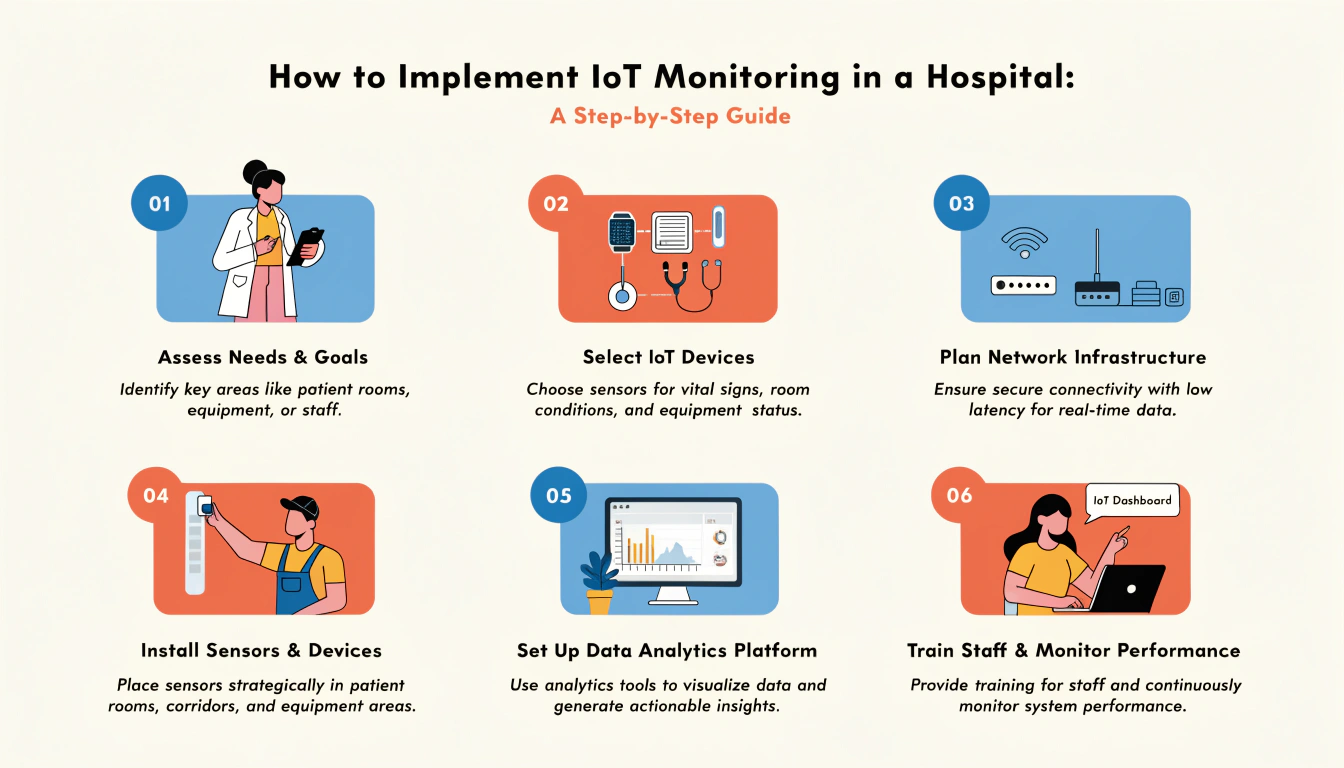
Step 1: Define Clear Business Objectives
Before selecting technology, hospitals must determine what problems they want IoT to solve.
Common objectives include:
- Improving ICU patient monitoring
- Tracking high-value medical assets
- Reducing equipment downtime
- Monitoring cold-chain storage
- Optimising building energy consumption
- Enhancing patient flow
- Improving infection control
Each objective should have measurable Key Performance Indicators (KPIs), such as:
- Equipment utilisation rate
- Patient response time
- Average asset search time
- Energy consumption
- Maintenance costs
- Alarm response time
Clear objectives prevent unnecessary technology investments.
Step 2: Assess Existing Infrastructure
Successful hospital IoT monitoring depends on reliable infrastructure.
Hospitals should evaluate the following:
Network Coverage
Ensure Wi-Fi, LAN, or private 5G networks provide consistent coverage across:
- ICUs
- Emergency departments
- Operating theatres
- Laboratories
- Patient wards
- Pharmacies
Device Compatibility
Determine whether existing medical devices support IoT connectivity through:
- Wi-Fi
- Bluetooth
- Zigbee
- RFID
- Ethernet
- Cellular connectivity
Data Systems
Review existing platforms, such as:
- Electronic Health Records (EHR)
- Hospital Information Systems (HIS)
- Laboratory Information Systems (LIS)
- Building Management Systems (BMS)
IoT solutions should integrate seamlessly rather than operate independently.
Step 3: Identify High-Impact Use Cases
Instead of attempting hospital-wide implementation immediately, focus on a few high-value applications.
Examples include:
Remote Patient Monitoring
Wearable devices continuously track:
- Heart rate
- Blood pressure
- Oxygen saturation
- Respiratory rate
- Body temperature
Healthcare teams receive instant alerts when abnormal readings occur.
Asset Tracking
RFID tags and Bluetooth beacons track:
- Ventilators
- Defibrillators
- Infusion pumps
- Portable ultrasound machines
- Wheelchairs
Environmental Monitoring
Sensors monitor:
- Temperature
- Humidity
- Air quality
- Pressure
- Refrigeration units
Predictive Maintenance
Connected equipment reports:
- Operating hours
- Performance metrics
- Error codes
- Maintenance schedules
This reduces unexpected downtime.
Step 4: Choose the Right IoT Devices
Device selection directly impacts system reliability.
Hospitals should prioritise devices offering the following:
- Medical-grade certification
- High accuracy
- Long battery life
- Secure communication
- Remote firmware updates
- Cloud compatibility
- Easy maintenance
Common IoT devices include:
- Smart patient monitors
- Wearable sensors
- RFID tags
- Environmental sensors
- Smart infusion pumps
- Connected ventilators
- Occupancy sensors
- Smart lighting systems
Avoid purchasing incompatible devices from multiple vendors without interoperability planning.
Step 5: Build a Secure Network
Healthcare data is highly sensitive.
Cybersecurity must be incorporated from the start.
Key security measures include:
Network Segmentation
Separate IoT devices from administrative networks.
Encryption
Encrypt data during transmission and storage.
Multi-Factor Authentication
Protect administrator access using MFA.
Device Authentication
Ensure only authorised devices connect to hospital networks.
Continuous Monitoring
Use Security Operations Centres (SOC) or Security Information and Event Management (SIEM) platforms to detect unusual activity.
Cybersecurity planning should align with national healthcare regulations and industry best practices.
Step 6: Integrate IoT with Hospital Systems
The true value of hospital IoT monitoring comes from connecting devices with existing clinical systems.
Integration enables:
- Automatic patient record updates
- Real-time equipment availability
- Automated maintenance scheduling
- Centralised dashboards
- Clinical alerts
- Data analytics
Modern APIs and healthcare interoperability standards such as HL7 and FHIR simplify integration.
Without integration, IoT devices become isolated data sources rather than strategic assets.
Step 7: Develop Real-Time Dashboards
Hospitals generate enormous volumes of operational data.
Dashboards convert this information into actionable insights.
Executives can monitor:
- Bed occupancy
- Equipment availability
- Building performance
- Staff activity
- Patient flow
Clinical teams can view:
- Patient alerts
- Device status
- Vital signs
- Alarm history
Maintenance teams monitor:
- Equipment health
- Predictive maintenance schedules
- Fault notifications
Well-designed dashboards reduce information overload and support faster decision-making.
Step 8: Train Clinical and Technical Staff
Technology adoption depends heavily on user confidence.
Training programmes should cover:
- Device operation
- Dashboard navigation
- Alert management
- Troubleshooting
- Security awareness
- Data privacy policies
Simulation-based training helps staff become comfortable with new workflows before live deployment.
Change management is equally important.
Staff should understand how IoT improves patient care rather than viewing it as additional administrative work.
Step 9: Start with a Pilot Project
Launching across an entire hospital carries significant risk.
Instead, begin with a pilot.
Ideal pilot locations include:
- ICU
- Emergency department
- Operating theatre
- Pharmacy
- Radiology
During the pilot, measure:
- System reliability
- User satisfaction
- Response times
- Network performance
- Clinical outcomes
- Return on investment
Lessons learned during the pilot help refine broader implementation.
Step 10: Scale Across the Hospital
Once the pilot succeeds, expand implementation gradually.
Typical expansion roadmap:
Phase 1
- ICU
- Emergency
Phase 2
- Operating theatres
- Laboratories
Phase 3
- Patient wards
- Pharmacy
Phase 4
- Administrative facilities
- Building management
Scaling gradually reduces disruption while allowing infrastructure improvements as needed.
Best Practices for Hospital IoT Monitoring
Successful hospitals follow several best practices.
Focus on Interoperability
Choose platforms capable of integrating with multiple vendors and existing systems.
Prioritise Patient Privacy
Ensure compliance with healthcare privacy regulations and implement strict access controls.
Use Predictive Analytics
Machine learning can analyse IoT data to predict equipment failures, patient deterioration, and operational bottlenecks.
Standardise Devices
Using standardised hardware simplifies maintenance and future upgrades.
Continuously Monitor Performance
Regular audits identify:
- Device failures
- Battery issues
- Network gaps
- Cybersecurity vulnerabilities
Common Challenges During Implementation
Even well-planned IoT projects face obstacles.
Legacy Infrastructure
Older hospitals may require network upgrades before deploying connected devices.
Budget Constraints
IoT implementation involves investment in hardware, software, networking, and staff training.
However, long-term operational savings often justify these costs.
Staff Resistance
Healthcare professionals may hesitate to adopt unfamiliar technologies.
Clear communication and practical training help overcome resistance.
Data Overload
Thousands of sensors generate large volumes of information.
Hospitals need intelligent analytics rather than excessive notifications.
Cybersecurity Risks
Every connected device introduces a potential attack surface.
Continuous monitoring and regular security updates remain essential.
Future Trends in IoT Healthcare Facilities
The next generation of IoT healthcare facilities will incorporate advanced technologies that extend beyond simple monitoring.
Emerging innovations include:
Artificial Intelligence
AI will analyse IoT data to predict patient deterioration before symptoms become severe.
Digital Twins
Hospitals will create virtual replicas of facilities for operational planning and predictive maintenance.
Edge Computing
Processing data closer to connected devices reduces latency for time-sensitive clinical applications.
Smart Robotics
Connected robots will assist with logistics, medication delivery, and disinfection.
5G Connectivity
Ultra-low latency networks will support real-time communication between thousands of connected medical devices.
These innovations will make hospitals more intelligent, responsive, and patient-centred.
Measuring Success After Implementation
Hospitals should regularly evaluate their IoT programmes using measurable performance indicators.
Key metrics include:
- Reduced equipment downtime
- Faster emergency response
- Improved patient satisfaction
- Lower maintenance costs
- Increased equipment utilisation
- Reduced medication storage incidents
- Better staff productivity
- Lower energy consumption
- Fewer manual inspections
Tracking these metrics demonstrates the long-term value of hospital IoT monitoring and supports future digital transformation initiatives.
Conclusion
Implementing hospital IoT monitoring is not simply a technology upgrade, it is a strategic investment in smarter, safer, and more efficient healthcare delivery. By following a structured implementation process, hospitals can connect clinical devices, infrastructure, and operational systems into a unified ecosystem that delivers real-time visibility and actionable insights.
Success begins with defining clear objectives, assessing existing infrastructure, selecting the right IoT solutions, and ensuring robust cybersecurity. Starting with targeted pilot projects allows healthcare organisations to validate outcomes before expanding across departments, while ongoing staff training and system optimisation ensure long-term adoption.
As IoT healthcare facilities continue to evolve with AI, predictive analytics, edge computing, and 5G connectivity, hospitals that embrace connected technologies today will be better positioned to improve patient outcomes, streamline operations, and meet the demands of modern healthcare.
Download Our Event Agenda
Want to learn how leading hospitals are implementing smart infrastructure, IoT-enabled monitoring, AI, and digital healthcare technologies?
Download our event agenda: https://bmaconventions.com/smart-healthcare-facilities-convention-2026-sep/
Explore expert-led sessions, industry case studies, and practical strategies that can help your organisation build the next generation of intelligent healthcare facilities.