Healthcare is undergoing one of its biggest transformations in decades. Rising patient expectations, increasing operational costs, workforce shortages, and rapid technological innovation are pushing hospitals to rethink how healthcare facilities are designed and operated.
In 2026, hospitals are no longer just buildings where treatment happens, they are becoming intelligent, connected ecosystems capable of improving clinical outcomes, enhancing patient experiences, and optimising operational efficiency.
The rise of smart hospital infrastructure 2026 is driven by the convergence of Artificial Intelligence (AI), Internet of Things (IoT), cloud computing, automation, digital twins, and data-driven decision-making. Instead of investing in isolated technologies, healthcare providers are building integrated digital environments where clinical systems, building management, medical devices, and patient services work together seamlessly. Industry experts increasingly view infrastructure as a strategic enabler of care rather than merely a support function. (TechTarget)
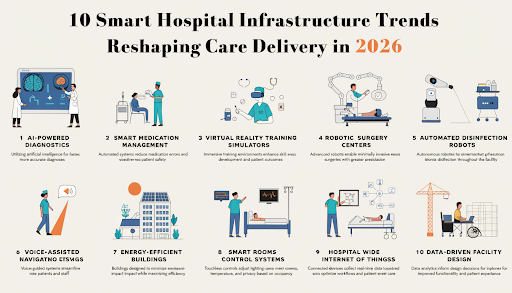
This article explores the 10 biggest hospital technology trends that are redefining healthcare infrastructure and shaping the future of patient care.
1. AI-Powered Hospital Operations
Artificial Intelligence has moved beyond diagnostic support and entered hospital infrastructure itself.
Modern hospitals are deploying AI to:
- Predict patient admissions
- Optimise bed allocation
- Reduce emergency department wait times
- Forecast equipment maintenance
- Improve staff scheduling
- Automate administrative workflows
Instead of reacting to operational problems, AI enables hospitals to predict demand and allocate resources proactively.
For example, hospitals are increasingly implementing AI-driven bed management and smart outpatient systems to improve patient flow and reduce delays. (The Times of India)
As smart hospital infrastructure 2026 evolves, AI will become the central intelligence layer connecting every hospital department.
2. Connected IoT Ecosystems
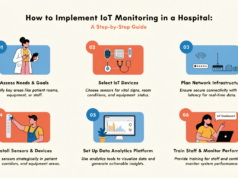
The Internet of Things (IoT) is transforming hospitals into highly connected environments.
Thousands of smart sensors continuously monitor:
- Medical equipment
- Patient locations
- Asset utilisation
- Indoor air quality
- Temperature-sensitive medicines
- Energy consumption
- Critical infrastructure
Instead of manually tracking equipment, hospitals receive real-time visibility into where devices are located and whether they are functioning properly.
IoT also supports patient safety by monitoring environmental conditions and enabling rapid responses to equipment failures.
This interconnected infrastructure improves efficiency while reducing equipment downtime and operational costs. (arXiv)
3. Digital Twins for Hospital Planning
One of the fastest-growing hospital technology trends is the adoption of digital twins.
A digital twin is a virtual replica of an entire healthcare facility that mirrors real-world operations in real time.
Hospital administrators can simulate:
- Patient flow
- Emergency scenarios
- HVAC performance
- Energy usage
- Equipment placement
- Facility expansion
Rather than making costly physical changes, planners can test multiple scenarios digitally before implementation.
This significantly improves planning accuracy while reducing construction risks and operational disruptions. Digital twins are also emerging as a key technology for healthcare facility management and long-term infrastructure optimisation. (ScienceDirect)
4. Intelligent Patient Rooms
Patient rooms are becoming smarter, more personalised, and increasingly connected.
Modern smart rooms include:
- Voice-controlled lighting
- Smart climate controls
- Automated nurse call systems
- Remote patient monitoring
- Digital entertainment systems
- Medication reminders
- Integrated electronic medical records
Patients can adjust their environment without assistance while clinicians receive continuous health updates.
These intelligent environments improve patient comfort while allowing nurses to focus on higher-value clinical care instead of routine tasks.
Smart patient rooms also contribute to shorter hospital stays through proactive monitoring and faster clinical intervention.
5. Cloud-Based Healthcare Infrastructure
Traditional hospital IT systems often struggle with scalability and interoperability.
Cloud computing is changing this by enabling:
- Secure medical record access
- Multi-site collaboration
- Remote diagnostics
- AI model deployment
- Disaster recovery
- Scalable data storage
Cloud infrastructure supports hospitals in integrating diverse clinical applications while reducing dependence on expensive on-premise hardware.
Healthcare organisations are increasingly investing in cloud-ready infrastructure to support AI workloads, improve resilience, and strengthen data governance. (TechTarget)
Cloud technology has become a foundational pillar of smart hospital infrastructure 2026.
6. Cybersecurity by Design
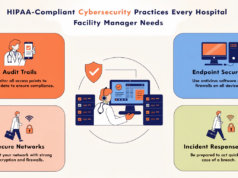
As hospitals become increasingly connected, cybersecurity is no longer an IT issue, it is a patient safety issue.
Healthcare organisations face growing risks from:
- Ransomware attacks
- Medical device vulnerabilities
- Data breaches
- Insider threats
- Network disruptions
Modern smart hospitals now incorporate cybersecurity directly into infrastructure planning.
This includes:
- Zero-trust architecture
- Multi-factor authentication
- Network segmentation
- Continuous threat monitoring
- Secure IoT device management
- AI-powered anomaly detection
Strong cybersecurity ensures clinical operations remain uninterrupted while protecting sensitive patient information.
Infrastructure decisions in 2026 increasingly prioritise resilience alongside digital innovation. (TechTarget)
7. Sustainable and Energy-Efficient Hospitals
Sustainability has become a strategic priority across healthcare.
Hospitals operate continuously, making them among the most energy-intensive buildings worldwide.
Smart infrastructure now helps reduce environmental impact through:
- Intelligent HVAC systems
- Smart lighting automation
- Renewable energy integration
- Water management
- Predictive maintenance
- Occupancy-based energy optimisation
Building management systems automatically adjust energy usage based on real-time occupancy and environmental conditions.
These initiatives lower operating costs while supporting hospitals’ sustainability goals.
Future-ready healthcare facilities are designed to balance clinical excellence with environmental responsibility. (Siemens Blog)
8. Interoperability Across Healthcare Systems
Data silos remain one of healthcare’s biggest challenges.
Patients often receive care across multiple hospitals, laboratories, pharmacies, and specialists.
Modern smart hospitals prioritise interoperability by enabling secure communication between:
- Electronic Health Records (EHRs)
- Laboratory systems
- Imaging platforms
- Pharmacy management
- Billing systems
- Telemedicine platforms
When systems communicate effectively, clinicians gain faster access to comprehensive patient information.
Improved interoperability reduces duplicate testing, enhances care coordination, and supports more informed clinical decisions. Healthcare leaders increasingly identify interoperability as a top infrastructure priority for 2026. (TechTarget)
9. Smart Emergency and Critical Care Infrastructure
Emergency departments require rapid decision-making under constant pressure.
Smart infrastructure is improving emergency response through:
- AI-supported triage
- Real-time patient tracking
- Smart ambulance integration
- Automated bed availability systems
- Predictive emergency demand forecasting
Hospitals can instantly identify available ICU beds, critical equipment, and specialist teams.
Digital coordination shortens response times while improving patient outcomes during high-demand situations.
Several healthcare systems are already implementing online bed allocation and AI-assisted emergency workflows to improve operational efficiency. (The Times of India)
10. Flexible, Future-Ready Hospital Design
Healthcare technology evolves rapidly.
Hospitals designed today must remain functional for decades.
Modern infrastructure therefore prioritises adaptability through:
- Modular construction
- Scalable digital networks
- Flexible clinical spaces
- Plug-and-play medical technologies
- Software-defined building systems
Instead of designing static facilities, architects are creating hospitals capable of evolving alongside medical innovation.
This flexible approach allows healthcare organisations to adopt emerging technologies without expensive structural renovations.
Industry leaders increasingly emphasise resilience and adaptability as defining characteristics of next-generation healthcare facilities. (Siemens Blog)
Challenges of Implementing Smart Hospital Infrastructure
Despite its enormous potential, adopting smart hospital infrastructure 2026 is not without challenges.
Healthcare organisations must overcome:
- High capital investment
- Legacy infrastructure integration
- Workforce training
- Data privacy concerns
- Regulatory compliance
- Interoperability barriers
- Cybersecurity risks
Successful implementation requires collaboration between healthcare leaders, architects, technology providers, engineers, policymakers, and clinical teams.
Hospitals that treat digital transformation as an organisation-wide strategy, not merely an IT project are more likely to achieve lasting success. (TechTarget)
The Future of Smart Hospitals
The future of healthcare lies in intelligent infrastructure that supports both clinicians and patients.
Rather than replacing healthcare professionals, technology is augmenting their capabilities by reducing administrative burdens, improving decision-making, and enabling more personalised care.
The next generation of hospitals will feature:
- Autonomous service robots
- AI-powered clinical assistants
- Predictive maintenance systems
- Real-time operational dashboards
- Digital twins
- Intelligent building automation
- Fully integrated patient journeys
As these innovations mature, hospitals will become more efficient, resilient, sustainable, and patient-centric than ever before.
The shift towards smart infrastructure represents not just a technological evolution, but a complete reimagining of healthcare delivery.
Conclusion
The transformation of healthcare facilities is accelerating rapidly, making smart hospital infrastructure 2026 one of the defining priorities for healthcare leaders worldwide.
From AI-powered operations and IoT-enabled ecosystems to digital twins, cloud infrastructure, cybersecurity, interoperability, and sustainable design, today’s hospital technology trends are reshaping how care is delivered.
Hospitals that invest in intelligent infrastructure today will be better equipped to improve patient outcomes, optimise operational performance, and remain resilient in an increasingly digital healthcare landscape.
Register for Healthcare Convention 2026
Want to explore the latest innovations in smart healthcare facilities, digital infrastructure, AI, and future-ready hospital design?
Register for Healthcare Convention 2026: https://bmaconventions.com/smart-healthcare-facilities-convention-2026-sep/