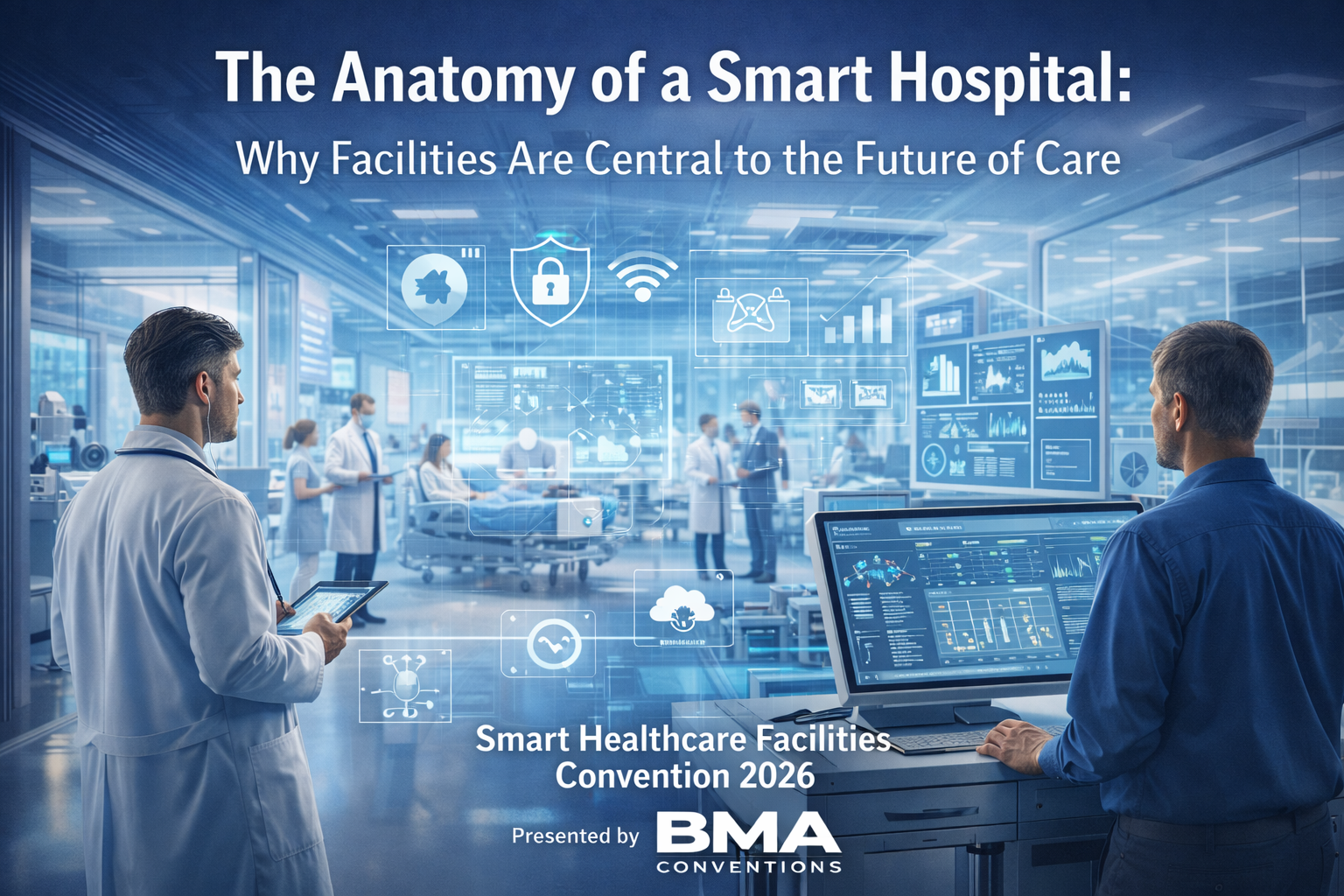
The idea of a smart hospital has moved well beyond innovation pilots and experimental technologies. Across the U.S. healthcare system, hospitals are being reimagined as connected, intelligent environments where infrastructure, data, and clinical care operate as one integrated ecosystem.
At the heart of this transformation is a clear realization:
smart care delivery is only possible when facilities are designed to support it.
This reality is shaping the conversations at the Smart Healthcare Facilities Convention 2026, curated by BMA Conventions.
Smart Hospitals Start With Intelligent Infrastructure
Smart hospitals are not defined by a single technology or platform. They are built on infrastructure that allows systems to communicate, adapt, and respond in real time.
Power, HVAC, networks, medical equipment, and building management systems must function as a coordinated whole. When infrastructure is intelligent, hospitals gain:
- Higher system reliability and uptime
- Real-time operational visibility
- Faster response to disruptions
- Stronger support for clinical workflows
Facilities are no longer passive assets—they are active participants in care delivery.
Data Is the Nervous System of a Smart Hospital
In a smart hospital, data flows continuously across clinical, operational, and facility systems. Sensors, connected devices, and integrated platforms provide insight that enables proactive decision-making.
This allows healthcare organizations to:
- Move from reactive to predictive maintenance
- Optimize patient flow and space utilization
- Improve environmental conditions for healing
- Support more informed operational planning
At the Smart Healthcare Facilities Convention 2026, these data-driven facility strategies are explored not as isolated IT initiatives, but as part of a broader infrastructure ecosystem.
Cybersecurity Begins at the Facility Level
As hospitals become more connected, cybersecurity becomes inseparable from facility design. Building systems, medical devices, and operational technology are now part of the healthcare attack surface.
Smart hospitals prioritize:
- Secure segmentation between clinical and facility networks
- Continuous monitoring of connected infrastructure
- Resilient system design that assumes disruption
- Collaboration between IT, facilities, and security teams
Without cyber-resilient facilities, digital healthcare innovation remains fragile.
Patient Experience Is Shaped by Smart Environments
Patient experience in a smart hospital extends far beyond digital apps. Lighting, air quality, acoustics, wayfinding, and check-in processes all play a role in how patients experience care.
Smart facilities reduce friction, lower stress, and enable smoother patient journeys—while also improving efficiency for care teams.
This convergence of environment, technology, and experience is a key focus of the Smart Healthcare Facilities Convention 2026.
Why Cross-Functional Collaboration Matters
No hospital becomes smart through siloed decision-making. Success depends on collaboration between:
- Healthcare executives
- Facilities and engineering leaders
- IT and cybersecurity teams
- Operations and patient experience leaders
The Smart Healthcare Facilities Convention 2026 serves as a platform for these groups to align—bridging strategy, infrastructure, and execution.
Looking Ahead
The anatomy of a smart hospital is defined by alignment—between systems, teams, and purpose. As healthcare delivery continues to evolve, facilities will determine how resilient, adaptable, and patient-centered that evolution can be.
By convening leaders around infrastructure-led healthcare transformation, the Smart Healthcare Facilities Convention 2026—organized by BMA Conventions—helps move the industry from isolated upgrades toward integrated, future-ready healthcare environments.