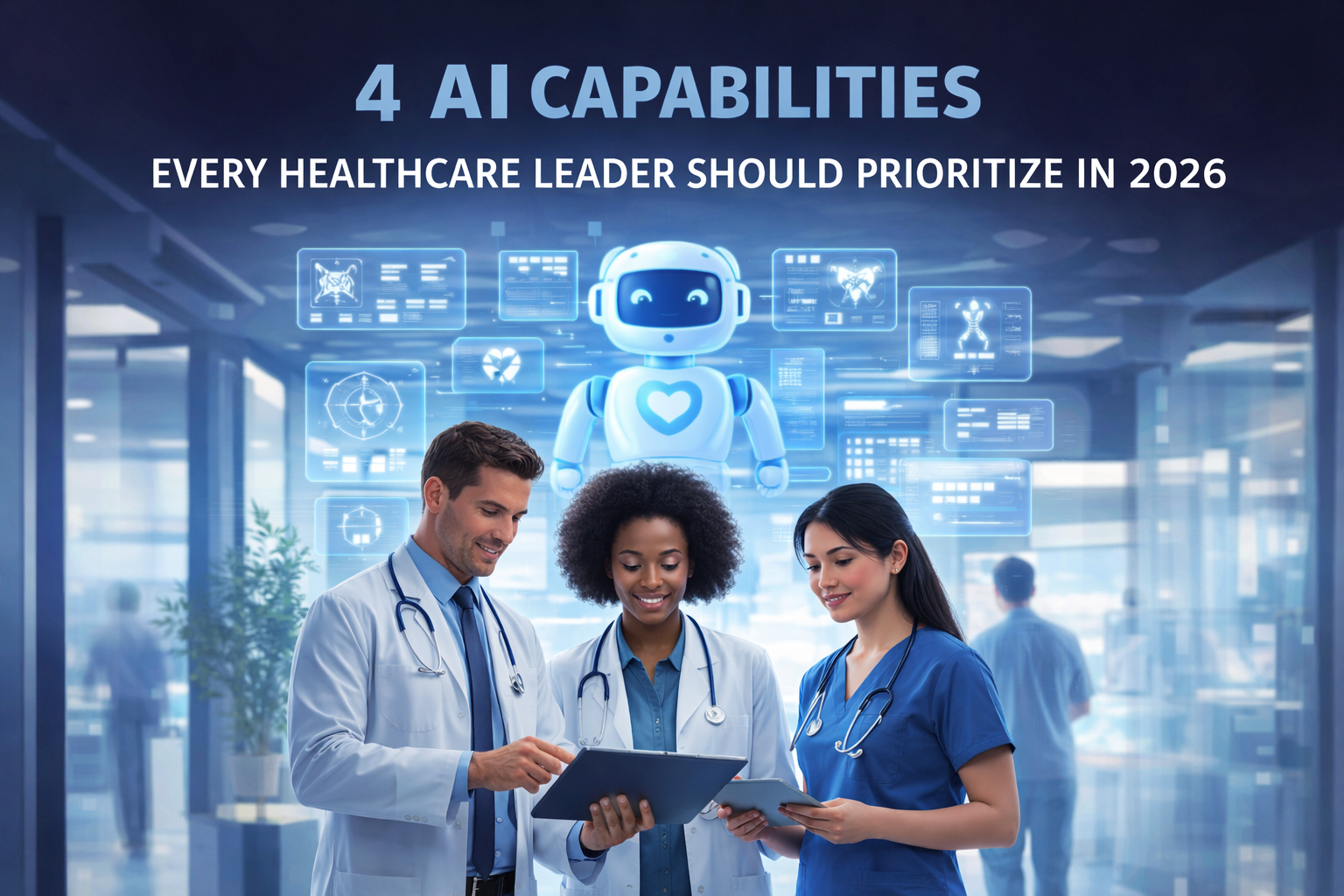
Artificial intelligence is no longer a future concept in healthcare. It is actively reshaping how hospitals operate, how clinicians deliver care, and how patients experience the system. However, while AI promises efficiency and better outcomes, many healthcare organizations still struggle with immature tools, fragmented systems, and unclear implementation strategies.
According to research published in the Journal of the American Medical Informatics Association, 77 percent of health systems identified immature AI tools as a major barrier to adoption. This highlights a critical issue: not all AI solutions are built for real clinical environments.
As we move through 2026, healthcare leaders must focus on AI capabilities that truly deliver value rather than create additional complexity. Here are four capabilities that should be at the top of every healthcare organization’s priority list.
1. AI Clinical Assistants and Autonomous Agents
The evolution of AI in healthcare has moved beyond simple documentation tools. Early AI scribes focused primarily on note-taking. Today, AI clinical assistants and autonomous agents are capable of far more.
AI clinical assistants can:
- Capture and structure clinical documentation
- Suggest accurate diagnoses and coding
- Perform calculations
- Support revenue cycle accuracy
- Answer clinical queries in real time
For example, if a clinician discusses a patient with renal failure and diabetes, the AI can infer a more precise diagnosis such as diabetes with nephropathy. This leads to improved documentation, better coding accuracy, and enhanced patient care.
Autonomous agents take it a step further. Unlike assistants that support tasks, agents can manage multi-step workflows independently. They coordinate actions, retrieve relevant data, and execute processes without constant manual input.
For healthcare leaders, investing in these advanced assistants means reducing administrative burden while improving clinical precision.
2. Collaborative Multi-Agent Workflows
The future of healthcare AI is not a single assistant performing multiple tasks. Instead, it involves multiple specialized agents working together behind the scenes.
In a multi-agent system:
- One agent gathers patient data from multiple sources
- Another generates differential diagnoses
- A third oversees workflow coordination
- Others may handle compliance, coding, or scheduling
Each agent focuses on a specific function, improving accuracy and efficiency. This collaborative model mirrors how healthcare teams operate in real life, where specialists contribute distinct expertise.
For healthcare leaders, this approach means scalable AI systems that enhance clinician empowerment rather than overwhelm them.
3. A Unified and Secure Data Platform
AI is only as effective as the data it can access. Many healthcare organizations still operate within data silos:
- Electronic Health Records
- Third-party systems
- Research databases
- Billing and operational platforms
Without a connected infrastructure, even the most advanced AI agents cannot perform optimally.
A unified and secure data platform acts as connective tissue across the clinical workspace. It allows AI tools to access relevant information while maintaining compliance, responsible AI practices, and strong governance.
Healthcare leaders should prioritize platforms that:
- Integrate multiple data sources
- Ensure interoperability
- Support regulatory compliance
- Maintain strong cybersecurity protections
This foundation is essential for long-term AI scalability and safe adoption.
4. Seamless Integration of Third-Party AI Applications
Healthcare innovation is happening across startups, tech companies, research institutions, and enterprise technology providers. No single organization can build every AI tool internally.
That is why healthcare systems must adopt AI ecosystems that allow easy integration of trusted third-party applications and agents.
For example, platforms developed by organizations like Microsoft enable healthcare providers to plug in specialized AI solutions within a unified workflow. Rather than building from scratch, hospitals can tap into domain-specific expertise while maintaining operational cohesion.
This flexibility ensures that healthcare organizations remain adaptable as new innovations emerge.
What the Future Exam Room May Look Like
Imagine walking into an exam room where the system recognizes the clinician through voice or proximity badges. As the provider speaks with the patient, the AI:
- Surfaces relevant lab results
- Displays imaging such as CT scans
- Suggests guideline-based recommendations
- Updates documentation in real time
- Provides clinical decision support
In this environment, AI works quietly in the background, supporting but not distracting. The clinician remains focused on the patient, not the screen.
This vision reflects the true promise of AI in healthcare: augmenting human expertise rather than replacing it.
Why Healthcare Leaders Must Act Now
AI advancement is accelerating. Organizations that delay investment risk falling behind in efficiency, patient experience, and financial sustainability.
However, the priority should not be adopting AI for the sake of innovation. Instead, healthcare leaders must focus on:
- Mature, clinically validated tools
- Integrated platforms
- Responsible AI governance
- Workforce training and change management
When built on a unified and secure foundation, AI can automate time-consuming tasks, streamline workflows, and allow clinicians to dedicate more attention to patient care.
Final Thoughts
In 2026, successful healthcare organizations will not be those that simply use AI. They will be the ones that use it strategically.
By prioritizing advanced clinical assistants, collaborative agent systems, unified data platforms, and seamless third-party integration, healthcare leaders can unlock measurable value while strengthening care delivery.
AI should empower clinicians, improve operational efficiency, and ultimately enhance patient outcomes. The organizations that choose the right tools and partners today will be best positioned to lead healthcare into the future.