Healthcare facilities are becoming more complex every year. Hospitals, clinics, medical campuses, laboratories, and specialty care centers must manage not only patient care but also energy consumption, building systems, maintenance, security, infection control, sustainability, staff safety, and increasingly sophisticated digital infrastructure.
In this environment, traditional facility management methods are no longer enough. Healthcare organizations need systems that can collect data, identify problems early, automate routine processes, and help facility teams make faster and more informed decisions.
That is where smart healthcare facility management 2026 becomes increasingly important.
Smart healthcare facility management combines connected building technologies, real-time monitoring, automation, analytics, predictive maintenance, energy management, digital workflows, and human expertise to create safer, more efficient, resilient, and patient-focused healthcare environments.
For facility managers and healthcare executives, the objective is not simply to install more technology. The real goal is to use technology strategically to improve the performance of the entire healthcare environment.
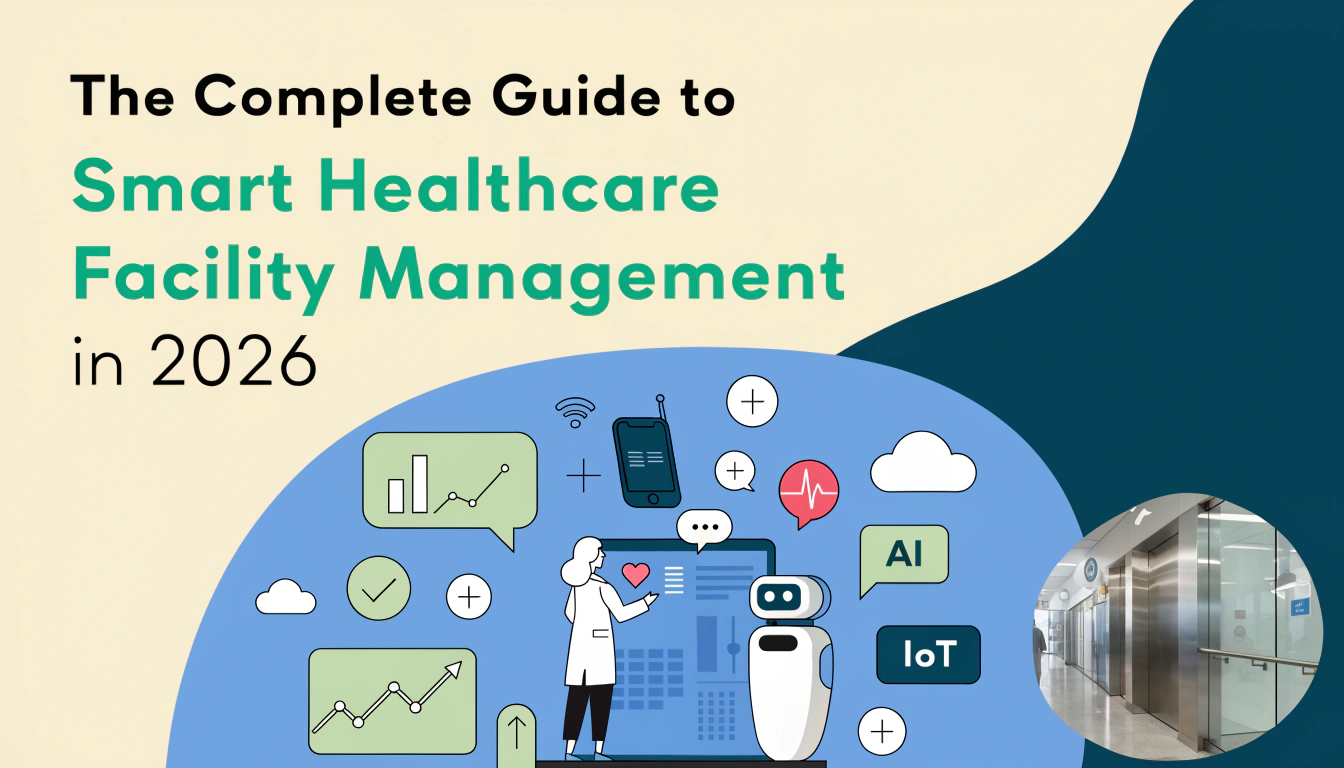
This complete hospital facilities guide 2026 explains what smart healthcare facility management means, why it matters, which technologies are transforming hospitals, how organizations can implement smart systems, and what facility leaders should prioritize when planning for the future.
What Is Smart Healthcare Facility Management?
Smart healthcare facility management refers to the use of connected technologies, automation, data analytics, and intelligent workflows to manage healthcare buildings and their supporting infrastructure more effectively.
Traditional facility management often depends on scheduled inspections, manual reporting, reactive maintenance, spreadsheets, disconnected systems, and staff experience. These approaches can still have value, but they may make it difficult to understand what is happening across a large healthcare campus in real time.
Smart facility management creates a more connected operating model.
Building management systems, sensors, equipment monitoring platforms, computerized maintenance management systems, Internet of Things devices, energy meters, environmental monitoring systems, and analytics platforms can work together to provide facility teams with a more complete view of building performance.
For example, instead of waiting for an air-handling unit to fail, a smart system can monitor equipment performance and identify unusual vibration, temperature, pressure, or energy patterns. Maintenance teams can then investigate the issue before it becomes a major operational problem.
Similarly, instead of relying only on monthly energy bills, healthcare organizations can monitor electricity, heating, cooling, water, and other resource consumption continuously.
The result is a shift from reactive facility management to proactive and predictive facility management.
Why Smart Healthcare Facility Management Matters in 2026
Healthcare facilities operate under conditions that are very different from ordinary commercial buildings.
A hospital may operate 24 hours a day, seven days a week, with critical systems that cannot simply be switched off for maintenance. Operating rooms, intensive care areas, laboratories, imaging departments, pharmacies, emergency departments, and patient rooms all have different environmental and operational requirements.
A failure involving power, HVAC, medical gases, water, elevators, communications, refrigeration, or security can have consequences far beyond inconvenience.
This makes reliability one of the most important reasons to adopt smart facility management.
At the same time, healthcare organizations face pressure to control operating costs and improve sustainability. Energy-intensive systems such as HVAC, lighting, sterilization, refrigeration, and medical equipment can contribute significantly to facility operating expenses.
Smart technologies can help facility teams identify inefficiencies while maintaining the environmental conditions required for patient safety.
Another major consideration is workforce efficiency. Facility management teams frequently have to manage large buildings with limited resources. Digital work orders, mobile maintenance tools, automated alerts, remote monitoring, and predictive analytics can reduce unnecessary manual work and allow teams to concentrate on higher-value activities.
Smart healthcare facility management therefore supports several objectives at once: reliability, efficiency, safety, sustainability, cost control, and improved decision-making.
The Core Components of a Smart Healthcare Facility
A smart healthcare facility is not defined by one piece of technology. It is an ecosystem of systems that work together.
Connected Building Management Systems
A modern building management system can provide visibility into HVAC, temperature, humidity, air pressure, lighting, energy use, alarms, and other building functions.
In healthcare environments, this information can be particularly important because different areas may have specific environmental requirements.
A connected BMS can help facility teams monitor conditions across multiple zones and identify deviations quickly. Instead of manually checking every location, teams can receive alerts when predefined thresholds are exceeded.
The greatest value comes when BMS data is integrated with other facility platforms rather than operating as an isolated system.
Internet of Things Sensors
IoT sensors can transform physical healthcare infrastructure into a source of continuous operational data.
Sensors can monitor temperature, humidity, occupancy, vibration, pressure, air quality, water conditions, equipment performance, and energy consumption.
For example, temperature sensors can support monitoring of sensitive storage areas, while vibration sensors can help identify unusual equipment behavior.
The objective is not to collect data simply because it is available. Facility managers should identify the operational questions they need to answer and then determine which sensors can provide useful information.
Predictive Maintenance
One of the most valuable applications of smart technology is predictive maintenance.
Traditional preventive maintenance follows a schedule. Equipment may be inspected or serviced after a predefined period, regardless of its actual condition.
Predictive maintenance uses real-time and historical data to identify signs that equipment may be approaching failure.
For healthcare organizations, this can be especially valuable for critical equipment and infrastructure.
A predictive maintenance program may analyze variables such as temperature, vibration, operating hours, pressure, energy consumption, and fault history. When the system detects an unusual pattern, it can alert maintenance personnel.
This approach can help reduce unexpected breakdowns, improve equipment availability, and make maintenance planning more efficient.
Digital Maintenance Management
A smart healthcare facility also needs a strong digital maintenance workflow.
A computerized maintenance management system, or CMMS, can centralize work orders, asset information, maintenance schedules, service histories, spare parts, technician assignments, and inspection records.
Instead of receiving maintenance requests through phone calls, paper forms, emails, and informal messages, teams can use a structured digital process.
Facility managers can prioritize work based on urgency and criticality.
For example, an issue involving a critical clinical area may require immediate attention, while a minor cosmetic issue can be scheduled for later.
Digital maintenance management also creates historical data. Over time, that information can help organizations understand which assets require the most maintenance, where recurring problems exist, and which equipment may need replacement.
Smart HVAC and Indoor Environmental Management
HVAC is one of the most important facility systems in healthcare.
It influences temperature, humidity, ventilation, pressure relationships, air quality, comfort, infection-control requirements, and energy consumption.
Smart healthcare facility management 2026 increasingly focuses on using sensors, automation, controls, and analytics to optimize HVAC performance without compromising clinical requirements.
A smart HVAC system can continuously monitor environmental conditions and adjust building systems according to occupancy, operational needs, and predefined requirements.
Analytics can also help facility teams identify inefficient equipment, abnormal energy consumption, or areas where HVAC systems are working harder than expected.
The goal is to balance clinical requirements, patient comfort, staff safety, equipment reliability, and energy efficiency.
Energy Management and Sustainability
Energy efficiency has become a strategic issue for healthcare organizations.
Hospitals need reliable power and environmental control, but they also need to manage operating costs and environmental impact.
Smart energy management systems provide more detailed information about how and when energy is being consumed.
Facility managers can use this information to identify high-consumption equipment, inefficient operating schedules, abnormal usage patterns, and opportunities for optimization.
Smart lighting can also support energy savings through occupancy sensors, automated scheduling, and daylight-responsive controls.
However, energy efficiency should never be approached as simply switching systems off. Healthcare facilities require careful planning because certain areas must maintain continuous environmental and operational conditions.
Smart systems help facility teams make these decisions using real-time information rather than assumptions.
Water Management in Healthcare Facilities
Water is another critical resource that requires careful management.
Hospitals use water for patient care, sanitation, sterilization, cooling, food services, cleaning, landscaping, and many other purposes.
Smart water monitoring can help identify unusual consumption patterns and possible leaks.
A leak that remains unnoticed in a large healthcare facility can result in wasted water, property damage, service interruptions, and expensive repairs.
Connected water meters and sensors can help facility teams detect abnormal consumption sooner.
The same data can also support sustainability reporting and long-term infrastructure planning.
Indoor Air Quality and Environmental Monitoring
Indoor environmental quality is increasingly important in healthcare.
Smart environmental monitoring systems can track variables such as temperature, humidity, particulate matter, carbon dioxide, and other air-quality indicators depending on the application.
The value of monitoring is that it allows facility teams to move from occasional checks to continuous visibility.
When unusual conditions occur, alerts can help teams investigate the issue quickly.
For clinical environments, environmental monitoring should always be aligned with applicable healthcare requirements, engineering standards, infection-control policies, and organizational procedures.
Technology should support professional judgment rather than replace it.
Smart Security and Access Management
Healthcare facilities must protect patients, staff, visitors, medical assets, pharmaceuticals, sensitive areas, and critical infrastructure.
Smart access-control systems can provide more precise management of who can enter specific areas and when.
Connected surveillance, access systems, visitor management, alarms, and emergency communication platforms can improve situational awareness.
For example, access rights can be designed around roles and facility zones rather than relying solely on physical keys.
Smart security can also support emergency response by providing facility teams with information about access points, alarms, and affected areas.
Because healthcare facilities handle sensitive information and vulnerable populations, smart security systems must be implemented with strong privacy and cybersecurity controls.
Digital Twins and Healthcare Facility Planning
Digital twins are another emerging component of smart facility management.
A digital twin is a digital representation of a physical facility or system that can incorporate information about assets, spaces, equipment, operations, and performance.
For healthcare organizations, digital twins can support facility planning, maintenance, space management, renovation planning, and operational analysis.
A facility manager could potentially use digital information to understand where critical assets are located, how systems interact, and how changes could affect facility operations.
Digital twins can become particularly valuable for large campuses and organizations managing multiple buildings.
However, successful implementation depends on accurate data. A digital model that is not maintained properly can quickly become outdated.
Artificial Intelligence in Facility Management
Artificial intelligence is increasingly influencing facility management.
AI can analyze large volumes of operational data and identify patterns that may be difficult to detect manually.
Potential applications include predictive maintenance, energy optimization, anomaly detection, demand forecasting, space utilization analysis, and automated reporting.
For example, an AI-powered analytics system might identify that a particular piece of equipment consistently consumes more energy than comparable equipment under similar conditions.
The facility team can then investigate the reason.
AI should not be treated as a replacement for experienced facility professionals. Instead, it can act as a decision-support tool that helps teams process information faster and focus their attention where it is most needed.
How Smart Healthcare Facility Management Improves Patient Experience
Facility management may operate behind the scenes, but its impact can be visible throughout the patient journey.
Temperature, lighting, cleanliness, elevators, water availability, noise, air quality, room conditions, signage, waiting areas, and reliability of critical systems can all influence the healthcare experience.
A facility that operates smoothly can reduce unnecessary disruptions for patients and clinical staff.
Smart systems can contribute by improving response times, identifying environmental issues, optimizing building conditions, and helping teams maintain reliable infrastructure.
The relationship between facility management and patient experience should therefore be viewed strategically.
Facility management is not simply about maintaining buildings. It helps create the physical environment in which healthcare delivery takes place.
Cybersecurity Must Be Part of the Smart Facility Strategy
Greater connectivity creates greater cybersecurity responsibility.
When building systems, IoT devices, maintenance platforms, access controls, energy systems, and other technologies become connected, the potential attack surface can expand.
Healthcare organizations therefore need cybersecurity considerations to be included from the beginning of every smart facility project.
Facility teams should work closely with IT and cybersecurity professionals to understand system architecture, access privileges, software updates, vendor responsibilities, network segmentation, device security, monitoring, and incident response.
Cybersecurity should not be treated as an IT-only issue.
A compromised connected building system could potentially affect physical operations, making collaboration between facility management, IT, security, clinical leadership, and executive management essential.
Data Integration Is More Important Than Buying More Technology
One of the biggest mistakes organizations can make is purchasing multiple smart technologies without creating an integrated strategy.
A hospital may have a BMS, CMMS, energy platform, access-control system, IoT sensors, security systems, and asset management software. If these systems cannot exchange information effectively, facility managers may still have to move between multiple dashboards.
The objective should be connected intelligence rather than disconnected technology.
Before investing in new systems, organizations should evaluate existing infrastructure, data availability, interoperability, cybersecurity requirements, and long-term integration goals.
A smaller number of well-integrated systems may deliver greater value than a large number of disconnected solutions.
A Practical Roadmap for Implementing Smart Facility Management
Healthcare organizations do not need to transform their entire facility overnight.
A practical approach starts with an assessment.
First, facility leaders should identify their biggest operational challenges. Are equipment failures causing disruption? Is energy consumption increasing? Are maintenance teams overwhelmed? Are environmental conditions difficult to monitor? Are work orders being managed manually?
Once the key problems are clear, organizations can identify where smart technology can provide measurable value.
The next step is to establish baseline performance.
Facility teams should understand current maintenance costs, equipment downtime, energy consumption, response times, work-order volumes, environmental performance, and other relevant indicators.
This baseline makes it easier to evaluate whether a smart initiative is actually producing results.
Organizations can then select a pilot project.
Instead of implementing technology across an entire hospital, a facility may begin with one building, one department, or one type of equipment.
The pilot should have clear objectives and measurable outcomes.
Once the system demonstrates value, the organization can expand it gradually.
Training Healthcare Facility Teams
Technology alone does not create a smart facility.
People remain at the center of facility management.
Facility engineers, technicians, administrators, security professionals, IT teams, clinical stakeholders, and leadership need to understand how the new systems work and how they fit into existing processes.
Training should cover both technical operation and decision-making.
Staff should know what an alert means, how it should be investigated, when escalation is necessary, and how information should be documented.
It is also important to avoid creating excessive alerts.
A system that generates hundreds of low-value notifications can overwhelm staff and make critical warnings easier to miss.
Smart systems should therefore be configured around meaningful thresholds and clear response procedures.
Measuring the Success of Smart Facility Management
Smart facility management initiatives should be measured through outcomes, not simply the number of technologies installed.
Useful performance indicators may include equipment downtime, preventive maintenance completion, emergency work orders, maintenance response times, energy consumption, water consumption, environmental compliance, system availability, and operating costs.
Organizations can also evaluate less direct benefits, such as improved staff productivity, better visibility into assets, faster issue resolution, and improved planning.
The most important question is simple:
Is the technology helping the facility operate better?
If the answer cannot be demonstrated through data or operational improvements, the technology strategy may need to be reassessed.
Common Challenges in Smart Healthcare Facility Management
Despite the benefits, implementing smart facility management is not always straightforward.
One challenge is legacy infrastructure. Many hospitals operate buildings and equipment that were installed years or even decades ago. Integrating older systems with modern technologies can require careful planning.
Another challenge is budget justification. Facility leaders need to demonstrate that investments will generate measurable value rather than simply adding new technology.
Data quality can also be a problem. Inaccurate asset records, incomplete maintenance histories, inconsistent naming conventions, and outdated building information can reduce the effectiveness of analytics.
Staff resistance is another consideration. Employees may worry that automation will replace jobs or make their roles more complicated.
Clear communication and training can help organizations explain that smart technology is intended to improve decision-making, reduce repetitive tasks, and support facility professionals.
Cybersecurity and privacy must also be considered throughout the process.
Finally, organizations should avoid implementing technology without a clear operational purpose.
The Role of Facility Managers in 2026
The role of the healthcare facility manager is evolving.
Facility managers are no longer responsible only for maintenance schedules, contractors, repairs, and physical infrastructure.
They increasingly need to understand data, digital systems, energy performance, cybersecurity, sustainability, resilience, and technology integration.
This does not mean every facility manager needs to become a software engineer.
Instead, modern facility leaders need the ability to understand how technology can solve operational problems and how different teams can work together.
The strongest facility managers will combine technical knowledge with strategic thinking.
They will ask questions such as:
How can we reduce unplanned downtime?
Which assets create the greatest operational risk?
Where are we wasting energy?
Which maintenance tasks can be predicted rather than scheduled?
How can we improve response times?
How can we make the facility more resilient?
How can technology support clinical teams without creating additional complexity?
These questions form the foundation of smart healthcare facility management 2026.
Building More Resilient Healthcare Facilities
Resilience should be a core objective of modern healthcare facility planning.
Hospitals must be prepared for equipment failures, extreme weather, power interruptions, water issues, supply disruptions, cybersecurity incidents, and other unexpected events.
Smart facility systems can improve resilience by providing real-time visibility into critical infrastructure.
For example, monitoring systems can help teams understand the status of critical equipment, environmental conditions, energy systems, and backup infrastructure.
Predictive analytics can identify emerging risks before they become failures.
Digital documentation can also help facility teams understand assets, maintenance histories, emergency procedures, and system dependencies.
Resilience is ultimately about ensuring that the healthcare organization can continue delivering essential services when conditions become difficult.
Smart Facilities and Sustainability
Sustainability will remain a major consideration in healthcare facility planning.
Hospitals have significant energy, water, waste, and material requirements. Improving sustainability therefore requires more than installing efficient equipment.
Smart facility management can help organizations understand resource consumption and identify operational improvements.
Energy analytics can reveal inefficient systems. Smart controls can reduce unnecessary consumption. Water monitoring can help detect leaks. Building performance data can support long-term capital planning.
The most successful sustainability programs connect environmental goals with financial and operational outcomes.
For example, reducing energy consumption can lower costs while also reducing environmental impact.
This creates a stronger business case for investment.
What Should Healthcare Leaders Prioritize in 2026?
Healthcare organizations planning smart facility initiatives should focus on practical outcomes.
First, prioritize critical infrastructure. Systems that directly affect patient safety, clinical operations, or business continuity should receive close attention.
Second, improve visibility. Facility teams cannot manage what they cannot see. Real-time data from critical assets and building systems can create a stronger foundation for decision-making.
Third, focus on integration. Avoid creating disconnected technology islands.
Fourth, invest in people. Technology requires trained professionals who understand how to interpret information and act on it.
Fifth, make cybersecurity part of the design rather than an afterthought.
Finally, measure results continuously. Smart facility management should evolve as new data reveals new opportunities.
The Future of Smart Healthcare Facility Management
The healthcare facility of the future will be increasingly connected.
Sensors will provide more real-time information. Analytics will become more sophisticated. AI will support decision-making. Digital twins will improve planning. Predictive maintenance will become more common. Energy management will become increasingly data-driven.
However, technology will not be the only defining feature.
The future of healthcare facility management will be about creating an environment where people, buildings, equipment, data, and technology work together.
A smart hospital should not simply have more sensors or dashboards. It should be able to identify problems earlier, respond faster, use resources more efficiently, protect critical infrastructure, and support clinicians and patients more effectively.
That is the real purpose of smart healthcare facility management 2026.
Final Takeaway
Smart healthcare facility management is becoming an essential strategy for healthcare organizations seeking safer, more efficient, resilient, sustainable, and data-driven facilities.
From connected building management systems and IoT sensors to predictive maintenance, energy analytics, AI, digital twins, cybersecurity, and integrated maintenance platforms, modern technologies provide facility teams with new ways to manage complex healthcare environments.
But technology should always serve a clear operational objective.
The strongest smart facility strategies begin with real problems, establish measurable goals, integrate systems carefully, train people effectively, and continuously evaluate results.
For healthcare leaders, facility managers, engineers, technology providers, sustainability professionals, and other industry stakeholders, 2026 is an important time to evaluate how smart technologies can strengthen healthcare infrastructure.
The next generation of healthcare facilities will not simply be more digital. They will be more connected, proactive, resilient, efficient, and intelligent.
Register for Healthcare Facilities Convention 2026
The transformation of healthcare facilities requires collaboration between healthcare leaders, facility professionals, technology providers, engineers, and solution experts.
If you want to explore the latest ideas, technologies, strategies, and opportunities shaping smart healthcare facilities, register for Healthcare Facilities Convention 2026 and connect with professionals focused on the future of healthcare facility management.
Register for Healthcare Facilities Convention 2026 – https://bmaconventions.com/smart-healthcare-facilities-convention/