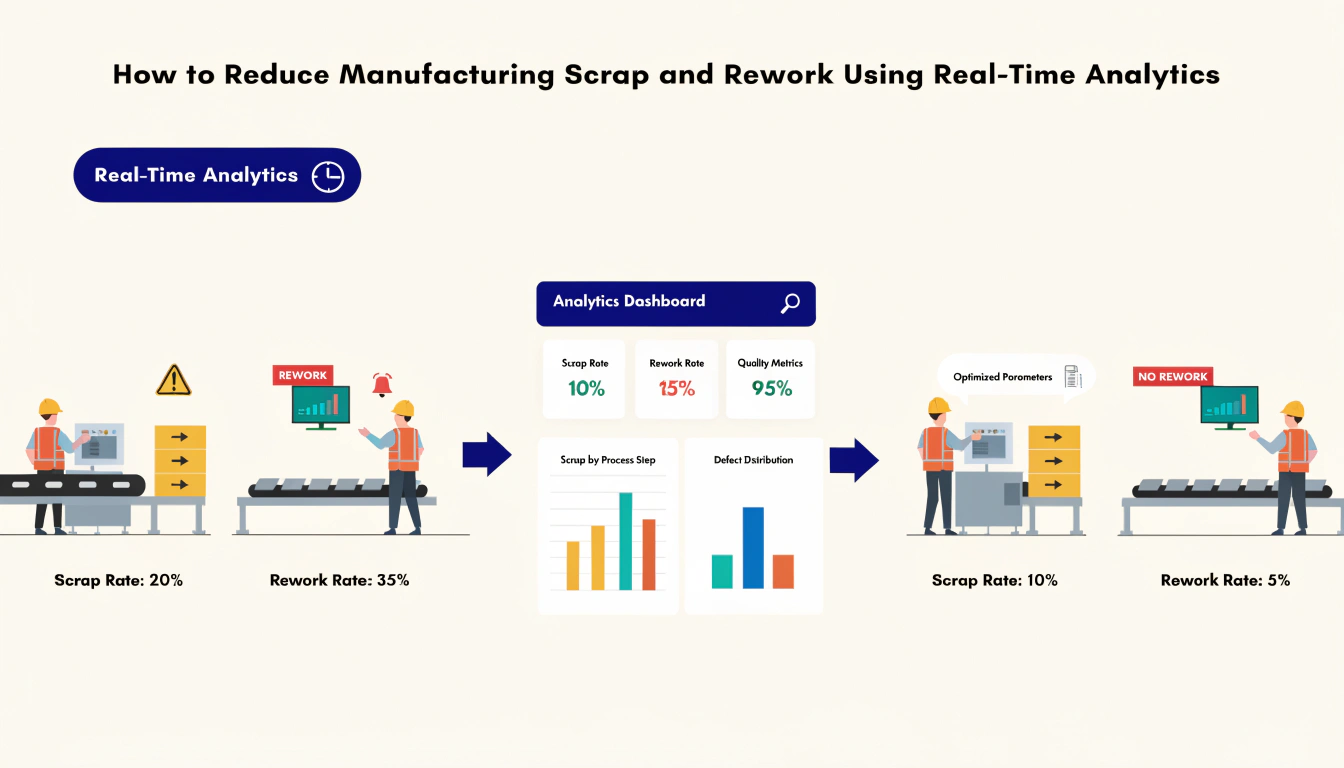
Manufacturing companies are under constant pressure to produce more, maintain consistent quality, and control costs without slowing down production. Yet two of the biggest sources of hidden manufacturing losses remain scrap and rework. Materials that must be discarded, products that require correction, and production time lost to quality problems can significantly affect profitability.
Traditional quality-control methods often identify problems after they have already occurred. By contrast, real-time analytics gives manufacturers the ability to monitor production continuously, identify abnormal conditions early, and take corrective action before defects multiply.
The ability to reduce manufacturing scrap analytics through real-time data is becoming an important part of modern manufacturing strategy. When connected with sensors, industrial IoT systems, machine data, and smart factory platforms, analytics can turn quality management from a reactive process into a proactive one.
This article explores how manufacturers can use real-time analytics to reduce scrap and rework, improve quality, and build a stronger quality management smart factory environment.
Why Scrap and Rework Are Major Manufacturing Problems
Scrap occurs when a product, component, or material cannot be used because it fails to meet required specifications. Rework is different: the product can still be used, but additional work is required to correct the problem.
Both create costs that go beyond the value of the material itself.
For example, a defective component may require additional labor, machine time, inspection, energy, and materials before it can be shipped. In some cases, rework can also disrupt production schedules and reduce available machine capacity.
Scrap and rework can also indicate deeper process problems. A recurring dimensional defect may point to machine calibration issues. Variations in temperature could affect product consistency. Incorrect settings, worn tooling, poor-quality raw materials, or operator errors can all contribute to defects.
The challenge is that conventional quality inspections may only identify these issues after production has taken place. By that stage, manufacturers may have already produced dozens or hundreds of defective units.
Real-time analytics changes this approach by providing continuous visibility into what is happening on the production floor.
What Is Real-Time Manufacturing Analytics?
Real-time manufacturing analytics involves collecting and analyzing production data as processes are happening rather than waiting until the end of a production cycle or shift.
Modern production environments can generate huge volumes of information from machines, sensors, PLCs, industrial IoT devices, production systems, and quality inspections. This data can include machine temperature, pressure, vibration, speed, cycle time, energy consumption, production output, downtime, and defect rates.
Analytics platforms can process this information and identify patterns or deviations from expected operating conditions.
For instance, suppose a machine normally operates within a particular temperature range. If the temperature starts increasing beyond the normal pattern, real-time analytics can flag the change. The production team can investigate the cause before the machine begins producing defective products.
This creates a shift from detecting defects to preventing defects.
How Real-Time Analytics Helps Reduce Manufacturing Scrap
One of the strongest benefits of real-time analytics is its ability to identify process deviations before they result in significant material losses.
Manufacturers can establish acceptable operating ranges for critical production parameters. When data moves outside those ranges, the analytics platform can generate alerts or trigger predefined responses.
Consider a packaging line where incorrect sealing temperature can cause product failures. Instead of waiting for final inspection to discover the problem, sensors can continuously monitor temperature. If the temperature begins moving away from the target range, operators can receive an alert and correct the process.
This approach helps manufacturers reduce the number of defective units produced during the period between the beginning of a process problem and its discovery.
Real-time analytics can also identify gradual changes that may not immediately trigger traditional alarms. A machine might still be technically operating, but its vibration, cycle time, or energy consumption may slowly move away from normal patterns.
Analytics can detect these trends and highlight them for investigation.
Identifying the Root Causes of Defects
Reducing scrap requires more than knowing how many defective products are being produced. Manufacturers need to understand why those defects are occurring.
Real-time analytics can combine data from different stages of production to identify relationships between process conditions and quality outcomes.
For example, a manufacturer may discover that defect rates increase when:
- A particular machine operates beyond a specific production speed
- A raw material batch has different characteristics
- Production takes place under certain temperature conditions
- Tool wear reaches a particular stage
- A particular process setting is used
- Machine downtime is followed by an increase in defects
Instead of relying entirely on assumptions or manual investigations, production teams can use data to identify the variables most closely associated with quality problems.
This makes root-cause analysis faster and more evidence-based.
Predictive Analytics and Early Defect Detection
Real-time analytics becomes even more powerful when combined with predictive analytics.
Predictive models use historical and current production data to identify conditions that are likely to lead to future problems. Instead of simply reporting that a defect has occurred, a predictive system can identify warning signs before the defect occurs.
For example, if historical data shows that a specific combination of machine vibration, temperature, and operating speed frequently precedes defects, the system can monitor those variables in real time.
When a similar pattern begins to appear, the production team can intervene.
This can help manufacturers move toward predictive quality management, where production conditions are continuously evaluated to prevent quality failures.
Reducing Rework Through Real-Time Quality Monitoring
Rework is often caused by defects that are discovered after a product has already moved through one or more production stages.
The later a defect is detected, the more expensive it can become.
Imagine a component that passes through five manufacturing stages before final inspection. If a defect introduced during stage two is only discovered at stage five, significant resources may already have been invested in that component.
Real-time quality monitoring allows manufacturers to detect problems closer to the point where they occur.
Digital inspection systems, sensors, machine vision, and connected production equipment can provide immediate information about product quality. If a measurement falls outside the required specification, the system can alert operators or stop the process depending on the severity of the issue.
This reduces the chance that defective products continue through subsequent production stages.
Using Machine Vision for Automated Quality Control
Machine vision is another technology that can support real-time analytics and quality management.
Camera-based systems can inspect products for defects such as incorrect assembly, surface imperfections, missing components, incorrect labels, or dimensional inconsistencies.
When machine vision systems are connected to analytics platforms, manufacturers can go beyond identifying individual defects. They can analyze defect patterns over time and identify relationships with machines, production lines, materials, shifts, or operating conditions.
This creates a continuous feedback loop between production and quality teams.
Instead of treating inspection as the final step in manufacturing, organizations can make quality information part of the production process itself.
Building a Quality Management Smart Factory
A quality management smart factory integrates machines, people, data, analytics, and quality processes into a connected production environment.
In a smart factory, quality data does not remain isolated within the quality department. Production managers, maintenance teams, operators, engineers, and management can access relevant information and collaborate around the same data.
For example, a quality dashboard might display:
- Current defect rates
- Scrap quantities
- Rework levels
- Production trends
- Machine conditions
- Process deviations
- Quality alerts
- First-pass yield
- Defect categories
- Production-line performance
This visibility enables faster decision-making.
If one production line suddenly experiences a higher defect rate, managers can investigate immediately instead of discovering the problem during a later quality review.
Connecting Quality Data With Machine Data
A major advantage of real-time analytics comes from connecting different types of manufacturing information.
Quality data alone may tell a manufacturer that defects increased by 8%. However, connecting that information with machine data could reveal that the increase occurred after a particular machine started operating at higher temperatures.
Similarly, combining production data with maintenance information may show that defect rates increase shortly before a machine requires maintenance.
Connecting data sources can therefore reveal relationships that would remain invisible in separate systems.
Manufacturers can integrate data from manufacturing execution systems, enterprise resource planning platforms, industrial IoT devices, sensors, quality management systems, and maintenance platforms.
The objective is to create a unified view of production performance and quality.
Real-Time Dashboards for Faster Decisions
A dashboard can turn complex production information into visual insights that operators and managers can understand quickly.
Instead of reviewing spreadsheets at the end of every shift, teams can monitor quality indicators as production takes place.
A well-designed dashboard should focus on actionable information. For example, showing a rising defect rate is useful, but identifying the affected production line, machine, product type, and process parameter makes the information much more valuable.
Manufacturers can also establish thresholds and alerts for critical metrics.
When a metric reaches a predefined limit, the responsible team can investigate immediately. This shortens the time between identifying a problem and taking corrective action.
Measuring the Impact of Analytics
To determine whether real-time analytics is delivering results, manufacturers should establish measurable performance indicators.
Important metrics can include scrap rate, rework rate, first-pass yield, defect rate, cost of poor quality, downtime associated with quality issues, customer returns, and production yield.
The goal should not simply be to collect more data. The goal is to use data to improve measurable business outcomes.
For example, if a manufacturer introduces real-time monitoring on a production line, it can compare defect and scrap levels before and after implementation.
Over time, the organization can identify which analytics-driven interventions have the strongest impact and expand them across other production areas.
Challenges Manufacturers Need to Address
Although real-time analytics can provide significant benefits, implementation requires careful planning.
One challenge is data quality. If sensors are inaccurate or production systems contain incomplete information, analytics results may be unreliable.
Another challenge is integration. Many factories operate with equipment from different generations and vendors. Connecting older machines with modern analytics platforms may require additional hardware or software.
Employee adoption is equally important. Operators and managers need to understand how analytics supports their work rather than viewing it as an additional monitoring system.
Manufacturers should therefore begin with clearly defined use cases, reliable data, appropriate KPIs, and practical workflows.
Start Small and Scale
Manufacturers do not necessarily need to transform their entire facility at once.
A practical approach is to identify one production line or process with a significant scrap or rework problem. The organization can then collect relevant data, identify the major causes, implement real-time monitoring, and measure the results.
Once the approach demonstrates measurable improvement, it can be expanded to additional lines, products, and facilities.
This phased strategy can reduce implementation risk while helping teams develop the skills required to manage data-driven manufacturing.
The Future of Scrap and Rework Reduction
As manufacturing becomes increasingly connected, the role of analytics in quality management is expected to expand.
Artificial intelligence, machine learning, digital twins, industrial IoT, advanced machine vision, and edge computing can make production analytics faster and more predictive.
Future systems will increasingly be capable of recognizing subtle process changes, predicting quality problems, recommending corrective actions, and supporting automated responses.
The ultimate objective is not simply to produce fewer defective products. It is to create production systems in which defects are prevented as early as possible.
Manufacturers that successfully combine real-time analytics with strong quality processes can improve productivity, reduce material waste, lower operating costs, and strengthen customer confidence.
Conclusion
Scrap and rework represent more than quality problems; they are indicators of inefficiency, lost resources, and missed production opportunities. Traditional inspection methods remain valuable, but manufacturers increasingly need real-time visibility to identify problems before they become expensive.
Using reduce manufacturing scrap analytics strategies, organizations can monitor production conditions continuously, identify root causes, detect early warning signs, and take corrective action faster.
When real-time analytics is integrated with connected equipment, machine vision, predictive models, and quality dashboards, manufacturers can create a more proactive approach to quality management.
The result is a smarter manufacturing environment where quality is built into the process rather than inspected only at the end.
For manufacturers planning their next stage of digital transformation, real-time analytics can be an important step toward reducing scrap, minimizing rework, improving productivity, and building a more resilient smart factory.
Register as a delegate to explore the latest manufacturing technologies, automation strategies, and smart factory solutions shaping the future of industrial operations.