Artificial intelligence is no longer a futuristic concept for manufacturers. It is becoming an essential part of how factories operate, how equipment is maintained, how products are inspected, and how business leaders make decisions. At the Dallas convention 2027, discussions around artificial intelligence highlighted how quickly AI is moving from experimental projects to practical manufacturing applications.
The event brought together manufacturing professionals, technology leaders, automation experts, engineers, and decision-makers to explore the technologies shaping the next generation of industrial operations. Among the biggest themes was the growing role of AI in improving productivity, reducing downtime, strengthening quality control, and creating smarter factories.
These discussions provided valuable AI manufacturing insights 2027 that manufacturers can use when planning their technology investments and digital transformation strategies.
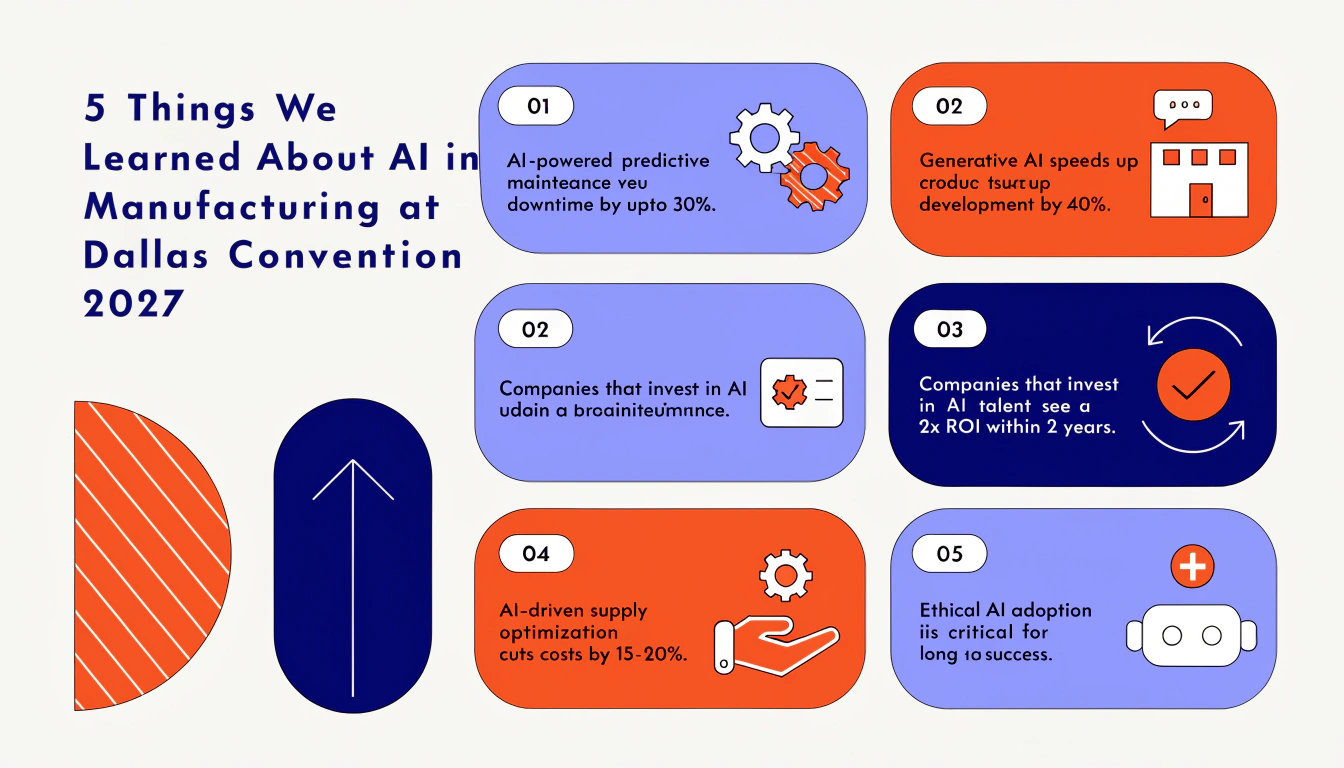
Here are five key lessons from the event.
1. AI Is Moving from Experimentation to Real Factory Applications
One of the biggest AI manufacturing insights 2027 is that manufacturers are becoming more focused on practical applications rather than simply experimenting with artificial intelligence.
In the early stages of Industry 4.0 adoption, manufacturers often focused on understanding what technologies such as AI, IoT, robotics, and cloud computing could potentially achieve. Today, the conversation has shifted toward measurable business outcomes.
Manufacturers want to know whether an AI solution can reduce production costs, increase equipment availability, improve product quality, or help employees make better decisions.
AI can now support a wide range of manufacturing activities. Production teams can use AI-powered systems to analyse machine data, identify unusual operating patterns, forecast maintenance requirements, and improve production planning.
For example, an AI system can analyse historical machine data alongside real-time information from sensors. If the system identifies a pattern that has previously been associated with equipment failure, maintenance teams can receive an alert before the machine experiences a major breakdown.
This shift toward measurable outcomes was an important theme at the manufacturing AI conference discussions surrounding the Dallas convention. The focus is no longer simply on whether manufacturers should adopt AI but on where AI can deliver the greatest operational value.
2. Predictive Maintenance Is Becoming More Intelligent
Equipment downtime remains one of the biggest challenges for manufacturing businesses. Unexpected machine failures can interrupt production schedules, increase maintenance costs, and affect delivery commitments.
AI is changing the way manufacturers approach this problem.
Traditional maintenance strategies often depend on fixed schedules or reactive repairs. Predictive maintenance uses data from machines and sensors to identify potential problems before they become serious.
AI takes this approach further by analysing large volumes of information and identifying patterns that may not be obvious to human operators.
Temperature, vibration, pressure, energy consumption, operating speed, and other machine parameters can be monitored continuously. AI models can then assess this information and help maintenance teams determine whether equipment is operating normally.
This can allow manufacturers to move from simply asking, “When should we maintain this machine?” to asking, “What is this machine telling us about its future performance?”
The AI manufacturing insights 2027 from these conversations demonstrate why predictive maintenance is becoming a strategic priority. Instead of waiting for equipment to fail, businesses can use intelligence from their operational data to plan maintenance more effectively.
The result can be better asset utilisation, fewer unexpected shutdowns, improved maintenance planning, and more consistent production.
However, successful predictive maintenance depends on reliable data. Manufacturers need appropriate sensors, connected equipment, data infrastructure, and systems capable of integrating information from across the plant.
3. AI and Human Workers Will Work Together
Another important takeaway from the Dallas convention 2027 was that AI should not be viewed simply as a replacement for human workers.
Manufacturing requires practical knowledge, technical expertise, judgement, creativity, and problem-solving skills. AI can process information quickly, but people remain essential for interpreting results, managing complex situations, and making decisions.
The future manufacturing environment is therefore likely to be based on collaboration between humans and intelligent technologies.
AI can help employees identify potential issues, analyse production data, recommend process improvements, or automate repetitive administrative tasks. Workers can then use these insights to make faster and more informed decisions.
For example, a production manager may previously have needed to review multiple reports before identifying why production efficiency had declined. An AI-enabled system could analyse operational data and highlight the most likely factors contributing to the decline.
This does not eliminate the manager’s role. Instead, it allows the manager to spend less time searching for information and more time deciding what action to take.
This human-AI relationship was one of the most valuable AI manufacturing insights 2027 emerging from the event. Manufacturers that successfully introduce AI will need to focus not only on technology but also on workforce training, change management, and employee adoption.
Employees need to understand how AI systems work, how to interpret their recommendations, and when human judgment should take priority.
4. AI-Powered Quality Control Is Becoming a Major Opportunity
Quality control was another significant area of interest surrounding AI in manufacturing.
Traditional inspection processes can be time-consuming and may depend heavily on manual inspection. While human inspectors remain valuable, computer vision and AI can help manufacturers analyse products quickly and consistently.
AI-powered vision systems can examine components, surfaces, packaging, and finished products to identify defects or irregularities.
The technology can be particularly useful in high-volume manufacturing environments where thousands of products may need to be inspected during a production shift.
AI can identify patterns in defects and potentially help manufacturers understand why those defects are occurring. This creates an opportunity to move beyond simply identifying defective products toward improving the underlying production process.
For instance, if an AI system identifies an increasing number of defects associated with a particular production stage, engineers can investigate the process and determine whether machine settings, materials, environmental conditions, or other factors are contributing to the issue.
This makes AI valuable not only for inspection but also for continuous improvement.
The discussions highlighted at the manufacturing AI conference also reinforce the importance of combining AI with other Industry 4.0 technologies. Connected sensors, robotics, machine vision, digital twins, and manufacturing software can provide the data and infrastructure needed to make AI applications more effective.
5. Data Quality Will Determine AI Success
Perhaps the most important lesson is also one of the simplest: AI is only as useful as the data behind it.
Manufacturers generate enormous amounts of information every day. Machines produce operational data, enterprise systems store business information, sensors monitor equipment, and production platforms record process performance.
However, having large quantities of data does not automatically mean that a company is ready for AI.
Data may be stored across disconnected systems. Some information may be incomplete, outdated, duplicated, or difficult to access. Different machines may also use different data formats, creating additional integration challenges.
Before implementing sophisticated AI solutions, manufacturers need to establish a strong data foundation.
This includes connecting relevant systems, improving data quality, establishing appropriate governance, and ensuring that information can move securely between different parts of the manufacturing environment.
The AI manufacturing insights 2027 discussed at the Dallas convention demonstrate that successful AI adoption requires a broader digital transformation strategy. AI should not be treated as a standalone software purchase. It needs to be connected to the organisation’s wider technology ecosystem and business objectives.
Manufacturers should therefore begin with clearly defined problems. Instead of asking, “Where can we use AI?” businesses can ask questions such as:
How can we reduce unplanned downtime?
How can we improve product quality?
How can we optimise production schedules?
How can we reduce energy consumption?
How can we make better use of existing equipment and workforce expertise?
Answering these questions can help companies identify AI applications that offer meaningful business value.
What These AI Manufacturing Insights Mean for the Future
The Dallas convention 2027 made one thing clear: AI is becoming an increasingly important part of the modern manufacturing environment.
But successful adoption will not happen simply because a company purchases an AI platform. Manufacturers need a clear strategy that combines technology, people, data, processes, and measurable business objectives.
The most successful businesses will likely be those that begin with practical use cases and gradually expand their AI capabilities. Predictive maintenance, intelligent quality inspection, production optimisation, energy management, and AI-assisted decision-making can all provide opportunities to create measurable improvements.
At the same time, manufacturers must prepare their workforce for a changing industrial environment. Training employees, building digital skills, and creating a culture that supports innovation will be just as important as investing in new technologies.
These are among the most important AI manufacturing insights 2027 for organisations preparing for the next stage of Industry 4.0.
Preparing for the Next Generation of Smart Manufacturing
AI is changing manufacturing from the factory floor to the executive office. It can help machines become more predictive, quality control become more intelligent, and business decisions become more data-driven.
The key lesson from the Dallas convention 2027 is that AI adoption should be strategic rather than purely technological. Manufacturers need to identify meaningful challenges, establish reliable data foundations, involve their workforce, and continuously measure results.
For manufacturing leaders, engineers, technology professionals, and automation specialists, staying connected with industry developments is becoming increasingly important. Events and industry gatherings provide opportunities to explore new technologies, learn from experts, and understand how other organisations are approaching digital transformation.
The next stage of manufacturing will not be defined by AI alone. It will be shaped by the combination of artificial intelligence, automation, connected equipment, data analytics, robotics, and human expertise.
Ready to explore what comes next for smart manufacturing? Register for next BMA event and discover the technologies, strategies, and ideas shaping the future of industrial operations.
Register for the next BMA event.
Register for next BMA event