Manufacturing has entered a new era where every minute of production counts. Unexpected machine failures no longer represent just maintenance challenges; they directly impact production schedules, customer commitments, operational costs, and profitability. As manufacturers continue to embrace digital transformation, predictive maintenance has become one of the most valuable investments for improving operational efficiency.
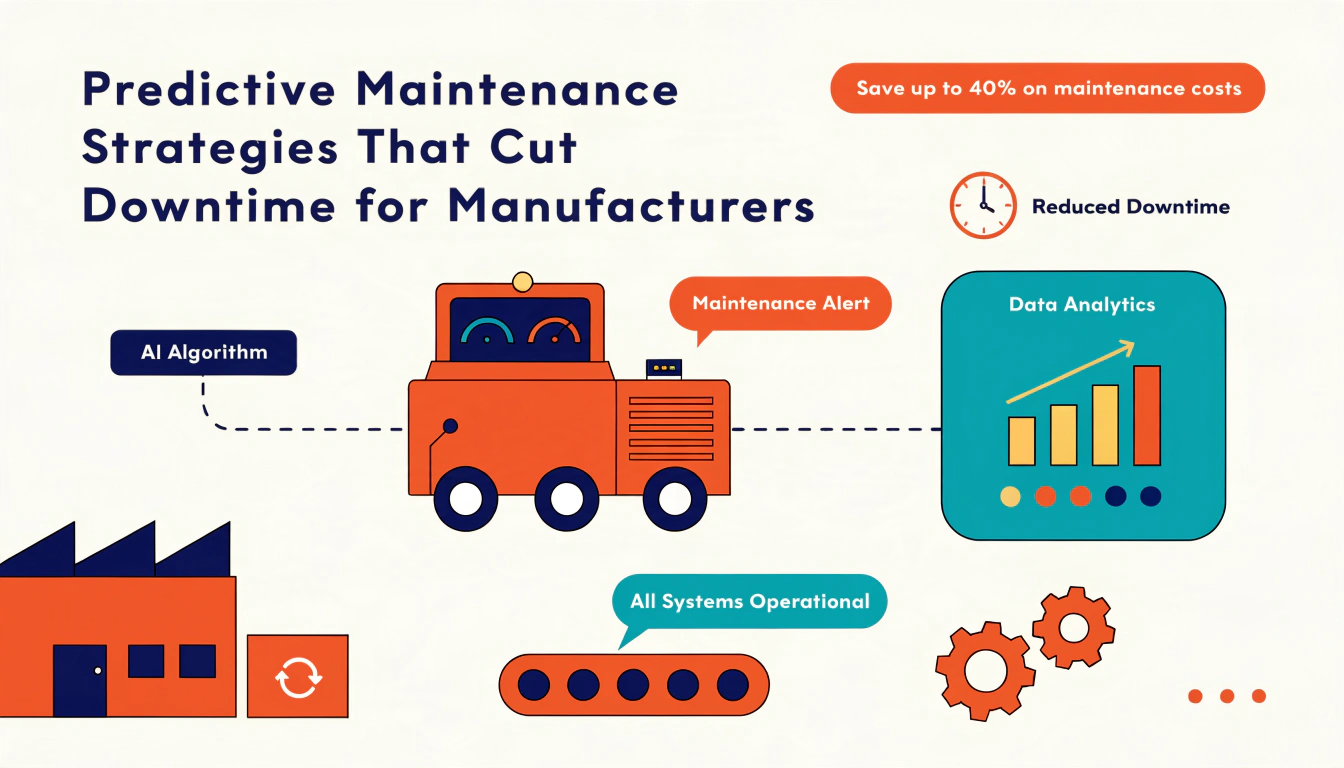
Unlike traditional maintenance approaches that rely on fixed schedules or reactive repairs after failures occur, predictive maintenance manufacturing uses real-time equipment data, artificial intelligence (AI), machine learning, and connected sensors to identify potential failures before they happen. This proactive approach enables maintenance teams to intervene only when necessary, reducing unnecessary servicing while preventing costly breakdowns.
In 2026, manufacturers across automotive, pharmaceuticals, electronics, food processing, aerospace, metals, and heavy engineering are increasingly integrating predictive maintenance into their smart factory initiatives. Combined with industrial IoT maintenance, these technologies are delivering measurable improvements in equipment availability, production quality, energy efficiency, and workforce productivity.
Below are eight proven predictive maintenance strategies that manufacturers can implement to significantly reduce downtime while improving overall equipment effectiveness (OEE).
1. Install IoT Sensors for Continuous Equipment Monitoring
The first step towards effective predictive maintenance is collecting reliable operational data. Modern industrial sensors continuously monitor equipment health by measuring vibration, temperature, pressure, humidity, current, voltage, lubrication quality, and rotational speed.
Instead of relying on periodic inspections, maintenance teams gain continuous visibility into machine performance throughout production cycles.
Industrial IoT devices collect this information in real time and send it to cloud or edge computing platforms where anomalies are automatically identified. Even small deviations from normal operating conditions can indicate developing mechanical issues long before operators notice any visible symptoms.
For example, a slight increase in bearing vibration could indicate early wear. Detecting this issue weeks before failure allows maintenance teams to replace components during scheduled shutdowns rather than facing unexpected production interruptions.
Continuous monitoring forms the backbone of successful predictive maintenance manufacturing because accurate data enables smarter maintenance decisions.
2. Use Artificial Intelligence for Failure Prediction
Collecting equipment data alone is not enough. Manufacturers must transform raw sensor readings into meaningful insights.
Artificial intelligence analyses historical maintenance records, machine behaviour, operating conditions, and production data to recognise patterns associated with equipment failures.
Machine learning algorithms improve over time by continuously learning from new operational data. Rather than reacting to alarms after thresholds are exceeded, AI predicts future failures based on subtle changes that human operators might overlook.
For instance, an AI system may determine that a combination of increasing motor temperature, declining power efficiency, and higher vibration levels consistently precedes gearbox failure within three weeks.
Maintenance teams can then plan repairs with confidence while avoiding unnecessary component replacement.
This predictive capability significantly reduces emergency maintenance while improving maintenance planning accuracy.
3. Implement Digital Twins for Asset Performance Simulation
Digital twins have become one of the most valuable technologies in smart manufacturing.
A digital twin is a virtual representation of physical equipment that continuously updates using live operational data. Engineers can observe machine performance, simulate different operating scenarios, and predict future behaviour without disrupting production.
When integrated into predictive maintenance programmes, digital twins provide maintenance teams with deeper insights into equipment degradation.
Instead of relying solely on historical data, manufacturers can simulate how different production loads, operating temperatures, environmental conditions, or maintenance schedules influence equipment lifespan.
This enables organisations to optimise maintenance timing while extending asset life.
Digital twins also improve collaboration between production managers, maintenance engineers, and equipment suppliers by providing a shared view of equipment health.
4. Integrate Predictive Maintenance with Manufacturing Execution Systems
One common challenge in manufacturing is disconnected operational systems.
Production teams often use Manufacturing Execution Systems (MES), while maintenance departments manage Computerised Maintenance Management Systems (CMMS). Without integration, valuable information remains isolated.
Connecting predictive maintenance solutions with MES enables manufacturers to coordinate maintenance activities with production schedules.
When AI predicts an impending equipment issue, maintenance tasks can automatically be scheduled during planned production breaks or shift changes.
This integration minimises production disruption while ensuring repairs occur before failures happen.
Additionally, combining production and maintenance data provides greater visibility into how equipment performance affects manufacturing efficiency, product quality, and delivery timelines.
Integrated systems support better operational decision-making across the factory.
5. Prioritise Critical Assets Using Risk-Based Maintenance
Not every machine contributes equally to production output.
Manufacturers often operate hundreds or thousands of assets, making it impractical to monitor every component with the same intensity.
Risk-based maintenance focuses predictive monitoring efforts on equipment whose failure would cause the greatest operational impact.
Critical assets typically include production bottlenecks, high-value machinery, safety-related systems, or equipment with long replacement lead times.
By analysing equipment criticality alongside failure probability, maintenance teams allocate monitoring resources where they generate the greatest return.
This targeted strategy reduces implementation costs while maximising uptime improvements.
Organisations adopting risk-based predictive maintenance frequently experience faster ROI because they prioritise investments where downtime is most expensive.
6. Strengthen Industrial IoT Maintenance with Edge Computing
As factories deploy thousands of connected devices, transmitting all sensor data to cloud platforms can introduce latency and bandwidth challenges.
Edge computing addresses this issue by processing data closer to the equipment itself.
Instead of sending every sensor reading to central servers, edge devices analyse information locally and only transmit relevant events, alerts, or trends.
This enables much faster response times, especially for high-speed production environments where immediate decisions are essential.
Edge computing also improves cybersecurity by limiting unnecessary data transfers while maintaining operational continuity even during temporary network disruptions.
For manufacturers expanding industrial IoT maintenance, edge computing provides scalable, efficient infrastructure capable of supporting large volumes of connected equipment.
The result is faster fault detection, reduced communication costs, and improved maintenance responsiveness.
7. Build Predictive Maintenance Around Historical Maintenance Data
Many manufacturers already possess years of maintenance records, repair histories, inspection reports, warranty claims, and production logs.
These datasets represent valuable assets for predictive maintenance programmes.
Historical maintenance information allows AI models to understand recurring failure patterns, identify root causes, and improve prediction accuracy.
Rather than beginning with generic failure models, manufacturers can develop maintenance algorithms tailored to their own operating conditions.
For example, historical data may reveal that a specific motor consistently fails after operating above certain temperatures during seasonal production peaks.
Predictive systems can automatically recognise these conditions and recommend preventive action before failures occur.
Combining historical knowledge with live operational data significantly improves maintenance reliability while reducing false alarms.
8. Develop Workforce Skills Alongside Smart Technologies
Technology alone cannot deliver successful predictive maintenance.
Maintenance engineers, production supervisors, data analysts, and plant managers all play essential roles in interpreting predictive insights and making operational decisions.
As manufacturers adopt AI-driven maintenance platforms, workforce training becomes increasingly important.
Employees should understand sensor technologies, equipment diagnostics, data interpretation, cybersecurity practices, and AI-assisted maintenance recommendations.
Cross-functional collaboration between IT, operational technology (OT), engineering, and maintenance departments also improves implementation success.
Organisations that combine advanced technologies with skilled personnel typically achieve better equipment reliability, faster adoption, and stronger long-term returns.
Investing in employee capabilities ensures predictive maintenance programmes continue evolving alongside technological advancements.
Benefits of Predictive Maintenance for Manufacturers
The growing popularity of predictive maintenance reflects its measurable business value across manufacturing operations.
By identifying equipment problems before failures occur, manufacturers can dramatically reduce unplanned downtime while improving production consistency.
Additional benefits include the following:
- Higher Overall Equipment Effectiveness (OEE)
- Lower maintenance costs
- Extended equipment lifespan
- Reduced spare parts inventory
- Improved product quality
- Better workplace safety
- Lower energy consumption
- Greater production scheduling accuracy
- Increased operational resilience
As AI algorithms become more sophisticated and sensor technologies continue improving, predictive maintenance is evolving from an operational improvement initiative into a strategic competitive advantage.
Emerging Trends Shaping Predictive Maintenance in 2026
Manufacturing continues to evolve rapidly, with predictive maintenance becoming increasingly intelligent.
Several emerging trends are accelerating adoption across industries.
Artificial intelligence is becoming more autonomous, automatically generating maintenance recommendations and optimising maintenance schedules with minimal human intervention.
Generative AI is helping maintenance engineers quickly analyse equipment documentation, troubleshoot faults, and recommend corrective actions.
Computer vision systems are inspecting equipment using cameras that detect wear, corrosion, leaks, and alignment issues without requiring manual inspections.
Digital twins are becoming more accurate through integration with live production systems, allowing manufacturers to simulate maintenance scenarios before implementing changes.
Sustainability is also influencing maintenance strategies. Predictive maintenance reduces waste by extending equipment life, lowering unnecessary component replacement, reducing energy consumption, and minimising production losses.
These innovations demonstrate that predictive maintenance is becoming a central pillar of smart manufacturing strategies worldwide.
Conclusion
Manufacturers can no longer afford to depend solely on reactive repairs or fixed maintenance schedules. Increasing production complexity, rising operational costs, labour shortages, and higher customer expectations demand smarter approaches to equipment management.
Implementing these eight predictive maintenance strategies enables manufacturers to significantly reduce downtime while improving reliability, efficiency, and profitability.
From IoT-enabled monitoring and AI-powered analytics to digital twins, edge computing, historical data analysis, and workforce development, every strategy contributes to a more resilient manufacturing operation.
As predictive maintenance manufacturing continues advancing alongside industrial IoT maintenance, organisations that invest early will be better positioned to maximise asset performance, improve production continuity, and maintain a competitive advantage in the increasingly digital industrial landscape.
Enquire About Sponsorship
Looking to showcase your manufacturing technology, automation solutions, industrial IoT platforms, or predictive maintenance innovations to key industry decision-makers?
Enquire about sponsorship: https://bmaconventions.com/smart-manufacturing-automation-convention-2027/
Connect with manufacturing leaders, plant managers, automation specialists, system integrators, and technology innovators at one of the industry’s leading smart manufacturing events.