Hospitals rely on thousands of interconnected assets to deliver safe, uninterrupted patient care. From HVAC systems and electrical infrastructure to medical gas pipelines, lifts, lighting, and water treatment systems, every component plays a vital role in maintaining a healthy environment. As healthcare facilities become increasingly digital, choosing the right technology to manage these assets has become a strategic decision rather than simply an operational one.
One of the most common questions facing hospital facility managers today is BMS vs CMMS hospital which system delivers the greatest value? Although both solutions improve facility operations, they are designed for different purposes. Understanding how they differ can help hospitals reduce downtime, improve compliance, optimise maintenance costs, and enhance patient comfort.
This guide explains the differences between Building Management Systems (BMS) and Computerised Maintenance Management Systems (CMMS), their advantages, limitations, and when hospitals should consider using one or both.
Understanding a Building Management System (BMS)
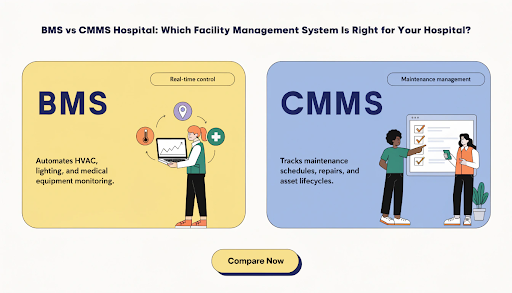
A building management system is an intelligent platform that monitors and controls a hospital’s building infrastructure in real time. Rather than focusing on maintenance schedules, a BMS continuously supervises environmental and utility systems to ensure they operate efficiently.
In hospitals, a BMS typically controls:
- Heating, ventilation and air conditioning (HVAC)
- Air pressure in operating theatres and isolation rooms
- Lighting systems
- Energy consumption
- Water supply systems
- Electrical distribution
- Fire alarms and life safety systems
- Backup generators
- Chillers and boilers
The importance of building management systems healthcare has grown significantly as hospitals seek greater energy efficiency while maintaining strict environmental standards required for patient safety.
For example, an operating theatre requires precise temperature, humidity and air pressure. A BMS continuously monitors these conditions and automatically adjusts equipment whenever readings move outside acceptable limits. This automation reduces manual intervention while ensuring compliance with healthcare regulations.
Benefits of a BMS for Hospitals
Hospitals operate around the clock, making continuous monitoring essential. A building management system offers several advantages.
Improved Energy Efficiency
Hospitals consume enormous amounts of electricity. HVAC systems alone account for a significant share of energy costs. A BMS analyses real-time usage and adjusts equipment automatically, reducing unnecessary consumption without compromising patient care.
Better Environmental Control
Patient recovery depends on maintaining stable indoor conditions. Operating theatres, laboratories, pharmacies and intensive care units all require specific environmental settings.
A BMS ensures these conditions remain within predefined parameters throughout the day.
Faster Fault Detection
Rather than waiting for equipment failure, a BMS immediately alerts facility teams when abnormalities occur.
For instance, if a chiller begins operating above normal temperature, the system generates an alert before complete failure occurs, allowing technicians to intervene quickly.
Reduced Operational Costs
Automated control prevents equipment from running unnecessarily, extending asset life while reducing electricity bills.
Enhanced Sustainability
Many hospitals are working towards sustainability and carbon reduction targets. A BMS provides valuable insights into energy consumption, helping organisations identify opportunities to reduce emissions.
What Is a Computerised Maintenance Management System (CMMS)?
While a building management system focuses on operating building infrastructure, a computerised maintenance management system manages maintenance activities.
A CMMS stores detailed information about every asset in the hospital and helps maintenance teams organise inspections, preventive maintenance, repairs and work orders.
Instead of monitoring temperature or energy consumption, a CMMS answers questions such as the following:
- Which assets require servicing this week?
- When was the MRI chiller last inspected?
- Which technician completed the repair?
- What spare parts were used?
- How much has each asset cost to maintain?
- Which equipment experiences repeated failures?
A CMMS becomes the central maintenance database for the entire healthcare facility.
Benefits of CMMS in Hospitals
Hospitals depend on reliable equipment to deliver patient care. A CMMS helps ensure every asset receives maintenance before problems affect operations.
Preventive Maintenance
Routine maintenance is far more cost-effective than emergency repairs.
A CMMS automatically schedules inspections based on time, operating hours or manufacturer recommendations.
This reduces unexpected failures while extending equipment life.
Improved Compliance
Healthcare organisations must maintain detailed maintenance records for inspections and accreditation.
A CMMS stores service history, inspection reports, certificates and technician notes in one place, making audits far easier.
Better Asset Visibility
Facility managers gain complete visibility into every building asset.
Instead of relying on spreadsheets or paper records, they can instantly access maintenance history, warranties, manuals and repair costs.
Work Order Management
Maintenance requests are assigned digitally, allowing technicians to receive tasks immediately.
Managers can monitor progress, prioritise urgent repairs and track completion times.
Inventory Management
Hospitals maintain thousands of spare parts.
A CMMS tracks inventory levels and automatically identifies when replacement components need ordering, reducing delays caused by unavailable parts.
BMS vs CMMS Hospital: Understanding the Key Differences
Although both systems support facility management, their primary objectives differ considerably.
A building management system is designed to operate building systems automatically and monitor real-time performance.
A CMMS is designed to organise maintenance activities and improve long-term asset reliability.
Think of it this way:
A BMS tells you what is happening right now.
A CMMS tells you what maintenance should happen next.
For example, imagine an air handling unit serving an operating theatre.
The BMS detects abnormal airflow and rising motor temperature.
Meanwhile, the CMMS automatically creates a maintenance work order, assigns it to a technician, records the repair and schedules future inspections.
Together, both systems create a highly efficient maintenance ecosystem.
Comparing BMS and CMMS for Healthcare Facilities
When evaluating BMS vs CMMS hospitals, it is important to compare their capabilities across different operational requirements.
A building management system focuses primarily on monitoring live building performance. It excels at controlling HVAC, lighting, energy systems and environmental conditions essential for patient care. Its greatest strength lies in automation and real-time response.
A computerised maintenance management system, on the other hand, focuses on maintenance planning, asset management and documentation. It helps hospitals organise preventive maintenance programmes, manage technician workloads, track repair histories and improve equipment reliability over time.
In practical terms, a BMS keeps the hospital running efficiently from moment to moment, while a CMMS ensures that every critical asset continues performing reliably throughout its lifecycle.
Neither system replaces the other because they solve different operational challenges.
When Is a BMS the Better Choice?
Hospitals that are investing in smart infrastructure often prioritise a building management system.
A BMS is particularly valuable when the organisation wants to improve energy efficiency, automate building operations and gain continuous visibility into environmental performance.
It is especially suitable for:
- Large hospitals with complex HVAC systems
- Multi-building healthcare campuses
- Facilities aiming to reduce energy costs
- Hospitals pursuing sustainability initiatives
- Organisations implementing smart building technologies
Because environmental control directly affects patient safety, many healthcare organisations consider a BMS an essential operational platform rather than an optional investment.
When Is a CMMS the Better Choice?
While a building management system excels at monitoring building performance, a computerised maintenance management system becomes indispensable when the priority is structured maintenance management. Hospitals with a growing asset portfolio often find that manual spreadsheets and paper-based maintenance records are no longer sufficient.
A CMMS is particularly valuable for organisations that need to improve preventive maintenance, reduce equipment downtime, maintain compliance records and manage maintenance budgets more effectively.
Hospitals should consider implementing a CMMS if they want to:
- Reduce emergency maintenance through scheduled servicing.
- Track the complete maintenance history of every asset.
- Improve technician productivity with digital work orders.
- Manage spare parts inventory efficiently.
- Simplify accreditation and regulatory audits.
- Analyse maintenance costs and asset performance over time.
For example, if an emergency generator requires quarterly servicing, the CMMS automatically schedules the task, notifies the assigned technician, records the completed work and stores all documentation for future audits. This structured approach reduces the risk of missed maintenance activities that could compromise critical hospital operations.
Can Hospitals Benefit from Both Systems?
The answer is yes. In fact, many modern healthcare organisations achieve the greatest operational efficiency by integrating both systems.
Rather than viewing BMS vs CMMS hospitals as an either-or decision, hospitals increasingly recognise that the two platforms complement each other.
A building management system continuously monitors building performance and identifies abnormal operating conditions. When an issue is detected, the information can be transferred directly into the CMMS, where a maintenance work order is automatically generated.
This integration creates a seamless workflow:
- The BMS detects an abnormal condition.
- An alert is generated instantly.
- The CMMS creates a maintenance request.
- A technician is assigned automatically.
- Repairs are completed and documented.
- Historical maintenance records are updated for future analysis.
This approach reduces response times, eliminates manual reporting and ensures that operational issues are resolved before they escalate into costly failures.
How Integration Improves Hospital Operations
Integrating a Building Management System with a CMMS provides benefits that neither platform can achieve independently.
One of the biggest advantages is predictive maintenance. Instead of relying solely on fixed maintenance schedules, hospitals can use real-time operational data from the BMS to determine when equipment genuinely requires servicing.
For example, if an air handling unit begins consuming more energy than normal or operating outside its expected temperature range, the BMS identifies the anomaly immediately. Rather than waiting until the next scheduled inspection, the CMMS can automatically generate a maintenance work order, allowing technicians to investigate before a breakdown occurs.
This proactive approach helps hospitals:
- Reduce unplanned downtime.
- Extend equipment lifespan.
- Improve patient safety.
- Lower maintenance costs.
- Optimise technician workloads.
- Increase equipment reliability.
As hospitals continue investing in digital transformation, this integration is becoming a standard feature of modern facility management strategies.
Factors to Consider Before Choosing a System
Every hospital has unique operational priorities, making it essential to evaluate organisational requirements before selecting a facility management solution.
When comparing BMS vs CMMS hospitals, decision-makers should consider several key factors.
Hospital Size
Smaller hospitals with fewer assets may initially benefit more from a CMMS, while larger healthcare campuses often require both systems to manage complex infrastructure.
Existing Infrastructure
Hospitals with advanced HVAC, energy management and automation systems can maximise the value of a building management system.
Conversely, organisations relying on manual maintenance processes may achieve faster returns by implementing a CMMS first.
Budget
A BMS generally requires greater investment because it integrates directly with building control systems and sensors. A CMMS is typically more affordable and can often be implemented more quickly.
However, long-term return on investment should be evaluated rather than focusing solely on implementation costs.
Regulatory Compliance
Healthcare facilities operate under strict regulations. A CMMS simplifies compliance by maintaining detailed maintenance records, inspection reports and equipment histories.
Meanwhile, a BMS helps maintain environmental conditions required for patient safety and infection prevention.
Future Expansion
Hospitals planning new buildings, campus expansions or smart hospital initiatives should choose solutions capable of scaling alongside future infrastructure developments.
Future Trends in Hospital Facility Management
Digital healthcare infrastructure continues to evolve rapidly, and facility management systems are becoming more intelligent each year.
Artificial intelligence is beginning to enhance both BMS and CMMS platforms by identifying operational patterns and recommending maintenance activities before failures occur.
Internet of Things (IoT) sensors are enabling hospitals to collect real-time performance data from thousands of connected assets, improving operational visibility and supporting predictive maintenance.
Cloud-based platforms are making facility management systems more accessible, allowing authorised staff to monitor buildings, review maintenance activities and generate reports from virtually any location.
Data analytics is also transforming decision-making. Instead of reacting to equipment failures, facility managers can use historical performance data to optimise maintenance schedules, improve energy efficiency and make informed capital investment decisions.
As healthcare organisations continue their digital transformation journeys, the integration of intelligent building technologies with maintenance management platforms will become increasingly important.
Which System Is Right for Your Hospital?
Choosing between a building management system and a computerised maintenance management system ultimately depends on your hospital’s objectives.
If your primary goal is monitoring building performance, reducing energy consumption and maintaining optimal environmental conditions, a building management system offers significant operational advantages.
If your organisation is focused on improving maintenance efficiency, extending asset lifespan, simplifying compliance and reducing equipment downtime, a computerised maintenance management system is likely the better starting point.
However, for many modern healthcare facilities, the most effective solution is not choosing one over the other—it is combining both. A BMS provides the intelligence needed to monitor building performance in real time, while a CMMS ensures that maintenance activities are planned, executed and documented efficiently.
Together, these systems create a proactive, data-driven approach to hospital facility management that supports operational excellence, regulatory compliance and, most importantly, better patient care.
Conclusion
The discussion around BMS vs CMMS hospital is no longer about determining which technology is superior. Instead, it is about understanding how each system contributes to a safer, more efficient and more resilient healthcare environment.
As hospitals face increasing pressure to improve operational performance, reduce costs and meet sustainability goals, investing in the right facility management technology has become a strategic necessity.
By evaluating your organisation’s operational priorities, asset complexity and long-term digital transformation goals, you can determine whether a building management system, a computerised maintenance management system or an integrated approach will deliver the greatest value.
Healthcare facilities that embrace intelligent facility management today will be better positioned to deliver reliable, efficient and patient-centred care in the years ahead.
Register
Showcase your facility management solutions to senior hospital decision-makers at the Smart Healthcare Facilities Convention 2026.
👉 Register :https://bmaconventions.com/smart-healthcare-facilities-convention-2026-sep/
Whether your organisation specialises in building automation, CMMS software, energy management, predictive maintenance, IoT solutions or smart healthcare technologies, this is an opportunity to connect with healthcare leaders seeking innovative facility management solutions.