A Joint Commission inspection is more than a routine assessment of hospital policies, documentation, and facility conditions. It is an opportunity to demonstrate that a healthcare organization has effective systems in place to protect patients, support staff, and deliver safe, high-quality care. For hospital facility managers, preparing for an inspection requires coordination across engineering, maintenance, infection prevention, environmental services, clinical teams, leadership, and compliance functions.
In 2026, hospitals also need to understand several important changes in the Joint Commission framework. The National Performance Goals (NPGs) became effective for hospitals on January 1, 2026, replacing the former National Patient Safety Goals chapter. The Joint Commission also introduced the Survey Process Guide (SPG), which replaced the Survey Activity Guide for hospitals and critical access hospitals. The NPG framework brings existing high-priority requirements together into 14 measurable topics, while the SPG provides a more unified approach to standards, regulatory requirements, and survey activities. (Joint Commission International)
For hospitals preparing for a Joint Commission inspection in 2026, the goal should not be to create a temporary “inspection-ready” environment. Instead, organizations should build a culture where compliance, safety, and facility readiness are maintained every day.
What Is a Joint Commission Inspection?
A Joint Commission inspection, formally part of the accreditation survey process, evaluates whether a hospital complies with applicable Joint Commission standards and relevant regulatory requirements. During the on-site survey, surveyors assess the organization’s performance and look for vulnerabilities that could affect patient safety and quality of care. The process can involve document reviews, staff discussions, observations, facility tours, and tracer activities. (Joint Commission International)
The Joint Commission uses tracer methodology to follow a patient’s experience through different parts of the care-delivery process. This means surveyors may examine how policies work in actual practice rather than simply confirming that a written procedure exists. A hospital may therefore have a comprehensive policy but still face a compliance concern if staff do not consistently follow it.
For facility teams, this makes operational readiness particularly important. A hospital’s physical environment, emergency systems, maintenance records, infection prevention practices, and life-safety measures can all contribute to the overall picture of compliance.
Understand the 2026 Joint Commission Changes
One of the most important steps in preparing for a Joint Commission inspection hospital leaders should take in 2026 is reviewing the updated framework.
The National Performance Goals became effective on January 1, 2026. According to the Joint Commission, the NPG chapter contains 14 high-priority, measurable topics focused on patient safety and quality. It replaces the former National Patient Safety Goals chapter for hospitals and critical access hospitals. The Joint Commission states that the NPGs incorporate existing requirements rather than introducing an entirely new set of requirements. (Joint Commission International)
The goals cover areas including right patient/right care, safety culture, workplace violence prevention, emergency readiness, safe care, infection prevention and control, pain management, and informed care. Facility managers should understand how these priorities connect with the physical environment and operational systems of the hospital.
The Survey Process Guide is another important 2026 development. Effective January 1, 2026, it replaced the Survey Activity Guide for hospital and critical access hospital accreditation programs. The SPG brings standards, regulatory requirements, and survey procedures together to help organizations understand what surveyors will evaluate. (Joint Commission International)
Hospitals should therefore avoid relying exclusively on older preparation checklists. Compliance teams should review the current standards, SPG, and relevant Joint Commission updates applicable to their organization.
Start With a Comprehensive Facility Gap Assessment
Before preparing for the inspection, conduct a thorough assessment of the hospital’s current condition.
A gap assessment should compare existing facility practices against current Joint Commission requirements, applicable CMS requirements, internal policies, and relevant safety standards. The objective is to identify weaknesses early enough to correct them before the survey.
Facility managers should review areas such as preventive maintenance, emergency power, fire and life safety systems, medical gas systems, HVAC performance, water management, infection control, electrical systems, equipment maintenance, and environmental conditions.
The assessment should go beyond checking whether equipment exists. Ask whether it is maintained, tested, documented, and available when needed.
For example, an emergency generator may be fully operational, but incomplete testing records can create a compliance concern. Similarly, a fire safety system may function correctly while inspection tags, maintenance documentation, or corrective-action records are incomplete.
The same principle applies throughout the facility: compliance requires both operational performance and reliable evidence.
Review Preventive Maintenance and Equipment Records
Preventive maintenance is one of the most important areas for facility teams preparing for an inspection.
Create a complete inventory of critical infrastructure and equipment. This can include generators, HVAC equipment, fire alarms, sprinkler systems, emergency lighting, medical gas systems, elevators, boilers, electrical distribution systems and other systems essential to patient care.systems,
Review whether each asset has:
- A defined preventive maintenance schedule
- Current inspection and testing records
- Documented corrective actions
- Clear ownership and responsibility
- Evidence of completed work
- Escalation procedures for overdue maintenance
- Appropriate vendor documentation where applicable
A Computerized Maintenance Management System (CMMS) can care facilities teams track work orders, preventive maintenance schedules, equipment history, and overdue tasks. However, technology alone does not create compliance. The hospital must also have processes that ensure maintenance issues are identified, prioritized, and resolved.
Before a Joint Commission inspection hospital teams should review overdue work orders and determine whether any unresolved issues could affect patient safety, regulatory compliance, or critical operations.
Inspect Life Safety and Emergency Preparedness Systems
Life safety is a major part of hospital facility readiness. A hospital must be prepared not only for normal operations but also for emergencies that could threaten patients, staff or infrastructure.
Facility teams should systematically review fire protection systems, fire doors, smoke barriers, emergency exits, evacuation routes, emergency lighting, fire extinguishers and related systems. Storage practices should also be examined to ensure equipment, supplies and other materials are not obstructing corridors, exits or safety equipment.
Emergency preparedness should extend beyond fire safety.
Hospitals should evaluate how they would respond to power failures, severe weather, utility interruptions, infrastructure failures, cybersecurity incidents and other emergencies that could disrupt patient care. Emergency plans should be accessible, understood by relevant staff and supported by appropriate drills and documentation.
The Joint Commission’s 2026 National Performance Goals include emergency readiness as one of its high-priority areas, making this an especially relevant part of hospital compliance 2026 planning. (Joint Commission International)
Strengthen Infection Prevention and Environmental Hygiene
A clean and controlled healthcare environment is essential to patient safety.
Facility and environmental services teams should work closely with infection prevention specialists to evaluate cleaning procedures, ventilation, water management, waste handling, isolation areas and environmental controls.
Look for practical issues that may be visible during a facility walk-through. These can include damaged surfaces, water leaks, dust accumulation, poor storage practices, clutter, improperly maintained equipment or areas that are difficult to clean.
HVAC systems deserve particular attention because ventilation can influence indoor air quality and infection prevention. Maintenance records should demonstrate that critical systems are being inspected and maintained according to established schedules.
Water management is another important area. Hospitals should have appropriate processes for identifying and managing water-related risks and documenting relevant monitoring and corrective actions.
The 2026 NPG framework includes preventing and controlling infection as a dedicated high-priority goal, reinforcing the importance of collaboration between facility management and clinical safety teams. (Joint Commission International)
Make Documentation Easy to Find
One of the biggest mistakes hospitals can make before an inspection is treating documentation as an administrative task that can be completed at the last minute.
Documentation should be maintained continuously.
Surveyors may want evidence that maintenance, inspections, training, testing, corrective actions and quality improvement activities have actually occurred. A hospital should therefore be able to quickly retrieve records supporting its compliance.
Instead of keeping information scattered across spreadsheets, paper folders, email chains and individual computers, hospitals should consider creating a structured digital compliance repository.
Documentation should be organized logically and include relevant evidence for:
Preventive maintenance, fire and life safety inspections, emergency drills, equipment testing, environmental rounds, infection prevention activities, corrective actions, staff training and competency, risk assessments and performance improvement initiatives.
The Joint Commission’s public standards platform provides access to current effective standards, while accredited organizations have access to an edition for more comprehensive standards information. (Joint Commission International)
The objective is not simply to have more documents. It is to make sure the right evidence is accurate, current and readily accessible.
Conduct Mock Tracers Before the Survey
Mock tracers can help hospitals identify problems before surveyors do.
Instead of conducting only a checklist-based inspection, simulate the way a Joint Commission surveyor may move through the hospital. Follow a patient journey from admission through treatment, diagnostics, medication, procedures, discharge or another relevant pathway.
At each stage, evaluate the physical environment, equipment, documentation, staff practices and communication.
Facility managers can also perform focused tracers on high-risk areas such as operating rooms, intensive care units, emergency departments, imaging areas, medication storage spaces, isolation rooms and utility areas.
The value of a mock tracer is that it tests whether policies work in real-world situations.
If staff cannot explain a procedure, if maintenance records are difficult to locate or if a piece of equipment has an unresolved issue, the mock tracer gives the hospital an opportunity to correct the weakness.
Train Staff to Demonstrate Compliance
Inspection readiness is not only the responsibility of the quality department or facility manager.
Employees across the organisation should understand the policies and procedures that apply to their roles. Staff may be asked questions about emergency procedures, infection prevention, patient safety, reporting processes, workplace safety or their responsibilities during an emergency.
Training should therefore be practical rather than purely theoretical.
Instead of asking staff to memorise policy language, hospitals should help them understand what they are expected to do. Staff should know how to report a safety concern, where emergency equipment is located, what to do during a utility failure and how to escalate a facility problem.
Facility managers should also train maintenance and engineering teams on how to respond during a survey. Staff should answer questions honestly and clearly rather than attempting to guess what a surveyor wants to hear.
Create a Cross-Functional Inspection Readiness Team
A successful Joint Commission inspection hospital strategy requires collaboration.
Create a cross-functional readiness team that includes representatives from facilities, engineering, clinical operations, infection prevention, environmental services, quality, safety, emergency management, human resources and leadership.
Assign clear ownership for identified gaps. Every issue should have a responsible person, target completion date and verification process.
Regular meetings can then focus on progress rather than general discussion.
Leadership involvement is particularly important. Facility improvements sometimes require budget approval, contractor support, equipment replacement or operational changes. When leadership understands the compliance risk and patient safety implications, corrective actions can move faster.
Focus on Continuous Hospital Compliance in 2026
Hospitals should avoid the traditional approach of preparing intensively only when an inspection is approaching.
A stronger strategy is continuous readiness.
Monthly facility rounds, quarterly compliance reviews, preventive maintenance monitoring, staff training, emergency drills and regular mock tracers can help maintain readiness throughout the year.
Technology can strengthen this approach. Modern facility management platforms can provide dashboards for preventive maintenance, work orders, equipment performance, energy use and compliance tasks. Digital records also make it easier to identify trends and demonstrate that corrective actions are being managed systematically.
The Joint Commission’s accreditation process is designed around quality and safety rather than simply passing an inspection. Its standards are intended to help organizations identify vulnerabilities in the patient care experience and develop strategies to address them. (Joint Commission International)
That means the best inspection strategy is one that improves the hospital even when surveyors are not present.
Prepare for the Surveyor’s Questions
In the days leading up to the inspection, hospital leaders should ensure that key teams know what to expect.
Staff should be prepared to demonstrate normal processes rather than perform an artificial version of them. Surveyors may observe how work is performed, ask employees questions and follow information across different departments.
Facility managers should be ready to explain how preventive maintenance is managed, how critical systems are monitored, how emergency failures are addressed and how environmental risks are identified.
They should also be able to demonstrate how identified deficiencies are tracked through corrective action.
Most importantly, the organization should avoid creating a culture where staff feel pressured to hide problems. A mature safety culture encourages employees to identify risks and report them so that the organization can address them.
Use 2026 as an Opportunity to Modernize Facility Management
Preparing for a Joint Commission inspection can also reveal opportunities to modernize hospital infrastructure.
Hospitals are increasingly dealing with complex infrastructure, rising energy costs, ageing equipment, cybersecurity concerns, and growing expectations for operational resilience. Facility managers need visibility into their buildings and systems to make better decisions.
Smart sensors, building management systems, CMMS platforms, predictive maintenance tools, digital dashboards and data analytics can help facilities teams move from reactive maintenance towards proactive management.
However, technology should support not replace sound processes.
The strongest hospital compliance 2026 strategy combines updated standards, trained people, reliable documentation, preventive maintenance, risk-based decision-making and technology-enabled visibility.
Final Thoughts
Preparing for a Joint Commission inspection hospital leaders can be proud of requires more than cleaning the facility and organizing paperwork before surveyors arrive. It requires a continuous commitment to safety, quality, compliance and operational reliability.
The 2026 transition to National Performance Goals and the new Survey Process Guide makes it particularly important for hospitals to review their current preparation strategies and make sure they are aligned with the latest applicable requirements. (Joint Commission International)
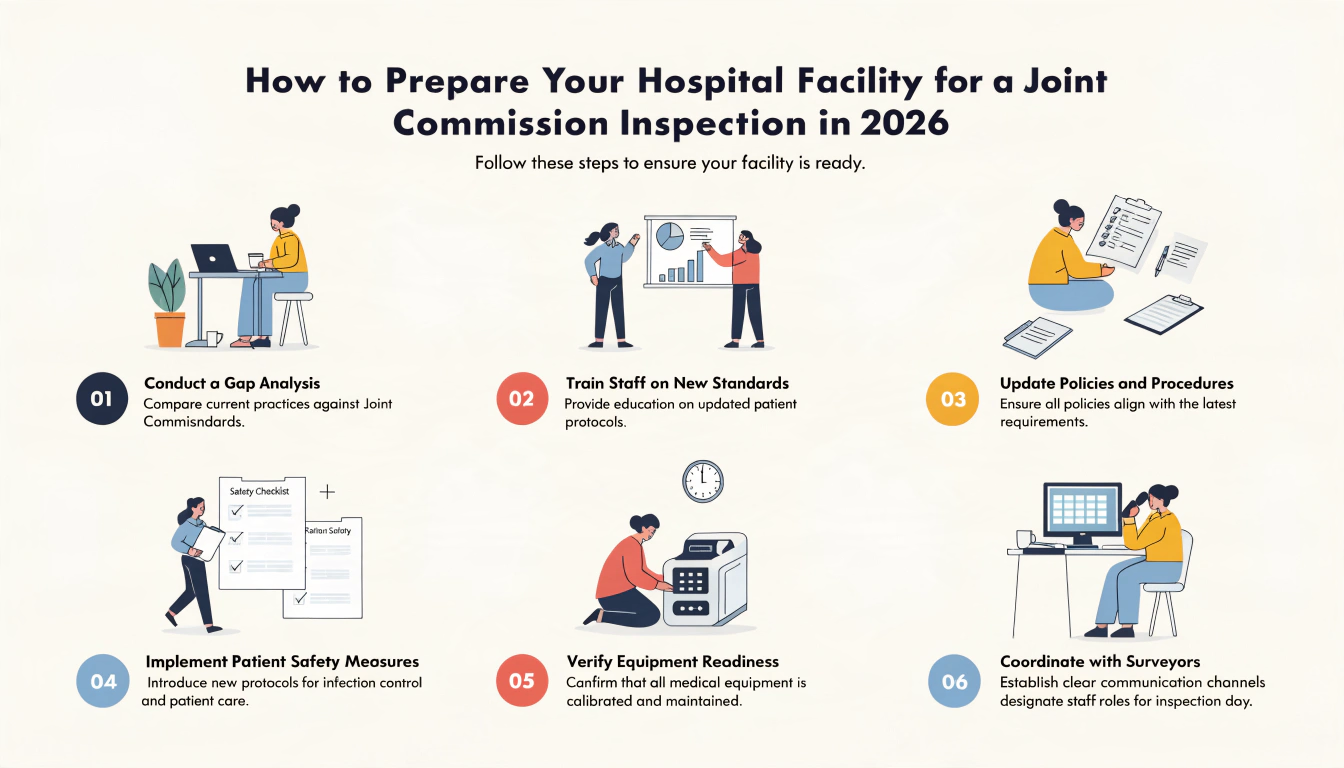
Facility managers should begin with a comprehensive gap assessment, strengthen preventive maintenance, verify life-safety systems, improve infection prevention practices, organize documentation, conduct mock tracers and train employees. Most importantly, every department should understand that inspection readiness is part of everyday patient safety not a temporary project.
Hospitals that build continuous compliance into their operational culture are better positioned to respond confidently when surveyors arrive. They also create safer, more resilient and more efficient environments for patients, clinicians and staff.
Register for Healthcare Convention 2026
Healthcare facility management is evolving rapidly, with smart infrastructure, digital monitoring, operational resilience, sustainability and compliance becoming increasingly interconnected. Industry events provide an opportunity for healthcare leaders and facility professionals to explore new approaches, technologies and strategies for modern hospital environments.
Register for Healthcare Convention 2026 to connect with industry professionals and explore the latest ideas shaping smart healthcare facilities.