Data centers are among the most energy-intensive facilities in modern business infrastructure. As workloads increase, AI applications expand, and organizations demand greater availability, operators face growing pressure to control energy consumption without compromising reliability or performance. A well-executed data center energy audit provides a structured way to understand where energy is being used, identify inefficiencies, and prioritize improvements that can reduce operational costs.
An energy audit is more than simply reviewing monthly electricity bills. It involves examining the entire facility, including IT equipment, cooling systems, power distribution, lighting, backup infrastructure, and building systems. When performed correctly, it can help operators establish a measurable baseline, uncover energy losses, and create an actionable improvement plan.
This guide explains how data center operators can conduct an energy audit step by step and turn the results into long-term efficiency gains.
What Is a Data Center Energy Audit?
A data center energy audit is a systematic assessment of how electricity enters, moves through, and is consumed within a data center. The objective is to understand energy usage patterns and determine whether the facility is operating as efficiently as possible.
The assessment typically covers the power chain from utility supply and electrical distribution to servers, storage systems, networking equipment, cooling infrastructure, lighting, and other facility loads.
A comprehensive audit can also reveal whether energy is being used effectively relative to the computing workload being delivered. This distinction is important because reducing electricity consumption alone is not always the goal. Operators need to improve efficiency while maintaining uptime, redundancy, security, and required environmental conditions.
The audit therefore becomes an important component of a broader data center efficiency assessment, helping facility teams balance energy performance with operational requirements.
Why Should Data Center Operators Conduct an Energy Audit?
Energy is a major operating expense for data centers, making efficiency improvements financially significant. Even small reductions in unnecessary consumption can create substantial savings when multiplied across a continuously operating facility.
However, cost reduction is only one reason to conduct an audit. Energy efficiency can also support sustainability objectives, improve infrastructure planning, and help operators prepare for growing power demands.
An audit can help identify overloaded or underutilized equipment, inefficient cooling practices, poor airflow management, unnecessary lighting, power conversion losses, and other sources of waste.
It can also provide data that supports future decisions. For example, before expanding a facility or deploying high-density computing, operators can use audit findings to determine whether existing power and cooling systems can accommodate additional loads.
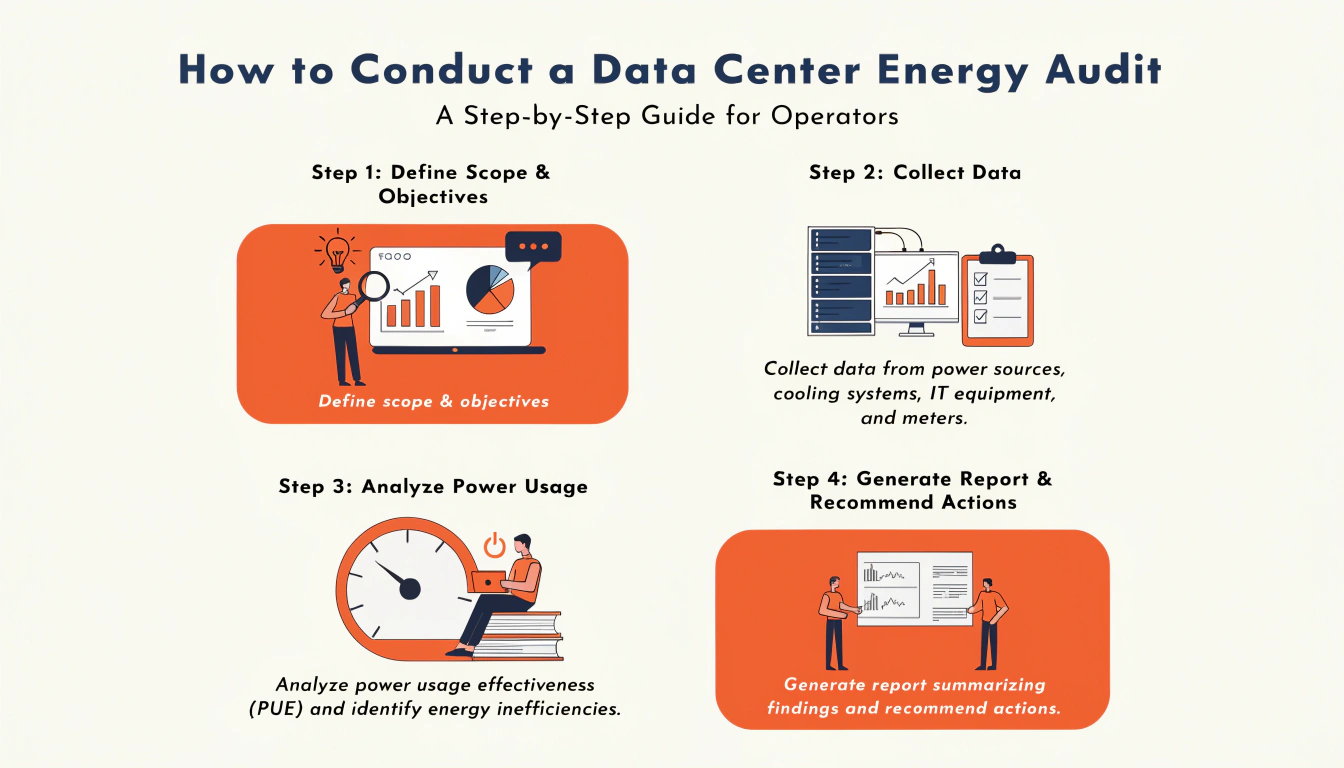
Step 1: Define the Scope and Objectives
The first step is to establish exactly what the audit should accomplish.
Operators should determine whether the assessment will cover the entire data center or focus on a specific area, such as cooling, power distribution, or IT infrastructure. The scope should also define the time period being analyzed and the metrics that will be used to evaluate performance.
Typical objectives may include reducing electricity costs, improving power usage effectiveness, identifying inefficient equipment, establishing a baseline for future improvements, or preparing for higher-density workloads.
It is also useful to identify operational constraints at this stage. A recommendation that affects redundancy or uptime may require a different implementation strategy than a simple facility-level improvement.
Step 2: Gather Historical Energy Data
Before inspecting equipment, collect as much historical information as possible.
Start with utility bills and electricity consumption records. Ideally, operators should review at least 12 months of data to account for seasonal changes in cooling demand and other variables.
Additional information can include:
- Utility demand charges and peak-load data
- Generator fuel consumption
- UPS efficiency records
- Power distribution measurements
- Cooling system operating data
- IT equipment utilization
- Temperature and humidity trends
- Maintenance records
- Previous energy assessments
- Building management system data
The purpose is to establish a baseline against which future improvements can be measured.
Operators should avoid relying exclusively on annual electricity consumption. Monthly or even hourly data can reveal patterns that annual totals hide, such as overnight loads, seasonal cooling increases, or unexpected peak-demand events.
Step 3: Map the Data Center’s Energy Flow
The next step is to understand how energy travels through the facility.
Electricity typically moves from the utility connection through switchgear, transformers, UPS systems, power distribution units, and other electrical infrastructure before reaching IT equipment. Energy is also consumed by cooling systems, lighting, pumps, fans, security equipment, and other facility loads.
Creating an energy-flow diagram can make this process easier to understand.
The diagram should identify major energy-consuming systems and, wherever possible, indicate their approximate share of total consumption. Submetering data can make this analysis significantly more accurate.
Mapping energy flows allows operators to see where losses occur and which systems deserve closer investigation.
Step 4: Measure IT Equipment Energy Consumption
IT equipment is at the heart of the data center, but not all computing resources consume energy equally.
During the audit, operators should evaluate servers, storage equipment, networking hardware, and other IT systems. Measurements should ideally be compared against workload or utilization data.
One common source of inefficiency is underutilized infrastructure. Servers operating at low utilization levels may continue consuming significant amounts of electricity even though they are delivering limited computing capacity.
Operators should investigate opportunities such as server consolidation, virtualization, workload optimization, and retirement of obsolete equipment where appropriate.
The goal is not simply to reduce the number of servers. It is to understand the relationship between energy consumption and useful computing output.
Step 5: Assess Cooling System Performance
Cooling can represent a substantial portion of total data center energy consumption, making it one of the most important areas of an energy audit.
Evaluate chillers, computer room air conditioning units, computer room air handlers, cooling towers, pumps, fans, and other cooling components. Review operating temperatures, setpoints, airflow patterns, equipment loading, and control strategies.
Operators should also examine whether cooling capacity matches actual IT requirements. Running cooling equipment unnecessarily or maintaining overly conservative temperature settings can increase energy consumption.
Airflow management deserves particular attention. Hot and cold aisle arrangements, containment systems, blanking panels, cable openings, and rack placement can significantly influence cooling efficiency.
A detailed inspection may reveal that cooling systems are compensating for avoidable airflow problems rather than actual heat loads.
Step 6: Inspect Power Distribution and Electrical Infrastructure
Energy losses can occur at multiple points between the utility connection and IT equipment.
The audit should examine transformers, switchgear, UPS systems, PDUs, power supplies, and distribution equipment. Operators should review efficiency ratings, loading levels, operating conditions, and maintenance records.
UPS systems deserve particular attention because their efficiency can vary depending on load. Equipment operating significantly below its optimal range may introduce avoidable losses.
Operators should also examine power quality and harmonics where relevant. Electrical problems may increase losses, create reliability concerns, or affect equipment performance.
Any potential changes to electrical infrastructure must be evaluated carefully against redundancy requirements and the facility’s resiliency strategy.
Step 7: Evaluate Lighting and Other Facility Loads
Although IT equipment and cooling systems generally dominate data center energy consumption, smaller loads can still contribute to unnecessary consumption.
Inspect lighting systems, office areas, security systems, ventilation, pumps, elevators, and other auxiliary equipment.
Lighting controls, occupancy sensors, LED upgrades, and automated scheduling can reduce energy consumption in spaces that do not require continuous illumination.
Operators should also examine whether non-IT equipment is operating continuously when demand is intermittent. Small savings across multiple auxiliary systems can become meaningful when sustained throughout the year.
Step 8: Analyze Energy Efficiency Metrics
After collecting the data, operators need to convert measurements into meaningful performance indicators.
One widely used metric is Power Usage Effectiveness, or PUE. It compares total facility energy consumption with the energy consumed by IT equipment.
A lower PUE generally indicates that a larger proportion of facility energy is being directed toward useful IT workloads rather than supporting infrastructure.
However, PUE should not be considered the only metric in a data center efficiency assessment. Operators should also consider IT utilization, cooling efficiency, energy consumption per workload, peak demand, renewable energy usage, and other metrics relevant to the facility’s goals.
The most useful metrics are those that help operators understand not only how much energy the facility consumes but also why it consumes it.
Step 9: Identify Energy-Saving Opportunities
Once the measurements and performance indicators are available, categorize potential improvements according to their impact, cost, and implementation complexity.
Some improvements may require minimal investment. Examples include adjusting cooling setpoints, correcting airflow issues, improving temperature controls, shutting down unnecessary equipment, or optimizing operating schedules.
Other initiatives may involve capital expenditure, such as replacing inefficient cooling equipment, upgrading UPS systems, installing advanced controls, or redesigning power distribution.
It is useful to estimate the potential energy savings and financial return associated with each recommendation.
For example, an opportunity that requires little investment and produces measurable savings should generally receive a higher priority than an expensive project with uncertain benefits.
Step 10: Create an Action Plan
The final audit report should translate findings into a practical action plan.
Rather than presenting a long list of technical observations, operators should rank recommendations according to priority. Each recommendation should ideally include the problem identified, proposed solution, expected benefit, estimated investment, operational considerations, and measurement method.
The action plan can be divided into short-, medium-, and long-term initiatives.
Short-term improvements may include operational adjustments and maintenance corrections. Medium-term projects might involve equipment upgrades or control-system improvements. Long-term initiatives could include infrastructure redesign, renewable energy integration, or major cooling and electrical modernization.
This approach makes it easier for management teams to approve projects and track progress.
Step 11: Implement Improvements Without Compromising Reliability
Energy efficiency projects in data centers must be implemented carefully.
The facility cannot sacrifice availability simply to reduce electricity consumption. Any change involving power, cooling, controls, or IT infrastructure should be evaluated through appropriate risk-management and change-management procedures.
Operators should test improvements where possible and monitor the impact after implementation.
For example, if a cooling setpoint is changed, teams should monitor rack temperatures, humidity, equipment alarms, and other relevant indicators. Similarly, if a UPS operating strategy is modified, operators should confirm that redundancy and backup requirements remain intact.
Efficiency and resilience should therefore be treated as complementary goals rather than competing priorities.
Step 12: Continuously Monitor Performance
A data center energy audit should not be treated as a one-time activity.
Data center workloads change continuously. New servers may be installed, equipment may be retired, AI workloads may increase power density, and cooling requirements can change as infrastructure evolves.
Continuous monitoring allows operators to identify performance changes early.
Modern data centers can use intelligent monitoring platforms, smart meters, building management systems, data center infrastructure management tools, and analytics platforms to track energy performance in near real time.
Establishing dashboards with key performance indicators can help facility teams quickly identify unusual energy consumption and determine whether efficiency initiatives are delivering expected results.
Common Challenges During a Data Center Energy Audit
Conducting an energy audit can be challenging when accurate submetering is unavailable or historical data is incomplete. Some facilities may have multiple tenants, legacy infrastructure, or complex power distribution systems that make energy attribution difficult.
Another challenge is separating IT energy consumption from facility energy consumption.
Operators may also encounter conflicting objectives. For example, an efficiency improvement could potentially affect redundancy, environmental conditions, or maintenance procedures.
For these reasons, energy audits should involve multiple stakeholders, including data center operations, facilities management, IT teams, engineering personnel, finance teams, and sustainability professionals when appropriate.
Cross-functional collaboration helps ensure that recommendations are technically sound and commercially practical.
Building a Long-Term Data Center Energy Strategy
The findings from an energy audit can serve as the foundation for a broader energy-management strategy.
Rather than pursuing isolated upgrades, operators can use audit data to establish long-term efficiency targets and continuously measure progress.
This is particularly important as data centers accommodate more AI and high-performance computing workloads. Higher rack densities can significantly increase electricity and cooling requirements, making efficient infrastructure increasingly important.
Operators should therefore revisit energy performance whenever there are significant changes to IT workloads, facility capacity, cooling infrastructure, or power systems.
A recurring data center energy audit can help organizations identify emerging inefficiencies before they become major operational or financial problems.
Conclusion
Conducting a data center energy audit provides operators with a structured way to understand energy consumption, uncover inefficiencies, and make informed infrastructure decisions. From collecting historical utility data and mapping energy flows to analyzing cooling performance and IT utilization, each stage contributes to a more complete picture of facility efficiency.
The most effective audits go beyond identifying energy consumption. They connect energy performance with workload requirements, operational reliability, financial objectives, and future infrastructure needs.
As data centers become more power-intensive and organizations place greater emphasis on efficiency and sustainability, regular energy assessments will become increasingly important. By combining accurate measurement, intelligent analysis, targeted improvements, and continuous monitoring, operators can build facilities that are more efficient without compromising performance or resilience.
Enquire About Sponsorship
Want to connect with data center professionals, technology providers, facility operators, and industry decision-makers? Explore sponsorship opportunities at the Data Center Facilities Convention and position your organization in front of an audience focused on the future of data center infrastructure, energy efficiency, and facility management.
Enquire about sponsorship:
Data Center Facilities Convention – Sponsorship Enquiry