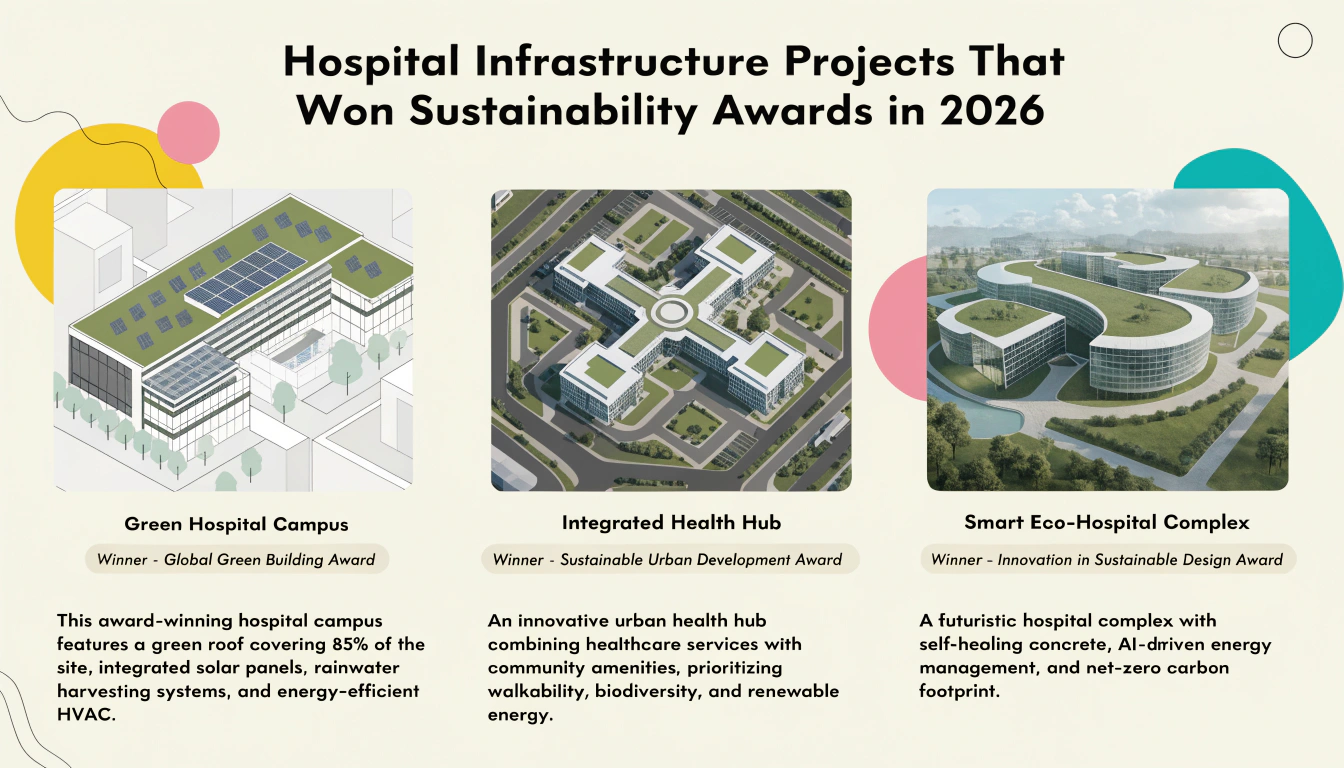
Healthcare infrastructure is undergoing a major transformation. Hospitals are no longer being designed only around clinical capacity, patient safety, and operational efficiency. In 2026, sustainability has become a defining measure of healthcare infrastructure excellence, influencing everything from building materials and energy systems to water management, waste reduction, indoor environments, and resilience.
The growing recognition of sustainable healthcare facilities is reflected in the hospital sustainability awards 2026, which have highlighted organizations and projects demonstrating measurable environmental leadership. From LEED Platinum-certified hospital buildings to facilities recognized for green building, energy efficiency, and climate action, this year’s award landscape shows that sustainability is becoming deeply embedded in healthcare construction and facility management.
For healthcare executives, architects, engineers, facility managers, and developers, these examples offer an important lesson: green healthcare construction is no longer an optional enhancement. It is becoming a core component of high-performing hospital infrastructure.
What the Hospital Sustainability Awards 2026 Reveal
The 2026 sustainability awards landscape is broader than simply recognizing hospitals with solar panels or energy-efficient lighting. Major healthcare sustainability programs are evaluating environmental performance across multiple dimensions, including energy, water, waste, sustainable procurement, green building, climate resilience, transportation, and operational practices.
Practice Greenhealth’s 2026 Environmental Excellence Awards recognized 430 healthcare organizations with 538 awards across 11 sustainability areas. Collectively, recipients reported approximately $235 million in savings from environmental programs during 2025. Projects addressing greenhouse gas emissions generated median annual savings of more than $77,000 per organization, while energy-efficiency and medical-device reprocessing initiatives each generated median annual savings of approximately $48,000. (Building Design + Construction)
This is significant because it demonstrates that sustainability is increasingly being evaluated through both environmental and financial performance.
The most successful hospital infrastructure strategies therefore connect three objectives: reducing environmental impact, improving patient and staff experience, and creating long-term operational value.
1. Michigan Medicine’s Kahn Healthcare Pavilion
One of the most notable sustainable healthcare infrastructure achievements of 2026 is the D. Dan and Betty Kahn Healthcare Pavilion at Michigan Medicine.
In May 2026, the Pavilion officially achieved LEED version 4 Platinum certification, the highest level of recognition offered by the U.S. Green Building Council’s LEED program. Michigan Medicine described the building as the world’s largest LEED v4 Platinum-certified healthcare building. (Michigan Medicine)
The significance of the project extends beyond the certification itself. The Kahn Pavilion was designed to increase access to high-acuity and complex care while integrating sustainability into a major inpatient healthcare environment.
This is an important model for green healthcare construction because it demonstrates that environmental performance does not have to compete with clinical functionality. Instead, sustainability can be integrated into a hospital’s fundamental design objectives.
For future hospital projects, the lesson is clear: sustainability should be considered at the earliest stages of planning rather than added after construction has already been designed.
Early decisions regarding building orientation, energy systems, water infrastructure, materials, lighting, ventilation, and indoor environmental quality can have consequences for decades.
2. UVA Health University Medical Center
The UVA Health University Medical Center also earned major recognition in 2026. Practice Greenhealth awarded the facility a Greenhealth Champion Award and a Circle of Excellence Award in Green Building.
The Green Building recognition places UVA Health University Medical Center among the top-performing healthcare facilities in this sustainability category. (uvahealth.com)
What makes the example particularly relevant to hospital infrastructure is the range of strategies associated with its green-building performance. These include a greywater reuse system, green roofs, healthier building materials, and an emphasis on occupant health and wellness. (uvahealth.com)
These features illustrate how sustainable hospital infrastructure is evolving.
Water efficiency, for example, is increasingly important as hospitals face high water demand and growing pressure to improve resource resilience. Greywater systems can help reduce reliance on potable water for appropriate non-potable applications.
Green roofs can also contribute to stormwater management, heat mitigation, and the creation of more environmentally responsive facilities.
Meanwhile, healthier materials demonstrate that sustainability is not simply about energy consumption. The materials selected for a hospital can affect indoor air quality, chemical exposure, maintenance requirements, and occupant well-being.
UVA Health’s recognition therefore demonstrates a broader definition of sustainability: a sustainable hospital should support the planet while creating a healthier environment for the people using the building.
3. UC San Diego Health’s Sustainability Leadership
UC San Diego Health was another major healthcare sustainability leader recognized in 2026. The organization received multiple Practice Greenhealth awards for the fifth consecutive year, demonstrating sustained progress rather than a one-time sustainability initiative. (UC San Diego Health)
UC San Diego Health’s 2026 recognitions included two Greenhealth Leader awards, a Greenhealth Champion award, and a Circle of Excellence award for climate leadership. (UC San Diego Health)
While these awards recognize healthcare organizations and sustainability performance rather than a single construction project, they provide an important lesson for infrastructure leaders.
A green hospital building cannot operate sustainably if the organization surrounding it does not have the processes, leadership, data, and culture needed to maintain its environmental performance.
That means hospital infrastructure projects should be planned alongside long-term sustainability management.
A building may have efficient mechanical systems, but poor operating practices can reduce their effectiveness. Similarly, a hospital may have water-saving infrastructure, but without monitoring and maintenance, the expected savings may not materialize.
The strongest 2026 examples show that infrastructure and operations need to work together.
4. Lucile Packard Children’s Hospital Stanford
Pediatric healthcare infrastructure presents a unique sustainability challenge because hospitals must maintain highly controlled environments while supporting children, families, clinicians, and visitors.
In 2026, Lucile Packard Children’s Hospital Stanford was named among the nation’s Top 25 hospitals for environmental sustainability by Practice Greenhealth. The hospital also received eight Circle of Excellence awards recognizing leadership across specific sustainability areas. (deprod.stanfordchildrens.org)
The recognition is particularly relevant to healthcare infrastructure because it reinforces the idea that sustainability must be embedded across the entire healthcare environment.
Hospitals need to balance infection prevention, temperature and humidity control, medical technology requirements, patient comfort, energy consumption, waste management, and environmental goals.
For designers, the challenge is therefore not simply to make a building “green.” The objective is to create infrastructure that can perform safely and efficiently under demanding clinical conditions.
5. University of Michigan Health and the Role of Whole-System Sustainability
University of Michigan Health-Michigan Medicine earned Practice Greenhealth’s Top 25 Environmental Excellence Award for the second consecutive year in 2026. The award recognizes performance across areas including waste, chemicals, operating-room sustainability, food, sustainable procurement, energy, water, climate, transportation, and green building. (Michigan Medicine)
This is a useful example because it highlights how the definition of sustainable healthcare infrastructure is expanding.
Traditionally, sustainable construction was often associated with building certification. Today, the focus is increasingly on the complete lifecycle of a healthcare facility.
That includes how a building is constructed, how materials are sourced, how much energy it consumes, how water is used, how waste is managed, and how the facility adapts to climate-related risks.
For hospital owners planning new developments in 2026 and beyond, this whole-system approach can produce better long-term outcomes than focusing on individual technologies.
6. Providence St. Patrick Hospital
Providence St. Patrick Hospital in Montana also received significant recognition in 2026. The hospital earned Practice Greenhealth’s Top 25 award for the fifth consecutive year, from 2022 through 2026.
The recognition covers a wide range of sustainability programs, including energy, water, climate, transportation, green building, waste, sustainable procurement, and operating-room practices. (To Your Health Blog)
The continuity of this recognition is particularly important.
Sustainability in healthcare is not achieved when a building opens or when a facility receives its first certification. A hospital must continue measuring performance, maintaining infrastructure, training staff, updating systems, and investing in improvements.
This creates a strong business case for facility managers to treat sustainability as an ongoing performance program rather than a construction milestone.
Why Green Healthcare Construction Is Becoming More Important
The projects and organizations recognized in 2026 point toward several major changes in hospital infrastructure.
Energy efficiency is moving from goal to necessity
Hospitals operate around the clock. Critical care units, operating rooms, imaging equipment, laboratories, HVAC systems, sterilization equipment, lighting, and digital infrastructure can create substantial energy demand.
Energy-efficient equipment, optimized HVAC systems, smart building controls, heat recovery, renewable energy, and better building envelopes can reduce consumption while supporting reliable clinical operations.
The ASHE 2026 Energy to Care Awards further demonstrate this trend. Seventy healthcare facilities across 13 organizations earned the program’s Sustainability Champions Award for leadership in reducing energy use and emissions. (ashe.org)
Water management is becoming a strategic priority
Hospitals have complex water requirements, from patient care and sanitation to cooling and sterilization.
Projects such as UVA Health’s greywater reuse system show how water conservation can become part of hospital infrastructure rather than simply an operational policy.
Future facilities are likely to increasingly incorporate water reuse, efficient fixtures, leak detection, rainwater management, and real-time monitoring.
Materials matter more than ever
Healthcare buildings require enormous quantities of construction and interior materials. Sustainable procurement can therefore influence the environmental footprint of a facility over its entire lifecycle.
Material selection is increasingly considering factors such as recycled content, responsible sourcing, durability, chemical composition, maintenance requirements, and end-of-life considerations.
The emphasis on healthier materials in recognized projects such as UVA Health demonstrates the connection between environmental sustainability and occupant wellbeing. (uvahealth.com)
Climate resilience must be part of infrastructure planning.
Sustainability is also becoming inseparable from resilience.
Hospitals must remain operational during heatwaves, storms, flooding, power interruptions, water shortages, and other climate-related disruptions.
A resilient hospital may require backup power, distributed energy systems, robust water infrastructure, improved building envelopes, emergency cooling strategies, flood protection, and carefully designed critical systems.
The best sustainable infrastructure therefore does more than reduce emissions. It helps hospitals remain functional when conditions become difficult.
What Healthcare Leaders Can Learn from the 2026 Winners
The biggest lesson from the hospital sustainability awards 2026 is that there is no single definition of a sustainable hospital.
The strongest examples combine building design with operational performance.
For healthcare developers, that means sustainability should be integrated into project requirements from the beginning. Architects and engineers should work with facility managers, clinicians, sustainability officers, finance teams, and procurement professionals before major design decisions are finalized.
For facility managers, the focus should be on measurable performance. Energy consumption, water use, waste generation, emissions, indoor environmental quality, and maintenance performance should be tracked over time.
For hospital executives, sustainability should be connected to financial planning. The 2026 Practice Greenhealth results demonstrate that environmental initiatives can deliver significant financial value alongside environmental benefits. (Building Design + Construction)
And for construction teams, sustainable design should not be treated as an isolated architectural feature. It should influence the building envelope, mechanical systems, electrical infrastructure, materials, landscape design, water systems, controls, and commissioning process.
The Future of Sustainable Hospital Infrastructure
The next generation of healthcare infrastructure will likely be more intelligent, efficient, resilient, and data-driven.
Smart building platforms can help facilities teams monitor energy and water consumption in real time. Building automation systems can optimize HVAC performance based on occupancy and conditions. Digital monitoring can identify equipment inefficiencies before they become expensive failures.
At the same time, sustainability will increasingly be linked with patient experience.
Daylight, access to nature, healthier materials, thermal comfort, acoustics, air quality, and outdoor spaces can contribute to healing environments while supporting environmental objectives.
This is where the concept of green healthcare construction becomes especially important. Green design should not be separated from healthcare design. The best hospitals can make environmental responsibility part of the patient experience and operational model.
The projects and institutions recognized in 2026 show that this transformation is already underway.
Conclusion
The hospital sustainability awards 2026 provide a valuable snapshot of where healthcare infrastructure is heading.
From Michigan Medicine’s Kahn Healthcare Pavilion achieving LEED v4 Platinum certification to UVA Health’s recognition for green building, and from UC San Diego Health’s continuing sustainability leadership to the environmental achievements recognized at Stanford, Michigan Medicine, and Providence St. Patrick Hospital, the message is consistent: sustainable healthcare infrastructure is becoming a benchmark for excellence.
The most successful projects are not simply reducing energy or achieving green certifications. They are creating hospitals that use resources more efficiently, support healthier environments, improve resilience, reduce operating costs, and remain adaptable to future needs.
For healthcare leaders planning their next infrastructure project, the question is no longer whether sustainability belongs in the hospital design conversation. The question is how deeply it can be integrated into the building’s strategy, systems, operations, and long-term performance.
As the healthcare sector continues to evolve, the facilities that combine clinical excellence with environmental responsibility will increasingly set the standard for the hospitals of tomorrow.
Is your healthcare facility delivering meaningful sustainability results?