Healthcare facilities operate around the clock, making them some of the most energy-intensive buildings in the world. Hospitals require continuous lighting, heating and cooling, medical equipment, ventilation, sterilization systems, refrigeration, water supply, and emergency power. As healthcare organizations face rising operating costs and growing environmental expectations, sustainability is becoming a strategic priority rather than an optional initiative.
A well-designed hospital sustainability roadmap can help healthcare organizations reduce energy consumption, improve operational efficiency, lower environmental impact, and create healthier spaces for patients and staff. For hospitals aiming to achieve LEED Gold certification, the journey should begin with a clear understanding of existing building performance and continue through structured improvements in energy, water, materials, indoor environmental quality, and facility management.
This healthcare green building guide explains how hospitals can move from an initial energy audit to a practical sustainability strategy and ultimately work toward LEED Gold certification.
What Is a Hospital Sustainability Roadmap?
A hospital sustainability roadmap is a structured, long-term plan that identifies how a healthcare facility can improve environmental performance while maintaining patient safety, clinical quality, regulatory compliance, and operational reliability.
Unlike a one-time sustainability project, a roadmap establishes measurable goals and connects them with specific actions, budgets, timelines, responsibilities, and performance indicators.
A hospital sustainability roadmap may cover energy efficiency, renewable energy, water conservation, waste reduction, sustainable procurement, building materials, indoor air quality, transportation, and resilience.
The roadmap should also recognize that hospitals have unique requirements. A healthcare facility cannot simply apply the same sustainability strategies used in a commercial office building. Critical care areas, operating rooms, laboratories, imaging departments, isolation rooms, pharmacies, and other clinical spaces have specialized ventilation, temperature, humidity, infection-control, and reliability requirements.
The goal is therefore to make sustainability improvements without compromising healthcare delivery.
Step 1: Begin With a Comprehensive Energy Audit
The first stage of a successful hospital sustainability roadmap is understanding how the facility currently uses energy.
An energy audit provides a baseline for identifying where energy is being consumed and where efficiency improvements are possible. Hospitals should examine electricity, natural gas, chilled water, heating systems, emergency generation, and other significant energy sources.
The audit should review major systems such as HVAC, lighting, boilers, chillers, pumps, air-handling units, medical equipment, refrigeration, domestic hot water, and building automation systems.
Historical utility bills are particularly useful. Comparing energy consumption over multiple years can reveal seasonal trends, unusual increases, and areas requiring further investigation.
Facility teams should also examine energy use by department or building zone when submetering is available. A hospital may discover that certain areas consume substantially more energy because of extended operating hours, aging equipment, or specialized ventilation requirements.
The result should be a clear energy baseline against which future improvements can be measured.
Step 2: Identify Energy Conservation Opportunities
Once the audit is complete, the next step is to identify energy conservation measures that can deliver measurable improvements.
Some opportunities may involve relatively simple operational changes. Optimizing HVAC schedules, adjusting controls, eliminating unnecessary simultaneous heating and cooling, improving equipment maintenance, and using occupancy-based controls can reduce energy consumption without major capital investment.
Other improvements may require significant investment. Hospitals may consider high-efficiency chillers, variable-speed drives, advanced building automation systems, efficient boilers, heat recovery systems, LED lighting, improved insulation, and high-performance building envelopes.
However, hospitals should not evaluate projects only by their upfront cost.
A better approach is to consider lifecycle cost, energy savings, maintenance requirements, expected equipment life, operational risks, and potential impact on patient care. Projects with strong energy savings and short payback periods can often be prioritized first, while larger capital projects can be incorporated into long-term facility planning.
Step 3: Establish Clear Sustainability Goals
A roadmap becomes much more effective when sustainability goals are specific and measurable.
Instead of stating that the hospital wants to “become greener,” facility leaders should define targets such as reducing energy intensity, lowering water consumption, increasing renewable energy use, diverting waste from landfills, reducing greenhouse gas emissions, or improving indoor environmental quality.
Goals should have realistic timelines. For example, the hospital could establish short-term objectives for the next 12 months, medium-term targets for three to five years, and longer-term goals aligned with capital planning and future facility development.
Leadership support is essential at this stage. Sustainability affects facilities, finance, clinical operations, procurement, infection prevention, engineering, housekeeping, and administration. A cross-functional sustainability team can help ensure that environmental objectives are aligned with patient-care priorities.
Step 4: Develop a High-Performance Building Strategy
A major component of any healthcare green building guide is the physical performance of the building itself.
Hospitals should assess the building envelope, windows, insulation, roofing, air leakage, lighting, HVAC infrastructure, and controls. Older facilities may have significant efficiency opportunities because their systems were designed according to standards that are now outdated.
Building performance improvements can include high-efficiency lighting, improved glazing, efficient mechanical systems, better insulation, advanced controls, and optimized ventilation.
However, healthcare facilities require special attention to air quality and infection prevention. Ventilation improvements should be designed in coordination with clinical engineering and infection-control teams.
A sustainability strategy should never reduce ventilation or environmental controls simply to save energy. Instead, the objective should be to optimize system performance while maintaining required clinical conditions.
Step 5: Integrate Renewable Energy
After reducing unnecessary energy consumption, hospitals can explore renewable energy options.
Solar photovoltaic systems are increasingly being considered by healthcare organizations because hospitals often have substantial electricity demand. Rooftop solar, parking-canopy solar, or other renewable energy installations can help offset grid electricity consumption where site conditions permit.
Hospitals should evaluate solar potential based on available roof or parking space, structural capacity, shading, electrical infrastructure, maintenance requirements, and financial feasibility.
Renewable energy can also support resilience when combined with appropriate energy storage and microgrid strategies. For hospitals, resilience is particularly important because critical operations must continue during grid disruptions and extreme weather events.
The most effective hospital sustainability roadmap therefore considers sustainability and resilience together rather than treating them as separate objectives.
Step 6: Create a Hospital Water Management Plan
Water is another major area of opportunity.
Hospitals use water for patient care, sterilization, cooling systems, kitchens, laundry, sanitation, landscaping, and other operations. A water audit can identify where consumption is highest and where efficiency measures can be implemented.
Low-flow fixtures, efficient irrigation, leak detection, cooling tower optimization, rainwater management, and water-efficient equipment can contribute to reductions.
Hospitals should also investigate water reuse opportunities where appropriate and permitted by local requirements. For example, captured rainwater or treated non-potable water may have potential applications in irrigation or other suitable uses.
Water conservation strategies should always account for infection prevention, hygiene, clinical requirements, and applicable regulations.
Step 7: Improve Healthcare Waste Management
Waste management should be another important component of the roadmap.
Healthcare facilities generate multiple waste streams, including general waste, recyclable materials, food waste, pharmaceutical waste, sharps, and regulated medical waste. Treating every waste stream as equally hazardous can increase environmental impact and disposal costs.
Hospitals can improve performance through proper segregation, recycling programs, reusable products where clinically appropriate, responsible procurement, food waste reduction, and staff education.
Waste segregation is particularly important because incorrectly classified waste can increase the volume of regulated waste requiring specialized treatment.
Procurement teams can also support sustainability by evaluating product durability, packaging, recycled content, recyclability, and supplier environmental practices without compromising clinical requirements.
Step 8: Prioritize Indoor Environmental Quality
Sustainable hospitals should provide healthier and more comfortable environments for patients, visitors, and staff.
Indoor environmental quality can be influenced by ventilation, filtration, thermal comfort, lighting, acoustics, moisture control, and material selection.
Hospitals should consider low-emitting materials and finishes where appropriate, while ensuring that products meet healthcare-specific performance and infection-control requirements.
Access to daylight and outdoor views can also contribute to a better patient and staff environment where the building design permits it.
For healthcare organizations pursuing LEED Gold, indoor environmental quality should be considered from the beginning rather than addressed near the end of a certification project.
Step 9: Build Sustainability Into Capital Planning
One of the biggest challenges for hospitals is funding sustainability improvements.
A strong hospital sustainability roadmap should therefore connect sustainability projects with the organization’s existing capital planning process.
Instead of treating energy efficiency as a separate expense, healthcare leaders can integrate sustainability requirements into equipment replacement, renovations, expansions, and new construction.
For example, if a chiller is approaching the end of its useful life, the hospital can evaluate a high-efficiency replacement rather than simply replacing it with a similar model. When a department is renovated, lighting, controls, materials, water fixtures, and indoor environmental quality can be incorporated into the project.
This approach allows sustainability improvements to become part of normal facility investment decisions.
Step 10: Align the Roadmap With LEED Gold Requirements
For hospitals targeting LEED Gold certification, sustainability planning should be aligned with the applicable LEED rating system and project requirements from the beginning.
LEED evaluates buildings across multiple areas, including energy and atmosphere, water efficiency, materials and resources, indoor environmental quality, sustainable sites, and other categories depending on the applicable rating system.
The exact certification strategy will vary according to whether the project involves new construction, major renovation, an existing building, or another project type.
Healthcare leaders should therefore involve qualified sustainability and LEED professionals early in the planning process. Waiting until construction is nearly complete can make it harder and more expensive to achieve targeted credits.
Documentation is also critical. Sustainability measures need to be planned, implemented, monitored, and properly documented throughout the project.
The objective should not simply be to collect LEED points. Instead, LEED Gold should serve as a framework for creating a healthcare facility with strong long-term environmental and operational performance.
Step 11: Track Performance After Implementation
A sustainability roadmap does not end when a project is completed or certification is achieved.
Hospitals need ongoing measurement to determine whether sustainability initiatives are delivering expected results.
Key performance indicators may include energy use intensity, utility costs, water consumption, greenhouse gas emissions, waste diversion, renewable energy generation, and maintenance performance.
Building automation and energy management systems can provide valuable data for identifying inefficiencies and detecting abnormal system behavior.
Regular performance reviews can also help facility teams identify whether equipment is operating according to design specifications. Even highly efficient systems can become less effective when controls are poorly configured or equipment is not properly maintained.
Continuous monitoring turns sustainability from a one-time project into an ongoing operational strategy.
Step 12: Engage Staff and Build a Sustainability Culture
Technology and infrastructure are only part of the solution. Staff behavior also influences sustainability performance.
Hospitals should educate employees about waste segregation, energy conservation, water efficiency, responsible purchasing, and other sustainability practices relevant to their roles.
Training should be practical rather than purely theoretical. Staff need to understand what actions they can take and why those actions matter.
Leadership can strengthen engagement by sharing progress and recognizing departments that achieve meaningful improvements. Sustainability dashboards, internal campaigns, and departmental targets can make environmental performance more visible.
A successful sustainability culture develops when employees understand that environmental responsibility supports the hospital’s broader mission of protecting health and improving community well-being.
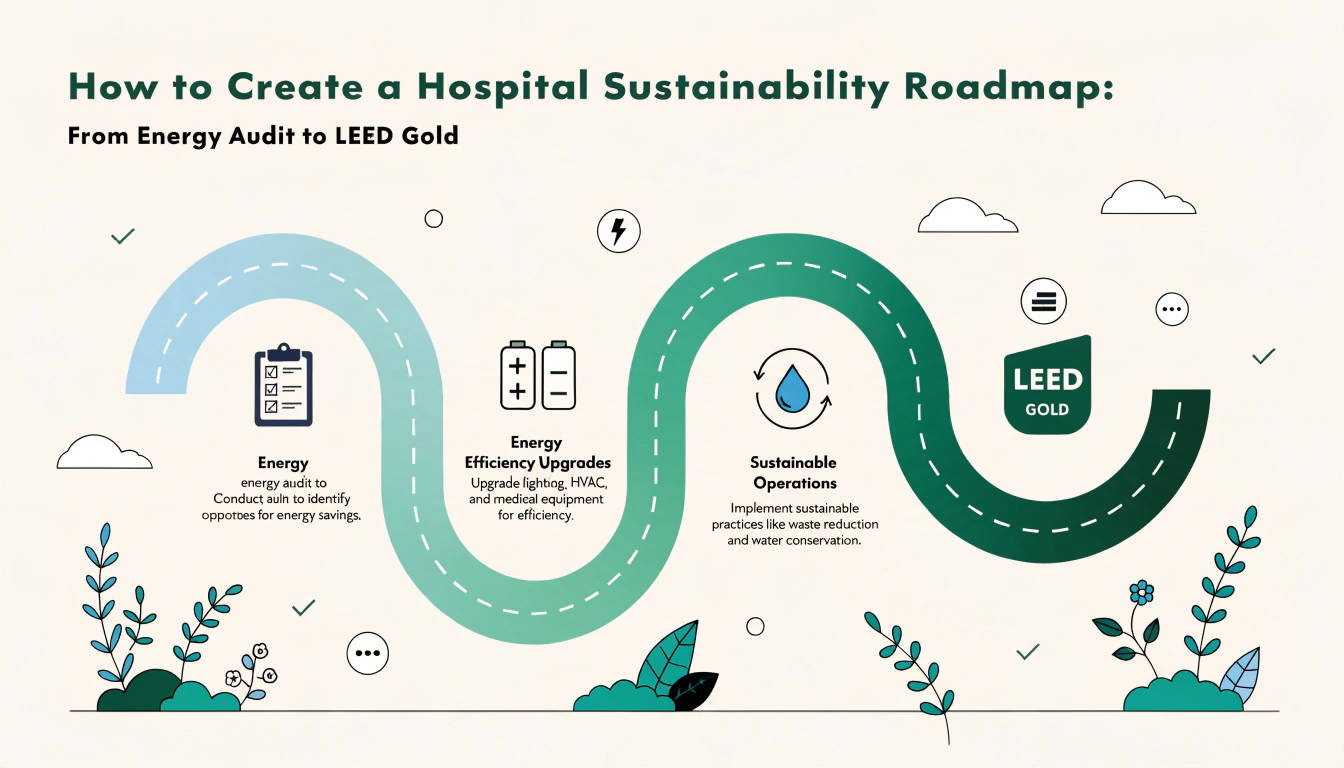
A Practical Roadmap From Audit to LEED Gold
The journey toward a sustainable healthcare facility can be organized into several stages.
First, conduct an energy and resource audit to establish a baseline. Second, identify high-impact opportunities and prioritize projects according to cost, savings, operational requirements, and patient-care considerations. Third, establish measurable sustainability goals and assign responsibilities.
Next, integrate energy efficiency, renewable energy, water management, waste reduction, sustainable materials, indoor environmental quality, and resilience into facility planning. At the same time, align project decisions with the appropriate LEED requirements if LEED Gold certification is the target.
Finally, measure results continuously and update the roadmap as technology, regulations, operational needs, and organizational goals evolve.
This approach creates a practical connection between sustainability strategy and everyday hospital operations.
The Business Case for Hospital Sustainability
Sustainability is not only an environmental responsibility. It can also support financial and operational performance.
Energy efficiency can reduce utility expenses. Water conservation can lower operating costs. Efficient equipment can reduce maintenance requirements and improve reliability. Better building performance can contribute to improved occupant comfort and indoor environmental quality.
Sustainability can also strengthen an organization’s reputation with patients, employees, investors, communities, and healthcare partners.
Most importantly, resilient and efficient healthcare infrastructure can help organizations prepare for changing climate conditions, energy challenges, resource constraints, and future regulatory expectations.
Conclusion
Creating a hospital sustainability roadmap requires more than installing efficient equipment or pursuing a green building certification. It requires a coordinated strategy that connects energy performance, water efficiency, waste management, building design, indoor environmental quality, renewable energy, resilience, staff engagement, and long-term financial planning.
The process should begin with a detailed energy and resource audit, followed by measurable goals and prioritized improvement projects. From there, hospitals can integrate sustainable design principles into renovations, capital projects, daily operations, and future development.
For organizations pursuing LEED Gold, early planning is especially important. Using this healthcare green building guide as a framework can help facility leaders approach sustainability systematically while keeping patient safety, clinical performance, and operational reliability at the center of every decision.
Ultimately, the strongest sustainability roadmap is one that delivers measurable environmental improvements while creating a more efficient, resilient, and future-ready healthcare facility.
Nominate for BMA Healthcare Awards
Is your healthcare facility, project, or leadership team driving meaningful progress in sustainable healthcare infrastructure? Recognition can help showcase innovative approaches and inspire wider industry transformation.