
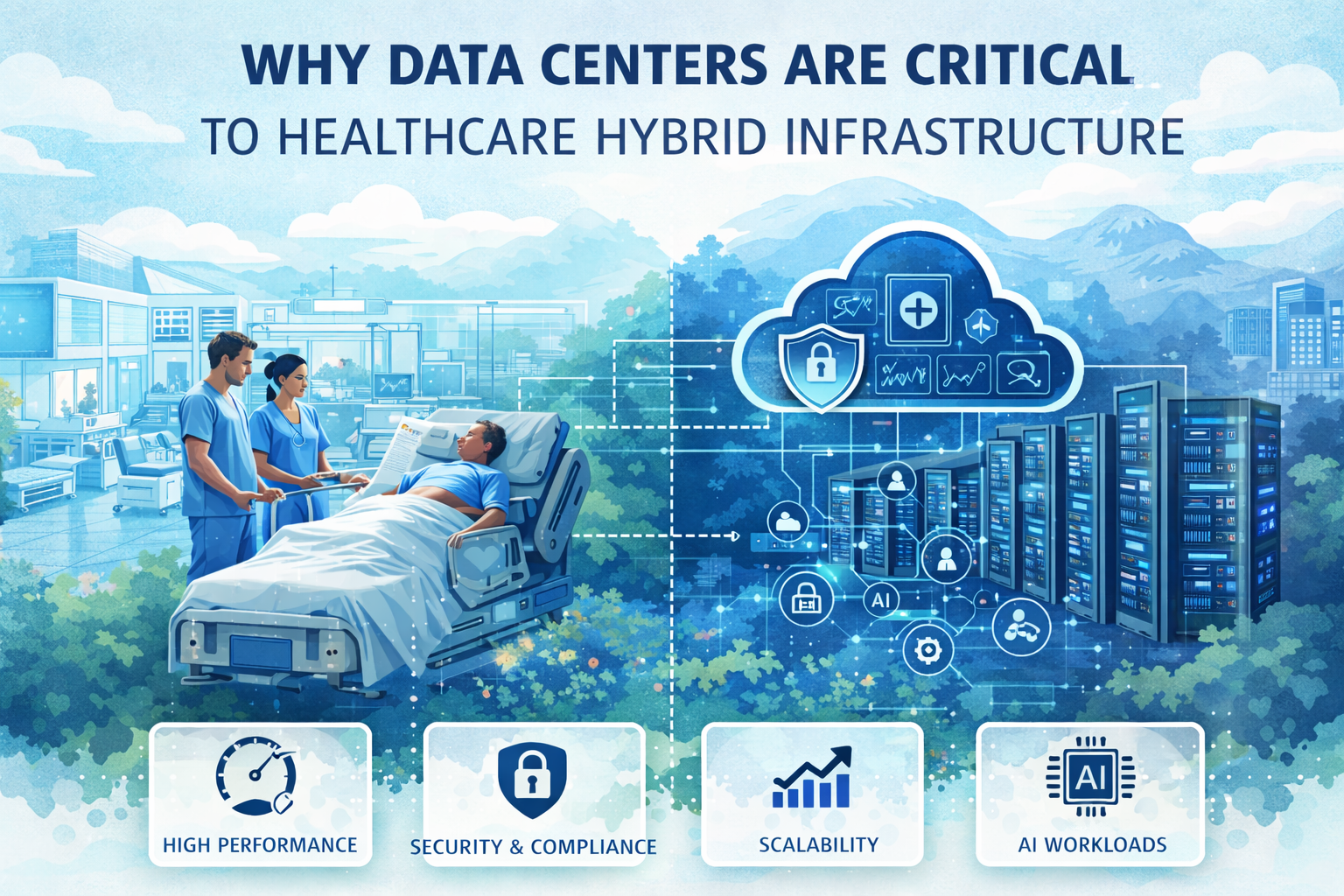
In today’s digital healthcare landscape, data is at the heart of nearly every clinical and operational function. From electronic health records to advanced imaging systems and AI‑driven analytics, healthcare organizations depend on fast, secure, and reliable access to data. To meet those demands, modern healthcare IT environments are evolving toward hybrid infrastructures that blend cloud services with on‑premises data centers — and data centers are emerging as a cornerstone of this approach.
The Role of Data Centers in Healthcare IT
Healthcare data centers are no longer just passive storage units for legacy systems. Instead, they serve as central hubs of performance, security, and availability — processing clinical information with minimal latency and ensuring that critical applications are always within reach for clinicians and care teams.
Traditionally, hospitals stored most of their critical systems in on‑site data facilities. While cloud services have become mainstream for many administrative and support tools, core clinical workloads — especially those that require speed and consistency — still benefit greatly from data center infrastructure that sits close to the point of care. This proximity reduces delays in accessing patient records, diagnostic results, and real‑time alerts that clinicians rely on every day.
Why Hybrid Infrastructure Matters
A hybrid infrastructure combines the strengths of on‑premises data centers with the scalability and flexibility of cloud platforms. This model allows healthcare organizations to:
1. Support High‑Performance Clinical Workloads
Certain clinical systems require ultra‑fast processing and data retrieval — such as imaging workflows, diagnostic decision support tools, and real‑time telemetry. Keeping these workloads closer to the hospital’s own infrastructure reduces latency and improves performance for time‑sensitive tasks.
2. Enable Scalable Hybrid Environments
Cloud platforms are ideal for growth, backup, analytics, and collaboration across distributed care networks. By pairing cloud resources with local data centers, healthcare providers can scale when needed without sacrificing performance or control of critical patient data.
3. Maximize AI and Analytics Potential
Healthcare organizations are rapidly expanding AI use cases — from predictive diagnostics to operational optimization. Many of these AI workloads demand both significant compute power and rapid access to large, diverse datasets. Data centers provide the hardware and connectivity needed to support these advanced processing requirements while ensuring that sensitive data remains accessible and secured.
4. Improve Reliability and Resilience
Healthcare systems must run 24/7 without interruption. Hybrid infrastructures ensure services remain operational even if one platform experiences issues. With data centers focused on core functions and cloud services backing up redundancy and disaster recovery, hospitals can maintain continuity of care in critical situations.
Performance and Patient Care
Data centers play an essential role in linking clinical information systems with the clinicians who use them. Fast access to a patient’s electronic health record, real‑time monitoring data, and imaging results can literally mean the difference between timely intervention and delayed care. Reliable infrastructure ensures that physicians and nurses are not waiting for systems to catch up with them — enhancing both clinical efficiency and patient outcomes.
Security and Compliance Benefits
Healthcare data must be protected to meet strict regulatory and privacy requirements. Local data centers give IT teams greater control over security configurations, access restrictions, and encryption, which are critical for sensitive information such as protected health data. By integrating these controls within a hybrid context, healthcare providers can benefit from cloud innovation while maintaining strong on‑site governance.
Future‑Ready Infrastructure for Healthcare
As healthcare organizations continue to adopt more digital tools — including telemedicine, machine learning, and population health analytics — the demand for robust, hybrid infrastructure will only grow. Data centers will remain foundational to that evolution, delivering the performance, reliability, and security needed to support next‑generation care delivery models.
By building hybrid infrastructures that intelligently combine on‑site resources with cloud capabilities, healthcare leaders can future‑proof their IT environments and ensure that care teams always have the data they need — when and where they need it.
Conclusion
Modern healthcare depends on data — and data centers are integral to effectively managing that information within hybrid IT environments. By balancing the performance and control of on‑premises systems with the flexibility and scale of the cloud, healthcare organizations can deliver faster, more secure, and more reliable care in an increasingly data‑driven world.