Manufacturing in 2027 is more competitive than ever. Rising material costs, supply chain uncertainties, increasing customer expectations, labour shortages, and growing sustainability requirements are forcing manufacturers to rethink how they operate. Simply producing more is no longer enough. The focus has shifted toward producing smarter, faster, and with minimal waste.
This is where lean manufacturing implementation 2027 becomes a strategic priority rather than just another improvement initiative. Modern lean manufacturing combines proven operational principles with digital technologies such as Industrial IoT, artificial intelligence, predictive analytics, connected machines, and real-time production monitoring. Instead of replacing traditional lean practices, these technologies make them more accurate, measurable, and scalable.
Companies across automotive, electronics, pharmaceuticals, food processing, aerospace, packaging, and industrial manufacturing are adopting lean strategies to increase productivity while reducing costs. Those that successfully integrate lean with digital transformation are achieving better operational performance and stronger competitive advantages.
This lean production guide explains how manufacturers can implement lean manufacturing step by step, avoid common mistakes, and build a continuous improvement culture that delivers measurable long-term results.
What Is Lean Manufacturing?
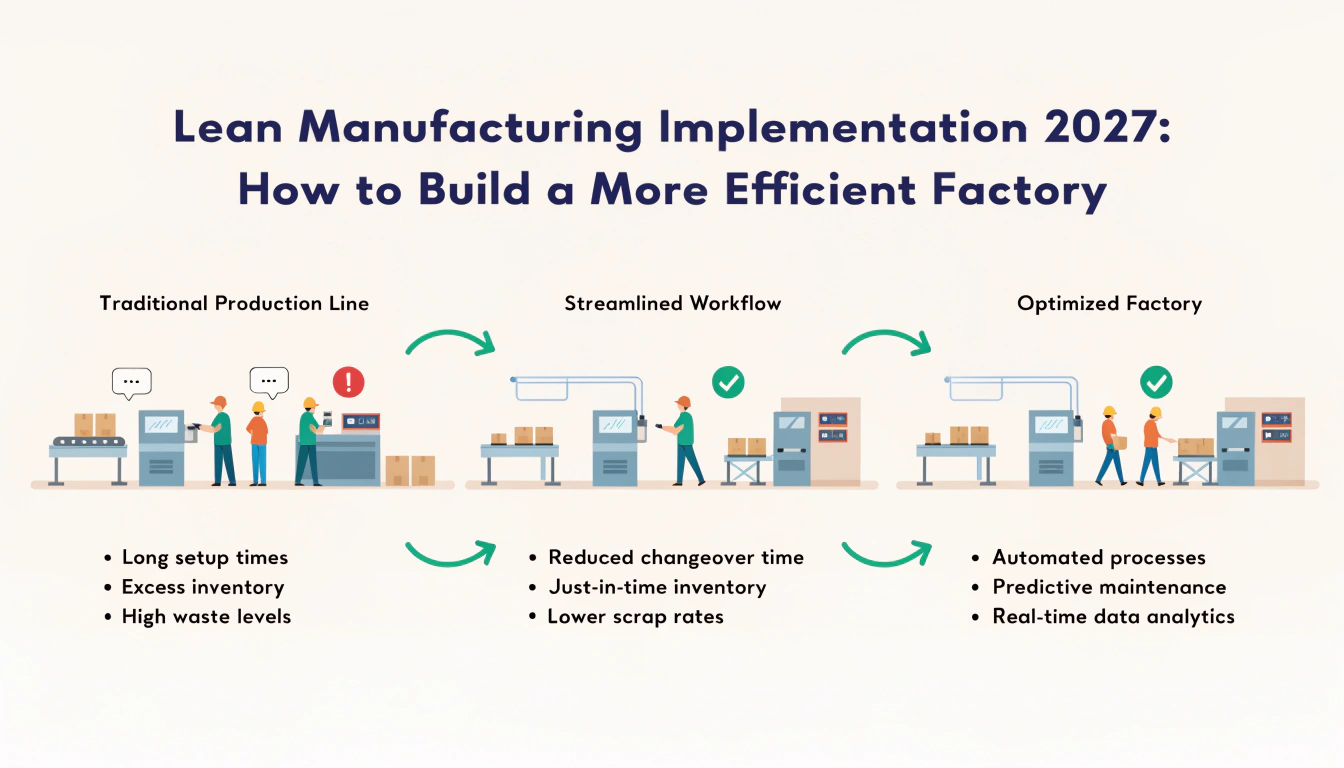
Lean manufacturing is a systematic approach to eliminating activities that do not create value for the customer. Every process, machine, movement, inspection, and material flow should contribute directly to producing a quality product efficiently.
The philosophy originated from the Toyota Production System but has evolved significantly over the past several decades. In 2027, lean manufacturing extends beyond physical production lines to include digital workflows, maintenance operations, inventory management, supplier collaboration, and data-driven decision-making.
Rather than focusing only on cost reduction, lean manufacturing aims to improve the following:
- Product quality
- Production efficiency
- Employee engagement
- Customer satisfaction
- Delivery performance
- Sustainability
- Operational flexibility
Modern manufacturers view lean as a company-wide operating philosophy instead of a collection of isolated improvement projects.
Why Lean Manufacturing Matters in 2027
Manufacturing facilities face challenges that were less significant a decade ago.
Global competition demands shorter lead times. Customers expect customised products without paying premium prices. Energy costs continue to fluctuate. Skilled labour shortages make workforce productivity increasingly valuable.
Meanwhile, digital manufacturing technologies provide unprecedented visibility into factory operations.
The combination of these factors makes lean manufacturing implementation 2027 especially valuable because organisations can now identify waste using live production data rather than relying solely on manual observations.
Manufacturers adopting lean today often experience:
Higher equipment utilisation
Lower inventory costs
Improved production scheduling
Reduced downtime
Faster product delivery
Better employee productivity
Lower defect rates
Improved customer satisfaction
Enhanced profitability
These benefits compound over time when continuous improvement becomes part of the company culture.
Step 1: Assess Your Current Manufacturing Processes
Every successful lean transformation begins with understanding the current state.
Many organisations rush into implementing solutions without identifying the actual causes of inefficiencies. Instead, manufacturers should perform a comprehensive operational assessment.
Evaluate production workflows from raw material receipt to finished goods shipment. Measure cycle times, waiting periods, machine utilisation, changeover times, inventory levels, quality defects, transportation delays, and operator movements.
Data collected during this stage becomes the baseline for measuring future improvements.
Modern digital tools such as production monitoring software, IoT sensors, and manufacturing execution systems simplify this process by automatically collecting operational data.
Step 2: Identify Waste Throughout the Value Stream
The foundation of every lean production guide is recognising waste.
Lean manufacturing traditionally identifies eight major forms of waste:
Overproduction
Waiting
Transportation
Overprocessing
Inventory
Motion
Defects
Unused employee talent
Although these categories remain relevant, manufacturers in 2027 also consider digital inefficiencies such as disconnected software systems, inaccurate production data, duplicated manual reporting, and poor data visibility.
Value Stream Mapping remains one of the most effective techniques for visualising these inefficiencies.
Instead of examining individual departments separately, manufacturers map the complete journey of materials and information throughout the production process.
This reveals where delays occur, where inventory accumulates, and where unnecessary activities consume resources.
Step 3: Set Clear Lean Manufacturing Objectives
Lean implementation should never begin without measurable objectives.
Rather than pursuing vague goals like “improve efficiency”, define specific performance indicators.
Examples include:
Reduce production lead time by 20%
Lower inventory holding costs by 15%
Improve Overall Equipment Effectiveness (OEE) by 10%
Reduce machine downtime by 25%
Increase first-pass quality rate to 98%
Improve on-time delivery performance
These measurable goals align improvement efforts across departments and make success easier to evaluate.
Step 4: Build Cross-Functional Improvement Teams
Lean manufacturing is not solely the responsibility of production managers.
Successful organisations involve employees from operations, maintenance, quality, engineering, logistics, procurement, IT, and executive leadership.
Operators often understand production bottlenecks better than management because they interact with processes every day.
Encouraging employee participation increases engagement while generating practical improvement ideas.
Cross-functional collaboration also prevents improvements in one department from creating problems elsewhere.
Step 5: Standardise Existing Processes
Before introducing automation or advanced technologies, manufacturing processes must be standardised.
Standard Operating Procedures create consistency across shifts, departments, and facilities.
Without standardisation, organisations struggle to determine whether process changes produce genuine improvements or simply introduce additional variation.
Standard work should clearly define:
Task sequence
Cycle time
Quality checkpoints
Safety procedures
Machine settings
Material handling methods
Visual work instructions supported by tablets, digital displays, and augmented reality are becoming increasingly common in smart factories.
Step 6: Introduce Continuous Improvement Through Kaizen
Continuous improvement forms the heart of lean manufacturing.
Rather than relying on large transformation projects every few years, successful manufacturers encourage employees to make frequent incremental improvements.
Small improvements accumulate into significant operational gains over time.
Daily improvement meetings, suggestion programmes, visual performance boards, and digital collaboration platforms encourage employees to identify opportunities continuously.
In 2027, AI-powered analytics can even recommend process improvements based on production trends and historical performance.
Step 7: Optimise Inventory Management
Excess inventory increases storage costs, occupies valuable floor space, hides production issues, and reduces operational flexibility.
Lean manufacturing promotes producing only what customers require when they require it.
Just-in-time production remains a valuable principle, although manufacturers today often balance lean inventory with supply chain resilience following recent global disruptions.
Digital demand forecasting, supplier collaboration platforms, and predictive analytics help manufacturers optimise inventory without increasing risk.
Step 8: Improve Equipment Reliability
Machine failures remain one of the largest sources of production waste.
Instead of waiting for equipment breakdowns, manufacturers increasingly adopt predictive maintenance strategies.
IoT sensors continuously monitor vibration, temperature, pressure, energy consumption, and equipment performance.
Artificial intelligence analyses these data streams to predict failures before they occur.
Combining predictive maintenance with Total Productive Maintenance (TPM) significantly improves equipment availability while reducing maintenance costs.
Reliable equipment supports smoother production flow and higher productivity.
Step 9: Integrate Digital Technologies with Lean Principles
One misconception is that digital transformation replaces lean manufacturing.
In reality, technology strengthens lean principles.
Manufacturers implementing lean manufacturing implementation in 2027 increasingly integrate the following:
Industrial IoT
Artificial Intelligence
Digital Twins
Machine Vision
Predictive Analytics
Manufacturing Execution Systems (MES)
Cloud Manufacturing Platforms
Collaborative Robots
Automated Quality Inspection
Real-Time Production Dashboards
These technologies provide greater operational visibility, allowing managers to identify waste immediately rather than after reviewing monthly reports.
Step 10: Measure Results and Sustain Improvements
Lean implementation never truly ends.
Continuous monitoring ensures improvements remain effective.
Track key performance indicators, including the following:
Overall Equipment Effectiveness
Cycle Time
Lead Time
Scrap Rate
Inventory Turnover
Customer Complaints
Production Throughput
Machine Downtime
Employee Suggestions
Review performance regularly and adjust improvement priorities as business needs evolve.
Companies achieving long-term lean success establish ongoing review cycles rather than treating lean as a temporary project.
Common Challenges During Lean Manufacturing Implementation
Although lean offers substantial benefits, many implementations fail due to avoidable mistakes.
One common issue is insufficient leadership commitment. Employees quickly lose motivation if management does not actively support improvement initiatives.
Another challenge is focusing exclusively on cost reduction while ignoring quality, customer value, and employee engagement.
Some organisations introduce advanced automation before simplifying existing processes, resulting in expensive systems that automate inefficiencies rather than eliminating them.
Resistance to change is another frequent obstacle. Employees may worry that lean initiatives threaten job security. Transparent communication and workforce involvement help overcome these concerns.
Finally, organisations sometimes expect immediate results. Lean manufacturing delivers its greatest value through sustained, continuous improvement rather than quick fixes.
The Role of Sustainability in Lean Manufacturing
Environmental responsibility has become an important component of manufacturing strategy.
Fortunately, lean manufacturing naturally supports sustainability goals.
Reducing waste decreases raw material consumption.
Efficient production lowers energy usage.
Improved quality reduces scrap generation.
Optimised logistics reduce transportation emissions.
Digital energy monitoring enables manufacturers to identify excessive electricity consumption and optimise equipment performance.
Many manufacturers now integrate Environmental, Social, and Governance (ESG) objectives directly into their lean improvement programmes.
This creates both environmental and financial benefits.
Lean Manufacturing and Industry 4.0: A Powerful Combination
Industry 4.0 technologies have transformed lean manufacturing.
Instead of manually collecting production data, connected factories generate continuous operational insights.
Artificial intelligence identifies bottlenecks automatically.
Digital twins simulate production changes before implementation.
Machine learning predicts maintenance requirements.
Cloud platforms enable collaboration across multiple facilities.
Rather than replacing lean thinking, these technologies accelerate continuous improvement by providing better information and faster decision-making.
The result is a more agile manufacturing environment capable of responding quickly to changing customer demands.
Best Practices for Successful Lean Manufacturing in 2027
The most successful manufacturers treat lean as a long-term business strategy rather than a short-term cost-saving initiative.
Leadership should consistently communicate improvement objectives while celebrating employee contributions.
Training programmes should equip employees with both lean methodologies and digital manufacturing skills.
Technology investments should always support clearly defined operational improvements instead of following industry trends.
Regular audits help ensure standardised processes remain effective.
Finally, organisations should continuously benchmark performance against industry standards while encouraging innovation throughout the workforce.
When lean principles become embedded within company culture, continuous improvement becomes part of everyday operations instead of an occasional management initiative.
The Future of Lean Manufacturing
The future of lean manufacturing lies in intelligent decision-making supported by real-time operational data.
Artificial intelligence will increasingly identify improvement opportunities automatically.
Collaborative robots will handle repetitive tasks while employees focus on higher-value activities.
Digital twins will allow manufacturers to optimise production before making physical changes.
Predictive analytics will improve scheduling, maintenance, inventory planning, and quality management.
Meanwhile, sustainability reporting will become more integrated with operational performance metrics.
Manufacturers embracing these technologies while maintaining lean fundamentals will be better positioned to compete in increasingly dynamic global markets.
Conclusion
Successful lean manufacturing implementation 2027 is not about adopting a single methodology or purchasing new technology. It requires a structured approach that combines process improvement, employee engagement, leadership commitment, and digital innovation.
By assessing current operations, identifying waste, standardising processes, embracing continuous improvement, optimising inventory, improving equipment reliability, and integrating Industry 4.0 technologies, manufacturers can build resilient and highly efficient production systems.
This lean production guide demonstrates that lean manufacturing is no longer limited to eliminating waste. In 2027, it serves as the foundation for smarter factories, stronger competitiveness, greater sustainability, and long-term operational excellence.
View the manufacturing convention agenda.
Want to learn how leading manufacturers are implementing lean manufacturing, Industry 4.0, predictive maintenance, AI, digital twins, and smart factory technologies?
View the Manufacturing Convention Agenda: https://bmaconventions.com/smart-manufacturing-automation-convention-2027/
Connect with manufacturing leaders, technology innovators, plant managers, and industry experts to discover practical strategies shaping the future of modern manufacturing.