Hospitals operate around the clock, making them among the most energy-intensive buildings in the commercial sector. From operating rooms and intensive care units to diagnostic imaging equipment, HVAC systems, lighting, and data centres, nearly every department depends on continuous power. While uninterrupted operations are essential for patient safety, rising energy costs have made it increasingly important for healthcare organisations to reduce hospital energy consumption without compromising the quality of care.
For facility managers, energy efficiency is no longer just a cost-saving initiative; it is a strategic priority. Modern hospitals are expected to meet sustainability goals, comply with environmental regulations, improve operational resilience, and provide comfortable healing environments for patients and staff. Effective hospital energy management helps achieve all of these objectives while lowering operational expenses.
This guide outlines a practical six-step plan that facility managers can implement to improve energy performance, extend equipment life, and build a more sustainable healthcare facility.
Why Reducing Hospital Energy Consumption Matters
Healthcare facilities consume significantly more energy than standard commercial buildings due to their specialised equipment, strict indoor air quality requirements, and 24/7 operations. Energy costs often represent one of the largest controllable operating expenses in a hospital.
Reducing energy consumption delivers benefits beyond financial savings. Hospitals can:
- Lower operating costs
- Improve equipment reliability
- Reduce carbon emissions
- Support ESG and sustainability initiatives
- Enhance patient comfort
- Increase resilience during power disruptions
- Meet regulatory and accreditation expectations
The goal is not simply to consume less energy; it is to use energy more intelligently.
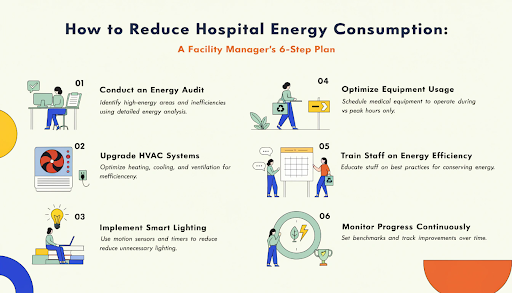
Step 1: Conduct a Comprehensive Energy Audit
Every successful energy-saving initiative begins with understanding where energy is being used.
A detailed energy audit provides facility managers with a clear picture of how electricity, heating, cooling, and water are consumed throughout the hospital. Rather than relying on assumptions, the audit identifies measurable opportunities for improvement.
During an audit, evaluate:
- HVAC performance
- Lighting systems
- Medical equipment usage
- Building automation controls
- Chiller efficiency
- Boiler operations
- Electrical distribution systems
- Building envelope insulation
- Water heating systems
Many hospitals discover that ageing infrastructure or poorly optimised systems account for a substantial portion of unnecessary energy use.
Benchmarking energy consumption against similar healthcare facilities also helps determine whether performance is above or below industry standards.
Modern energy audits often use smart sensors, submeters, and analytics platforms that provide real-time visibility into energy usage across different departments.
After completing the audit, prioritise projects according to the following:
- Expected energy savings
- Return on investment
- Operational impact
- Implementation complexity
This structured approach ensures that capital investments generate measurable improvements.
Step 2: Optimize HVAC Systems for Maximum Efficiency
Heating, ventilation, and air conditioning (HVAC) systems account for the largest share of hospital energy consumption. Because healthcare facilities require strict temperature, humidity, and air quality control, HVAC systems often operate continuously.
Instead of replacing entire systems immediately, facility managers should first optimize existing infrastructure.
Key optimisation strategies include the following:
Regular preventive maintenance helps maintain airflow, reduce equipment strain, and improve efficiency. Dirty filters, clogged coils, and worn belts force systems to consume more electricity.
Scheduling periodic calibration of temperature and humidity sensors ensures environmental conditions remain accurate without unnecessary overcooling or overheating.
Variable Frequency Drives (VFDs) installed on pumps and fans allow motors to operate according to actual demand rather than running at full speed continuously.
Demand-controlled ventilation adjusts fresh air supply based on occupancy levels while still maintaining healthcare air quality standards.
Advanced Building Management Systems (BMS) can automatically regulate HVAC operations based on occupancy schedules, outdoor weather conditions, and department-specific requirements.
Hospitals should also evaluate opportunities to:
- Upgrade chillers
- Improve boiler efficiency
- Reduce steam losses
- Repair duct leakage
- Balance air distribution systems
Even relatively small improvements in HVAC efficiency can significantly reduce hospital energy consumption because these systems operate throughout the year.
Step 3: Upgrade Lighting Systems with Smart Controls
Lighting represents another major opportunity for energy savings.
Many hospitals still use outdated fluorescent fixtures that consume more electricity and require frequent maintenance. Transitioning to LED lighting offers immediate and long-term benefits.
LED technology provides:
- Lower electricity consumption
- Longer operating life
- Reduced maintenance costs
- Better illumination quality
- Lower heat generation
However, replacing fixtures alone is only part of an effective strategy.
Smart lighting controls maximise efficiency by ensuring lights operate only when needed.
These technologies include:
Occupancy sensors automatically switch lights off in storage rooms, offices, conference areas, and restrooms when spaces are vacant.
Daylight harvesting systems adjust artificial lighting according to available natural sunlight.
Scheduling software enables facility managers to control lighting based on operating hours in administrative spaces.
Dimming controls reduce energy usage while maintaining comfortable illumination levels.
Healthcare environments require different lighting standards depending on clinical functions, so facility managers should develop customised lighting strategies for patient rooms, surgical suites, laboratories, waiting areas, and administrative offices.
Emergency lighting systems should also be reviewed to ensure compliance while minimising unnecessary energy consumption.
Lighting upgrades often provide one of the fastest returns on investment because installation costs are relatively low and energy savings begin immediately.
Step 4: Implement a Smart Hospital Energy Management System
After identifying energy-saving opportunities and optimising major systems, the next step is to manage energy proactively. A smart hospital energy management system provides real-time visibility into how energy is used across the facility, enabling facility managers to make informed decisions instead of reacting to problems after they occur.
A centralised Building Management System (BMS) or Energy Management System (EMS) connects HVAC equipment, lighting, power distribution, water systems, and other building assets into a single dashboard. Facility teams can monitor energy usage by department, identify abnormal consumption patterns, and receive alerts when equipment is operating outside expected parameters.
For example, if an air handling unit continues to run at full capacity after outpatient clinics close, the system can flag the issue immediately. Likewise, unusual electricity consumption from imaging equipment or laboratory spaces can indicate maintenance needs or operational inefficiencies.
Modern platforms also use artificial intelligence and predictive analytics to forecast energy demand based on weather conditions, occupancy, and historical usage. These insights help hospitals optimise energy-intensive systems without affecting patient care.
Another advantage of digital monitoring is data-driven reporting. Hospitals pursuing sustainability certifications or environmental, social, and governance (ESG) goals require accurate records of energy performance. Automated reporting simplifies compliance while demonstrating measurable progress toward efficiency targets.
When implementing an energy management system, facility managers should define clear key performance indicators (KPIs), such as:
- Total energy consumption per square foot
- Peak electricity demand
- HVAC energy efficiency
- Lighting energy usage
- Water heating performance
- Carbon emissions
- Monthly utility costs
Tracking these metrics over time helps hospitals continuously improve performance and identify opportunities for further savings.
Step 5: Improve Equipment Efficiency Through Preventive Maintenance
Medical equipment, mechanical systems, and electrical infrastructure consume a significant portion of a hospital’s energy. While replacing outdated equipment may eventually become necessary, many facilities can achieve meaningful savings simply by maintaining existing assets properly.
Preventive maintenance ensures that equipment operates at peak efficiency while reducing the risk of unexpected failures. Poorly maintained systems often consume more electricity because they must work harder to deliver the same level of performance.
A well-planned maintenance programme should include regular inspections, cleaning, lubrication, calibration, and timely replacement of worn components. Chillers, boilers, pumps, compressors, generators, and air handling units all benefit from scheduled maintenance that keeps them operating efficiently.
Medical equipment should also be evaluated for energy-saving opportunities. Devices that remain powered on when not in use contribute to unnecessary electricity consumption. Where appropriate, departments can establish shutdown protocols for non-essential equipment during periods of inactivity while ensuring critical systems remain fully operational.
Hospitals should also review the age and efficiency of major assets. Equipment nearing the end of its lifecycle often requires more maintenance and consumes more energy than newer alternatives. When capital budgets allow, replacing ageing chillers, motors, pumps, or air compressors with high-efficiency models can generate substantial long-term savings.
Facility managers should collaborate with clinical teams to ensure maintenance activities do not disrupt patient care. Scheduling inspections during low-occupancy periods and coordinating with department heads helps maintain operational continuity while improving efficiency. By combining preventive maintenance with strategic equipment upgrades, hospitals can further reduce hospital energy consumption and extend the lifespan of critical infrastructure.
Step 6: Build an Energy-Conscious Culture Across the Hospital
Technology alone cannot deliver lasting energy savings. Staff awareness and daily operational practices play an equally important role in reducing waste.
Every employee, from administrators and clinicians to housekeeping and maintenance teams, influences the hospital’s energy performance. Creating an energy-conscious culture encourages everyone to contribute to efficiency goals without compromising patient care.
Facility managers can begin by providing regular training on energy-saving practices. Staff should understand why reducing energy consumption matters, how it supports patient care, and what simple actions they can take throughout the day.
Examples include turning off lights in unoccupied rooms, reporting equipment malfunctions promptly, minimising unnecessary heating or cooling adjustments, and shutting down non-essential devices after use when appropriate.
Department-level energy champions can help reinforce best practices and encourage participation. Sharing monthly performance updates or recognising departments that achieve measurable reductions can also increase engagement.
Communication is essential. Displaying dashboards or internal reports that highlight energy savings helps employees see the impact of their efforts. When staff understand that energy efficiency supports better resource allocation, environmental responsibility, and improved healthcare services, participation tends to increase.
Hospitals should also incorporate sustainability objectives into long-term operational planning. Energy efficiency projects should align with capital improvement plans, resilience strategies, and broader organisational goals.
Over time, a culture of continuous improvement ensures that energy-saving initiatives remain effective rather than becoming one-time projects.
Conclusion
Hospitals face growing pressure to improve operational efficiency while maintaining exceptional patient care. Rising utility costs, ageing infrastructure, and ambitious sustainability goals make energy management a strategic priority for every healthcare organisation.
By following this six-step plan, facility managers can systematically reduce hospital energy consumption through comprehensive energy audits, optimised HVAC systems, smart lighting, advanced energy management technologies, preventive maintenance, and staff engagement.
The benefits extend far beyond lower electricity bills. Effective hospital energy management improves equipment reliability, enhances patient comfort, supports environmental objectives, and strengthens the long-term resilience of healthcare facilities.
Energy efficiency is no longer just a maintenance objective, it is an investment in the future of healthcare operations.
Explore More Healthcare Facility Innovations
Looking to stay ahead of the latest trends in healthcare infrastructure, sustainability, smart buildings, and facility management?
View all BMA convention topics: https://bmaconventions.com/smart-healthcare-facilities-convention-2026-sep/
Discover expert insights, emerging technologies, and practical strategies that are shaping the future of healthcare facilities worldwide.