Introduction
Manufacturing is entering a new era where factories are becoming more intelligent, connected, and data-driven than ever before. The convergence of Industrial Internet of Things (IIoT), artificial intelligence (AI), cloud computing, edge analytics, and advanced automation has transformed how manufacturers design, operate, and optimise production facilities. At the centre of this transformation is the concept of the digital twin.
A digital twin is far more than a 3D model of a factory. It is a dynamic, virtual representation of physical assets, processes, and systems that continuously receives data from the real manufacturing environment. This enables manufacturers to monitor operations in real time, predict equipment failures, simulate production changes, improve energy efficiency, and make informed decisions without disrupting live operations.
As manufacturers face increasing pressure to improve productivity, reduce downtime, meet sustainability goals, and respond quickly to changing market demands, investing in digital twin manufacturing has become a strategic priority rather than a future aspiration. By combining real-time operational data with intelligent simulations, organisations can unlock greater visibility across their production environment while reducing operational risks.
This practical guide explains how manufacturers can successfully build a digital twin for their production facility, the technologies required, common implementation challenges, and best practices for achieving measurable business value. It also explores how manufacturing simulation 2027 is shaping the future of smart factories worldwide.
Understanding Digital Twin Manufacturing
A digital twin is a continuously updated digital replica of a physical manufacturing asset, production line, machine, or even an entire factory. Unlike traditional computer models that rely on static information, a digital twin receives live operational data from connected equipment through sensors, industrial networks, and manufacturing execution systems.
This continuous data exchange allows manufacturers to compare expected performance with actual performance, identify inefficiencies, predict failures before they occur, and evaluate operational improvements in a virtual environment before implementing them on the factory floor.
Instead of relying on assumptions, manufacturers can use evidence-based insights generated from real operational conditions.
For example, if a production line begins consuming more energy than expected or a machine starts vibrating beyond normal levels, the digital twin immediately reflects these changes. Engineers can investigate the issue virtually, simulate corrective actions, and determine the most effective solution before making physical adjustments.
Why Manufacturers Are Investing in Digital Twins
Global manufacturing has become increasingly complex. Companies are expected to produce higher-quality products while reducing costs, improving sustainability, managing supply chain disruptions, and maintaining operational resilience.
Digital twins help manufacturers address these challenges by creating a virtual environment where improvements can be tested safely and efficiently.
Some of the biggest business drivers include improved equipment reliability, reduced unplanned downtime, better production scheduling, predictive maintenance, faster product development, lower operational costs, and improved quality control.
Digital twins also support sustainability initiatives by helping organisations monitor energy consumption, optimise resource utilisation, and minimise production waste.
As factories become more connected, digital twins provide a single source of operational intelligence across engineering, maintenance, operations, and executive management.
Step 1: Define Clear Business Objectives
Many digital twin projects struggle because organisations begin with technology instead of business outcomes.
Before investing in software or sensors, manufacturers should identify the specific problems they want to solve.
For some facilities, the objective may be reducing equipment downtime. Others may prioritise increasing production throughput, improving maintenance planning, reducing energy consumption, or enhancing product quality.
Clearly defined objectives allow project teams to determine which assets should be included in the first phase and how success will be measured.
Rather than attempting to model an entire factory immediately, many successful organisations begin with one production line or one critical asset before expanding across the facility.
This phased approach reduces implementation risk while demonstrating measurable return on investment early in the project.
Step 2: Identify the Assets to Include
Not every piece of equipment requires a digital twin.
Manufacturers should prioritise assets that have the greatest operational impact.
These often include production machinery, robotic systems, conveyor lines, packaging equipment, compressors, boilers, HVAC systems, utility infrastructure, and automated storage systems.
Critical assets that frequently experience downtime or require expensive maintenance generally deliver the fastest return on investment.
Some organisations also develop digital twins for entire production processes rather than individual machines, enabling better coordination between multiple systems operating simultaneously.
Selecting the appropriate scope ensures the project remains manageable while generating valuable operational insights.
Step 3: Build a Reliable Data Foundation
A digital twin is only as accurate as the data it receives.
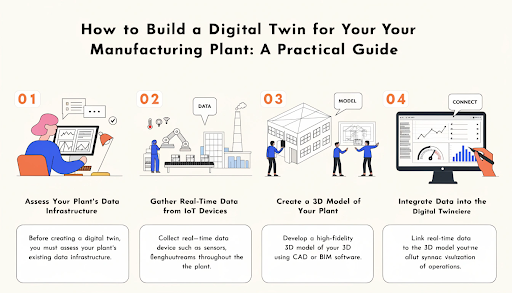
Reliable data collection begins with connected sensors and industrial devices capable of monitoring machine performance continuously.
Common operational data includes temperature, vibration, pressure, production speed, cycle times, energy consumption, equipment status, machine utilisation, and environmental conditions.
Data may originate from programmable logic controllers (PLCs), supervisory control and data acquisition (SCADA) systems, manufacturing execution systems (MES), enterprise resource planning (ERP) platforms, or IIoT devices.
Before integrating these data sources, manufacturers should assess data quality, consistency, and availability.
Poor-quality data often produces inaccurate simulations and unreliable predictive insights.
Step 4: Create the Digital Model
Once operational data becomes available, engineers develop a virtual model representing the selected manufacturing assets.
This model includes equipment geometry, process flows, operational parameters, maintenance history, and performance characteristics.
The objective is not simply creating an attractive 3D visualisation.
Instead, the model must accurately reflect how equipment behaves under real operating conditions.
As live operational data continuously updates the virtual model, the digital twin evolves alongside the physical factory.
Any change occurring on the shop floor should be reflected within the digital environment with minimal delay.
This real-time synchronisation enables informed operational decision-making.
Step 5: Integrate Existing Manufacturing Systems
Most manufacturing facilities already operate numerous digital platforms.
A successful digital twin should integrate with these existing systems rather than replacing them.
Typical integrations include MES, ERP software, SCADA platforms, quality management systems, maintenance management software, warehouse management systems, and production scheduling applications.
These integrations provide a complete operational picture by combining production, maintenance, inventory, quality, and business information.
Without integration, organisations risk creating isolated data silos that limit the effectiveness of the digital twin.
Open communication standards and secure APIs simplify interoperability across multiple software environments.
Step 6: Use Simulation to Test Improvements
One of the greatest advantages of digital twin manufacturing is the ability to simulate changes before implementing them in live production.
Instead of interrupting manufacturing operations, engineers can test various scenarios virtually.
For example, manufacturers may evaluate different production schedules, machine settings, staffing levels, maintenance intervals, or factory layouts.
The digital twin predicts how these changes affect productivity, equipment utilisation, energy consumption, product quality, and operational costs.
This capability significantly reduces implementation risks while accelerating continuous improvement initiatives.
As manufacturing simulation 2027 continues advancing through artificial intelligence and machine learning, simulation accuracy is becoming increasingly sophisticated.
Manufacturers can now evaluate thousands of operational scenarios far more quickly than traditional planning methods.
Step 7: Implement Predictive Maintenance
Unexpected equipment failures remain one of the largest contributors to manufacturing downtime.
Digital twins continuously monitor equipment health by analysing sensor data alongside historical maintenance records.
Instead of relying on fixed maintenance schedules, manufacturers receive early warnings when equipment begins operating outside normal parameters.
Maintenance teams can schedule repairs before failures occur, reducing emergency maintenance, production interruptions, and spare parts costs.
Predictive maintenance also extends equipment lifespan while improving workforce productivity.
Over time, artificial intelligence further enhances maintenance accuracy by identifying subtle failure patterns that human operators may overlook.
Step 8: Monitor Performance Continuously
Building a digital twin is not a one-time technology project.
Its long-term value depends on continuous monitoring and ongoing optimisation.
Manufacturers should regularly evaluate key performance indicators such as overall equipment effectiveness (OEE), machine availability, production throughput, quality rates, energy efficiency, maintenance response times, and operational costs.
As production requirements evolve, the digital twin should be updated to reflect equipment upgrades, process improvements, factory expansions, and new production lines.
Continuous refinement ensures the digital twin remains an accurate representation of real operations.
Common Challenges During Implementation
Despite their significant advantages, digital twin projects often encounter implementation challenges.
One of the most common obstacles is poor data quality. Inconsistent sensor readings, incomplete maintenance records, and disconnected operational systems reduce model accuracy.
Legacy equipment may also lack modern connectivity, requiring additional sensors or industrial gateways before integration becomes possible.
Another challenge involves organisational collaboration.
Successful digital twins require close cooperation between operations, maintenance, engineering, IT, production planning, and executive leadership.
Without cross-functional collaboration, implementation efforts frequently become fragmented.
Cybersecurity must also receive careful attention.
Because digital twins connect operational technology with information technology, organisations should implement robust access controls, network segmentation, encryption, and continuous monitoring to protect sensitive manufacturing data.
Finally, employee adoption plays an essential role.
Technology alone cannot improve manufacturing performance unless operators, engineers, and managers actively use digital twin insights to support everyday decision-making.
Best Practices for Long-Term Success
Manufacturers that achieve the greatest value from digital twins typically adopt a gradual, strategic implementation approach.
Rather than pursuing large-scale deployments immediately, they begin with clearly defined pilot projects, validate measurable business outcomes, and expand progressively across additional production assets.
Executive sponsorship remains essential throughout the implementation journey.
Leadership support ensures adequate investment, cross-functional collaboration, and long-term commitment.
Regular employee training also improves adoption by helping teams understand how digital twins enhance daily operations rather than replacing human expertise.
Manufacturers should continuously review performance metrics, refine simulation models, and incorporate lessons learned into future expansion phases.
Digital twins should evolve alongside factory operations, technological advancements, and changing business objectives.
The Future of Manufacturing Simulation in 2027 and Beyond
The future of manufacturing simulation in 2027 is closely linked with advances in artificial intelligence, machine learning, edge computing, and industrial automation.
Future digital twins will become increasingly autonomous, capable of recommending production adjustments, automatically detecting anomalies, and optimising manufacturing processes with minimal human intervention.
Generative AI will accelerate engineering analysis by suggesting operational improvements based on historical factory performance.
Digital twins will also become more integrated with robotics, autonomous mobile robots, supply chain management, carbon monitoring, and sustainability reporting.
Manufacturers will increasingly create digital twins that represent not only factories but entire supply networks, enabling end-to-end operational visibility from suppliers to customers.
As these technologies mature, digital twins will become foundational to Industry 4.0 and the next generation of intelligent manufacturing.
Conclusion
Digital twins are transforming manufacturing by enabling organisations to connect physical operations with intelligent virtual models that support better decision-making, predictive maintenance, operational optimisation, and continuous improvement.
Implementing digital twin manufacturing successfully requires far more than purchasing new software. It demands clear business objectives, reliable operational data, integrated digital systems, accurate simulation models, strong cybersecurity, and ongoing collaboration across engineering, operations, maintenance, and IT teams.
Manufacturers that begin with focused pilot projects, measure tangible business outcomes, and continuously refine their digital twins will be well positioned to compete in an increasingly connected industrial landscape.
As manufacturing simulation 2027 continues evolving through AI, IIoT, and advanced analytics, digital twins will become one of the most valuable technologies for achieving smarter, more resilient, and more sustainable manufacturing operations.
Download Manufacturing Convention Agenda
Discover the latest innovations in smart manufacturing, industrial automation, AI, digital twins, IIoT, robotics, predictive maintenance, and sustainable factory operations by connecting with industry experts and technology leaders.
Download Manufacturing Convention Agenda: https://bmaconventions.com/smart-manufacturing-automation-convention-2027/