Every quarter, a familiar scene plays out in healthcare boardrooms across the country. The Chief Information Security Officer stands at the front of the room, presenting a slide deck filled with dense, technical metrics. They talk about firewall logs, patch compliance rates, the number of phishing emails intercepted at the perimeter, and critical software vulnerabilities. The board members nod politely, but look closely and you will see a collective glazing over of the eyes.
For a non-technical executive or a Chief Financial Officer, these metrics present a fundamental communication barrier. How does a ten percent increase in blocked network scans translate to patient care? How does a technical vulnerability patch justify a six-figure budgetary increase?
When healthcare organizations treat cybersecurity purely as an isolated IT problem, it inevitably becomes a cost center. Decisions are made defensively and reactively. A hospital buys new software because a competitor suffered a high-profile breach, or because an IT vendor sounded the alarm on a new threat. This approach is no longer sustainable. To build truly resilient medical facilities while remaining fiscally responsible, executive leadership must alter the fundamental premise of the conversation.
We must stop measuring digital risk in terms of abstract technical scores and begin translating cybersecurity into the language the entire business understands: financial exposure.
The Great Disconnect in Modern Health Systems
Historically, medical facilities operated under the assumption that clinical risk and digital risk lived in separate worlds. Clinical risk was managed by physicians and Chief Medical Officers, while digital risk was handled by the technology team in the basement. However, as hospital infrastructure has become deeply interconnected, these two worlds have permanently merged. A legacy scheduling server, an automated prescription system, and an internet-connected patient monitor are now parts of a single digital nervous system.
Despite this technical evolution, the way we talk about risk has remained stagnant. Most security teams rely on Key Performance Indicators to justify their budgets. They report that they detected five hundred vulnerabilities this month or that network uptime was at ninety-nine percent. While these numbers are critical for the engineers maintaining the system, they fail to articulate actual operational or business risk.
To bridge this gap, organizations must transition to Key Risk Indicators. This requires taking a technical vulnerability and applying mathematical logic to its real-world business impact.
Consider how different the conversation sounds to a board of directors when the language shifts. A traditional IT update might sound like this: We have a critical vulnerability on server cluster seven that handles our outpatient scheduling framework. To a non-technical executive, that sounds like a standard maintenance task that can wait.
Now, consider the financial translation: An unpatched vulnerability in our central outpatient scheduling framework introduces a calculated three point five million dollar loss exposure, driven by operational downtime, lost surgical revenue, and patient diversion costs over a projected forty-eight hour outage.
Suddenly, cybersecurity is no longer an IT expense. It is an active form of balance sheet protection.
Dismantling the Oversized Security Stack
One of the most immediate operational benefits of adopting a financial exposure framework is the ability to audit and streamline technology expenditures. Over the last decade, healthcare facilities have engaged in reactive buying. Every time a new type of ransomware emerged, organizations rushed to purchase a specific software solution to plug the hole.
This behavior has created an incredibly fragmented, complex ecosystem often referred to as tool fatigue. This problem multiplies exponentially during hospital mergers and acquisitions, where two completely different IT environments are smashed together, resulting in multiple software applications performing the exact same function.
When an organization views its security investments through a lens of financial exposure, it can run a strict, objective audit of its existing environment. Leadership can look at a specialized security tool that costs one hundred and fifty thousand dollars annually and ask a simple question: How much financial exposure is this tool actually mitigating? If the calculated business risk it prevents is only worth thirty thousand dollars, the tool is a financial liability.
By quantifying the dollar value of risk, healthcare leaders can confidently consolidate redundant capabilities, eliminate shelfware that teams do not use, and reduce the hidden costs associated with maintaining an oversized, overly complicated technology stack.
Intelligent Prioritization Over Automated Scans
In any given week, a mid-sized healthcare system might face thousands of individual software vulnerabilities flagged by automated scanners. To an IT department, this looks like an impossible game of whack-a-mole. Traditional software ranking systems categorize these threats based on technical severity, meaning how easy it is for a bad actor to exploit the flaw.
However, technical severity does not equal business impact. An automated scanner might assign a high severity rating to a vulnerability found on an internal employee cafeteria menu page and the exact same high rating to a vulnerability on the central electronic health record login portal.
If the security team treats all high ratings equally, they waste valuable time and resources patching low-consequence systems while high-value assets remain vulnerable.
A financial exposure model changes how the IT department prioritizes its daily workload. It forces the organization to evaluate threats based on asset value. If a security team can reduce the risk surrounding a core clinical database by just ten percent, that effort might protect five million dollars in potential revenue and regulatory fines. Meanwhile, fixing a ninety percent vulnerability on a low-value administrative asset might only protect a few thousand dollars.
Quantifying risk ensures that human capital and financial resources are deployed where they can achieve the highest possible return on mitigation.
The Ripple Effect on Overhead and Insurance
The benefits of a quantified risk model extend far beyond internal budget discussions. The medical sector currently faces some of the most stringent insurance underwriting processes in corporate history. Cyber insurance carriers have grown weary of writing policies for health systems that simply check compliance boxes on a questionnaire. They want to see verifiable proof of risk management.
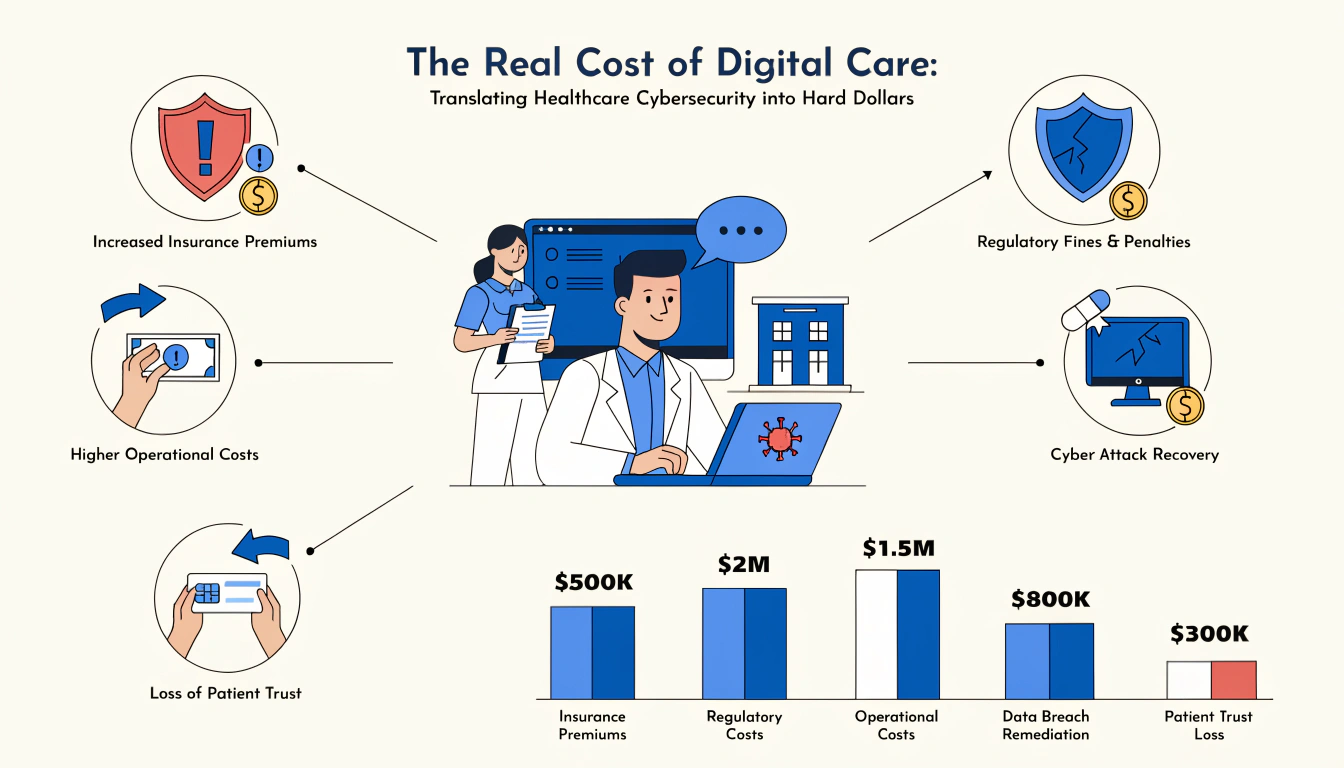
When a healthcare facility can present underwriters with a comprehensive, data-backed financial risk model, the entire dynamic shifts. It demonstrates to the insurer that the facility understands its core vulnerabilities and has strategically invested resources to mitigate the highest-dollar liabilities. This high level of transparency and analytical rigor frequently positions healthcare organizations to secure more competitive insurance premiums and better coverage terms.
Furthermore, a streamlined security environment reduces the ongoing operational burden on staff. Overcomplicated systems require specialized talent to manage them, which is incredibly difficult to retain in today’s competitive job market. A lean, financially optimized security architecture minimizes employee burnout, prevents alert fatigue among analysts, and keeps total cost of ownership low.
The New Standard for Healthcare Leadership
We are moving into an era where healthcare facilities can no longer afford to throw money blindly at technology problems. Cybersecurity can no longer live in an isolated silo, insulated from the economic realities of running a modern health system.
By translating digital risk into clear financial terms, healthcare organizations can foster absolute alignment between the technical teams working in the server rooms and the executives making decisions in the C-suite.
This approach transforms cybersecurity from a constant, ambiguous drain on capital into a sharp, measurable business advantage. It ensures that every single dollar spent on defense is a deliberate, strategic investment in the longevity of the institution, the continuity of care, and the protection of the bottom line.