Healthcare technology is evolving rapidly, and with it, the infrastructure that supports patient care, diagnostics, and clinical workflows. One key element gaining renewed importance is the data center — not as a relic of legacy IT, but as a core component of modern, hybrid healthcare architectures.
As health systems increasingly adopt digital tools like artificial intelligence (AI), advanced imaging, and connected clinical applications, their data needs are growing exponentially. In this landscape, effective data management isn’t just about storage — it’s about speed, reliability, security, and the ability to deliver data to clinicians exactly when and where it’s needed.
What Is a Hybrid Healthcare Infrastructure?
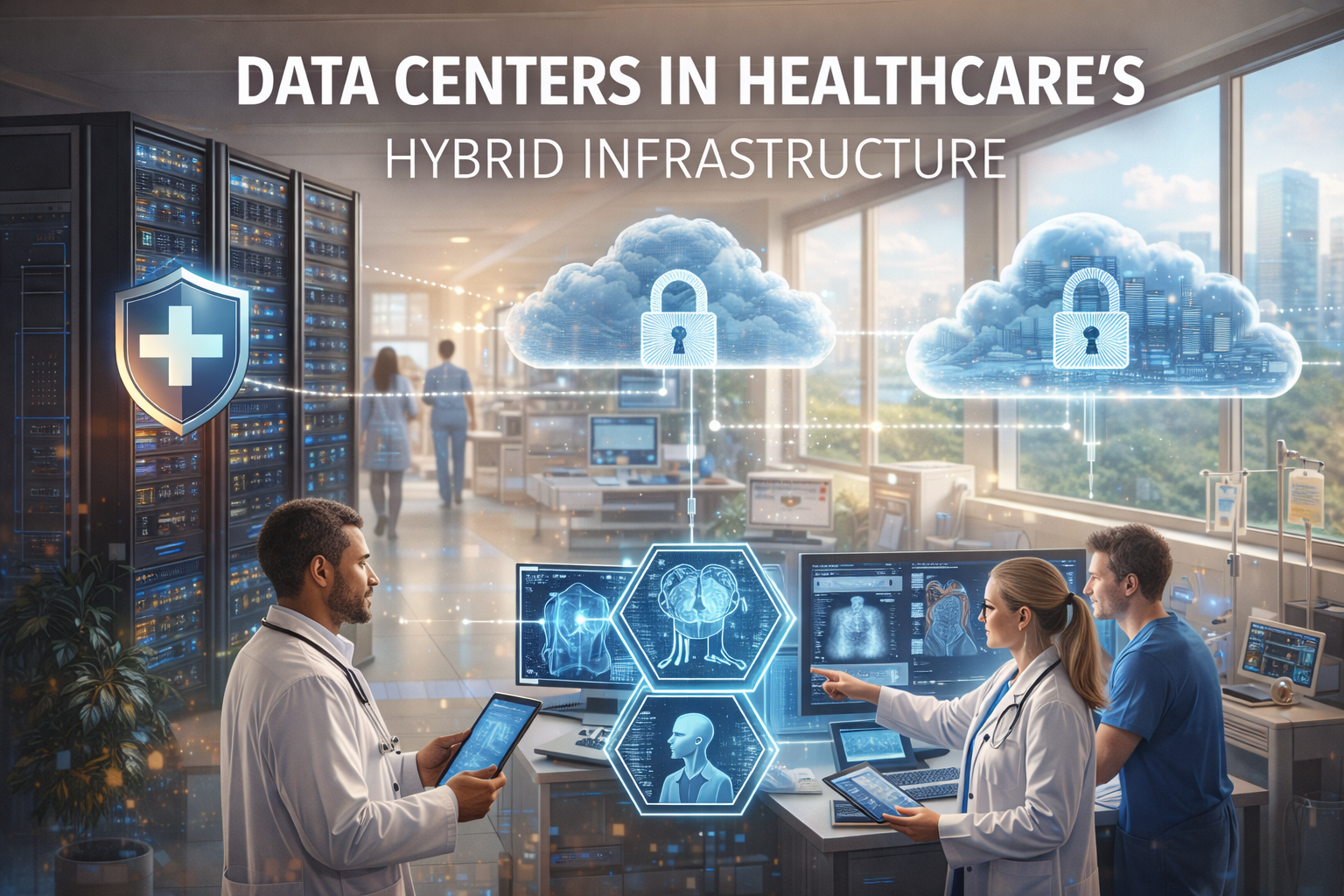
A hybrid infrastructure combines traditional on‑site data centers with cloud‑based systems to create a flexible, scalable, and secure technology environment. This model allows healthcare organizations to place different workloads in the environment that best serves their performance, compliance, and cost requirements.
In a hybrid strategy:
- Sensitive clinical data and mission‑critical applications often remain on‑site or in private environments where control and latency are priorities.
- Scalable services and analytics workloads migrate to cloud platforms that offer flexible compute capacity for advanced processing and large‑scale analytics.
This blended approach helps healthcare providers balance performance, regulatory requirements, and innovation with operational efficiency. It supports everything from real‑time diagnostics to telehealth services and AI‑enabled treatment planning.
Why Data Centers Still Matter in Healthcare
Even with widespread cloud adoption, on‑site data centers remain essential for several reasons:
1. Fast, Reliable Clinical Data Access
Clinical teams depend on rapid access to electronic health records, imaging studies, and lab results. Having data infrastructure physically closer to the point of care reduces latency and ensures that systems respond quickly under heavy workloads.
2. Support for AI and Advanced Workloads
AI tools and analytics platforms are becoming core components of modern healthcare — from interpreting medical images to supporting decision‑making. These applications require massive compute capacity and low‑latency access to data, which on‑site data centers can help deliver more consistently than cloud‑only setups.
3. Resilience and Redundancy
In a hybrid model, data centers act as a stable backbone. If cloud services are temporarily unavailable due to network issues, on‑site systems can continue supporting essential clinical operations. This resilience is especially critical in healthcare, where downtime directly affects patient care.
4. Security and Compliance Control
Healthcare data is some of the most sensitive in existence, governed by strict privacy and security standards. Keeping certain workloads, especially protected health information (PHI), on controlled, on‑site infrastructure enhances data protection and reduces risks associated with external data transfers.
How Hybrid Infrastructure Enhances Healthcare Delivery
The synergy between data centers and cloud platforms enables healthcare organizations to:
- Scale compute and storage dynamically for research, population health management, and AI training.
- Optimize costs by placing predictable, high‑security workloads on‑site while using cloud resources for peak demand and analytics.
- Improve uptime and reliability by distributing workloads across environments that can serve as failovers for each other.
- Support data‑driven innovation by pairing structured clinical data with scalable analytics tools.
With this hybrid approach, healthcare systems can move confidently into a future where data is not only stored securely but also used proactively to improve outcomes.
Operational Benefits for Healthcare IT Teams
Data centers integrated into hybrid infrastructure provide practical advantages:
Controlled Performance: On‑site systems can be fine‑tuned to the specific needs of clinical workflows and local network conditions.
Predictable Resource Planning: Healthcare IT teams can plan infrastructure growth based on usage patterns, reducing unexpected costs and performance bottlenecks.
Customized Security Frameworks: A hybrid model allows teams to implement tailored security controls for sensitive data while leveraging cloud security tools for scalable protection.
Looking Ahead: The Future of Healthcare Infrastructure
Healthcare’s digital transformation shows no signs of slowing. With the rise of connected devices, telemedicine, real‑time monitoring, and AI‑powered tools, data demands will only grow.
To meet these needs, healthcare organizations must continue evolving their hybrid infrastructures — leveraging robust data centers as the backbone that supports performance, resilience, and innovation. This evolution ensures that healthcare providers can safely harness the full potential of digital technologies without compromising speed, security, or patient care quality.
In short, data centers are far from obsolete — in a hybrid world, they are essential.