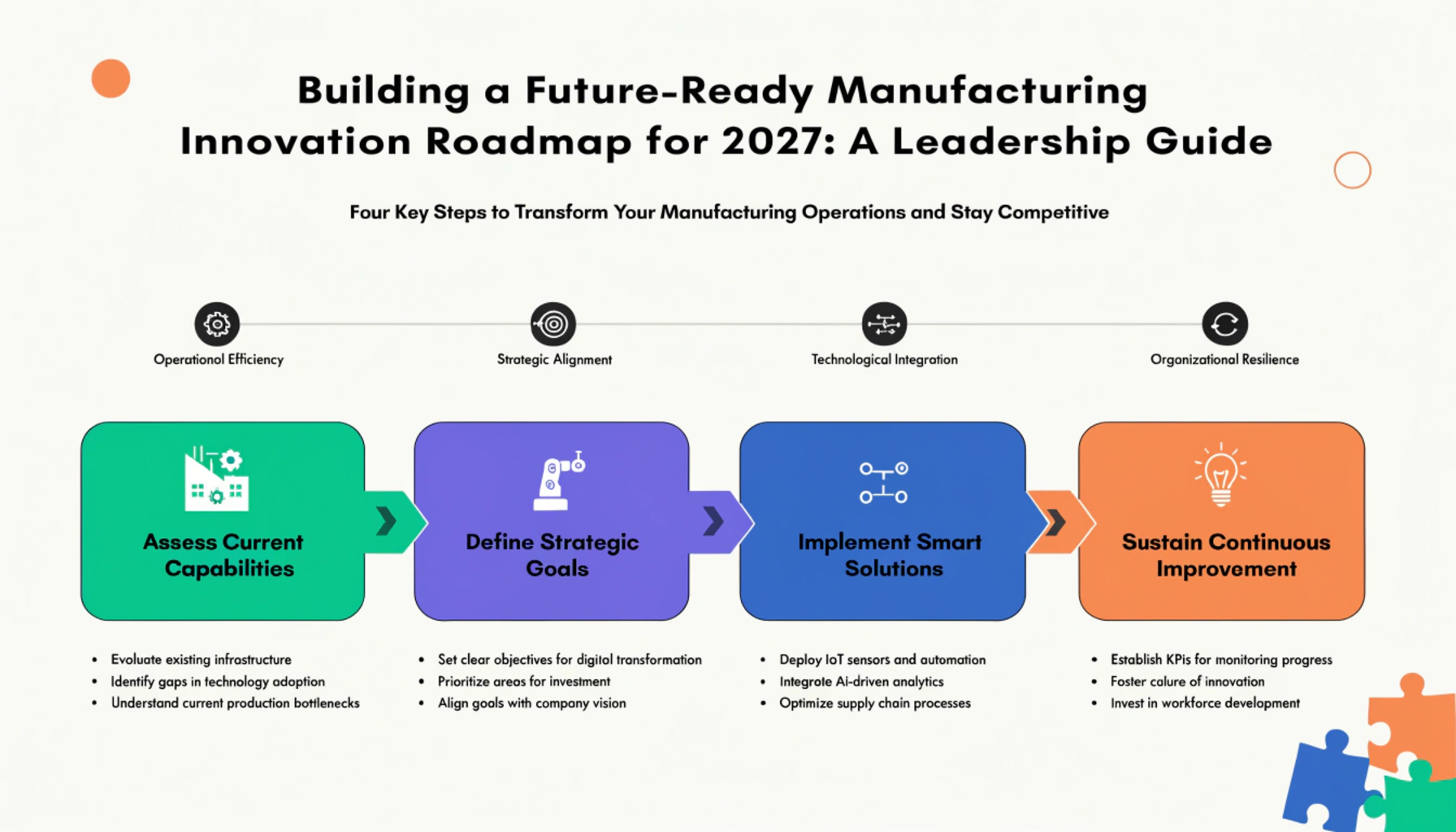
Manufacturing is entering a period where innovation is no longer simply about adopting the latest technology. For leadership teams, the bigger challenge is deciding which technologies, processes, and capabilities will create measurable business value in 2027 and beyond. Rising operating costs, supply-chain uncertainty, workforce challenges, sustainability expectations, and growing customer demands are pushing manufacturers to rethink how they innovate.
A well-designed manufacturing innovation roadmap 2027 can help organizations move from disconnected technology investments to a coordinated strategy. Instead of adopting automation, artificial intelligence, robotics, analytics, or connected systems simply because they are popular, leaders can prioritize initiatives based on business objectives, operational needs, investment capacity, and expected outcomes.
For manufacturers preparing for 2027, innovation should therefore be treated as a leadership priority rather than an isolated IT or engineering project.
What Is a Manufacturing Innovation Roadmap?
A manufacturing innovation roadmap is a structured plan that connects an organization’s long-term business objectives with the technologies, processes, skills, and investments required to achieve them.
The roadmap provides leadership with a clear view of where the organization is today, where it wants to be in the future, and what needs to happen to close the gap. It can include initiatives involving smart manufacturing, industrial automation, artificial intelligence, predictive maintenance, digital twins, robotics, industrial IoT, advanced analytics, cybersecurity, workforce development, and sustainable production.
The most effective roadmap does not attempt to implement every emerging technology. Instead, it identifies the innovations that can solve important business problems and create sustainable competitive advantages.
This is where effective manufacturing strategic planning becomes essential. Technology decisions should support measurable goals such as increasing productivity, improving quality, reducing downtime, lowering energy consumption, shortening production cycles, or improving supply-chain resilience.
Start With Business Objectives, Not Technology
One of the most common mistakes manufacturers make is starting the innovation process by asking, “What technology should we buy?”
Leadership teams should reverse this approach.
The first question should be: What business problems must we solve by 2027?
A manufacturer may want to increase production capacity without significantly expanding its workforce. Another organization may need to reduce scrap, improve product quality, or respond faster to changes in customer demand. Others may be focused on reducing energy consumption, improving equipment reliability, or building greater supply-chain visibility.
Once these objectives are clearly defined, technology becomes an enabler rather than the starting point.
For example, if the goal is to reduce unplanned downtime, predictive maintenance and machine-learning analytics may be valuable. If the objective is to improve production flexibility, robotics and automated material handling could be priorities. If management wants better visibility across operations, industrial IoT and real-time analytics may provide the foundation.
This business-first approach makes the manufacturing innovation roadmap 2027 more practical, measurable, and easier to justify financially.
Assess the Current Manufacturing Technology Landscape
Before planning future investments, leaders need a realistic understanding of their current operations.
A technology assessment should examine existing machinery, automation systems, enterprise software, production data, connectivity, cybersecurity, workforce capabilities, and operational processes.
Many manufacturers operate with a mixture of legacy equipment and newer digital technologies. Older machines may still deliver strong production performance but lack the connectivity required for real-time monitoring. Similarly, organizations may have large amounts of operational data but limited capabilities to convert that information into useful insights.
Leadership should identify these technology gaps and determine which ones are preventing the business from achieving its objectives.
This assessment should also consider data quality. Artificial intelligence and advanced analytics depend on reliable, accessible, and well-structured data. Investing in sophisticated AI systems without addressing poor data infrastructure can produce disappointing results.
The goal is to establish a clear baseline from which future innovation decisions can be made.
Identify the Technologies That Matter Most for 2027
The manufacturing technology landscape is expanding rapidly, but not every emerging solution deserves a place on every company’s roadmap.
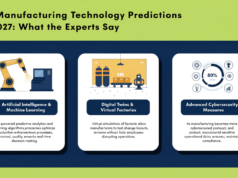
Artificial intelligence is likely to remain a major area of manufacturing investment. AI can support quality inspection, demand forecasting, predictive maintenance, process optimization, and production planning. However, manufacturers should evaluate AI projects based on specific use cases rather than treating AI adoption as an objective by itself.
Industrial IoT can provide greater visibility into equipment and production processes by connecting machines, sensors, and systems. Real-time information can help organizations detect problems earlier and make faster operational decisions.
Robotics and automation can address repetitive tasks, improve consistency, and help manufacturers manage workforce constraints. Collaborative robots may also provide opportunities to automate selected tasks while working alongside employees.
Digital twins can support simulation and optimization by creating digital representations of physical assets or processes. Manufacturers can use these capabilities to test changes before implementing them on the production floor.
Advanced analytics can help organizations identify patterns across production, maintenance, quality, and supply-chain data. Meanwhile, cybersecurity will become increasingly important as more machines and industrial systems become connected.
The key leadership decision is not simply which technologies are promising. It is determining which technologies align with the organization’s strategic priorities.
Prioritize Innovation Projects by Business Value
Once potential initiatives have been identified, leadership needs a consistent method for prioritization.
A practical roadmap can evaluate each initiative according to factors such as expected return on investment, implementation complexity, operational impact, scalability, risk, workforce requirements, and time to value.
Projects that solve urgent operational problems and have relatively low implementation complexity may become early priorities. More complex initiatives can be planned for later phases once the necessary infrastructure and capabilities are established.
This approach prevents innovation budgets from being spread too thinly across too many projects.
Leadership should also distinguish between pilot projects and enterprise-scale investments. A small proof of concept can help determine whether a technology delivers the expected results before significant capital is committed.
For example, a manufacturer could test predictive maintenance on a limited number of critical machines before expanding the solution across multiple facilities.
Build a Phased Roadmap
A successful manufacturing innovation roadmap 2027 should not be treated as a single-year technology shopping list. It should provide a sequence of initiatives that build upon one another.
The first phase can focus on foundational capabilities. This might include improving connectivity, standardizing data, upgrading cybersecurity, integrating systems, and developing workforce skills.
The next phase can introduce targeted automation, analytics, AI, or other technologies that directly support operational objectives.
Later phases can focus on scaling successful initiatives across facilities, integrating technologies, and developing more advanced capabilities.
This phased approach reduces implementation risk while creating opportunities to learn from earlier projects.
It also allows leadership to adjust priorities as market conditions, customer expectations, technology capabilities, and business requirements change.
Connect Innovation With Workforce Development
Technology transformation cannot succeed without people.
As manufacturers adopt more automation and digital systems, employees may need new skills in data analysis, robotics, automation engineering, cybersecurity, machine learning, and digital operations.
Leadership should therefore include workforce development as a core component of manufacturing strategic planning.
Training programs can help existing employees work effectively with new technologies instead of treating automation purely as a replacement for human labor. Operators may need training to interpret machine data, technicians may need new diagnostic skills, and managers may require stronger digital decision-making capabilities.
Manufacturers should also consider how future talent requirements will change. Partnerships with universities, technical institutions, training providers, and technology companies can help organizations develop a sustainable talent pipeline.
A technology roadmap without a people strategy is unlikely to deliver its full potential.
Establish Clear Innovation KPIs
Innovation initiatives should be measured using business outcomes rather than technology adoption alone.
Leadership teams can track metrics such as overall equipment effectiveness, unplanned downtime, production throughput, defect rates, scrap and rework, maintenance costs, energy consumption, labor productivity, order fulfillment times, and return on investment.
The right KPIs depend on the purpose of each initiative.
For example, an AI-based quality inspection project should be measured against defect detection accuracy, quality costs, inspection time, and customer returns. A predictive maintenance initiative should focus on downtime reduction, maintenance costs, equipment availability, and asset performance.
Clear KPIs make it easier for leadership to determine which projects should be expanded, redesigned, or discontinued.
Consider Cybersecurity and Risk From the Beginning
As manufacturing environments become increasingly connected, cybersecurity should be incorporated into innovation planning from the start.
Connected machines, industrial control systems, cloud platforms, remote access solutions, and IoT devices can create new points of vulnerability. A security issue affecting a connected production environment can have operational, financial, and reputational consequences.
Therefore, every major technology initiative should consider cybersecurity requirements during the planning and design stages.
Manufacturers should evaluate access controls, network segmentation, monitoring, software updates, data protection, employee awareness, and incident response capabilities.
Cybersecurity should not be treated as an additional step after technology has already been deployed. It should form part of the architecture of the innovation roadmap.
Align Sustainability With Manufacturing Innovation
Sustainability is increasingly becoming a business consideration rather than a separate corporate initiative.
Manufacturing innovation can support sustainability goals through energy-efficient equipment, intelligent energy management, process optimization, waste reduction, predictive maintenance, and improved resource utilization.
For example, real-time production data can help identify processes that consume excessive energy. Automation and analytics can reduce material waste by improving process consistency. Predictive maintenance can help equipment operate more efficiently and avoid unnecessary component replacement.
When sustainability objectives are incorporated into the innovation roadmap, organizations can pursue operational efficiency and environmental improvements together.
Create Strong Governance for Innovation
A roadmap requires clear ownership.
Leadership should establish a governance structure that defines who evaluates projects, who approves investments, who manages implementation, and who measures results.
Cross-functional participation is particularly important. Manufacturing, engineering, IT, finance, procurement, operations, HR, cybersecurity, and executive leadership may all have different perspectives on technology investments.
Bringing these stakeholders together can reduce organizational silos and improve decision-making.
An innovation governance model should also provide a mechanism for reviewing the roadmap regularly. Priorities should not remain fixed simply because they were approved at the beginning of the year.
Turn Pilots Into Scalable Solutions
Manufacturers frequently run successful technology pilots that never move beyond a single machine, production line, or facility.
Scaling should therefore be considered during the pilot stage.
Leadership should ask whether the technology can integrate with existing systems, whether employees can operate it effectively, whether the solution can be replicated across facilities, and whether the economics remain attractive at larger scale.
Standardized architectures and processes can make future scaling easier.
The objective should be to create a repeatable innovation model rather than a collection of isolated technology experiments.
A Leadership Framework for 2027
A strong roadmap can be organized around five leadership questions:
Where are we today?
Understand current technologies, processes, capabilities, data, workforce skills, and operational performance.
Where do we need to be by 2027?
Define measurable business and operational objectives.
Which innovations will close the gap?
Identify technologies and process improvements that directly support those objectives.
How will we implement and scale them?
Create phased initiatives with budgets, owners, timelines, skills requirements, and risk controls.
How will we measure success?
Establish KPIs and regularly evaluate whether each initiative is delivering measurable value.
These questions can turn an ambitious technology strategy into an actionable roadmap.
Preparing for a More Competitive Manufacturing Environment
The manufacturing companies that succeed in 2027 will not necessarily be those that adopt the greatest number of technologies. They will be those that understand how to combine technology, people, processes, and strategic decision-making effectively.
A successful manufacturing innovation roadmap 2027 should therefore be flexible enough to respond to emerging technologies while remaining disciplined enough to maintain focus on business value.
Leadership teams should avoid innovation for innovation’s sake. Instead, they should concentrate investment on initiatives that improve productivity, quality, resilience, sustainability, customer responsiveness, and long-term competitiveness.
The roadmap should also evolve continuously. As new technologies mature and business priorities change, manufacturers should reassess their assumptions, measure results, and update investment priorities.
Conclusion
Building an effective innovation roadmap requires more than selecting the latest manufacturing technologies. It requires leadership teams to understand current capabilities, define measurable objectives, prioritize high-value opportunities, develop workforce capabilities, manage cybersecurity risks, and create a practical path from pilot projects to enterprise-wide implementation.
For manufacturers preparing for 2027, the priority should be creating an integrated strategy where digital transformation and operational excellence work together.
Through disciplined manufacturing strategic planning, organizations can turn emerging technologies into measurable business outcomes. The companies that begin developing this roadmap now will be better positioned to respond to changing markets, workforce pressures, customer expectations, and competitive demands.
Ready to explore the future of smart manufacturing and automation? Register as a delegate and connect with industry leaders, technology experts, and manufacturing professionals shaping the next generation of industrial innovation.