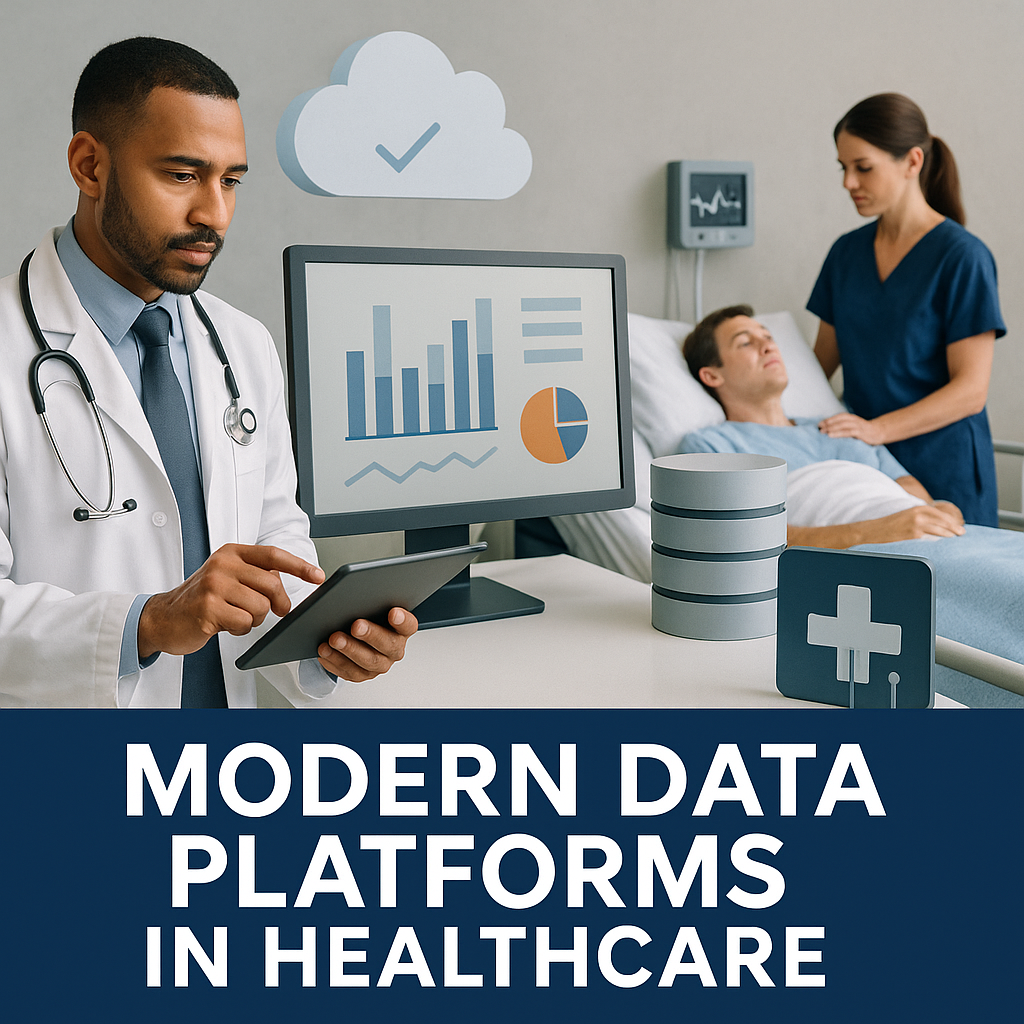
In 2025, as hospitals and healthcare systems navigate a complex digital environment, one thing is clear — data is at the center of everything. From clinical decision-making to operational efficiency, the ability to capture, analyze, and act on health data in real time has become essential.
Modern data platforms are emerging as foundational tools, enabling organizations to unify fragmented data, scale securely, and derive actionable insights faster — all while maintaining compliance with strict healthcare privacy laws.
The Problem with Legacy Healthcare Data Systems
Traditional healthcare IT environments are often built on siloed databases, aging infrastructure, and limited analytics capabilities. These limitations can result in:
- Delayed clinical decision-making
- Incomplete patient records
- Poor interoperability across departments or external partners
- High costs for system maintenance and upgrades
- Vulnerability to cyberattacks due to outdated architecture
To move forward, healthcare organizations are investing in modern data platforms that support real-time collaboration, data standardization, and analytics-driven workflows.
What Is a Modern Data Platform?
A modern data platform is a cloud-based or hybrid infrastructure that consolidates diverse data sources — such as electronic health records (EHRs), imaging systems, IoT devices, and financial databases — into a centralized, interoperable environment.
Core components include:
- Data ingestion pipelines for structured and unstructured sources
- Standardized APIs and HL7/FHIR compatibility
- AI/ML-powered analytics engines
- Data governance frameworks for access control and compliance
- Scalable cloud architecture for elasticity and remote access
Modern data platforms go beyond storing data — they enable smarter, faster, and more secure use of data across all levels of healthcare delivery.
Key Benefits of Modern Data Platforms in 2025
1. Real-Time Decision Support
Clinicians and administrators can access up-to-date dashboards, predictive models, and alerts to guide patient care, staffing, and resource allocation.
Impact: Faster response to clinical events, reduced delays in treatment, improved patient outcomes.
2. Enhanced Interoperability
Modern platforms are designed to integrate seamlessly with EHRs, lab systems, and external partners — breaking down barriers between departments and institutions.
Impact: Fewer manual handoffs, reduced duplication of testing, and smoother patient transitions between care settings.
3. Operational Efficiency and Cost Reduction
By consolidating infrastructure and automating reporting, healthcare organizations can cut IT maintenance costs, reduce errors, and streamline compliance tasks.
Impact: Lower administrative burden and improved productivity across departments.
4. Data-Driven Performance Improvement
Integrated data platforms provide health systems with a full view of KPIs, patient flows, and risk areas — enabling proactive improvement initiatives.
Impact: Better resource planning, population health management, and service optimization.
5. Scalability and Future-Proofing
Built for growth, these platforms can scale as patient volumes increase or new data sources emerge, without the need for expensive hardware investments.
Impact: Long-term sustainability in a fast-changing healthcare environment.
Strategic Considerations for Implementation
Implementing a modern data platform requires strategic alignment across IT, clinical leadership, and compliance teams. Key considerations include:
- Vendor selection: Choose platforms that support healthcare-specific standards and certifications (e.g., HITRUST, HIPAA).
- Data governance: Establish policies for who can access what data, how it’s used, and how it’s monitored.
- Training: Ensure that staff understand how to use new dashboards, analytics tools, and reporting interfaces.
- Change management: Communicate benefits clearly to stakeholders and address resistance to digital transformation.
Use Case Example: Performance Improvement in Action
A large regional health system integrated its EHR, supply chain, and staffing data into a modern data platform. Within six months, it reported:
- A 28% reduction in emergency department bottlenecks
- A 15% improvement in medication reconciliation accuracy
- Predictive analytics enabling pre-surgical risk scoring
- Near real-time reporting of infection control metrics
These results show how centralizing and activating healthcare data through a modern platform can drive measurable impact.
Conclusion: A Vital Investment for Smarter Healthcare
In 2025, healthcare organizations are expected to do more with less — and faster than ever. A modern data platform offers a unified, scalable foundation that transforms fragmented data into clinical intelligence and operational agility.
For hospitals and health systems aiming to thrive in a data-driven future, investing in a robust, interoperable, and secure data platform is no longer a luxury — it is a strategic imperative.