Data centers have become the backbone of modern business operations. From financial transactions and healthcare systems to cloud applications, manufacturing processes, and customer-facing platforms, organizations increasingly depend on continuous access to digital infrastructure. As this dependence grows, even a short data center outage can result in financial losses, operational disruption, compliance issues, and reputational damage.
This makes a data center disaster recovery plan more than an emergency document stored in a cabinet or shared drive. In 2026, it needs to be a practical, regularly tested strategy that helps organizations maintain critical services when infrastructure fails.
Power outages, cooling failures, cyberattacks, equipment breakdowns, natural disasters, human errors, network interruptions, and supply-chain disruptions can all affect data center availability. At the same time, the growing complexity of hybrid infrastructure, cloud environments, AI workloads, and interconnected systems makes recovery more challenging.
A successful disaster recovery strategy therefore needs to combine technology, people, processes, and continuous testing. The objective is not simply to recover after a disaster. It is to minimize downtime, protect critical data, maintain essential operations, and restore services in a controlled manner.
Why Disaster Recovery Matters More in 2026
Data center risks are evolving rapidly. Traditional disaster recovery approaches often focused on physical events such as fires, floods, hardware failures, or extended power outages. These threats remain important, but modern facilities face a much wider risk landscape.
Cybersecurity incidents are now a major consideration for infrastructure teams. A ransomware attack, for example, can affect production systems, backups, management platforms, and administrative credentials simultaneously. Simply having a backup is not enough if the backup environment can also be compromised.
At the same time, organizations are operating increasingly distributed infrastructure. Applications may depend on on-premises data centers, colocation facilities, cloud platforms, edge locations, and third-party providers. A failure in one part of this ecosystem can affect services elsewhere.
This is why data center business continuity and disaster recovery must work together. Business continuity focuses on keeping critical operations running, while disaster recovery focuses more specifically on restoring technology, applications, data, and infrastructure after disruption.
Start With a Business Impact Analysis
The first step in building a practical disaster recovery plan is understanding what needs to be protected.
A business impact analysis should identify critical applications, systems, services, data, and infrastructure dependencies. Not every workload requires the same recovery priority. A customer-facing payment platform, for instance, may need to be restored within minutes, while an internal reporting application may tolerate a longer interruption.
Organizations should determine which systems are essential to revenue generation, customer service, regulatory compliance, safety, and core operations.
The analysis should also identify dependencies. An application may appear independent but actually rely on specific databases, authentication services, DNS, network connections, storage systems, or external APIs.
Once these relationships are understood, recovery priorities become much clearer.
Define RTO and RPO
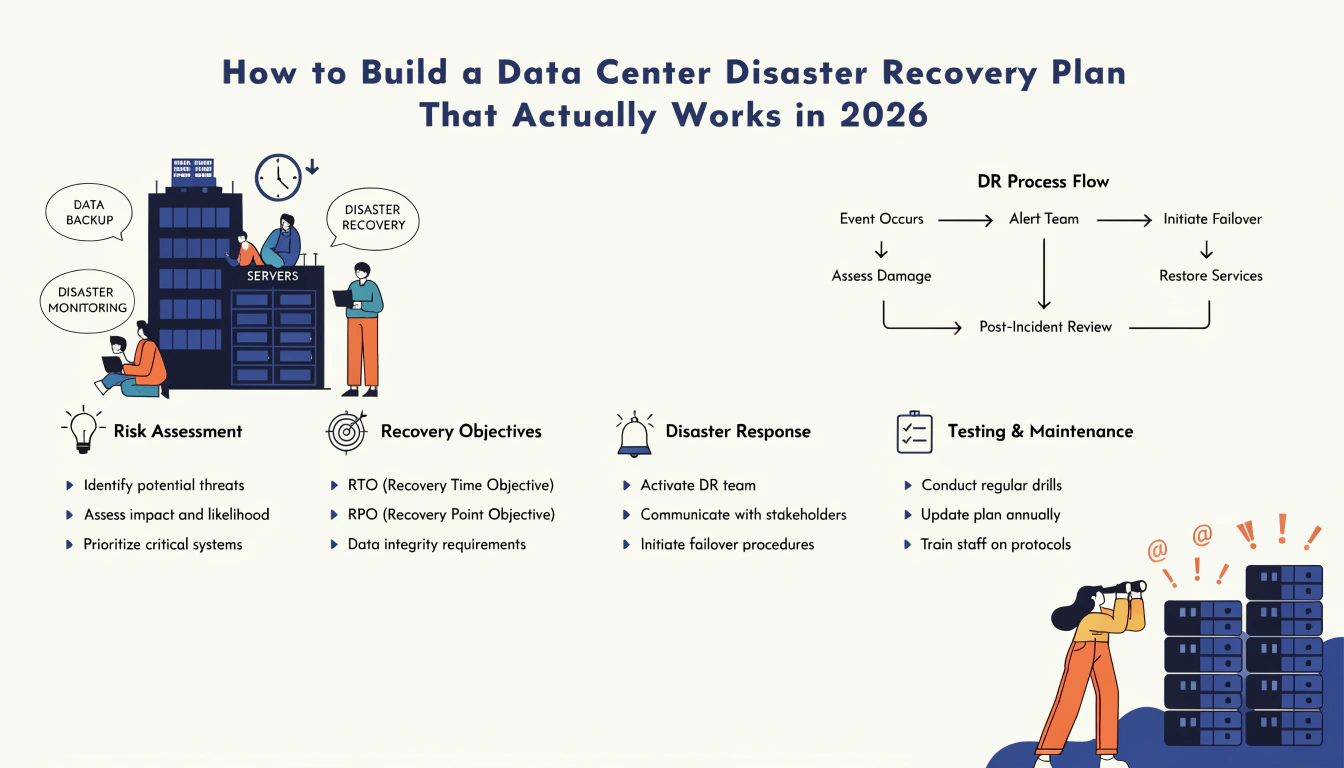
Two of the most important elements of a data center disaster recovery plan are Recovery Time Objective (RTO) and Recovery Point Objective (RPO).
RTO defines how quickly a system needs to be restored after an incident. If an application has an RTO of one hour, the recovery strategy should be designed to bring that service back within the required timeframe.
RPO defines how much data loss the business can tolerate, measured in time. For example, an RPO of 15 minutes means the organization should aim to recover data to a point no more than approximately 15 minutes before the disruption.
These objectives should be based on business requirements rather than simply selecting technically impressive targets. Extremely aggressive RTOs and RPOs can increase infrastructure costs significantly.
The goal is to establish recovery objectives that balance operational requirements, risk, and investment.
Identify Every Major Failure Scenario
A disaster recovery plan should not be designed around a single type of disaster.
Data center teams should assess a broad range of scenarios, including prolonged power failure, UPS or generator failure, cooling system breakdown, fire, flooding, extreme weather, network outage, hardware failure, storage corruption, software failure, cyberattack, ransomware, human error, physical security incidents, and third-party service disruption.
Cybersecurity deserves particular attention in 2026. Recovery plans should consider scenarios in which attackers compromise privileged accounts, encrypt production systems, disrupt backups, or interfere with management infrastructure.
Scenario planning allows organizations to determine whether existing recovery capabilities are actually sufficient.
Design a Resilient Infrastructure Architecture
A strong recovery plan cannot compensate for an infrastructure architecture that has a single point of failure.
Resilience should be incorporated into the design of critical systems. Depending on business requirements, organizations may use redundant power systems, multiple network paths, high-availability storage, clustered applications, geographically separated facilities, replicated databases, and redundant cooling infrastructure.
Geographic diversity can be especially important. If primary and recovery infrastructure are located too close together, the same flood, storm, regional power failure, or other event could affect both sites.
The right architecture depends on workload requirements and risk exposure. Some businesses may require an active-active environment, while others can operate effectively with a warm or cold recovery site.
The key is to match infrastructure investment to the consequences of downtime.
Build a Reliable Backup and Recovery Strategy
Backups are fundamental to disaster recovery, but simply creating backups does not guarantee recoverability.
Organizations should establish clear backup schedules based on RPO requirements and ensure that critical data is protected across appropriate storage environments. Backup systems should also be isolated sufficiently from production infrastructure to reduce the risk of an incident affecting both environments.
A strong strategy should consider multiple copies of critical data, different storage locations, and appropriate levels of logical or physical separation.
However, backup success reports are not enough. Teams need to verify that backups can actually be restored.
A backup that exists but cannot be recovered within the required timeframe provides a false sense of security.
Protect the Recovery Environment From Cyber Threats
Modern disaster recovery planning must integrate cybersecurity.
Recovery environments should have strong identity and access controls, multifactor authentication, appropriate network segmentation, secure administrative processes, monitoring, and controlled access.
Privileged accounts should be carefully managed because compromised administrator credentials can potentially allow attackers to disrupt both production systems and recovery infrastructure.
Organizations should also consider how they will recover if the primary identity platform, security tools, or management systems are unavailable.
Cyber recovery procedures should be documented separately where necessary and should include clear escalation processes. Recovery teams need to know which systems should be isolated, which services should be restored first, and how to verify that the environment is safe before reconnecting critical workloads.
Document Roles and Responsibilities
Technology alone cannot execute a disaster recovery strategy.
Every organization should clearly define who has authority to declare a disaster, who coordinates the response, who communicates with management, who restores infrastructure, who handles applications, and who works with external vendors.
Contact information should be maintained and reviewed regularly.
The plan should also account for staff availability. A disaster may occur outside normal working hours, during holidays, or when key personnel are unavailable. Recovery processes should therefore avoid depending entirely on one individual.
Clear responsibilities reduce confusion and help teams move from detection to response more quickly.
Make Communication Part of the Plan
Communication is often overlooked during disaster recovery planning.
When systems go offline, employees, customers, suppliers, executives, regulators, and service providers may all need information. Without a defined communication process, teams can provide inconsistent updates or waste valuable time deciding who should communicate what.
A practical plan should establish communication channels, escalation procedures, stakeholder responsibilities, and backup communication methods.
Organizations should also consider situations where normal email, collaboration platforms, or internal communication systems are unavailable.
Effective communication supports data center business continuity because stakeholders need timely information to make operational decisions during disruption.
Test the Plan Regularly
One of the biggest differences between a theoretical disaster recovery plan and a plan that actually works is testing.
Organizations should not wait for a real disaster to discover that a recovery process is outdated or incomplete.
Testing can range from tabletop exercises to technical recovery simulations. Teams can begin by discussing specific scenarios and then progress toward controlled failover and restoration exercises.
Testing should validate whether systems can be restored within their RTO and whether recovered data meets the required RPO.
It should also test human processes. Can employees find the recovery documentation? Do they know who makes decisions? Can the team contact vendors? Are emergency credentials accessible? Can systems be restored if the primary management platform is unavailable?
After every test, teams should document gaps, assign corrective actions, and establish deadlines for remediation.
Keep the Plan Updated
Data center infrastructure changes constantly. New servers are deployed, applications move to the cloud, network architectures evolve, vendors change, and employees take on new responsibilities.
A disaster recovery plan that was accurate two years ago may be ineffective today.
Organizations should therefore establish a regular review cycle. The plan should be updated whenever there is a major infrastructure change, application migration, vendor change, security incident, or organizational restructuring.
Documentation should be version-controlled so recovery teams can quickly identify the latest approved procedures.
Automation can also help. Where appropriate, infrastructure-as-code, automated failover procedures, configuration management, and orchestration tools can reduce manual recovery steps and improve consistency.
Measure Recovery Performance
A disaster recovery strategy should be measurable.
Organizations can track metrics such as actual recovery time, recovery point achieved, backup success rates, restoration success rates, test completion rates, unresolved recovery gaps, and system availability.
Comparing actual test results against RTO and RPO targets provides valuable insight into whether recovery capabilities are meeting business expectations.
For example, if a critical application has an RTO of 30 minutes but repeated exercises show that recovery takes two hours, the organization has a clear resilience gap that needs attention.
Measurement turns disaster recovery from a one-time documentation exercise into an ongoing improvement program.
Integrate Disaster Recovery With Business Continuity
A data center disaster recovery plan should never operate in isolation.
Data center business continuity requires organizations to understand how technology recovery connects with broader operational recovery. If the data center is restored but employees cannot access facilities, suppliers cannot deliver materials, or critical third-party services remain unavailable, business operations may still be disrupted.
Business continuity planning should therefore connect IT recovery with facilities, human resources, communications, finance, supply chains, cybersecurity, and executive decision-making.
This integrated approach helps organizations maintain essential services while full recovery is underway.
Build a Culture of Continuous Resilience
The most effective disaster recovery strategies are not created once and forgotten.
Resilience should become part of everyday data center management. Operations teams, IT professionals, cybersecurity specialists, facilities managers, business leaders, and vendors should understand their roles in maintaining continuity.
Regular exercises can improve organizational readiness. Lessons from incidents and near misses should be incorporated into future planning.
Organizations should also review emerging technologies and infrastructure trends that may influence their resilience strategy. As AI workloads, edge computing, cloud services, and increasingly distributed architectures continue to develop, disaster recovery requirements will evolve with them.
Conclusion
Building a data center disaster recovery plan that actually works in 2026 requires more than maintaining backups and writing emergency procedures. It requires a coordinated strategy built around business impact, recovery objectives, resilient infrastructure, cybersecurity, reliable backups, defined responsibilities, communication, testing, and continuous improvement.
The strongest plans are practical and measurable. They are tested under realistic conditions, updated as infrastructure changes, and connected directly to broader data center business continuity objectives.
For data center leaders, 2026 is an important opportunity to move disaster recovery from a compliance exercise to a strategic resilience capability. Organizations that invest in preparation today can reduce downtime, protect critical services, and respond more confidently when unexpected disruptions occur.
Want to explore the latest strategies, technologies, and best practices shaping data center resilience?
Enquire about BMA conventions to connect with industry-focused opportunities and gain insights into the future of data center facilities and operations.