Healthcare facilities are under constant pressure to deliver better patient care while controlling operating costs. For hospitals and health systems, the challenge extends far beyond clinical operations. Aging infrastructure, equipment failures, emergency repairs, energy consumption, labor costs, inventory waste, and compliance requirements can create millions of dollars in avoidable expenses every year.
This is where data-driven facility management is changing the way healthcare organizations operate.
A modern Computerized Maintenance Management System (CMMS) can bring maintenance, asset information, work orders, inspections, inventory, and facility performance data into one centralized platform. When that information is analyzed consistently, facility leaders can move away from reactive maintenance and make decisions based on measurable operational trends.
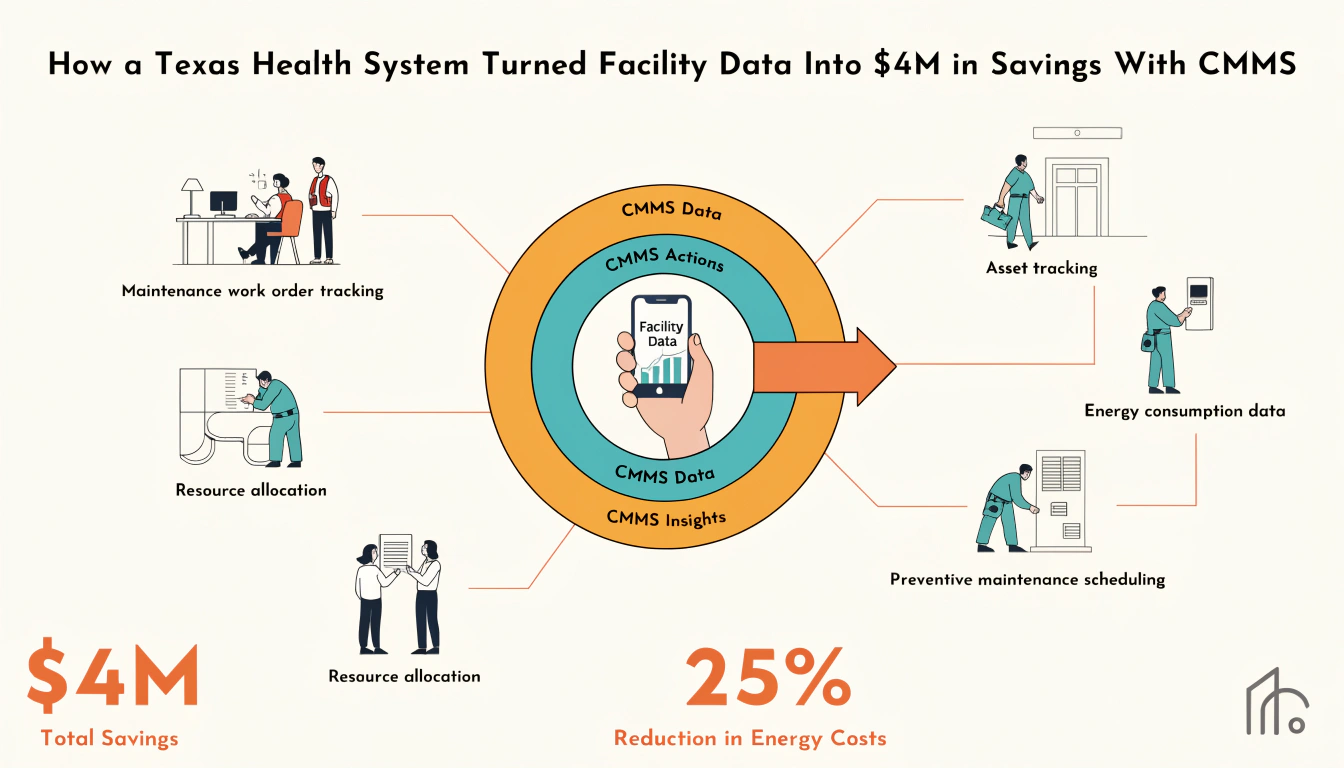
Consider a representative Texas health system with multiple hospitals and outpatient facilities. By integrating CMMS into its facility management strategy and using healthcare facility data analytics to identify recurring inefficiencies, the organization created a roadmap that generated approximately $4 million in cumulative savings.
The important lesson is not simply the size of the savings. It is how the health system used maintenance data to find hidden costs and turn them into opportunities for improvement.
The Problem: Healthcare Facilities Were Running on Reactive Maintenance
Before implementing a data-driven approach, the health system faced a familiar problem. Maintenance teams were working hard, but much of their time was spent responding to emergencies rather than preventing them.
A broken HVAC component could result in an urgent service call. A malfunctioning pump might require an emergency replacement. Preventive maintenance schedules could be difficult to track across multiple buildings. Technicians might also spend significant time searching for asset histories, locating spare parts, or manually updating work orders.
These problems create more than maintenance inconvenience.
A failed critical asset can disrupt clinical operations, affect patient comfort, increase energy consumption, and create unexpected capital expenditure. In a hospital environment, even a relatively small equipment failure can have consequences that extend beyond the maintenance department.
The health system therefore needed a way to answer several fundamental questions:
Where are maintenance costs increasing?
Which assets are generating the most work orders?
Which equipment repeatedly fails?
How much maintenance is preventive versus reactive?
Where are spare parts being overstocked?
Which facilities consume the most resources?
And perhaps most importantly, which problems should facility leaders address first?
The answer was not another spreadsheet. It was better operational data.
Building the Foundation With CMMS
The health system began by standardizing its facility management information through a CMMS platform.
A CMMS creates a centralized digital record of assets and maintenance activities. Instead of keeping information across paper records, spreadsheets, emails, and individual technician knowledge, facility teams can manage critical information from a common system.
For a healthcare organization, this can include HVAC equipment, boilers, chillers, generators, pumps, electrical systems, medical support infrastructure, elevators, fire protection systems, plumbing assets, and other building systems.
Each asset can have an associated history containing maintenance activities, service requests, inspections, repair costs, parts usage, and technician information.
This seemingly simple shift creates an important advantage: maintenance activity becomes measurable.
Facility leaders can begin comparing assets based on frequency of failure, repair costs, downtime, age, maintenance requirements, and overall performance.
That data becomes the foundation for healthcare facility data analytics.
From Maintenance Records to Actionable Insights
Collecting data alone does not produce savings. The real value comes from analyzing that information and turning it into operational decisions.
The Texas health system began examining work-order patterns across its facilities. One of the first discoveries was that certain assets were responsible for a disproportionately high number of emergency calls.
Instead of treating each breakdown as an isolated event, facility managers could now identify recurring patterns.
For example, if the same type of air-handling unit repeatedly generated work orders, the team could investigate whether the problem was related to its age, operating conditions, maintenance schedule, replacement parts, or installation.
This changed the conversation.
Rather than asking, “How quickly can we repair this equipment?” facility managers could ask, “Why does this equipment keep failing?”
That distinction is at the heart of data-driven facility management.
Reducing Reactive Maintenance
Reactive maintenance can be expensive because it often occurs at the worst possible time.
Emergency service calls may require premium labor rates. Replacement parts may need expedited shipping. Technicians may have to interrupt scheduled work. In a hospital, equipment downtime can also affect departments and create operational disruption.
The health system used CMMS data to gradually increase its focus on preventive and predictive maintenance.
Maintenance teams established recurring schedules for critical assets and used automated reminders to ensure inspections and servicing occurred on time.
Over time, this helped reduce the number of unexpected breakdowns.
The goal was not to perform maintenance on every asset at the same frequency. Instead, the organization used asset history and risk to determine where preventive maintenance created the greatest value.
High-risk assets received greater attention, while lower-risk equipment could be maintained according to appropriate intervals.
This risk-based approach helped technicians spend their time where it mattered most.
Identifying the Hidden Cost of Equipment Failures
One of the most important benefits of CMMS was that it allowed the health system to calculate the true cost of recurring failures.
Previously, a repair might have been recorded simply as a maintenance expense.
With more complete data, facility managers could examine the total cost associated with an asset, including labor, parts, emergency service, downtime, repeat repairs, and operational disruption.
Suppose an HVAC component requires several repairs each year. Individually, each repair may seem manageable. However, when the organization combines labor, replacement parts, contractor costs, and downtime, the annual expense may make continued repair less economical than replacement.
CMMS data therefore helped transform capital planning.
Instead of replacing equipment based solely on age, facility managers could build a business case based on actual maintenance history and lifecycle cost.
This allowed leadership to prioritize capital investments more effectively.
Better Inventory Management Created Another Savings Opportunity
Maintenance inventory can represent a significant hidden cost for healthcare organizations.
Without reliable usage data, facilities may overstock certain spare parts “just in case.” At the same time, critical parts may be unavailable when technicians actually need them.
The health system used CMMS inventory data to examine which parts were frequently consumed, which items remained unused, and which components were associated with high-priority equipment.
This helped the organization move toward more controlled inventory management.
Instead of maintaining excessive stock across multiple locations, teams could use historical consumption patterns to improve stocking levels.
Better inventory visibility also reduced the risk of technicians delaying repairs because the required part could not be located.
The resulting savings came from several directions: reduced excess inventory, fewer emergency purchases, improved purchasing decisions, and reduced downtime.
Improving Technician Productivity
Facility maintenance costs are not only about equipment and parts. Labor represents a major component of operating expenses.
A technician who spends significant time searching for asset information, manually processing paperwork, locating parts, or traveling unnecessarily between facilities is not spending that time performing maintenance.
CMMS helped streamline work-order management.
Technicians could receive assignments digitally, review asset histories, document completed work, and update maintenance records from the field. Managers could prioritize requests based on urgency, asset criticality, and operational impact.
This improved visibility across the maintenance department.
Managers could also identify workload imbalances and determine whether certain facilities or teams required additional support.
As the system matured, productivity improvements became measurable through metrics such as work-order completion time, preventive maintenance compliance, response time, repeat repairs, and technician utilization.
Using Healthcare Facility Data Analytics for Energy and Asset Decisions
The CMMS did not operate in isolation.
The health system increasingly viewed maintenance information alongside facility performance data, energy information, equipment condition, and operational trends.
This broader approach to healthcare facility data analytics made it easier to identify relationships between maintenance and energy performance.
For example, poorly maintained HVAC equipment can operate inefficiently. Filters, motors, controls, pumps, and other components can influence system performance.
When maintenance records are compared with building performance data, facility teams can identify opportunities that might otherwise remain hidden.
This creates a more complete picture of facility performance.
Instead of managing maintenance, energy, assets, and capital planning as separate functions, leaders can begin treating them as connected elements of one facility strategy.
Measuring the $4M Opportunity
The approximately $4 million savings opportunity in this illustrative Texas health-system scenario did not come from a single maintenance initiative.
It came from multiple improvements working together.
Reduced emergency repairs lowered service and labor expenses. Better preventive maintenance reduced repeat failures. More informed asset replacement decisions helped prevent unnecessary repair spending. Inventory optimization reduced excess stock and emergency purchases. Improved technician productivity increased the value generated from existing maintenance resources.
The organization could then track savings against a baseline.
This is critical because facility leaders need to demonstrate that technology investments are producing measurable returns.
A CMMS should not be viewed simply as software expenditure. It should be evaluated based on outcomes such as lower maintenance costs, improved asset reliability, reduced downtime, better preventive maintenance compliance, optimized inventory, and improved labor utilization.
Why Data Quality Matters
One of the biggest lessons from any CMMS implementation is that technology is only as effective as the data entered into it.
If asset records are incomplete, equipment is incorrectly classified, work orders are not closed properly, or technicians fail to document repairs, the resulting analytics will be unreliable.
Healthcare organizations should therefore establish data standards from the beginning.
Asset naming conventions, equipment classifications, maintenance codes, work-order categories, priority levels, and cost information should be standardized across facilities.
Training is equally important.
Technicians need to understand why accurate information matters. Facility managers need to know how to interpret dashboards and reports. Leadership needs to use the information consistently when making operational and capital decisions.
The objective is to make data part of the facility management culture rather than treating CMMS as an administrative system.
Creating a Repeatable Data-Driven Facility Management Model
The Texas example demonstrates a broader opportunity for healthcare organizations.
A successful approach can be built around a continuous cycle:
Capture accurate facility data.
Analyze maintenance and asset trends.
Identify the highest-value opportunities.
Implement targeted improvements.
Measure the financial and operational results.
Then repeat the process.
This approach prevents facility management from becoming a one-time technology project.
As more data accumulates, the organization can improve forecasting and identify emerging issues earlier.
Over time, facility teams may move from preventive maintenance toward condition-based and predictive strategies where appropriate. Sensors, building automation systems, IoT platforms, energy management systems, and analytics tools can further expand the amount of information available to facility leaders.
The long-term objective is not simply fewer work orders. It is a safer, more reliable, more efficient healthcare environment.
What Other Health Systems Can Learn
The biggest takeaway from the $4 million savings scenario is that cost reduction does not necessarily require cutting essential services.
Healthcare organizations can often find substantial savings by improving the way their existing facilities are managed.
CMMS provides the infrastructure for collecting maintenance and asset information. Healthcare facility data analytics provides the intelligence needed to interpret that information.
Together, they can help facility leaders understand where money is being spent, why costs are increasing, which assets are creating risk, and where investments will have the greatest impact.
The journey should begin with a clear baseline.
A health system should understand its current maintenance costs, preventive maintenance performance, emergency work order volume, asset condition, inventory levels, labor utilization, and equipment failure rates.
From there, leadership can identify measurable targets.
The most effective organizations then treat facility data as a strategic resource rather than an administrative by-product.
The Future of Hospital Facility Management Is Data-Driven
Healthcare facilities are becoming increasingly complex. Hospitals now depend on sophisticated HVAC systems, energy infrastructure, digital building controls, backup power, critical equipment, connected assets, and increasingly integrated technology platforms.
Managing that complexity with disconnected spreadsheets and reactive processes is becoming increasingly difficult.
CMMS gives healthcare facility teams a structured way to manage assets and maintenance activities. When combined with analytics, it can turn thousands of individual work orders into meaningful insights about cost, reliability, risk, and performance.
The illustrative Texas health-system case shows what can happen when those insights are acted upon systematically: millions of dollars in potential savings can emerge from improvements that individually may appear small but collectively have a major financial impact.
For healthcare leaders, the opportunity is bigger than reducing maintenance expenses. It is about building facilities that are more reliable, efficient, resilient, and ready to support patient care.
The next generation of hospital facility management will be defined by organizations that can turn facility data into better decisions.
Enquire About BMA Conventions
Want to explore emerging strategies for smarter, more efficient healthcare facilities? Connect with industry professionals, technology experts, and facility leaders at upcoming healthcare industry events.
Enquire about BMA conventions: BMA Healthcare Facilities Convention 2026