As data centers move toward higher rack densities, AI workloads, accelerated computing, and increasingly power-hungry infrastructure, cooling has become one of the most important factors influencing facility performance and operating costs. For years, traditional air cooling was the default choice for most facilities. However, the rapid growth of AI and high-density computing is changing that equation.
This has made air cooling vs liquid cooling data center strategies increasingly important considerations for facility managers, data center operators, IT leaders, and infrastructure planners.
At first glance, air cooling can appear to be the more economical option because it relies on familiar equipment and established infrastructure. Liquid cooling, meanwhile, often requires additional investment in cooling distribution units, piping, heat exchangers, manifolds, controls, and compatible IT equipment.
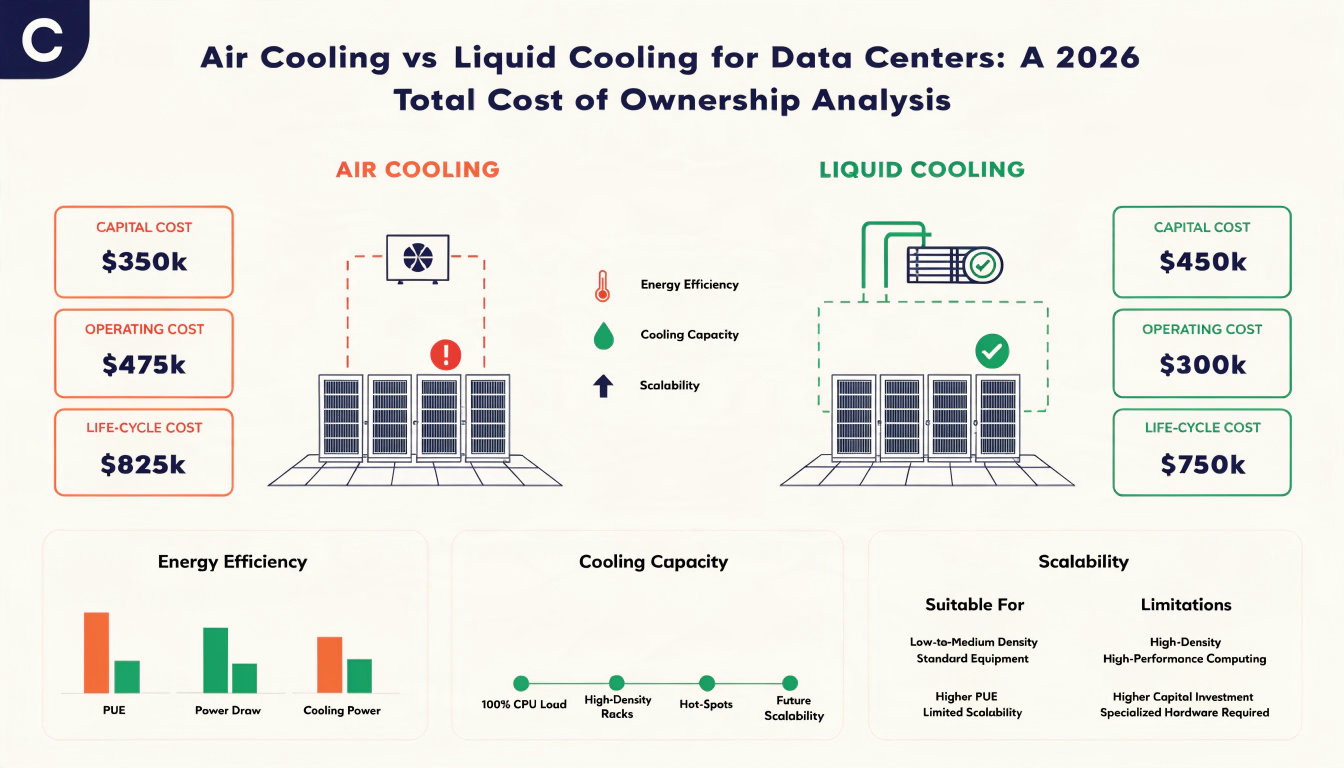
However, comparing only the initial installation price does not provide a complete picture. A more useful approach is to examine the data center cooling TCO over the expected life of the facility. This includes capital expenditure, energy consumption, maintenance, infrastructure requirements, water usage, scalability, equipment density, and the operational impact of cooling technology.
In 2026, the right question is no longer simply, “Which cooling technology costs less?” Instead, operators need to ask, “Which cooling strategy delivers the lowest total cost while supporting the workloads my data center will run over the next several years?”
Understanding Air Cooling and Liquid Cooling
Air cooling uses air as the primary medium for removing heat from servers and other IT equipment. Computer room air conditioning (CRAC) units, computer room air handlers (CRAHs), fans, chillers, cooling towers, containment systems, and air distribution infrastructure work together to maintain acceptable operating temperatures.
Traditional air cooling remains widely deployed because it is familiar, relatively straightforward to maintain, and compatible with a large range of conventional servers.
The challenge emerges as rack power density increases.
High-density AI servers and accelerated computing systems can generate substantially more heat within the same physical footprint than conventional enterprise workloads. Moving enough air across increasingly dense racks requires significant airflow, fan power, cooling capacity, and carefully designed airflow management.
Liquid cooling takes a different approach by transferring heat through a liquid medium. Depending on the architecture, cooling can be delivered directly to components through cold plates, circulated through rear-door heat exchangers, or implemented through immersion cooling.
Because liquids can transfer heat much more efficiently than air, liquid cooling can support higher rack densities while reducing the amount of air movement required.
That difference is at the center of the air cooling vs liquid cooling data center discussion in 2026.
Why Total Cost of Ownership Matters in 2026
The initial capital investment is only one component of a data center’s cooling economics.
A facility may spend less upfront on an air-based system but incur higher electricity costs over many years. Another facility could invest more heavily in liquid cooling infrastructure but achieve better energy efficiency and support significantly greater compute density.
A comprehensive data center cooling TCO analysis should therefore consider several cost categories.
The first is capital expenditure, including cooling equipment, pumps, piping, chillers, heat exchangers, cooling distribution units, containment systems, controls, and installation.
The second is operating expenditure. This includes electricity for chillers, pumps, fans, cooling towers, and other cooling equipment, as well as maintenance and replacement costs.
The third is capacity utilization. If a cooling system allows a facility to deploy more compute within the same physical footprint, the value of that additional capacity can have a major effect on TCO.
Finally, operators should consider future expansion. A cooling architecture that works well at today’s rack densities may become expensive or impractical if workloads become significantly more demanding.
Air Cooling: Lower Entry Cost, Familiar Infrastructure
One of the biggest advantages of air cooling is its maturity.
Most data center operators already understand how to design, operate, troubleshoot, and maintain air-based cooling systems. Existing facilities may also have substantial investments in CRAC or CRAH units, chillers, air handlers, containment, ducting, and associated infrastructure.
This familiarity can reduce training requirements and simplify maintenance.
Air cooling can also be economical for low- and medium-density environments. If a data center primarily supports conventional enterprise applications, storage, networking, and moderate-density computing, replacing or expanding an established air-cooling system may make financial sense.
However, air cooling becomes more challenging as rack density rises.
Higher-density racks require greater airflow and more cooling capacity. Poor airflow management can lead to hot spots, recirculation, and uneven temperatures. Operators may need additional cooling units, containment, floor-level modifications, or upgraded power and mechanical infrastructure.
The result is that the cost advantage of air cooling can narrow as computing density increases.
Liquid Cooling: Higher Investment With Potential Long-Term Benefits
Liquid cooling typically requires more specialized infrastructure than traditional air cooling.
Depending on the design, this could include cooling distribution units (CDUs), piping loops, pumps, heat exchangers, manifolds, monitoring systems, leak detection, and liquid-compatible IT hardware.
This can increase upfront capital expenditure.
Yet liquid cooling can offer important economic advantages in high-density environments.
Because liquid is highly effective at transferring heat, operators can cool powerful processors more directly and efficiently. This can make it easier to support AI clusters, GPUs, high-performance computing, and other demanding workloads without continuously increasing airflow.
Liquid cooling can also reduce the amount of heat that must be handled through traditional room-level air systems.
For new facilities designed around high-density computing, this can influence the overall mechanical design and potentially reduce the need for oversized air-handling infrastructure.
The financial value becomes particularly important when the facility’s primary objective is to maximize compute capacity per rack, cabinet, or square foot.
Comparing Energy Costs
Energy consumption is one of the most important factors in a data center cooling TCO calculation.
Air cooling requires fans to move large volumes of air, while chillers, compressors, pumps, and cooling towers may also consume significant amounts of energy depending on the system design and climate.
As rack density increases, the amount of airflow required to remove heat can increase substantially.
Liquid cooling can reduce reliance on high-volume air movement because heat is captured closer to its source. In some configurations, this can reduce cooling-related energy consumption.
However, it would be inaccurate to assume that every liquid cooling deployment automatically delivers lower total energy costs.
Pumps, CDUs, heat exchangers, chillers, and other components also consume energy. The actual savings depend on the liquid cooling architecture, facility design, climate, workload, operating temperatures, and heat rejection strategy.
Therefore, operators should evaluate actual system-level performance rather than comparing individual components in isolation.
Water Usage and Its Role in TCO
Water is another factor that is becoming increasingly important in data center planning.
Some cooling systems rely on evaporative cooling or cooling towers, which can create water consumption and associated treatment costs. Water availability and local environmental restrictions may also influence future expansion.
Liquid cooling does not necessarily eliminate water usage because the facility still needs a method of rejecting heat. However, certain designs can operate with reduced dependence on evaporative cooling or can integrate alternative heat rejection approaches.
For data center operators operating in water-stressed regions, the value of reducing water consumption may extend beyond direct utility savings.
Lower water dependence can support sustainability objectives, reduce exposure to future restrictions, and make expansion easier to justify.
Consequently, water should be included as part of the broader data center cooling TCO model rather than treated only as an environmental metric.
Maintenance and Operational Costs
Maintenance is another area where the two technologies can differ significantly.
Air cooling uses well-established equipment and maintenance practices. Technicians are generally familiar with filters, fans, compressors, chillers, CRAHs, CRACs, and associated controls.
Liquid cooling introduces additional components and operational considerations. Pumps, CDUs, piping, connectors, manifolds, fluid quality, and leak detection systems may require specialized procedures.
This can increase the need for staff training and specialized maintenance capabilities.
At the same time, liquid cooling can potentially simplify certain aspects of heat management by moving heat directly away from high-density components.
The most economical option therefore depends on the facility’s operating model, available technical expertise, equipment configuration, and maintenance strategy.
Space Efficiency and Data Center Capacity
Space is one of the most valuable resources inside a modern data center.
A conventional air-cooled facility may require significant space for air-handling equipment, airflow pathways, containment systems, and cooling infrastructure.
Liquid cooling can help operators manage high-density racks without requiring the same volume of airflow infrastructure.
This creates an important TCO consideration that is sometimes overlooked: capacity per square foot.
If liquid cooling allows an operator to deploy substantially more computing power in an existing facility, the technology may provide economic value even if the cooling equipment itself costs more.
For facilities with expensive real estate or limited expansion space, increasing compute density can be more financially attractive than building additional floor space.
Scalability: Planning for the Next Five to Ten Years
A cooling system should not be selected solely based on today’s server specifications.
AI adoption, accelerated computing, high-performance analytics, and other emerging workloads are pushing rack densities higher. A facility designed around today’s average rack may face significant limitations when future hardware requires much greater thermal management capacity.
Air cooling can remain an effective solution for moderate-density workloads, particularly when the facility has sufficient space and electrical capacity.
For environments expecting sustained high-density growth, liquid cooling can offer a more scalable pathway.
This does not necessarily mean that operators need to convert an entire facility to liquid cooling immediately. Hybrid strategies can allow organizations to continue using air cooling for conventional workloads while deploying liquid cooling for high-density zones.
For many operators, this approach can provide a practical balance between existing infrastructure and future requirements.
Air Cooling vs Liquid Cooling Data Center: Which Has the Lower TCO?
There is no universal winner.
For lower-density workloads, an existing air-cooled data center may deliver the lowest TCO because the infrastructure is already installed, staff are familiar with the technology, and the facility does not require expensive modifications.
For high-density AI and HPC environments, however, the economics can shift toward liquid cooling.
The additional capital investment may be justified by greater rack density, improved heat transfer, potentially lower cooling energy requirements, better use of available space, and greater long-term scalability.
The most useful comparison is therefore not simply air versus liquid. Operators should evaluate the total cost of ownership under their specific workload and facility conditions.
A practical 2026 evaluation should consider:
- Current and projected rack density
- IT load and expected growth
- Cooling infrastructure capital costs
- Cooling-related electricity consumption
- Water consumption and treatment
- Maintenance and staffing requirements
- Available data center floor space
- Future AI and high-performance computing requirements
- Expected facility lifespan
- Potential retrofit and expansion costs
These variables can produce dramatically different results from one data center to another.
The Case for Hybrid Cooling Strategies
For many organizations, the most practical answer may not be choosing one technology exclusively.
A hybrid approach can use air cooling for conventional racks while introducing direct-to-chip liquid cooling or other liquid technologies for high-density deployments.
This approach allows operators to preserve existing infrastructure while gradually adapting to new workloads.
It can also reduce transition risk. Instead of redesigning an entire facility, organizations can establish dedicated high-density zones and evaluate performance before expanding liquid cooling further.
For facilities undergoing phased modernization, hybrid cooling may provide an effective path between today’s infrastructure and tomorrow’s computing requirements.
How Data Center Leaders Should Approach a 2026 TCO Analysis
A successful cooling evaluation should begin with the workload rather than the technology.
Start by identifying current rack densities, server types, power requirements, and expected workload growth. Next, calculate the cooling capacity required under both air and liquid scenarios.
Then model capital costs and operating costs over the expected lifecycle of the infrastructure.
For example, a facility should compare not just the purchase price of an air-conditioning system against a liquid- cooling system, but also the electricity consumed over five, seven, or ten years. The model should include maintenance, replacement, water, space utilization, expansion, and potential retrofit expenses.
Operators should also consider the cost of stranded capacity.
If an air-cooled facility cannot support the density required by future AI hardware, the organization could be forced to build additional capacity or perform expensive upgrades. Those future costs belong in today’s TCO analysis.
Conclusion: Cooling Strategy Is Now a Business Decision
The debate around air cooling vs liquid cooling data center infrastructure has moved beyond a purely technical discussion.
In 2026, cooling technology can directly influence data center capacity, energy costs, sustainability performance, scalability, and the financial return on infrastructure investments.
Air cooling remains a strong choice for many conventional and moderate-density environments, particularly where existing infrastructure can be utilized efficiently.
Liquid cooling becomes increasingly compelling as rack densities rise and AI, GPU, and high-performance computing workloads become a larger part of the data center portfolio.
The right decision ultimately depends on the facility’s workload profile, energy environment, available space, capital budget, and long-term growth strategy.
For data center leaders, the goal should not be to select the newest cooling technology simply because it is newer. Instead, the goal should be to identify the cooling architecture that delivers the best combination of performance, efficiency, reliability, scalability, and lifecycle economics.
As high-density computing continues to reshape infrastructure planning, understanding data center cooling TCO will become increasingly important for making informed investment decisions.
Explore the Future of Data Center Infrastructure
Want to learn how facility leaders are approaching cooling, power, efficiency, high-density computing, and next-generation infrastructure?
View convention session topics and explore the discussions shaping the future of modern data center facilities.