Manufacturing businesses increasingly rely on digital systems to improve productivity, control costs, manage resources, and respond quickly to changing customer demands. As factories become more connected and data-driven, two software platforms frequently appear in manufacturing technology discussions: Enterprise Resource Planning (ERP) and Manufacturing Execution Systems (MES).
Although ERP and MES are both essential components of modern manufacturing technology, they serve different purposes. Understanding the difference between them is important for manufacturers deciding where to invest in digital transformation. The question is not always about choosing ERP vs MES manufacturing software. In many cases, the most effective approach is to use both systems together.
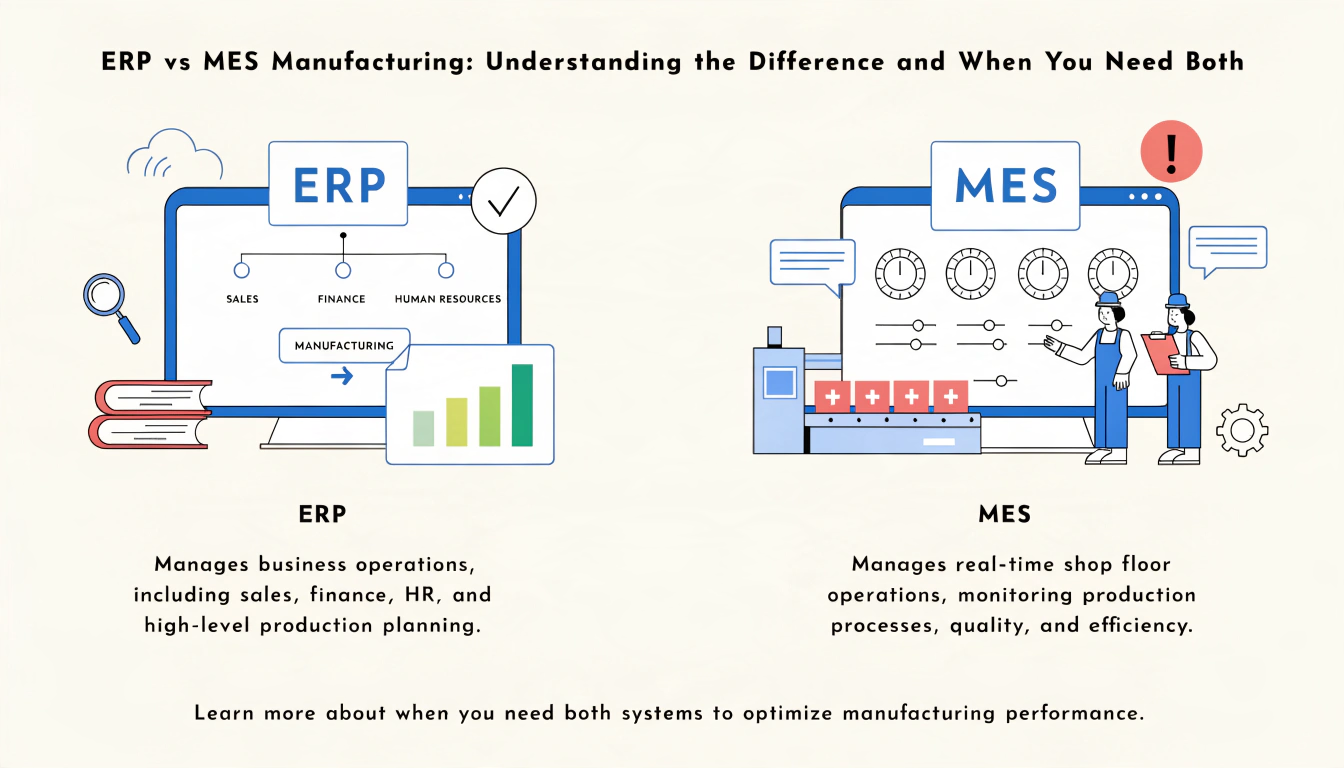
ERP typically manages business-wide processes such as finance, procurement, inventory, sales, purchasing, human resources, and production planning. MES, on the other hand, operates closer to the factory floor. It provides real-time visibility into production activities, machine performance, quality, work orders, and operational efficiency.
This manufacturing software comparison explains how ERP and MES differ, how they complement each other, and when manufacturers should consider implementing both.
What Is ERP in Manufacturing?
Enterprise Resource Planning software is designed to connect and manage core business processes through a centralized system. In manufacturing, an ERP platform helps organizations coordinate activities across departments and provides management with a broad view of business performance.
Manufacturing ERP systems commonly handle production planning, procurement, inventory management, sales orders, purchasing, accounting, supply chain management, workforce information, and customer-related processes.
For example, when a customer places an order, an ERP system can help determine whether sufficient raw materials are available, whether production capacity can support the order, what purchasing activities may be required, and how the transaction will affect inventory and financial records.
ERP therefore focuses primarily on the broader business and planning environment.
It answers questions such as :
- What materials need to be purchased?
- How much inventory is available?
- What customer orders are pending?
- What production should be planned?
- What are the costs associated with manufacturing?
- How is the business performing financially?
ERP provides the business-level information required to make strategic and operational decisions.
What Is MES in Manufacturing?
A manufacturing execution system is designed to manage, monitor, and control manufacturing operations on the shop floor. While ERP provides high-level planning and business information, MES focuses on what is happening during actual production.
MES software connects production activities with real-time operational data. Depending on the system and manufacturing environment, it can track work orders, machine status, production quantities, quality results, downtime, labor activity, material consumption, and production performance.
For example, an MES can show whether a production line is currently operating, whether a machine has stopped, how many units have been produced, whether production is meeting its scheduled target, and whether a quality issue has been detected.
MES, therefore, answers questions such as
- What is happening on the production floor right now?
- Which machines are running or stopped?
- How much has been produced?
- Why has production slowed down?
- Are products meeting quality requirements?
- How efficiently are resources being used?
The key difference is that MES brings visibility into execution, while ERP focuses more heavily on planning and business management.
ERP vs MES Manufacturing: What Is the Difference?
When comparing ERP vs MES manufacturing solutions, the simplest distinction is their operational focus.
ERP manages the business side of manufacturing, while MES manages the execution side of manufacturing.
ERP operates primarily at the enterprise level. It brings together information from different departments and helps organizations plan resources, manage costs, process orders, purchase materials, maintain inventory, and monitor financial performance.
MES operates primarily at the manufacturing operations level. It provides production teams with detailed information about what is happening on the factory floor and helps organizations improve execution, quality, traceability, and productivity.
Consider a simple example. A manufacturer receives an order for 10,000 units.
The ERP system can help determine the required materials, production schedule, inventory availability, purchasing requirements, and estimated costs. It can also record the customer order and support financial processes.
The MES system can then help production teams execute the manufacturing plan. It can track the work order on the shop floor, monitor machine performance, record production quantities, capture quality data, and identify downtime.
This shows why ERP and MES are not necessarily competing systems. They address different layers of manufacturing operations.
ERP vs MES: Key Functional Differences
A manufacturing software comparison becomes clearer when looking at the primary responsibilities of each platform.
ERP is generally focused on enterprise-wide planning and coordination. Its capabilities may include financial management, procurement, inventory, sales, supply chain management, workforce administration, production planning, and order management.
MES is focused on manufacturing execution. Its capabilities may include production tracking, work-order management, quality management, machine monitoring, production genealogy, labor tracking, traceability, downtime monitoring, and real-time performance analysis.
The difference can also be understood through the type of data each system handles.
ERP often works with business and planning data such as purchase orders, sales orders, inventory levels, bills of materials, production schedules, supplier information, and financial records.
MES works with more granular operational information, such as machine status, production quantities, process parameters, operator activities, defects, cycle times, and real-time production events.
The systems can therefore provide different perspectives of the same manufacturing operation.
ERP may tell management what production is planned and what resources are required. MES can tell the production team whether that plan is being executed effectively.
Why Manufacturers Need Both ERP and MES
For many organizations, the question should not be whether ERP or MES is better. Instead, manufacturers should consider how the two systems can work together.
ERP provides the overall business plan, while MES helps translate that plan into factory-floor execution.
Suppose an ERP system creates a production order based on customer demand. That information can be transferred to MES, where production personnel can use it to execute the order. MES can then collect real-time production information and send relevant data back to ERP.
This creates a connected information flow.
Customer demand can influence ERP planning. ERP can generate production requirements. MES can execute and monitor production. Production results can then be returned to ERP for inventory, costing, planning, and business reporting.
Without this integration, manufacturers may have to manually transfer information between systems. That can create delays, duplicate data entry, inconsistent information, and limited visibility.
With ERP and MES integration, businesses can create a more connected digital manufacturing environment.
When Do You Need ERP?
ERP may be the right starting point for a manufacturer that lacks a centralized system for managing business operations.
A growing manufacturer may initially rely on spreadsheets, separate accounting applications, manual inventory records, and disconnected systems. As operations expand, these approaches can become difficult to manage.
ERP becomes particularly valuable when a company needs better control over inventory, procurement, financial processes, production planning, customer orders, and supply chain activities.
Manufacturers should consider ERP when business data is fragmented across departments or when management lacks a reliable overview of costs, materials, orders, and resources.
ERP can provide a centralized foundation for business management and help standardize processes across the organization.
When Do You Need MES?
MES becomes particularly valuable when manufacturers need greater visibility and control over shop-floor activities.
A company may already have a strong ERP system but still struggle to answer important production questions in real time.
For example, management may know that a production order is scheduled for completion today, but they may not know whether the production line is currently operating at the required rate.
MES can help close this visibility gap.
Manufacturers should consider MES when they experience frequent production downtime, limited traceability, quality challenges, manual production reporting, inconsistent shop-floor data, or difficulty measuring operational performance.
MES is also useful for manufacturers operating complex production environments where real-time information and detailed production records are critical.
When Should You Implement Both ERP and MES?
The need for both systems becomes stronger as manufacturing operations become more complex.
Companies with multiple production lines, large product portfolios, strict quality requirements, complex supply chains, or significant automation may benefit from integrating ERP and MES.
The combination is particularly valuable when management needs accurate business-level information while production teams need real-time operational visibility.
For example, ERP might identify that a production order requires 5,000 units. MES can provide information about how many units have already been completed, how many failed quality inspections, how much downtime occurred, and whether the production line is meeting its expected rate.
This information can improve decision-making throughout the organization.
The ERP system remains responsible for business planning and resource management, while MES provides detailed execution data.
Benefits of Integrating ERP and MES
Integrating ERP and MES can create several operational benefits.
Better Production Visibility
Manufacturers can gain a clearer view of production activities from planning through execution. Management can understand whether production is progressing according to schedule, while operators can access the information they need to perform their work effectively.
Improved Data Accuracy
Manual data entry between systems can lead to errors and outdated information. Integration enables information to flow automatically between ERP and MES, reducing duplicate entry and improving data consistency.
Better Inventory Management
Production data from MES can help ERP maintain more accurate information about material consumption and finished goods. This can improve inventory planning and reduce discrepancies.
Stronger Quality Control
MES can capture detailed quality information during production. When connected with ERP, this information can contribute to broader business reporting and decision-making.
Faster Decision-Making
Real-time manufacturing data can help managers identify production problems faster. Instead of waiting for manually prepared reports, decision-makers can access more current information.
Improved Traceability
For industries where product traceability is important, MES can record detailed production information, including materials, processes, machines, operators, and quality results. This information can support compliance, recalls, investigations, and continuous improvement.
How ERP and MES Work Together
Think of ERP and MES as different layers of the same manufacturing technology ecosystem.
ERP operates at the enterprise level and focuses on planning, resources, orders, inventory, finances, and supply chain activities.
MES operates at the production level and focuses on execution, machines, workers, quality, materials, and real-time production information.
The integration between these systems creates a connection between business planning and shop-floor execution.
A typical workflow could look like this:
Customer order → ERP planning → Production order → MES execution → Real-time production data → ERP updates → Business reporting and planning.
This connection allows manufacturers to move toward a more data-driven operating model.
ERP vs MES Manufacturing: Which One Should You Choose?
There is no universal answer because the right solution depends on the organization’s operational maturity, manufacturing complexity, goals, and existing technology infrastructure.
If a company lacks centralized business management capabilities, ERP may be the priority.
If a company already has ERP but struggles with shop-floor visibility, real-time production monitoring, quality tracking, or traceability, MES may provide greater value.
For manufacturers with complex operations, implementing both can provide the strongest overall architecture.
The important point is to avoid selecting software based solely on the number of features. Manufacturers should evaluate how the system fits into existing processes and how effectively it can exchange data with other platforms.
What to Consider Before Implementing ERP or MES
Before investing in manufacturing software, businesses should first identify their operational challenges.
Start by documenting current workflows and determining where delays, errors, data gaps, and inefficiencies occur. Manufacturers should also assess their existing technology infrastructure, automation systems, machines, databases, and communication protocols.
Integration capability should be a major consideration. An ERP or MES solution that cannot communicate effectively with other systems may create another data silo rather than solving existing problems.
Scalability is equally important. Manufacturing requirements can change as production volumes increase, new facilities are added, or automation technologies are introduced. The chosen software should be capable of supporting future requirements.
Employee adoption also matters. Even a technically advanced platform may fail to deliver value if employees find it difficult to use. Training, change management, and user experience should therefore be part of the implementation strategy.
The Future of ERP and MES in Smart Manufacturing
As smart manufacturing continues to develop, ERP and MES platforms are becoming increasingly connected with technologies such as the Industrial Internet of Things (IIoT), artificial intelligence, machine learning, robotics, cloud computing, digital twins, and advanced analytics.
Factories are generating larger volumes of real-time data than ever before. Manufacturers need systems capable of turning that information into useful operational and business insights.
MES can collect detailed data from connected machines and production processes, while ERP can use business information to support planning and resource decisions.
The future of manufacturing software is therefore less about isolated applications and more about connected digital ecosystems.
Manufacturers that successfully connect ERP, MES, automation systems, machines, and analytics platforms can create a stronger foundation for predictive decision-making, continuous improvement, and operational resilience.
Final Thoughts
Understanding ERP vs MES manufacturing systems is essential for organizations planning their digital transformation journey.
ERP and MES are designed to solve different problems. ERP focuses on enterprise-wide planning and management, while MES focuses on real-time manufacturing execution and shop-floor visibility.
For smaller or less complex manufacturers, ERP alone may provide the foundation needed to organize business operations. For organizations that already have ERP but need greater control over production activities, MES may be the next logical step.
For larger and more complex manufacturers, using both systems together can create a connected flow of information from customer demand and business planning to production execution and performance analysis.
The goal is not simply to purchase more software. The goal is to create a connected manufacturing environment where accurate information reaches the right people at the right time.
As manufacturers move toward smarter, more automated, and data-driven factories, understanding how ERP and MES complement each other can help businesses make better technology investments and build a more efficient manufacturing operation.
Enquire Now
Discover the latest strategies, technologies, and innovations shaping smart manufacturing and industrial automation.
Enquire now: https://bmaconventions.com/smart-manufacturing-automation-convention-2027/