Healthcare facilities are entering a new phase of digital transformation. Hospitals are no longer looking at technology simply as a way to automate administrative tasks or digitize medical records. Increasingly, technology is becoming part of the physical infrastructure that determines how efficiently a hospital operates, how safely patients receive care, and how effectively clinical teams use their time.
The outlook for 2027 points toward hospitals becoming more connected, predictive, energy-efficient, and patient-centered. A 2024 Delphi study involving 39 experts in healthcare, artificial intelligence, and management identified artificial intelligence, sustainability, ecosystems, and human-centeredness as four major dimensions shaping the future of smart hospitals. (Springer)
At the same time, healthcare organizations are moving from technology pilots toward practical deployment. Current developments in AI, IoT, digital twins, cybersecurity, interoperability, and intelligent building systems provide important clues about what healthcare facilities may prioritize in 2027.
AI Will Move From Pilot Projects to Everyday Hospital Operations
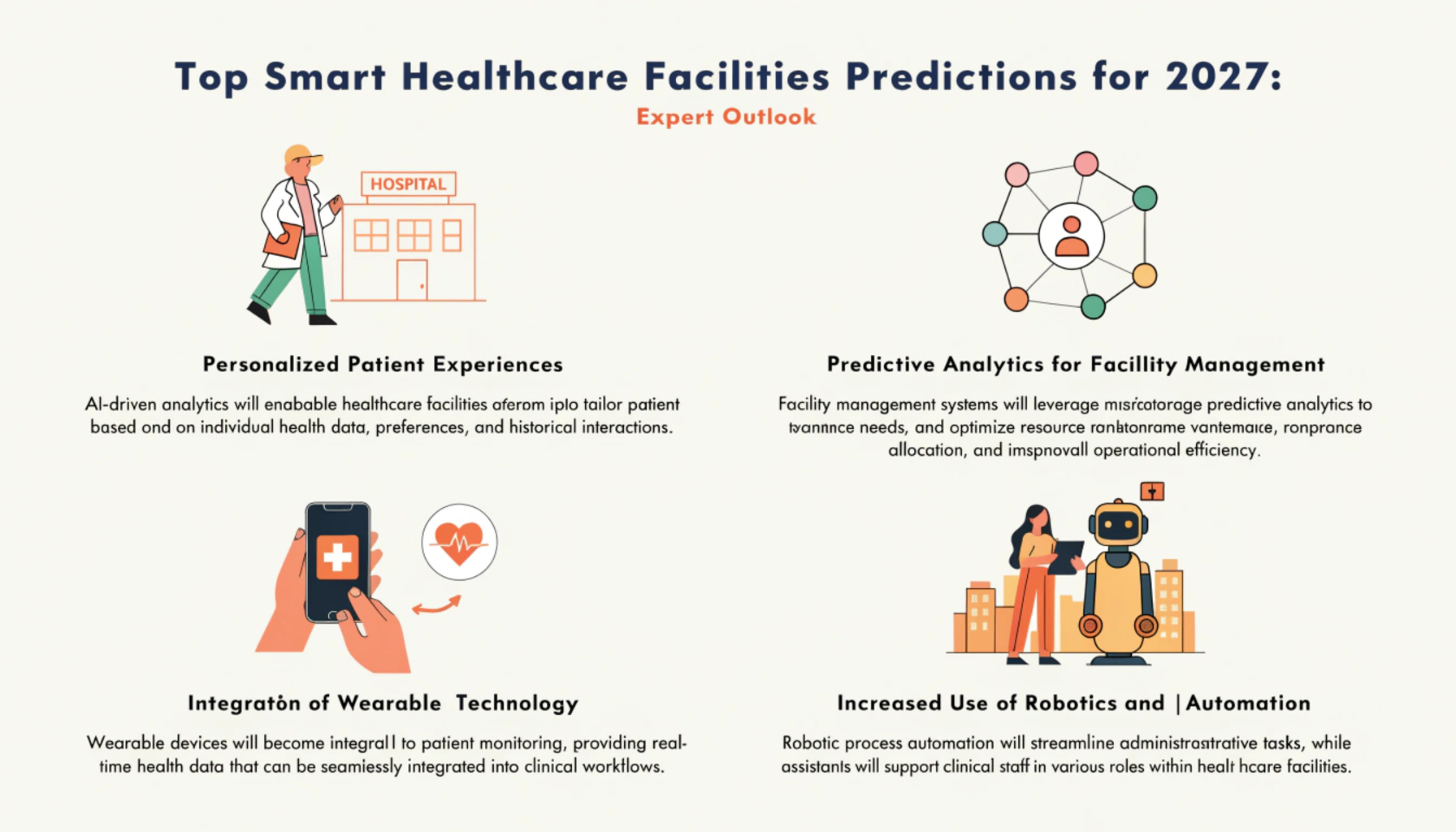
One of the strongest smart healthcare 2027 predictions is that artificial intelligence will become increasingly embedded in everyday hospital workflows.
AI is already being used for medical imaging, clinical documentation, patient monitoring, scheduling, and operational decision-making. Hospitals are now exploring how AI can connect information from multiple sources and support decisions rather than functioning as an isolated software application.
By 2027, more healthcare facilities are likely to use AI for predictive and operational tasks such as identifying potential equipment failures, forecasting patient demand, optimizing staffing, analyzing building performance, and supporting clinical workflows.
The important change will not simply be the number of AI tools hospitals purchase. Instead, healthcare leaders are likely to focus more strongly on whether these systems deliver measurable improvements in patient outcomes, staff productivity, safety, and operating costs.
Recent developments in Houston illustrate this direction. Local hospitals are already testing AI-assisted radiology, ambient documentation, wearable monitoring, fall-risk analysis, equipment tracking, and surgical scheduling technologies. (Houston Chronicle)
This suggests that 2027 may be less about asking whether hospitals should use AI and more about deciding where AI creates the greatest operational value.
Predictive Maintenance Will Become a Facilities Priority
A second major prediction is the expansion of predictive maintenance across healthcare facilities.
Hospitals depend on complex infrastructure. HVAC systems, backup power, medical equipment, elevators, water systems, security systems, refrigeration, and other building services must remain operational around the clock.
Traditional maintenance often relies on fixed schedules or reactive repairs. Connected sensors and analytics can provide a different approach by monitoring equipment performance continuously and identifying warning signs before a failure occurs.
The emerging hospital technology forecast points toward greater integration between IoT sensors, building management systems, equipment data, and AI-powered analytics. Healthcare facility management research published in 2026 identifies BIM, IoT, AI, and digital twins as important technologies for transforming facility management, while also highlighting interoperability and organizational adoption as major challenges. (ScienceDirect)
In 2027, facility managers may increasingly receive alerts such as unusual temperature changes, abnormal energy consumption, vibration patterns, or equipment performance deviations. Instead of waiting for a system to fail, teams can schedule maintenance based on actual operating conditions.
That could reduce downtime, improve asset utilization, and help hospitals manage maintenance budgets more strategically.
Digital Twins Will Become More Practical
Digital twins are another important part of the smart healthcare 2027 predictions.
A digital twin is a dynamic virtual representation of a physical asset, environment, process, or system. In healthcare, the concept can apply to individual medical devices, hospital buildings, departments, infrastructure systems, and eventually patient-specific models.
Recent research describes healthcare digital twins as a technology with applications in predictive, preventive, and personalized medicine, while also identifying challenges involving data quality and computational complexity. (ScienceDirect)
For facilities teams, digital twins could become particularly useful for planning and simulation.
Before modifying a hospital floor, managers could potentially model different layouts and assess their impact on patient movement, staff workflows, energy consumption, equipment locations, and capacity. Similarly, facility teams could simulate HVAC changes or emergency scenarios before implementing them physically.
The technology is unlikely to become universally mature overnight. However, 2027 could mark a period when more health systems move from experimental digital twin projects toward specific operational use cases.
Smart Buildings Will Become More Integrated
The future hospital will increasingly operate as a connected building rather than a collection of independent systems.
Today, HVAC, lighting, security, access control, medical equipment, energy management, and building automation can operate in separate technology environments. This creates data silos and makes it difficult for facility teams to understand the complete operational picture.
By 2027, healthcare organizations are likely to prioritize integration.
Current industry developments already show this direction. Johnson Controls reported in August 2026 that integrated systems connecting HVAC, utilities, access control, and medical equipment can help reduce data silos while improving operational resilience, occupant comfort, physical safety, and compliance. (Johnson Controls)
The next generation of smart hospitals may therefore use centralized platforms that allow facility leaders to monitor multiple building systems from a single environment.
For example, a hospital could combine occupancy information, indoor environmental conditions, energy consumption, equipment status, and maintenance alerts to identify operational problems in real time.
This integration could become one of the defining characteristics of smart facilities in 2027.
Energy Intelligence Will Gain Strategic Importance
Energy efficiency will move higher on the healthcare facilities agenda.
Hospitals operate continuously and require precise environmental conditions. Operating rooms, intensive care areas, laboratories, imaging departments, pharmaceutical storage, and other spaces have specific temperature, humidity, ventilation, and reliability requirements.
Consequently, healthcare organizations cannot simply reduce energy consumption without considering clinical requirements.
The opportunity is to make energy management more intelligent.
AI-powered systems can analyze historical and real-time data to identify patterns in energy consumption and recommend adjustments. Healthcare organizations are already showing interest in AI-driven energy optimization, with Johnson Controls reporting that 75% of healthcare organizations deploying new AI solutions in its referenced survey planned to use AI for energy optimization. (Johnson Controls)
In 2027, smart healthcare facilities may increasingly combine occupancy data, weather information, equipment performance, HVAC requirements, and energy pricing to optimize building operations.
The goal will be more sophisticated than simply reducing electricity consumption. Hospitals will seek a balance between sustainability, operating costs, patient comfort, clinical safety, and resilience.
Cybersecurity Will Become Part of Facility Planning
As hospitals connect more devices and building systems, cybersecurity will become increasingly important.
A smart hospital contains a growing digital attack surface. Connected medical devices, building management systems, cloud platforms, IoT sensors, remote-access tools, and clinical applications all create potential vulnerabilities.
The hospital technology forecast therefore cannot focus only on innovation. Security and resilience will need to be designed into the infrastructure from the beginning.
IEEE’s 2026 healthcare technology outlook highlights medical-device cybersecurity, AI delivery, and digital therapeutics among the developments requiring careful attention to safety, validation, and trust. (IEEE Standards Association)
Healthcare cybersecurity experts are also increasingly emphasizing that cybersecurity is connected directly to patient safety because an attack affecting critical infrastructure can disrupt care, not merely expose information. (Express Healthcare)
By 2027, healthcare facility leaders may increasingly work alongside IT and cybersecurity teams during building design, renovation, procurement, and technology deployment.
Cybersecurity will become less of an IT-only responsibility and more of a facility resilience requirement.
Interoperability Will Become a Competitive Advantage
Another important prediction is that healthcare organizations will pay greater attention to interoperability.
A hospital can purchase advanced technologies and still fail to become truly smart if those technologies cannot communicate with each other.
Fragmented systems can create duplicate data, manual processes, delayed decisions, and inefficient workflows. Current healthcare technology research continues to identify interoperability and data silos as major barriers to AI adoption. (TSIA)
For 2027, hospitals are likely to place greater emphasis on technology platforms that can exchange information securely across clinical, operational, and facilities systems.
This means procurement decisions may increasingly include questions such as:
Can this system integrate with our existing infrastructure?
Can data be shared securely?
Does the technology support recognized standards?
Can the organization scale it later?
Can different departments access useful information without creating new silos?
The smartest hospital may not necessarily be the one with the most technology. It may be the one where its technologies work together effectively.
Remote Monitoring and Care Beyond the Hospital Will Expand
The boundary between hospital and home is also expected to become less rigid.
Remote patient monitoring, wearable devices, virtual consultations, and connected health technologies are helping healthcare providers monitor patients outside traditional clinical settings.
The 2024 Delphi study found strong expectations for individualized medicine and an increasing role for home-based care in the future of smart hospitals. (Springer)
By 2027, healthcare facilities may therefore need to be designed not only for patients physically inside the building but also for digitally connected patients receiving care elsewhere.
This could influence hospital command centers, telehealth infrastructure, data platforms, remote monitoring teams, and patient communication systems.
Instead of thinking of a hospital as a single physical destination, health systems may increasingly operate as connected care networks.
Patient Experience Will Influence Facility Technology
Technology adoption will increasingly be evaluated from the patient’s perspective.
Patients may expect faster communication, easier navigation, personalized information, digital check-in, convenient appointment management, and more seamless interactions with healthcare providers.
Smart room technologies could also become more common. Digital displays, virtual communication, connected monitoring systems, and personalized room controls can potentially improve convenience while helping clinical teams manage information more efficiently.
However, technology should not make healthcare feel impersonal.
The strongest smart healthcare 2027 predictions point toward a human-centered model in which technology supports patients and staff rather than replacing meaningful human interaction. The Delphi research specifically identifies human-centeredness as one of the four core dimensions of future smart hospitals. (Springer)
This means healthcare leaders will need to evaluate technology not just by technical capability but by how it affects patient trust, staff experience, accessibility, and quality of care.
Staff Workflows Will Shape Technology Decisions
Workforce pressure will be another major driver.
Healthcare organizations continue to face staffing challenges, and technology is increasingly being evaluated as a way to reduce administrative workloads and improve operational efficiency.
Ambient documentation, automated scheduling, intelligent communication platforms, robotics, and predictive analytics could help staff spend less time on repetitive processes.
But successful adoption will depend on workflow design.
A technology that creates additional alerts, duplicate documentation, or complicated interfaces may increase rather than reduce workload.
Therefore, one of the most important smart healthcare 2027 predictions is that successful hospitals will involve frontline staff earlier in technology decisions.
The question will shift from “What technology can we buy?” to “What problem are our clinicians and facility teams trying to solve?”
Robotics and Automation Will Expand Selectively
Robotics will continue to attract attention in 2027, but adoption is likely to remain focused on areas where automation provides measurable value.
Potential applications include logistics, pharmacy operations, cleaning support, transportation of supplies, disinfection, laboratory processes, and surgical assistance.
The combination of robotics, AI, computer vision, and connected infrastructure could allow hospitals to automate selected repetitive tasks while allowing staff to focus on higher-value activities.
The key will be integration. Robots need to operate safely within complex hospital environments, interact with people, navigate changing spaces, and communicate with other systems.
Therefore, future facility planning may need to consider robotics from the beginning rather than adding automation after construction is complete.
What Healthcare Leaders Should Prepare for Now
The predictions for 2027 point toward a clear conclusion: smart healthcare will be less about individual gadgets and more about connected ecosystems.
Hospitals planning new construction, renovation, or technology investments should consider whether their infrastructure can support future AI workloads, connected devices, cybersecurity requirements, interoperability, predictive maintenance, energy intelligence, and flexible care models.
That means planning for sufficient network capacity, reliable power, adaptable spaces, integrated building systems, secure data architecture, and technology-ready infrastructure.
Organizations should also establish clear measures of success. A smart facility should demonstrate improvements in areas such as operating costs, energy performance, maintenance efficiency, patient experience, staff productivity, safety, or clinical outcomes.
Technology should have a purpose.
The Bottom Line: 2027 Will Be About Smarter Integration
The most significant change expected in 2027 will not be the arrival of one revolutionary healthcare technology. Instead, it will be the increasing integration of technologies that already exist or are rapidly developing.
AI will become more embedded in workflows. IoT will connect physical assets. Digital twins will support planning and simulation. Predictive maintenance will improve reliability. Energy intelligence will support sustainability. Cybersecurity will become part of facility resilience. Remote monitoring will extend care beyond hospital walls.
This direction is consistent with expert research forecasting the evolution of smart hospitals, which highlights AI, sustainability, ecosystems, and human-centeredness as interconnected components of future healthcare delivery. (Springer)
For healthcare executives, facility managers, architects, technology leaders, engineers, and planners, the opportunity is to prepare before these technologies become essential rather than reacting after infrastructure limitations appear.
The smartest healthcare facility of 2027 will not necessarily be the one with the most advanced technology. It will be the facility where technology, infrastructure, people, and patient needs work together.
Prepare for the Future of Healthcare Facilities
Healthcare leaders who want to understand emerging technologies, facility strategies, and the next generation of smart hospital infrastructure can connect with industry professionals and explore the latest developments at the upcoming event.
https://bmaconventions.com/smart-healthcare-facilities-convention-2027/ to explore the ideas, technologies, and strategies shaping the future of healthcare facilities.