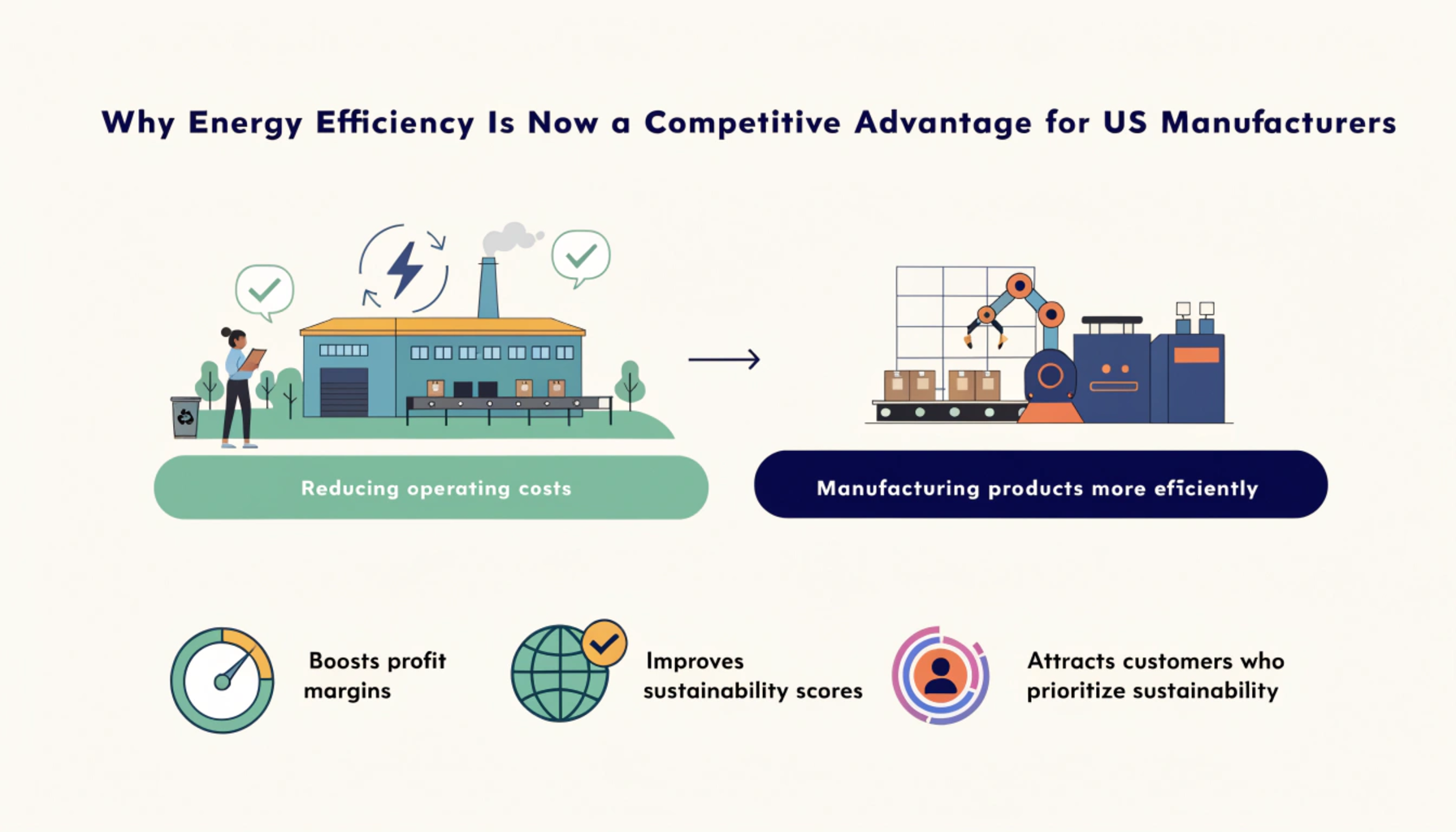
The Changing Industrial Landscape of American Manufacturing
For decades, industrial energy consumption was viewed across executive suite boardrooms as an unavoidable, fixed cost of doing business. Industrial electricity, natural gas, and water bills were routinely processed, budgeted as baseline operating expenses, and passed along through product pricing whenever market conditions allowed. However, the macroeconomic realities governing modern factory floors have fundamentally disrupted this passive approach. Rapid reshoring initiatives, surging electrification, supply chain localized pressures, and unprecedented regional grid volatility have shifted energy management from a back-office utility function straight to the center of corporate strategy.
Today, advanced energy tracking and systematic efficiency optimization are no longer limited to sustainability reports or corporate social responsibility (CSR) pledges. Instead, energy efficiency manufacturing USA programs have become a decisive lever for operational excellence and market differentiation. As industrial power rates fluctuate and regional utility grids face capacity constraints driven by data center expansions and industrial growth, facilities that master energy productivity gain a distinct margin advantage over their slower-moving competitors.
Entering the landscape of sustainable manufacturing 2026, forward-thinking operations leads, plant managers, and chief operating officers are discovering that every kilowatt-hour saved directly expands bottom-line profit margins. In an environment defined by tight labor markets, volatile material inputs, and intense global competition, optimizing power usage per unit produced offers one of the few direct, controllable pathways to enterprise value creation.
The New Economics of Industrial Power in the United States
The business case for aggressive energy management rests on changing grid dynamics across major domestic manufacturing corridors. Over the past several years, industrial power demand has escalated dramatically. The concurrent rise of domestic semiconductor fabrication, high-volume battery plants, electric vehicle infrastructure, and continuous-process heavy industry has placed historic stress on regional power distribution systems.
Consequently, industrial electricity tariffs are rising faster than historical baselines, while peak demand charges have multiplied. Facilities operating without real-time energy visibility face significant financial exposure during high-demand events. A single unmanaged peak load incident can artificially inflate an entire billing cycle’s utility expenditure, carving into operating margins that took months of lean manufacturing effort to secure.
Implementing high-resolution energy monitoring alters this financial dynamic completely. By treating power consumption as a dynamic, controllable variable rather than an unavoidable overhead cost, executive teams can align production schedules with favorable rate structures. Sub-metering technology allows plant operators to calculate the precise energy intensity of individual production lines, specific shifts, or discrete product lines. This level of granular cost accounting enables precise product pricing and prevents high-energy legacy products from quietly subsidizing company-wide gross margins.
Furthermore, capital markets and commercial lenders are increasingly pricing risk based on operational efficiency and resource resilience. Financial institutions recognize that energy-efficient facilities maintain lower break-even costs, making them far more resilient during broader macroeconomic downturns or energy market spikes. In this context, energy optimization acts as a permanent hedge against inflation and raw energy volatility.
Unlocking Operational Capacity and Preventing Unplanned Downtime
While direct utility cost reduction provides a compelling return on investment, the operational benefits of comprehensive energy efficiency extend deep into plant floor performance. One of the most severe constraints facing growing industrial operations today is the availability of expanded electrical grid utility connections. Across several fast-growing manufacturing hubs in North Texas, the Midwest, and the Southeast, regional power providers are requiring extended multi-year lead times to supply additional megawatt capacity to expanding industrial facilities.
For a manufacturer seeking to install new production lines or automate existing processes, waiting several years for a utility transformer upgrade is financially unviable. Energy efficiency provides an immediate, internally generated solution to grid interconnect bottlenecks. By retrofitting existing assets with high-efficiency variable frequency drives (VFDs), optimizing compressed air systems, capturing process waste heat, and modernizing thermal management systems, manufacturers routinely free up 15% to 30% of their existing electrical capacity. This liberated capacity can then be redirected toward new automated machinery and increased factory throughput without requiring expensive utility infrastructure upgrades.
| Operational Focus Area | Legacy Operational Challenge | Smart Energy Efficiency Solution | Financial & Operational Impact |
|---|---|---|---|
| Compressed Air Systems | Massive power losses via undetected leaks & fixed-speed generation. | Smart pressure controls, leak detection, & variable-speed compressors. | 20% to 40% reduction in compressed air energy costs; extended equipment life. |
| Process Thermal Operations | Uncaptured waste heat dissipated directly into plant environments. | Heat recovery exchangers & closed-loop thermal recycling systems. | Significant natural gas savings; lower facility HVAC cooling load. |
| Drive & Motor Systems | Continuous full-speed motor operation regardless of instantaneous load requirements. | Smart variable frequency drives (VFDs) paired with IIoT load-matching algorithms. | 15% to 30% energy reduction on motor-driven lines; decreased mechanical wear. |
| Facility Baseload & Lighting | Continuous power draw during non-production off-shifts. | Automated building management systems (BMS) & automated smart controls. | Elimination of off-shift energy waste; immediate drop in non-operational baseline costs. |
In addition to expanding electrical capacity, energy monitoring serves as an early indicator for predictive equipment maintenance. Power quality anomalies, localized phase imbalances, harmonic distortions, and sudden spikes in motor amperage draw are nearly always the first physical symptoms of mechanical friction, bearing wear, or impending motor failure. By integrating energy sub-metering into an Industrial Internet of Things (IIoT) ecosystem, maintenance engineers can detect machine degradation days or weeks before a catastrophic failure stops production. Preventing even a few hours of unplanned downtime frequently yields financial returns that exceed the original cost of the energy monitoring system itself.
Winning Supply Chain Mandates and Enterprise OEM Contracts
The commercial dynamics between raw material suppliers, component manufacturers, and enterprise OEMs are undergoing a significant shift. Tier-1 automotive manufacturers, aerospace defense primes, pharmaceutical conglomerates, and major retail brands are establishing stringent supplier performance standards. Procurement evaluations no longer focus solely on unit price, defect rates, and delivery schedules; they now actively incorporate verified carbon intensity metrics and operational energy efficiency targets.
As large enterprise buyers establish strict Scope 1, Scope 2, and Scope 3 emissions reduction targets, they pass these compliance requirements down through their supply chains. A supplier that can provide audited, low-carbon manufacturing output gains a distinct advantage over competitors that cannot track or demonstrate energy performance. In competitive bidding processes, proven sustainable manufacturing 2026 practices serve as a decisive differentiator, enabling proactive manufacturers to capture long-term contract wins and build strategic partnerships with major global brands.
Federal funding frameworks, state-level clean technology incentives, and tax credit mechanisms under recent federal legislation further accelerate this transformation. Accelerated depreciation schedules and direct financial grants for energy-efficient retrofits significantly reduce capital expenditure payback periods. Manufacturers that take advantage of these incentives lower their initial investment costs while permanently improving their cost structures compared to non-participating peers.
The Smart Tech Stack Powering High-Performance Factories
Achieving sustainable energy efficiency across modern manufacturing operations relies on the convergence of advanced software, smart sensor hardware, and automated process controls. Modern energy management is no longer defined by manual meter readings or quarterly utility audit reports; it is an active, continuous digital discipline.
At the foundation of this technological shift is the deployment of IoT-enabled smart sub-meters across all critical plant assets. These compact devices continuously stream high-frequency data regarding voltage, power factor, current, and total energy consumption to centralized cloud or edge platforms. When integrated with plant-floor Manufacturing Execution Systems (MES) and Enterprise Resource Planning (ERP) platforms, these analytics platforms automatically map energy consumption directly to specific production batches and operational shifts.
Artificial intelligence and machine learning algorithms play a key role in identifying hidden energy waste. By analyzing historical power consumption alongside ambient environmental conditions, production volumes, and raw material variations, AI platforms build dynamic energy baseload models for the facility. These systems can autonomously signal operational adjustments, such as staggering the warm-up schedules of heavy industrial kilns or turning down high-powered HVAC systems during peak tariff hours, all without impacting target production volume.
Furthermore, modern digital twin technology allows facility engineers to model energy flows in a virtual space before altering physical machinery configurations. By simulating thermal loss, airflow optimization, and motor loads across a digital representation of the plant, operations managers can validate capital investment proposals and optimize system efficiency prior to spending hardware dollars.
Overcoming Implementation Roadblocks and Scaling Efficiency
Despite the clear financial and operational advantages, scaling energy efficiency across mid-market and enterprise manufacturing facilities requires overcoming common organizational hurdles. Historically, split incentives between corporate facilities teams, finance departments, and floor operations leadership have hindered progress. Facilities teams were tasked with keeping utility bills down, while operations managers were evaluated exclusively on throughput volume and unit velocity, often viewing energy initiatives as potential risks to daily target output.
Unlocking energy efficiency as a lasting competitive edge requires aligning these operational silos around unified business metrics. Forward-thinking executive teams are framing energy efficiency as a core productivity index—measuring kilowatt-hours consumed per finished unit of product rather than total monthly power usage. This realignment turns energy optimization into an actionable operational target for floor supervisors and process engineers, encouraging daily continuous improvement on the plant floor.
Building a culture of continuous energy improvement also relies heavily on structured energy management frameworks, such as ISO 50001. By establishing standardized procedures for energy reviews, setting clear performance indicators, and conducting periodic audits, organizations ensure that efficiency gains are maintained over time rather than eroding after initial equipment installation.
Taking the Next Strategic Step in Smart Manufacturing
The shift toward energy-efficient, data-driven production represents a key trend in modern industrial manufacturing. Energy efficiency is no longer an incremental operational goal; it is a fundamental business imperative that provides cost leadership, risk mitigation, and continuous operational agility. American manufacturers that embrace digital energy management, upgrade inefficient infrastructure, and integrate real-time operational analytics will continue to widen their competitive advantage over lagging peers.
To gain deeper insights into cutting-edge energy management technologies, connect with industry leaders, and discover proven strategies driving sustainable manufacturing 2026 performance across North American facilities, join executives and smart factory experts at the industry’s premier conference.
Take the lead in shaping the future of industrial production by securing your spot today: Register as a delegate.