Introduction
For generations, the health of a regional healthcare system was measured by the size of its footprint and the count of its inpatient beds. Hospital executives routinely invested billions of dollars into constructing multi-story acute care towers, operating under a reliable financial framework: fill inpatient beds with high-margin surgical patients to subsidize emergency care, burn units, and uncompensated safety-net services.
Today, that financial framework is fracturing.
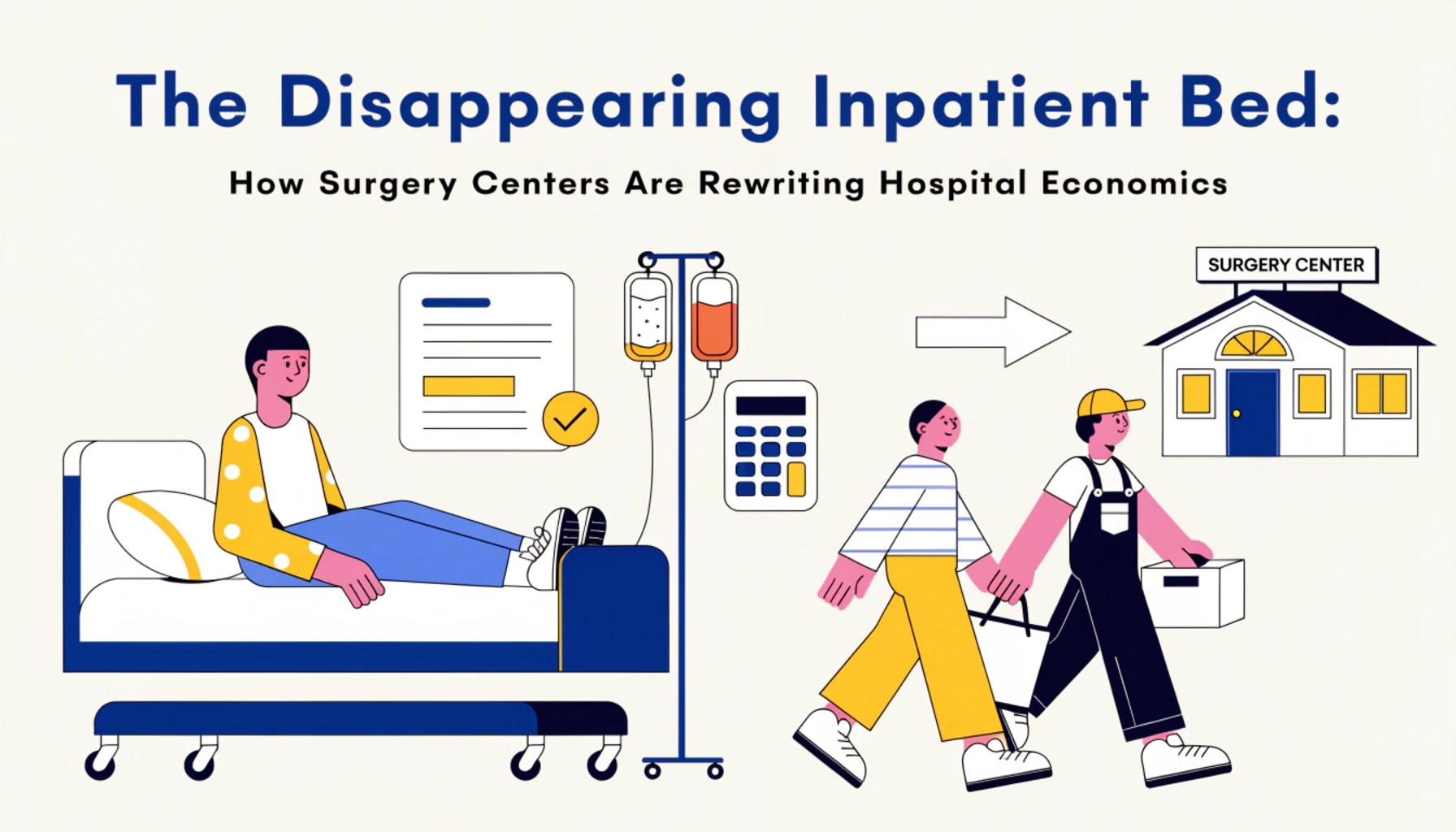
The traditional inpatient bed is rapidly disappearing from its role as the primary engine of health system profitability. Driven by advancements in minimally invasive surgical techniques, shifts in commercial and government reimbursement policies, and changing consumer preferences, high-margin elective procedures are migrating en masse out of acute care facilities and into Ambulatory Surgery Centers (ASCs).
This structural migration is far more than an operational adjustment. It represents a fundamental restructuring of healthcare economics. As routine total joint replacements, spinal fusions, and complex cardiology cases leave the main hospital campus, health systems face a critical dilemma: adapt to the decentralized surgical model or watch high-margin revenue bleed to nimble, specialized competitors.
Strategic Realignment: Why Health Systems Are Partnering with ASC Chains
Historically, hospital executives viewed independent surgery centers as market disruptors that siphoned off profitable patients. The initial instinct of many acute care systems was to fight back by acquiring local physician practices, employing surgeons directly, and enforcing non-compete agreements to lock procedures inside hospital operating rooms.
However, defensive strategies have proven unsustainable against market forces. Today, health systems are pivoting from resistance to strategic integration. Major hospital networks are increasingly partnering with or acquiring national ASC management companies and physician-owned ambulatory networks rather than building new inpatient towers.
Capital Allocation and Infrastructure Efficiency
Building and maintaining acute care inpatient towers represents one of the most capital-intensive activities in business. Constructing a modern acute care hospital bed can cost between $1.5 million and $2 million per bed when factoring in specialized infrastructure, 24/7 staffing overhead, and stringent regulatory compliance.
In contrast, developing a freestanding, multi-specialty ASC costs a fraction of that expenditure while offering dramatically faster time-to-market. By shifting capital deployment away from vertical brick-and-mortar expansion toward agile, distributed ASC networks, health systems can expand their geographic reach across suburban growth corridors without encumbering their balance sheets with long-term debt.
Protecting Market Share and Physician Alignment
Orthopedic, cardiovascular, and general surgeons are increasingly demanding access to outpatient surgical environments. In an ASC, surgeons experience greater operational control over scheduling, dedicated block times, faster room turnover, and specialized surgical teams. Crucially, ASC ownership structures allow physicians to hold equity stakes, creating a direct financial incentive aligned with operational efficiency.
Health systems that refuse to offer ASC options risk losing top-tier surgical talent to independent ambulatory groups. By offering joint-venture (JV) partnership models where the health system, the surgeon group, and often a third-party ASC operator share ownership health systems preserve physician alignment while retaining a share of procedural volume that would otherwise be lost entirely.
The Economic Equation: Better Value for Patients and Payers
The momentum behind outpatient surgical migration is fueled by compelling economic advantages for both commercial payers and self-insured employers. Surgical procedures performed in an ASC setting consistently generate substantial savings compared to identical procedures performed in a Hospital Outpatient Department (HOPD) or inpatient setting.
Lower Facility Fees and Payment Disparities
The core driver of price variation between settings lies in the facility fee structure. Hospital outpatient departments carry immense overhead costs associated with operating 24/7 emergency departments, intensive care units, and specialized trauma care. To offset these fixed overheads, hospital billing systems include inflated facility fees.
ASCs operate on a lean, specialized overhead model. Consequently, commercial reimbursement rates for ASC facility fees are routinely 40% to 60% lower than HOPD rates for identical surgical codes.
- Total Knee Arthroplasty (TKA): Performing a total knee replacement in an inpatient hospital setting can cost Medicare or commercial payers upwards of $25,000 to $35,000. In an ambulatory surgery center, the bundled cost frequently drops below $18,000.
- Spinal Fusion: Lumbar discectomies and cervical fusions performed in an ASC yield average savings exceeding $8,000 per case compared to hospital-based care.
Operational Throughput and Rapid Turnaround Times
The operational design of an ASC is optimized exclusively for elective procedures. Unlike acute care hospitals, where scheduled elective surgeries are frequently delayed or canceled due to emergency room admissions or trauma cases, ASCs maintain predictable, uninterrupted schedules.
- Operating Room Turnover: Room turnover times between surgical cases in an acute care hospital average 45 to 60 minutes due to centralized transport, complex cleaning protocols, and shifting priorities. In a focused ASC, turnover times are routinely cut to 15 to 20 minutes.
- Throughput Efficiency: Faster turnover allows surgeons to perform more cases per block hour, maximizing clinical productivity and facility utilization.
Financial Advantages Across Surgical Settings
| Metric | Traditional Inpatient / HOPD | Ambulatory Surgery Center (ASC) | Economic Impact | |
|---|---|---|---|---|
| Average Facility Fee Cost | Baseline (High Overhead) | 40% – 60% Lower than HOPD | Direct savings for payers and self-insured plans | |
| OR Turnover Time | 45 – 60 Minutes | 15 – 25 Minutes | Higher surgeon productivity and daily volume | |
| Patient Out-of-Pocket Cost | High (Deductibles + Copays) | Significantly Reduced | Higher patient satisfaction and compliance | |
| Infection Risk Rates | Standard Baseline | Consistently Lower | Reduced post-operative readmission penalties |
The Inpatient Residual: What Remains for Traditional Hospitals
As routine, highly profitable elective cases leave the acute care hospital, the economic model of the main facility undergoes profound strain. The hospital is left caring for a patient population defined by high clinical acuity, unpredictable emergency admissions, and challenging payer mixes.
Concentration of High-Acuity Patient Populations
The procedures remaining in traditional hospital beds are those that cannot be safely performed in an outpatient setting: multi-vessel bypass surgeries, complex oncology resections, severe trauma, and patients with multi-system comorbidities.
This shifting mix means the average hospital inpatient is sicker, requires more intensive nursing care, and stays longer. As a result, the cost to deliver care per bed-day increases dramatically at the exact moment high-margin elective subsidies are declining.
Structural Margin Compression
For decades, hospitals relied on the “cross-subsidization” model. High-margin elective orthopedics and cardiology reimbursed by commercial insurance effectively funded uncompensated care, behavioral health services, and Medicaid shortfalls.
When elective cases shift to ASCs especially if the health system does not own a financial stake in those centers the high-margin revenue vanishes. Health systems are left with fixed physical plant costs, expensive medical technology leases, and non-revenue-generating emergency services that cannot be downsized proportionally.
Staffing Pressures and Overhead Drag
Acute care hospitals must maintain clinical staffing 24 hours a day, 365 days a year. Rising labor costs, exacerbated by clinical workforce shortages and reliance on premium agency staffing, have escalated baseline operating costs.
Unlike an ASC, which can flex its operating hours, close on weekends, and adjust staffing directly to scheduled case volume, an acute care hospital cannot easily reduce its base operating cost. This cost asymmetry creates severe margin compression for health systems that fail to right-size their physical inpatient capacity.
Technological Enablers Accelerating the Outpatient Shift
The transition of complex surgeries to outpatient settings is accelerated by continuous technological innovation:
- Minimally Invasive and Robotic Platforms: Advanced robotic-assisted surgical systems allow for smaller incisions, reduced tissue trauma, and minimal blood loss, making immediate post-operative discharge clinically viable.
- Enhanced Recovery Protocols (ERAS): Modern perioperative care combining non-opioid multimodal analgesia, targeted short-acting anesthesia, and early mobilization allows patients undergoing major joint replacements or hysterectomies to ambulate within hours of surgery.
- Remote Patient Monitoring (RPM): Wearable biosensors and digital health platforms allow care teams to track vital signs, wound healing, and pain scores in real time after the patient returns home, replacing the traditional overnight observation bed.
Strategic Imperatives for Healthcare Executives
To thrive in an era where the inpatient bed is no longer the financial center of gravity, health system leaders must execute a multi-pronged strategic repositioning:
- Right-Size Inpatient Capacity: Audit existing inpatient footprint and decommission or repurpose underutilized med-surg units into specialized units or observation beds.
- Develop an Aggressive Outpatient Strategy: Transition from defensive, hospital-centric care models to an aggressive ambulatory strategy by forming joint ventures with physician groups and specialized ASC operators.
- Optimize the Acute Care Core: Re-engineer inpatient care delivery to focus on efficiency in high-acuity care, optimizing length-of-stay metrics, and reducing baseline operational overhead.
Conclusion
The disappearing inpatient bed is not a sign of declining healthcare demand; it is evidence of a maturing, more efficient healthcare ecosystem. As clinical technology advances and economic pressures demand lower costs, the migration toward ambulatory surgical models will continue to accelerate.
For health systems, surviving and thriving in this new environment requires abandoning the acute care tower as the central economic engine. Organizations that embrace decentralized, low-cost outpatient networks will secure physician alignment, protect market share, and build a resilient economic foundation for the future of care delivery.
Register as a Delegate
Are you looking to explore how advanced automation, modern facility infrastructure, and smart technology solutions are driving operational performance across complex industrial and healthcare environments?
Register as a Delegate – Smart Healthcare Facilities Convention to connect with industry leaders, operations executives, and technology innovators shaping the future of smart facilities and sustainable operational strategies.