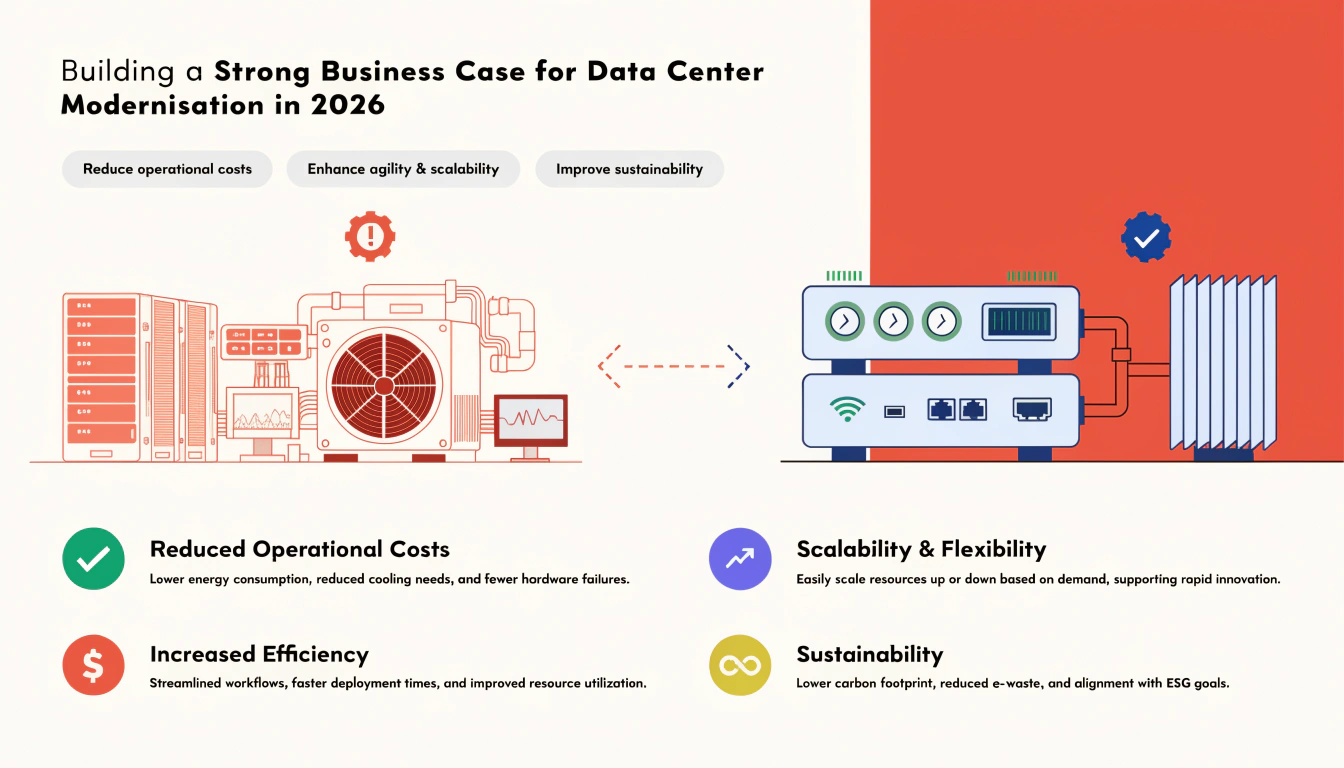
Data centers are no longer simply infrastructure environments that support business applications. They have become strategic assets that influence digital transformation, artificial intelligence adoption, cybersecurity, business continuity, energy efficiency, and customer experience. As workloads become more demanding in 2026, organizations are increasingly evaluating whether their existing facilities can support future requirements.
For data center operators and business leaders, modernization can represent a significant investment. Upgrading power systems, cooling infrastructure, networking equipment, servers, monitoring platforms, and physical facilities requires capital, planning, and operational commitment. This is why creating a strong data center modernisation business case is essential before requesting approval for a major project.
A well-developed business case does more than explain why infrastructure needs to be upgraded. It connects modernization investments with measurable business outcomes, financial benefits, operational improvements, risk reduction, and long-term strategic objectives.
Why Data Center Modernisation Matters in 2026
The technology landscape has changed significantly. Artificial intelligence, high-performance computing, cloud integration, edge computing, automation, and increasingly data-intensive applications are placing new demands on infrastructure.
Older data centers may have been designed around traditional workloads with predictable power and cooling requirements. Modern workloads can create much higher density requirements, making existing facilities difficult and expensive to operate.
At the same time, organizations are under increasing pressure to improve energy efficiency and manage operating costs. Aging equipment can consume more electricity, require more maintenance, and create operational risks.
Cybersecurity and resilience are also critical considerations. An outdated facility may have limitations related to redundancy, monitoring, physical security, network architecture, disaster recovery, or environmental controls.
These challenges make modernization a strategic decision rather than simply an IT upgrade. However, executives typically need clear financial and operational evidence before approving the investment. That is where a data center modernisation business case becomes valuable.
Start With the Current-State Assessment
The first step in developing a business case is understanding the current condition of the data center.
A modernization proposal should begin with a detailed assessment of existing infrastructure. This includes evaluating servers, storage, networking, power distribution, backup systems, cooling, fire suppression, physical security, monitoring systems, building management systems, and connectivity.
The assessment should also examine capacity utilization. Determine how much power, cooling, rack space, network bandwidth, and floor space are currently available and how much remains.
For example, if a facility is operating close to its available power or cooling capacity, future expansion may become difficult. Similarly, aging UPS systems, generators, cooling equipment, or electrical infrastructure could increase the probability of downtime.
The assessment should document both technical limitations and business consequences.
Instead of simply stating that “the cooling system is outdated,” the business case should explain what this means financially and operationally. It could result in higher energy costs, restricted rack density, increased maintenance expenses, or an inability to deploy new computing equipment.
This connection between infrastructure problems and business impact is central to effective data center upgrade justification.
Define the Business Problems Clearly
Once the current environment has been evaluated, identify the problems modernization is expected to solve.
The problems could include rising energy costs, limited capacity, frequent equipment failures, high maintenance expenses, insufficient redundancy, cybersecurity risks, poor monitoring capabilities, or difficulty supporting high-density workloads.
Avoid making modernization sound like an investment simply because equipment has become old. Executives are more likely to support a project when the business consequences are clearly demonstrated.
For example, an aging cooling system may create three different business problems:
Higher energy consumption increases operating expenses.
Limited cooling capacity prevents the organization from deploying higher-density computing equipment.
Frequent maintenance increases operational costs and the possibility of service disruption.
By presenting these issues together, the modernization proposal becomes much stronger.
The objective is to answer one important question: What happens if the organization does not modernize?
This “do nothing” scenario is an essential part of a data center upgrade justification because decision-makers need to understand the cost and risk of maintaining the status quo.
Connect Modernisation With Business Strategy
A successful data center modernisation business case should not exist separately from the company’s broader business strategy.
The modernization program should support specific organizational goals.
If the company is expanding its use of AI, for example, the data center may need higher power density, advanced cooling, faster networking, and increased computing capacity.
If the organization is pursuing sustainability goals, modernization may focus on energy-efficient cooling, renewable energy integration, improved power management, and better environmental monitoring.
If business continuity is the priority, the focus may be on redundancy, disaster recovery, backup power, fault tolerance, and resilient network architecture.
Connecting infrastructure investments to strategic priorities makes the proposal more relevant to senior management.
Rather than saying, “We need new cooling equipment,” the proposal could explain that modern cooling infrastructure will enable higher-density computing, improve energy performance, support future AI workloads, and reduce operational risk.
That is a much stronger business argument.
Calculate the Total Cost of Ownership
One of the most important elements of a modernization proposal is financial analysis.
Organizations should consider more than the initial purchase price of new infrastructure. The business case should evaluate the total cost of ownership over an appropriate period.
Capital costs may include new servers, storage systems, UPS equipment, generators, cooling infrastructure, racks, networking equipment, monitoring systems, construction, installation, and professional services.
Operating costs may include electricity, maintenance, replacement parts, software licensing, staffing, cooling, and facility management.
The business case should compare these costs with the expected benefits.
For example, an efficient cooling system may require significant upfront investment but reduce electricity consumption over several years. A modern monitoring platform could require implementation costs but help identify equipment problems earlier and reduce downtime.
This long-term perspective helps decision-makers understand the financial value of modernization rather than focusing exclusively on initial expenditure.
Measure Energy and Efficiency Improvements
Energy efficiency is becoming an increasingly important component of data center investment decisions.
A modernization business case should establish a baseline for current energy consumption and identify where improvements can be achieved.
Consider power usage across IT equipment, cooling systems, lighting, electrical infrastructure, and other supporting systems.
Modernization initiatives could include more efficient cooling technologies, intelligent controls, improved airflow management, power monitoring, variable-speed equipment, and optimized operating practices.
Where possible, quantify potential savings.
For example, the proposal might compare current annual energy expenditure with projected expenditure after modernization. Even if savings vary depending on workload and facility conditions, an estimated range can help establish the potential return on investment.
Energy efficiency can therefore strengthen both the financial argument and the organization’s sustainability objectives.
Quantify Downtime and Operational Risk
Downtime can have consequences far beyond technical inconvenience.
A data center outage can interrupt applications, delay transactions, affect customers, disrupt employees, damage brand reputation, and potentially create regulatory or contractual consequences.
A strong data center upgrade justification should therefore estimate the financial and operational impact of downtime.
Review historical incidents, equipment failures, maintenance records, service interruptions, and near misses. If possible, calculate the estimated cost associated with an hour of downtime or degraded service.
Modernization can reduce these risks through improved redundancy, better monitoring, upgraded power infrastructure, enhanced cooling, and more resilient architecture.
Risk reduction can be difficult to express as direct revenue, but it remains an important part of the financial argument.
Evaluate Different Modernisation Options
A business case becomes more credible when it evaluates multiple possible approaches.
Organizations could consider a complete infrastructure refresh, phased modernization, partial upgrades, relocation, hybrid infrastructure, or increased use of cloud services.
Each option should be evaluated according to cost, operational impact, scalability, risk, implementation time, and expected benefits.
For example, a phased modernization approach may require more planning but reduce disruption and spread capital expenditure over several years.
A complete modernization may deliver faster improvements but require greater upfront investment and potentially more operational disruption.
There is no single solution that works for every data center. The right approach depends on the organization’s workloads, facility condition, growth expectations, budget, risk tolerance, and strategic objectives.
Build a Clear ROI and Payback Model
Senior management needs to understand how the investment creates value.
A financial model should include expected savings, avoided costs, productivity improvements, capacity benefits, risk reduction, and potential revenue enablement.
Common measures include return on investment, payback period, net present value, and total cost of ownership.
However, the business case should not rely only on direct cost savings.
Modernization may enable the organization to deploy new services that could not be supported by the existing facility. It could also reduce the time required to provision infrastructure, improve system availability, or support business expansion.
These benefits should be clearly explained and, where possible, translated into financial values.
A strong financial model allows executives to compare the modernization investment against alternative uses of capital.
Create a Realistic Implementation Roadmap
Approval is only the beginning. Decision-makers also need confidence that the modernization program can be executed successfully.
The business case should include a realistic implementation roadmap.
The project may begin with assessment and design, followed by procurement, infrastructure preparation, installation, testing, migration, commissioning, and optimization.
The organization should identify dependencies and potential operational disruptions.
If critical workloads are involved, migration planning becomes particularly important. Projects may need maintenance windows, temporary infrastructure, redundant systems, or phased deployments to minimize business disruption.
The roadmap should also establish milestones and measurable success criteria.
For example, the organization could measure improvements in energy consumption, available capacity, equipment reliability, downtime, maintenance costs, and infrastructure utilization after implementation.
Address Risks and Challenges
Every modernization project comes with risks.
Potential challenges include budget overruns, supply chain delays, compatibility issues, migration failures, downtime, insufficient staffing, construction complications, and unexpected infrastructure limitations.
A strong business case should not hide these risks. Instead, it should explain how they will be managed.
For example, organizations can reduce migration risks through testing, phased implementation, backup procedures, and detailed rollback plans.
Budget risks can be controlled through accurate estimates, contingency planning, and clear project governance.
Including a risk management strategy increases confidence among decision-makers because it demonstrates that the proposal has considered both opportunities and potential obstacles.
Present the Business Case to Different Stakeholders
Different stakeholders will evaluate modernization from different perspectives.
The CFO may focus on capital expenditure, operating savings, ROI, and payback.
The CIO may focus on scalability, performance, availability, and technology strategy.
The facilities team may focus on power, cooling, space, maintenance, and physical infrastructure.
The security team may prioritize cybersecurity, physical security, compliance, and resilience.
The operations team may be concerned about implementation complexity and disruption.
A strong data center modernisation business case should therefore communicate benefits in terms that matter to each stakeholder.
Avoid presenting the proposal as purely technical. Instead, show how infrastructure improvements contribute to financial performance, operational resilience, growth, sustainability, and business continuity.
Turn Data Into an Executive-Level Proposal
Once all the analysis is complete, the final business case should be concise and easy for senior decision-makers to understand.
Start with the business problem, explain the consequences of inaction, present the proposed modernization strategy, and then demonstrate the financial and operational benefits.
The proposal should clearly explain how much investment is required, what the organization expects to gain, when benefits will be realized, and what risks are associated with the project.
Supporting technical details can be included in appendices for teams that need deeper information.
The main presentation should focus on the business story.
The strongest proposal is one where an executive can quickly understand why modernization is necessary, what the investment will achieve, and why acting now is preferable to waiting.
The Future of Data Center Modernisation
In 2026, data center modernization is increasingly about preparing infrastructure for what comes next.
AI workloads, high-density computing, automation, edge environments, sustainability requirements, cybersecurity expectations, and growing digital services are changing infrastructure requirements.
Organizations that postpone modernization may face higher operating costs, capacity constraints, greater technical debt, and increasing operational risk.
A well-developed data center modernisation business case helps organizations move from reactive infrastructure replacement toward strategic investment planning.
The goal is not simply to replace aging equipment. It is to build a more resilient, scalable, efficient, and future-ready environment that supports business objectives.
By assessing the current state, identifying business problems, calculating total costs, quantifying risks, evaluating modernization options, measuring ROI, and creating a practical implementation roadmap, organizations can create a compelling data center upgrade justification.
Ultimately, the best modernization proposal answers three questions: Why change? Why now? And what measurable value will the organization receive?
When those questions are supported by credible operational and financial data, data center modernization becomes much easier to justify and much easier for leadership teams to approve.
Enquire About Sponsorship
Connect with industry professionals and explore opportunities to showcase your solutions, expertise, and capabilities at the Data Center Facilities Convention.