Healthcare facility managers have a major responsibility: keeping hospitals, clinics, long-term care facilities, and other healthcare environments safe for employees, patients, contractors, and visitors. In 2026, this responsibility continues to grow as healthcare organizations face evolving workplace hazards, stricter safety expectations, staffing pressures, and increasingly complex facility operations.
Understanding OSHA healthcare facilities 2026 requirements is essential for managers who want to reduce workplace injuries, maintain regulatory readiness, and build a safer healthcare environment. From bloodborne pathogens and hazardous chemicals to respiratory protection and workplace violence, healthcare facilities must address a wide range of occupational risks.
For healthcare leaders, compliance should not be viewed simply as a regulatory obligation. Strong hospital safety compliance programs can protect employees, support operational continuity, reduce incidents, and contribute to better patient care.
Why OSHA Compliance Matters for Healthcare Facilities in 2026
The Occupational Safety and Health Administration (OSHA) establishes and enforces workplace safety standards designed to protect employees from recognized hazards. Healthcare is one of the most complex industries from a safety perspective because employees can encounter biological, chemical, physical, ergonomic, and psychological risks during their daily work.
Healthcare facility managers are often responsible for coordinating safety procedures across clinical areas, laboratories, pharmacies, maintenance departments, housekeeping, emergency services, and administrative spaces. This makes understanding OSHA healthcare facilities 2026 requirements particularly important.
A strong compliance program should go beyond preparing for inspections. Managers should continuously identify hazards, train employees, monitor safety performance, maintain documentation, and update procedures as workplace conditions change.
Bloodborne Pathogens Standard
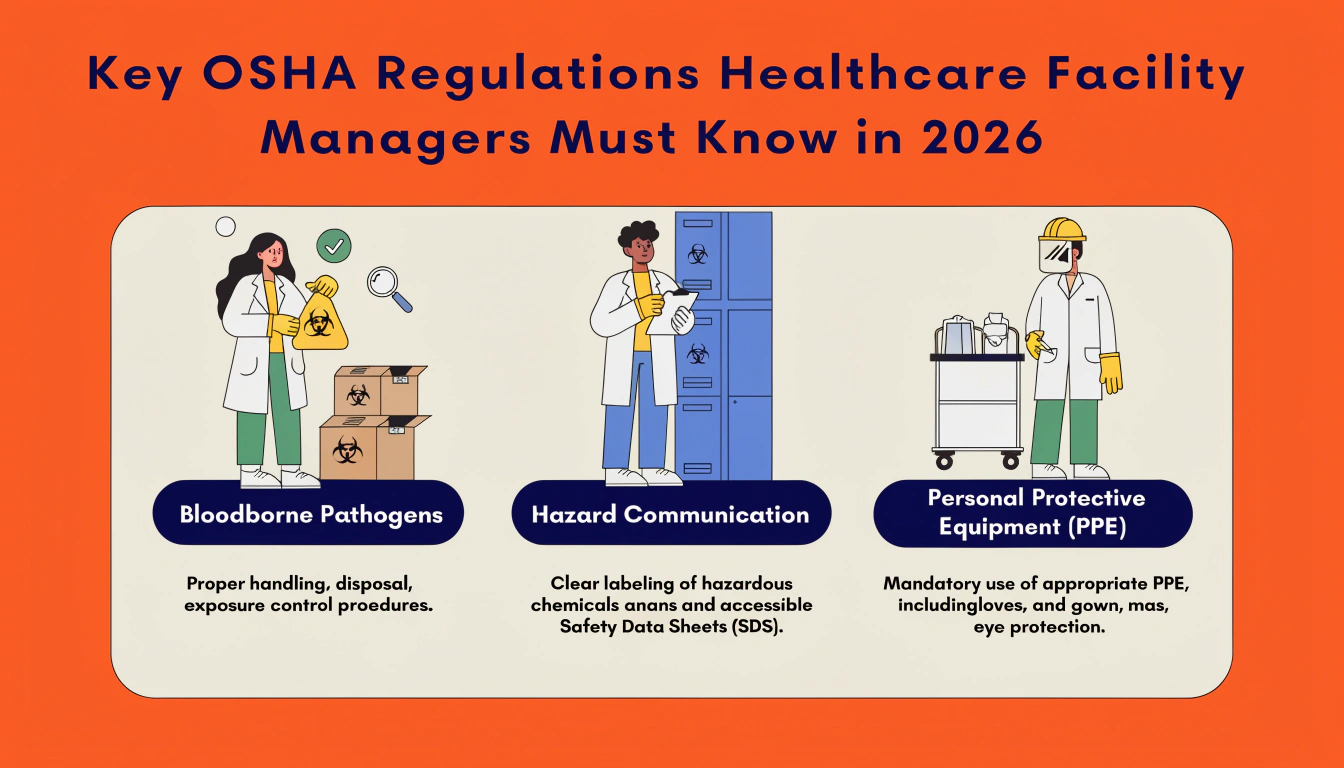
Blood and other potentially infectious materials are among the most significant occupational hazards in healthcare. OSHA’s Bloodborne Pathogens Standard requires employers with employees who have reasonably anticipated occupational exposure to blood or other potentially infectious materials to implement appropriate protective measures.
Healthcare facility managers should ensure that employees understand exposure risks and follow appropriate infection control and safety procedures. This includes maintaining an exposure control plan and reviewing it regularly.
The plan should identify job classifications and tasks where occupational exposure may occur and outline the controls used to reduce exposure.
Engineering controls are particularly important. Examples can include safer medical devices, sharps containers, and other equipment designed to reduce the risk of accidental exposure.
Work practices are equally important. Employees should receive appropriate training on handling needles, contaminated materials, waste, and other potentially infectious materials.
Personal protective equipment (PPE), such as gloves, gowns, masks, and eye protection, should also be readily available when required.
Facility managers should remember that compliance does not end with providing PPE. Employees need appropriate training and must understand when and how protective equipment should be used.
Hazard Communication Requirements
Healthcare facilities use a wide range of hazardous chemicals, including disinfectants, sterilizing agents, laboratory chemicals, cleaning products, and medications. OSHA’s Hazard Communication Standard helps ensure that employees understand the hazards associated with chemicals used in their workplace.
For hospital safety compliance, facility managers should maintain accurate chemical inventories and ensure that hazardous chemical containers are properly labeled.
Safety Data Sheets (SDSs) should be readily accessible to employees who may be exposed to hazardous chemicals. Employees should also receive training about chemical hazards, protective measures, emergency procedures, and appropriate handling practices.
Facility managers should coordinate with environmental services, laboratory teams, pharmacy personnel, maintenance staff, and other departments to ensure consistent chemical safety procedures.
Personal Protective Equipment
PPE plays a crucial role in protecting healthcare workers from exposure to biological, chemical, and physical hazards. Depending on their responsibilities, healthcare employees may need gloves, protective clothing, eye protection, face shields, respiratory protection, or other equipment.
OSHA requires employers to assess workplaces to determine whether hazards are present that require PPE. When PPE is necessary, employers must select appropriate equipment and provide employees with information and training on its proper use.
Healthcare facility managers should regularly review PPE requirements rather than relying on outdated assessments. Changes in equipment, clinical procedures, chemicals, or facility operations can create new risks.
Proper storage, inspection, replacement, and maintenance of PPE should also be incorporated into facility safety procedures.
Respiratory Protection
Respiratory hazards can occur in healthcare environments for a variety of reasons, including infectious diseases, airborne contaminants, chemical exposure, and certain clinical procedures.
Where respiratory protection is required, OSHA’s Respiratory Protection Standard establishes requirements for implementing an effective respiratory protection program.
Facility managers may need to coordinate medical evaluations, fit testing, respirator selection, employee training, and program documentation.
Respiratory protection should also be considered during emergency preparedness planning. Healthcare organizations should have appropriate procedures for situations where employees may face unexpected respiratory hazards.
A well-managed respiratory protection program is an important part of OSHA healthcare facilities 2026 planning, particularly for facilities where employees may encounter airborne or inhalation risks.
Emergency Action and Fire Safety
Healthcare facilities must be prepared to respond quickly to emergencies such as fires, hazardous material incidents, utility failures, and other events that could threaten employees.
OSHA requirements related to emergency action plans and fire prevention planning can help organizations establish clear procedures for responding to workplace emergencies.
Facility managers should ensure employees know how to report emergencies, where evacuation routes are located, and what responsibilities they have during an incident.
Emergency plans should be reviewed periodically and updated when there are changes to facility layouts, staffing, equipment, or operational procedures.
Hospitals present unique evacuation challenges because some patients may be unable to move independently. Although patient safety involves additional regulatory and accreditation considerations, facility managers should ensure that employee emergency procedures are integrated with the facility’s broader emergency preparedness strategy.
Electrical Safety and Facility Operations
Electrical systems represent another important workplace safety consideration. Healthcare facilities depend on complex electrical infrastructure to support medical equipment, lighting, HVAC systems, information technology, and life-safety systems.
Facility managers should ensure that electrical equipment and systems are maintained properly and that employees are not exposed to unnecessary electrical hazards.
Maintenance personnel should follow appropriate procedures when working on electrical systems. Where applicable, lockout/tagout practices should be implemented to prevent unexpected energization or startup of machinery and equipment during servicing.
Routine inspections and preventive maintenance can help identify damaged equipment, exposed wiring, overloaded circuits, or other hazards before they result in injuries or operational disruptions.
Lockout/Tagout for Maintenance Teams
Healthcare facilities have extensive mechanical and electrical equipment, including HVAC systems, pumps, generators, elevators, compressors, and other machinery.
OSHA’s Control of Hazardous Energy Standard, commonly known as lockout/tagout (LOTO), is designed to protect employees from unexpected machine startup or release of stored energy during maintenance and servicing.
Facility managers should make sure authorized employees receive appropriate training and understand the facility’s energy-control procedures.
Written procedures should identify the equipment covered, energy sources involved, isolation methods, and steps required to safely perform maintenance.
Contractors working on facility systems should also be coordinated with appropriately so that safety responsibilities are clearly established.
Ergonomics and Safe Patient Handling
Healthcare workers frequently perform physically demanding tasks, including lifting, transferring, repositioning, and assisting patients. These activities can contribute to musculoskeletal injuries, particularly among nurses, nursing assistants, orderlies, and other frontline staff.
While OSHA does not have a single comprehensive ergonomics standard specifically covering healthcare facilities, employers have responsibilities to address recognized workplace hazards.
Facility managers can support hospital safety compliance by evaluating high-risk tasks and implementing safer work practices.
Mechanical lifting devices, transfer equipment, adjustable beds, appropriate staffing, and employee training can help reduce the physical demands associated with patient handling.
Managers should also encourage employees to report hazards and injuries so recurring risks can be identified and addressed.
Workplace Violence Prevention
Workplace violence remains a significant concern for healthcare organizations. Employees may encounter aggressive behavior from patients, visitors, or other individuals, particularly in emergency departments, behavioral health environments, and other high-stress settings.
Healthcare facility managers should incorporate workplace violence prevention into their broader safety management strategy.
This can include identifying high-risk areas, improving communication procedures, providing appropriate training, reviewing security measures, and establishing clear incident-reporting processes.
Managers should also analyze incidents and near misses to identify recurring patterns. A proactive approach can help healthcare organizations strengthen employee protection while maintaining a patient-centered environment.
Recordkeeping and Reporting Requirements
Documentation is a critical component of OSHA healthcare facilities 2026 compliance. OSHA recordkeeping requirements generally require covered employers to maintain records of certain work-related injuries and illnesses.
Healthcare facility managers should coordinate with human resources, occupational health, safety teams, and other relevant departments to ensure records are accurate and maintained appropriately.
Incident documentation should be more than an administrative exercise. Reviewing injury and illness data can help managers identify trends, high-risk departments, recurring hazards, and opportunities for preventive action.
Managers should also understand OSHA requirements related to reporting certain severe injuries and fatalities within specified timeframes.
Employee Training Is a Core Compliance Requirement
Even the strongest safety policies are ineffective if employees do not understand them.
Training should be relevant to the employee’s responsibilities and the hazards they may encounter. New employees should receive appropriate orientation, while existing employees should receive refresher training when required or when procedures change.
Training topics may include bloodborne pathogens, PPE, hazard communication, emergency procedures, respiratory protection, chemical safety, electrical safety, and other hazards relevant to specific roles.
Healthcare facility managers should also maintain appropriate records of completed training. Documentation can demonstrate that the organization has taken reasonable steps to educate employees about workplace hazards.
How Technology Can Support OSHA Compliance
Technology can make safety management more efficient. Digital platforms can help facility managers track inspections, maintenance tasks, training, incidents, corrective actions, and compliance documentation.
For example, computerized maintenance management systems (CMMS) can help organizations schedule preventive maintenance and document completed work. Digital inspection tools can make it easier to identify hazards and assign corrective actions.
Data analytics can also help facility managers identify patterns in workplace incidents and prioritize areas requiring attention.
However, technology should complement—not replace—strong safety policies, employee training, leadership involvement, and regular workplace assessments.
Building a Proactive Safety Culture in 2026
Effective hospital safety compliance requires more than checking regulatory boxes. Healthcare organizations need a culture where safety is integrated into everyday operations.
Facility managers can encourage this culture by making it easy for employees to report hazards, responding quickly to safety concerns, recognizing safe practices, and communicating lessons learned from incidents.
Leadership support is especially important. When senior leaders prioritize employee safety and provide adequate resources for training, equipment, maintenance, and risk management, safety programs are more likely to succeed.
Regular safety audits can also help managers identify gaps before they become serious problems. Instead of waiting for an OSHA inspection or workplace incident, healthcare organizations can conduct internal assessments and continuously improve their processes.
Preparing for the Future of Healthcare Facility Safety
Healthcare environments are changing rapidly. New technologies, connected medical devices, evolving treatment models, staffing challenges, and facility modernization can introduce new workplace risks.
As a result, OSHA healthcare facilities 2026 compliance should be approached as an ongoing process rather than a one-time project.
Facility managers should regularly review applicable OSHA standards, monitor regulatory developments, assess workplace hazards, update training programs, and communicate changes to employees.
Collaboration is also essential. Safety cannot be managed by one department alone. Facility management, clinical leadership, occupational health, human resources, infection prevention, environmental services, IT, security, and executive leadership all have roles to play.
By creating an integrated approach, healthcare organizations can strengthen employee protection while improving operational resilience.
Conclusion
Understanding OSHA requirements is essential for healthcare facility managers responsible for maintaining safe and compliant workplaces in 2026. Bloodborne pathogens, hazardous chemicals, PPE, respiratory protection, emergency preparedness, electrical safety, lockout/tagout, ergonomics, workplace violence, and recordkeeping all deserve ongoing attention.
The most effective approach to hospital safety compliance is proactive. Healthcare organizations should regularly assess risks, provide appropriate training, maintain accurate documentation, invest in safety equipment, and continuously improve workplace procedures.
As healthcare facilities become more technologically advanced and operationally complex, facility managers will need to stay informed and adaptable. Strong safety management can help organizations protect employees, reduce preventable incidents, and create facilities that are safer and more resilient.
Enquire about BMA Conventions to explore industry insights, professional networking opportunities, and emerging strategies for smarter healthcare facility management.