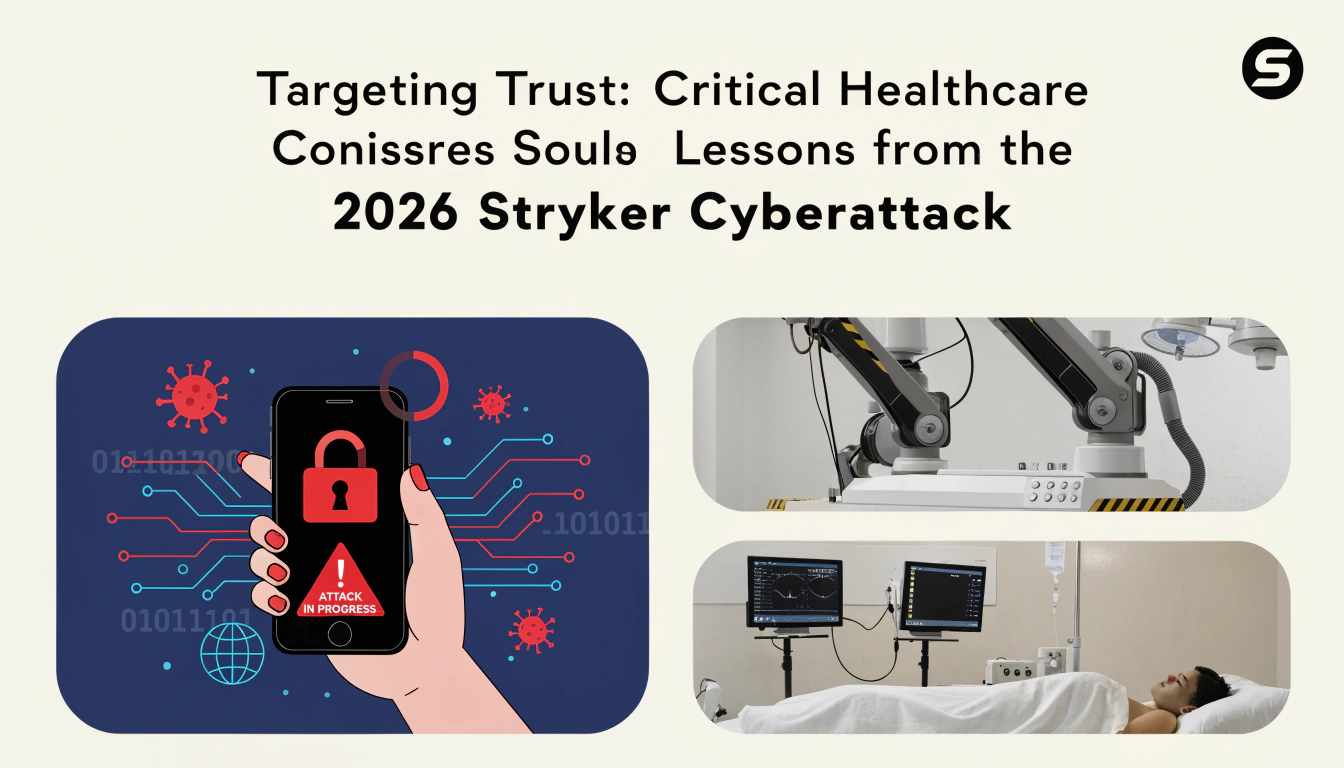
The conversation around healthcare cybersecurity usually revolves around protecting patient data from a breach or shielding medical equipment from ransomware. But the massive cyberattack on medical technology giant Stryker Corporation fundamentally altered the threat landscape.
The incident didn’t rely on complex ransomware to hold files hostage, nor did it target clinical endpoints directly. Instead, it targeted something far more foundational: the infrastructure of trust.
Our research team has analyzed the mechanics of this breach to understand what it means for the future of healthcare. The takeaway is sobering: digital identity and the systems that manage it are the new primary attack surface. For healthcare organizations and supply chain vendors, the Stryker incident is a critical wake-up call to re-evaluate how trust is managed across enterprise networks.
Here is our analysis of what happened, why it matters, and how healthcare organizations must adapt.
Anatomy of the Attack: What Happened?
In March 2026, Stryker experienced a catastrophic global disruption. According to our technical analysis, an adversary compromised a Windows domain administrator account, utilizing it to establish a new Global Administrator profile. From there, they didn’t deploy exotic malware—they used a tactic known as “Living off the Land” (LotL), leveraging the company’s own legitimate internal management software against it.
The attackers weaponized Stryker’s Microsoft Intune device management platform to push a remote “wipe” command across the network. Almost instantly, more than 200,000 corporate devices—laptops, servers, and mobile phones—were erased globally.
While Stryker’s patient-connected technologies and medical products remained entirely safe and unaffected, the destruction of their corporate environment halted manufacturing lines, jammed ordering workflows, and disrupted supply chains. The impacts rippled out to hospitals worldwide, causing delays in surgeries due to product availability shortages.
Shift 1: The Identity Plane is the New Attack Surface
In the past, cybersecurity focused heavily on perimeter defense—building strong walls to keep bad actors out. The Stryker attack proved that once an identity is compromised inside those walls, the tools built to protect and manage the system become the ultimate weapons.
When a hacker gains access to a Unified Endpoint Management (UEM) system or identity provider, they gain a “management plane” that establishes trust across the entire ecosystem.
- The Risk: Instead of compromising a single laptop, attackers can manipulate entire fleets of devices simultaneously.
- The Result: Complete operational paralysis in a matter of hours, without a single byte of ransomware ever being deployed.
Shift 2: Destructive Motivation and Geopolitical Warfare
Our investigation into the incident points to a group known as Handala. Unlike typical cybercriminal syndicates driven by monetary payouts, this attack was politically motivated and aimed at nihilistic destruction.
When state-sponsored or state-aligned actors target private healthcare supply chains, they aren’t looking to negotiate a ransom or provide a decryption key. Their goal is to disrupt critical infrastructure and send a geopolitical message. In healthcare, where operational continuity can literally be a matter of life or death, this standard of threat requires an entirely different defense strategy.
Strategic Takeaways: Securing the “Trust Infrastructure”
To safeguard against the next generation of identity-centric, destructive cyberthreats, our security experts recommend that healthcare organizations move beyond baseline cybersecurity and focus heavily on cyber resilience.
1. Audit and Secure Machine Identities
Identity is no longer just about username and password logins for human employees. The modern digital healthcare ecosystem relies heavily on “machine identities”—the automated credentials, cryptographic keys, and digital certificates that allow devices, applications, servers, and cloud services to interact with each other safely. Organizations must maintain a clear, real-time inventory of where these identities exist, how they are issued, and how they are validated.
2. Harden Device Management Platforms
Because centralized management tools (like Microsoft Intune, MDMs, or endpoint controllers) hold the “keys to the kingdom,” they must be locked down with the highest level of scrutiny. Enforce strict least-privilege access, require multi-factor authentication (MFA) for any administrative change, and heavily restrict the capabilities of accounts that can trigger mass commands like remote wipes.
3. Continuous Verification (Zero Trust)
Trust cannot be a one-and-done static approval. Healthcare environments must shift aggressively toward a dynamic Zero Trust architecture where every device, user, and transaction is continuously verified. Just because a command comes from an internal admin account does not mean it should be executed blindly without behavioral monitoring or secondary authentication safeguards.
4. Prepare for Wiper-Resilient Backups
Standard data backups are no longer enough if a wiper attack can target and delete the backup systems themselves. Healthcare organizations need immutable, air-gapped backups that are entirely isolated from the main corporate network. Furthermore, continuity plans must account for the reality that rebuilding hundreds of thousands of wiped systems from scratch is a timeline measured in weeks, not hours.
The Bottom Line
The Stryker cyberattack serves as an undeniable proof of concept for modern threat actors. Securing endpoints and networks is only the beginning; healthcare organizations must secure the very mechanisms they use to determine what and whom to trust.
As the threat universe evolves from data theft to systemic destruction, treating identity management as passive background infrastructure is no longer an option. It is the frontline of defense.