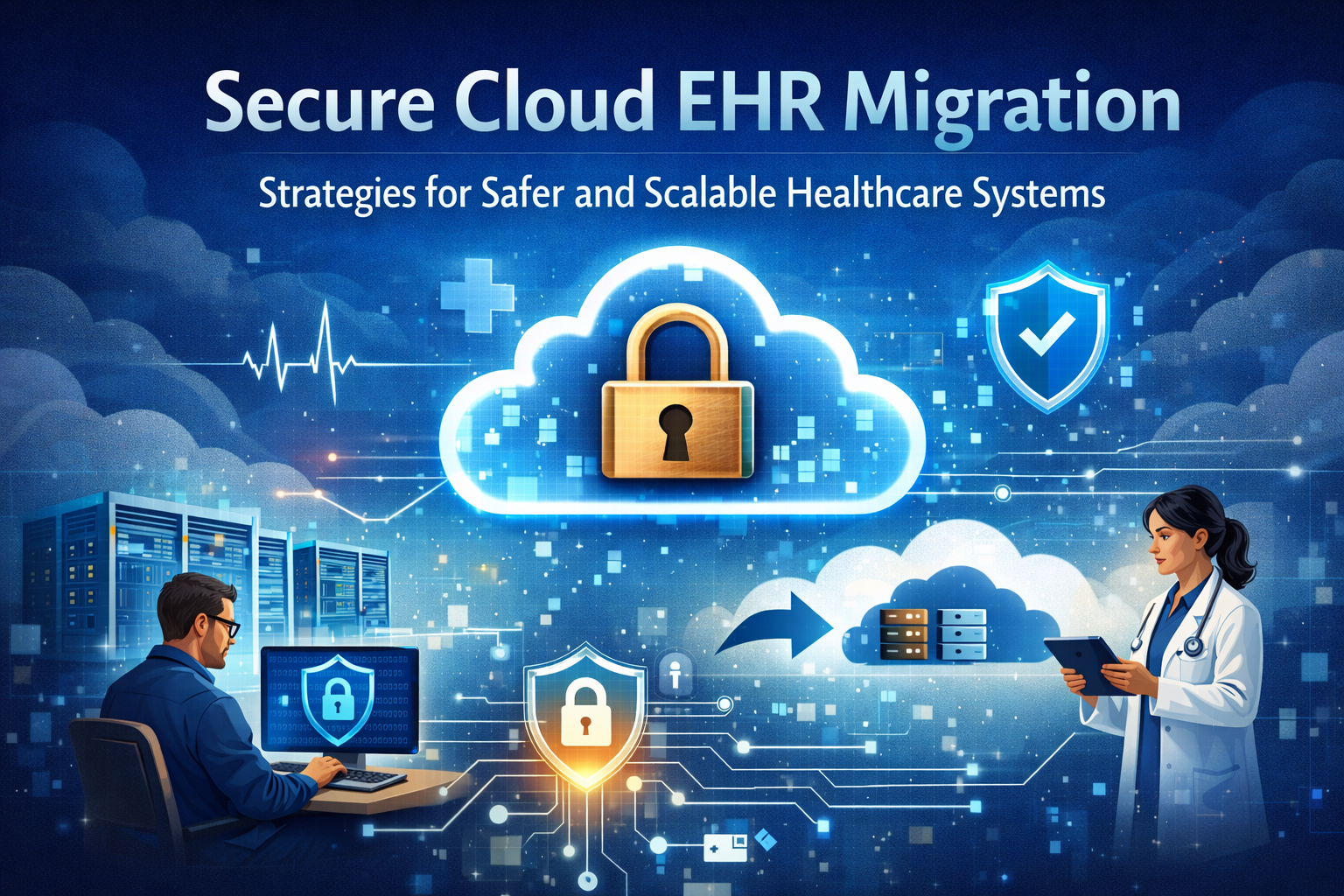
Healthcare organizations are rapidly shifting their electronic health record (EHR) systems to the cloud to improve efficiency, scalability, and security. However, a successful migration requires more than just moving data — it demands strong security planning and clearly defined responsibilities between healthcare providers and their technology partners.
Cloud-based EHR systems help organizations reduce infrastructure costs, increase system reliability, and strengthen cybersecurity frameworks. But to fully benefit from these advantages, healthcare institutions must make security a priority from the very beginning of the migration process.
Why Healthcare Organizations Are Moving EHR Systems to the Cloud
In the past, healthcare providers relied on on-premises data centers to manage their EHR systems. This required significant investments in hardware, IT staff, and maintenance.
Today, cloud computing has transformed this approach.
Luis Ahumada, Executive Director of Advanced Technologies and Data Science at Johns Hopkins Medicine, compares the shift to the early days of electricity providers. Before electricity became centralized, businesses had to build their own power plants. Similarly, healthcare organizations once had to maintain their own EHR infrastructure.
Cloud-based EHR platforms now provide a centralized, scalable model that reduces operational costs and improves reliability.
Key advantages include:
- Reduced capital expenditure on hardware
- Scalable infrastructure that grows with demand
- Faster deployment of system updates
- Improved system reliability and uptime
Instead of purchasing excess hardware to prepare for future growth, organizations can now pay only for the computing resources they actually use.
Security Benefits of Cloud-Based EHR Systems
One of the biggest advantages of migrating EHR systems to the cloud is the ability to design security from the ground up.
When Franciscan Health moved its EHR infrastructure to the cloud in 2024, the organization rebuilt its security architecture during the migration process.
This allowed them to implement stronger protections such as:
- Secure backup vaults for critical data
- Improved disaster recovery capabilities
- Enhanced monitoring and compliance dashboards
- Advanced access control and segmentation
With cloud platforms, healthcare organizations can achieve higher resilience against downtime and cyberattacks while maintaining continuous access to patient data.
Strong redundancy and disaster recovery capabilities also help healthcare providers maintain business continuity even during unexpected system disruptions.
Building Security Into Cloud EHR Migrations
Cybersecurity experts emphasize that security should not be treated as an afterthought.
Instead, it must be integrated into the migration process from the very beginning.
Jay Bhat, Chief Information Security Officer at Franciscan Health, advises organizations to treat security as a core requirement when moving EHR systems to the cloud.
If segmentation, access controls, and monitoring tools are implemented during the initial design phase, the final system will be significantly more secure.
A useful analogy is building a house — electrical wiring is installed while the house is being built, not after construction is complete. The same principle applies to cybersecurity in cloud environments.
Managing Security Risks in Cloud-Based EHR Systems
Despite its advantages, cloud infrastructure also introduces new risks.
Because cloud systems centralize data access, they can become attractive targets for cybercriminals. A single compromised account or phishing attack could potentially expose sensitive patient data.
Every employee interaction with a healthcare system creates a possible vulnerability.
To mitigate these risks, healthcare organizations must implement strict security policies, including:
- Multi-factor authentication
- Continuous system monitoring
- Employee cybersecurity training
- Regular vulnerability testing
These practices help prevent security breaches and maintain compliance with healthcare regulations.
Defining Security Responsibilities Between Vendors and Providers
A key factor in cloud migration success is clearly defining who is responsible for each aspect of system security.
Cloud providers and EHR software vendors typically operate under a shared responsibility model. While vendors provide secure infrastructure and platform services, healthcare organizations remain responsible for protecting the patient data stored within those systems.
This means healthcare institutions must still maintain strong internal cybersecurity policies and ensure compliance with healthcare regulations.
Even when using managed service providers, organizations must continuously verify that security standards are being maintained across updates, integrations, and system upgrades.
Ultimately, the responsibility for safeguarding patient data always lies with the healthcare provider.
The Future of Secure Cloud-Based Healthcare Systems
Cloud technology is transforming healthcare IT infrastructure, offering improved flexibility, scalability, and security.
When implemented correctly, cloud-based EHR systems provide healthcare organizations with:
- Better cybersecurity visibility
- Stronger disaster recovery capabilities
- Reduced operational costs
- Greater system reliability
However, successful cloud adoption requires careful planning, strict security protocols, and ongoing collaboration between healthcare providers and their technology partners.
By treating security as a foundational component of cloud migration, healthcare organizations can fully unlock the benefits of modern EHR systems while protecting sensitive patient information.