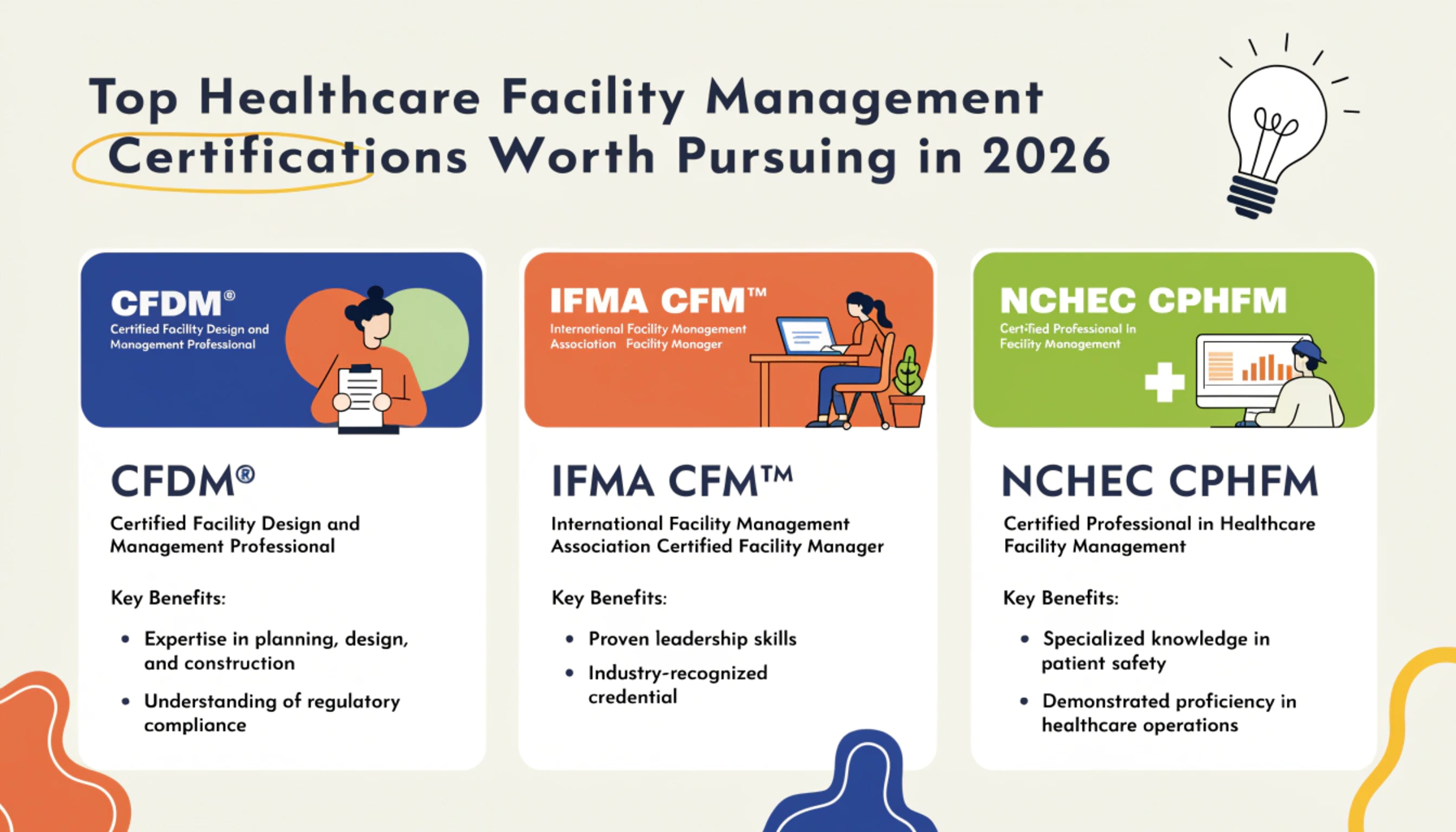
The modern hospital is a technological marvel, an ecosystem where life-saving interventions happen around the clock. Yet behind the sterile operating suites, responsive clinical teams, and patient-centered treatment wards lies an intricate infrastructure operating without pause. From medical gas distribution and redundant electrical microgrids to precision airborne infection isolation rooms, a healthcare facility functions as its own dedicated city. In 2026, managing these complex built environments demands far more than traditional plant engineering expertise. Today’s facility leaders navigate a dynamic convergence of decarbonization mandates, cybersecurity threats to building automation systems, strict accreditation surveys, and evolving emergency preparedness protocols.
For professionals aspiring to lead in this high-stakes arena, earned credentials serve as the clearest benchmark of competence and regulatory fluency. Holding a recognized healthcare facility manager certification validates your specialized knowledge to executive leadership, boards of directors, and regulatory agencies. Whether you are an experienced engineering technician transitioning into leadership or a seasoned operations director seeking to validate decades of clinical plant experience, earning the right credential can define your trajectory.
Below is an in-depth analysis of the top certifications shaping healthcare physical environments in 2026, key regulatory developments, strategic preparation methodologies, and how to position your career for long-term executive growth.
The Evolving Landscape of Healthcare Facilities in 2026
The physical environment of healthcare has experienced a profound structural evolution over the past decade. Facility managers are no longer evaluated solely on uptime, boiler performance, and preventive maintenance completion rates. Modern health systems face compounding regulatory, environmental, and financial pressures that require facility executives to sit at the strategic planning table.
Decarbonization and energy efficiency have shifted from optional corporate social responsibility goals to strict operational requirements. State-level building energy performance standards and federal environmental targets require older physical plants to be retrofitted with heat-recovery chillers, automated sub-metering, and variable-frequency drives, all while maintaining rigorous temperature, humidity, and air-exchange parameters mandated by clinical codes.
Simultaneously, building technology has integrated deeply into clinical workflows. Internet of Things (IoT) sensors, computerized maintenance management systems (CMMS), and automated building management systems (BMS) optimize indoor environmental quality in real time. However, this level of digital interconnectivity exposes critical mechanical infrastructure to potential cyber threats, making cybersecurity hygiene an indispensable competency for modern hospital engineers.
Above all, patient safety remains inseparable from physical plant integrity. The American Society for Health Care Engineering (ASHE), the National Fire Protection Association (NFPA), and accrediting bodies like The Joint Commission continuously update life safety and environment of care standards. To navigate this dense regulatory landscape, facilities executives increasingly prioritize certified professionals who can guarantee regulatory compliance while sustaining seamless clinical operations.
Top Industry Certifications for 2026
1. Certified Healthcare Facility Manager (CHFM): The Premier Gold Standard
When evaluating industry credentials, the Certified Healthcare Facility Manager designation stands unchallenged as the definitive professional standard across North America and increasingly worldwide. Administered by the American Hospital Association (AHA) Certification Center in close partnership with ASHE, this credential demonstrates comprehensive mastery across all facets of hospital engineering and administration.
Pursuing the CHFM certification 2026 is a decisive milestone for any professional seeking senior or executive facility director roles. Accrediting survey teams, hospital executive search committees, and risk management departments treat the CHFM designation as an objective guarantee that the holder understands the delicate balance between clinical safety, fiscal responsibility, and mechanical integrity.
The CHFM examination assesses candidates across five fundamental operational domains:
- Compliance (approx. 20%): Mastering the nuances of NFPA 101 (Life Safety Code), NFPA 99 (Health Care Facilities Code), OSHA requirements, EPA mandates, and conditions of participation established by the Centers for Medicare & Medicaid Services (CMS). Candidates must demonstrate how to manage statements of conditions, plans of correction workflows, and unannounced accreditation inspections.
- Planning, Design, and Construction (approx. 20%): Navigating the Facility Guidelines Institute (FGI) Guidelines for Design and Construction of Hospitals, conducting rigorous Infection Control Risk Assessments (ICRA), supervising pre-construction risk assessments (PCRA), and managing capital replacement projects within operational hospital environments.
- Maintenance and Operations (approx. 20%): Overseeing central utility plants, HVAC systems, medical gas storage and distribution, emergency standby power supply systems (EPSS), plumbing distribution systems, and legionella water safety management plans.
- Finance (approx. 15%): Formulating operational and capital budgets, conducting total cost of ownership (TCO) life-cycle assessments, administering vendor contracts, and forecasting long-range capital infrastructure renewal.
- Administration (approx. 25%): Emergency management planning under the Incident Command System (ICS), staff development, utility disruption response, departmental policy drafting, and strategic alignment with hospital executive goals.
Eligibility requires an intentional combination of formal education and verifiable healthcare-specific facility management experience. For instance, candidates holding a bachelor’s degree require at least three years of healthcare facility experience, while those with an associate degree require five years. Candidates without an undergraduate degree require seven years of qualifying experience, with a significant portion dedicated to direct supervisory or management accountability.
Earning the CHFM confirms that you speak the complex dialect of hospital operations, bridging the gap between mechanical contractors in the basement and clinical executives in the boardroom.
2. Certified Healthcare Constructor (CHC)
While the CHFM centers primarily on operational continuity and sustained asset performance, the Certified Healthcare Constructor (CHC) credential addresses the volatile intersection of active building construction and continuous clinical delivery. Also administered by the AHA Certification Center and ASHE, the CHC is engineered specifically for healthcare project managers, general contractors, hospital-based planning, design, and construction (PDC) directors, and consulting engineers.
Renovating an active healthcare facility carries life-or-death stakes. An improper containment barrier can disperse Aspergillus spores into an oncology ward; an accidental utility cut can disconnect clinical monitors or piped medical suction during surgery. The CHC credential validates that a construction leader understands these heightened operational risks.
The curriculum covers healthcare-specific building protocols, regulatory approvals, contractor badging, interim life safety measures (ILSM), air monitoring containment procedures, and clinical stakeholder communication. For facility managers charged with overseeing multimillion-dollar bed tower expansions, surgical suite modernizations, or ambulatory care network buildouts, earning the CHC alongside an operational healthcare facility manager certification builds a versatile, indispensable skill set.
3. Certified Facility Manager (CFM) by IFMA
The Certified Facility Manager (CFM) credential, issued by the International Facility Management Association (IFMA), represents the world’s most recognized cross-industry facility management certification. While not exclusive to healthcare, the CFM holds tremendous prestige and is particularly beneficial for professionals overseeing expansive healthcare systems, university medical centers, corporate healthcare headquarters, or non-acute ambulatory regional networks.
The CFM is a competency-based assessment rather than a memorization exercise. It assesses twenty-four distinct competencies clustered into eleven core modules, including real estate management, environmental stewardship, project management, business continuity, risk management, and facility communication.
In large healthcare networks where facility leaders must manage lease negotiations, off-campus medical office buildings, commercial real estate portfolios, and enterprise-wide workplace strategy, the broad-spectrum business acumen developed through the CFM perfectly complements technical hospital engineering credentials.
4. Certified Healthcare Environmental Services Professional (CHESP)
A sterile, clean physical environment is the first line of defense against healthcare-associated infections (HAIs). Administered by the Association for the Health Care Environment (AHE) of the American Hospital Association, the Certified Healthcare Environmental Services Professional (CHESP) credential focuses on environmental hygiene, surface disinfection, hazardous waste logistics, and textile services management.
In contemporary hospital organizational charts, facility operations, plant engineering, and environmental services (EVS) frequently report into a unified support services directorate. Facility managers who oversee both physical plant operations and environmental services find immense value in the CHESP. It provides deep technical grounding in microbiological pathogen pathways, chemical contact disinfection protocols, biomedical waste handling, and linen management, ensuring the physical building supports clinical infection prevention across every square foot.
5. Certified Energy Manager (CEM) and Healthcare Energy Leadership
Energy management has evolved from an administrative utility tracking function into an urgent operational priority. Hospitals consume roughly three to five times more energy per square foot than standard commercial office buildings due to constant 24/7/365 occupancy, high-volume air turnover requirements, and energy-dense medical imaging equipment.
The Certified Energy Manager (CEM) credential, awarded by the Association of Energy Engineers (AEE), validates your ability to optimize building energy performance, conduct formal energy audits, implement retro-commissioning programs, and deploy sustainable technologies. Healthcare facility leaders who pair a specialized healthcare certification with the CEM are uniquely positioned to lead capital decarbonization programs, identify utility rebates, and lower operating costs without compromising patient comfort or clinical safety standards.
Comparative Analysis of Top Credentials
| Certification Name | Sponsoring Organization | Primary Focus Area | Ideal Career Stage / Role |
|---|---|---|---|
| CHFM | AHA / ASHE | Full-spectrum hospital operations, life safety codes, compliance, and administration | Facility Managers, Directors of Plant Operations, Healthcare Engineers |
| CHC | AHA / ASHE | Healthcare planning, design, active hospital construction, and containment risk | Construction Project Managers, PDC Directors, General Contractors |
| CFM | IFMA | Enterprise facility management, real estate strategy, finance, and workplace systems | Multi-site Healthcare Real Estate Directors, Regional Operations Leaders |
| CHESP | AHA / AHE | Environmental hygiene, infection containment, waste stream protocols, and EVS operations | Support Services Directors, EVS Managers, Healthcare Operations Leaders |
| CEM | AEE | Utility conservation, decarbonization strategies, HVAC efficiency, and energy audits | Energy Managers, Sustainability Officers, Infrastructure Directors |
Strategic Roadmap to Prepare for the CHFM Certification in 2026
Passing the CHFM examination demands a structured, multi-disciplinary study routine. Because the test covers broad administrative, financial, and code-driven competencies, even seasoned hospital engineers encounter areas where they lack direct daily experience. Follow this proven blueprint to structure your preparation:
1. Perform an Honest Knowledge Gap Analysis
Examine the official AHA CHFM candidate handbook and content outline. Many plant engineers are exceptionally strong in physical mechanical and electrical systems, yet less familiar with depreciation accounting, capital expenditure formulas, or formal collective bargaining grievance steps. Conversely, leaders who entered healthcare facilities from administrative or architectural backgrounds often need focused study on medical air compressor cycles, diesel generator transfer switches, and NFPA 99 risk categories. Identify your weak domains early and allocate your study hours accordingly.
2. Master the Governing Codes and Standards
Compliance forms the foundational backbone of the examination. You must dedicate extensive study time to understanding the structure and practical application of NFPA 101 (Life Safety Code) and NFPA 99 (Health Care Facilities Code). Focus on the differences between new and existing occupancies, compartmentation concepts, dampening requirements, fire-rated door inspection criteria, hazardous area classifications, and testing intervals for emergency power supplies and piped medical gas valves.
3. Leverage ASHE Educational Resources and Practice Exams
ASHE publishes comprehensive study guides, e-learning modules, and exam review courses specifically tailored to the current testing specifications. Completing full-length practice exams under timed conditions helps you become comfortable with the situational phrasing of questions. The CHFM does not simply test your ability to recall code numbers; it tests your capacity to evaluate realistic operational emergencies and select the safest, most compliant course of action.
4. Form an Industry Study Group
Studying alongside peers who represent diverse functional areas such as biomedical engineering, hospital safety, or mechanical contracting enables mutual knowledge sharing. Explaining complex regulatory requirements to a peer is one of the most effective methods to solidify your own comprehension and retention.
The Career and Financial Impact of Certification
Investing time and resources into earning a recognized credential delivers tangible professional returns. In healthcare administration, capital infrastructure is one of the health system’s largest balance sheet assets. Hospital chief operating officers and vice presidents of support services must have total confidence that the individuals managing these high-value assets possess verified expertise.
Industry salary surveys consistently indicate that certified healthcare facility managers command substantial salary premiums over their uncertified counterparts. Beyond compensation, credentialing accelerates career advancement, transforming mid-level maintenance supervisors into competitive candidates for system-level administrative director and corporate vice president roles.
Furthermore, having certified leaders enhances an institution’s organizational profile. It communicates to liability insurance carriers, rating agencies, and clinical staff that the institution maintains an uncompromising commitment to environmental quality, life safety excellence, and clinical reliability.
Elevate Your Facility Leadership: Join the Industry Vanguard
Technical certifications provide the intellectual foundation, but true leadership thrives on active industry engagement, hands-on collaboration, and continuous exposure to pioneering engineering solutions. As hospitals incorporate autonomous robotics, artificial intelligence into predictive building maintenance, and microgrid resilience architectures, staying isolated within your home facility limits professional growth.
To network with senior engineering executives, discover state-of-the-art building management technologies, and discuss the regulatory shifts defining modern healthcare design, participate in upcoming national conferences such as those held in.
Attending industry-leading events empowers you to explore cutting-edge case studies, interact directly with regulatory authorities, and return to your health system with actionable insights that reduce operational costs and enhance patient safety.
Final Thoughts: Building a Resilient Future
The healthcare built environment is one of the most sophisticated, challenging, and rewarding sectors in professional facility management. Every uninterrupted electrical cycle, balanced ventilation pressure differential, and validated fire barrier actively protects vulnerable lives.
Pursuing a recognized credential like the CHFM demonstrates your dedication to technical mastery, patient safety, and institutional excellence. As 2026 unfolds, step forward to validate your expertise, inspire your maintenance teams, and help engineer the future of smart, sustainable, and resilient healing environments.
Register for Smart Healthcare Convention.