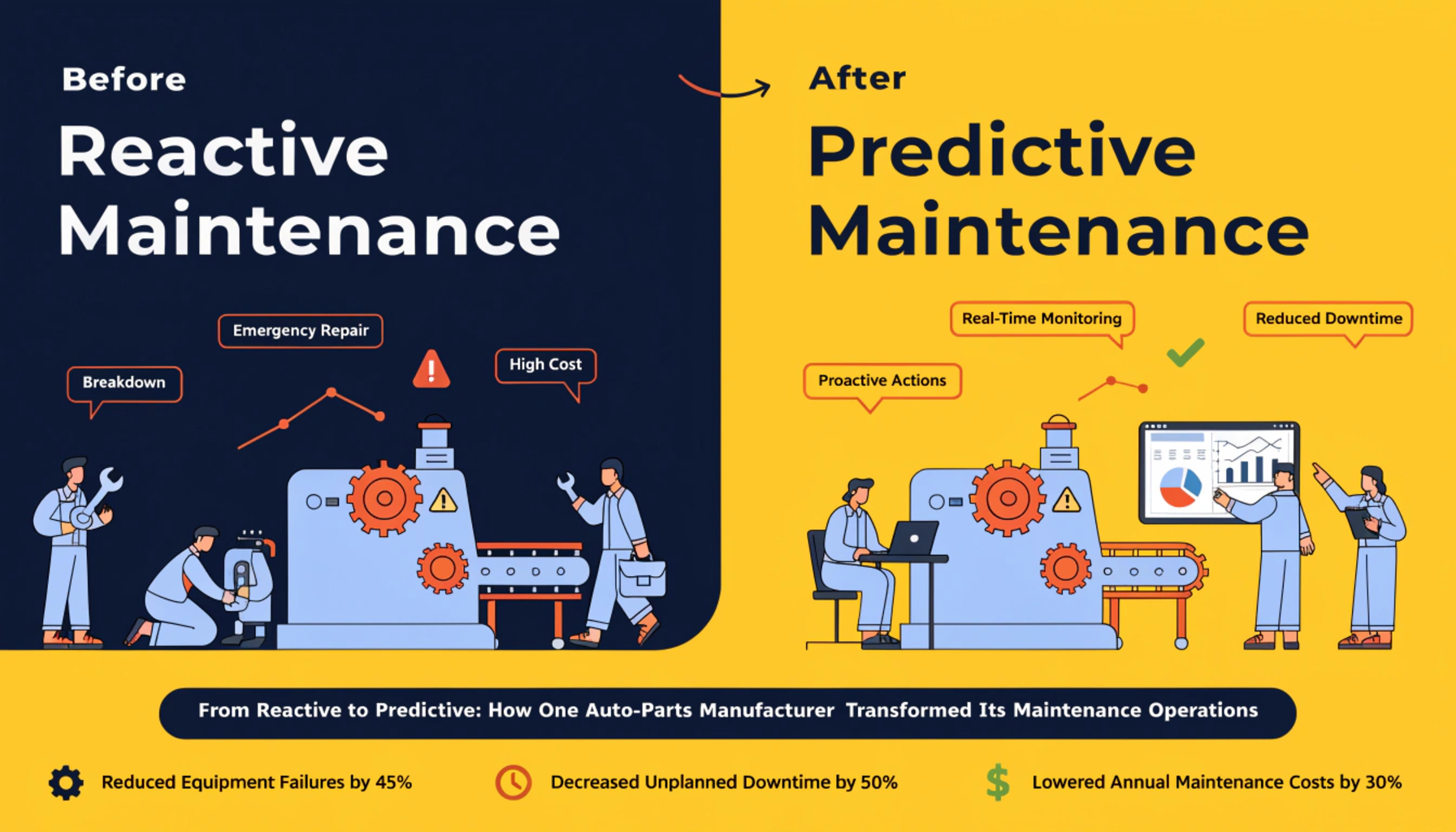
In high-volume automotive manufacturing, precision and uptime dictate survival. Modern automotive supply chains operate under strict just-in-time (JIT) delivery schedules, where tier-one and tier-two suppliers face severe financial penalties and lost contracts if an unexpected equipment breakdown halts delivery to an assembly plant. Yet, many manufacturing facilities continue to manage machine reliability using traditional, calendar-based preventive maintenance schedules or reactive emergency repairs.
When equipment is serviced according to arbitrary calendar intervals rather than actual physical condition, plant operators face two costly risks: performing unnecessary maintenance that introduces human error and increases labor costs, or experiencing catastrophic failures between scheduled inspections.
An automotive parts manufacturer recently challenged this conventional approach by deploying condition-based monitoring and machine learning across its stamping, CNC machining, and robotic welding lines. By transitioning from reactive firefighting to intelligent predictive maintenance auto manufacturing workflows, the facility achieved a dramatic reduction in unplanned downtime, extended machine component lifecycles, and significantly reduced scrap rates.
This manufacturing operations case study breaks down how the plant approached the transition, the technical architecture deployed, the operational hurdles overcome, and the measurable business outcomes achieved.
The True Cost of Unplanned Downtime in Auto Parts Production
Unplanned downtime in the automotive sector carries some of the highest financial penalties in modern industry. When an assembly line stops at a major OEM facility, costs can easily exceed tens of thousands of dollars per minute. For parts suppliers feeding those lines, an unexpected equipment failure quickly ripples through production schedules, resulting in costly expedited freight fees, emergency overtime, and strained customer relationships.
For this tier-one manufacturer, maintenance operations had historically relied on scheduled preventive maintenance (PM) routines. Technicians inspected machines, lubricated bearings, and replaced components on fixed 30-, 60-, or 90-day intervals.
Despite diligent adherence to these intervals, the plant experienced persistent bottlenecks:
- Unpredictable Failure Modes: High-stress assets such as heavy stamping presses and multi-axis CNC spindles—frequently suffered sudden bearing degradation and thermal expansion between scheduled maintenance windows.
- Maintenance-Induced Failures: Disassembling complex mechanical assemblies solely for routine visual inspections occasionally introduced alignment errors, contamination, and improper reassembly.
- High Secondary Damage: When a critical bearing or hydraulic valve failed during a high-speed production run, catastrophic failure often damaged surrounding tooling, resulting in days of emergency repairs rather than hours of planned servicing.
- Scrap and Quality Deficiencies: Machine wear rarely occurs instantaneously. As tooling lost rigidity and spindle runout increased, dimensional drift produced out-of-spec components that went unnoticed until post-process quality inspections, wasting raw materials.
Leadership realized that keeping pace with 2026 production demands required real-time visibility into machine health. The objective was clear: detect the earliest indicators of asset degradation and address mechanical wear before it impacted production schedules.
Designing the Predictive Maintenance Architecture
A common misconception in smart manufacturing is that predictive maintenance requires replacing entire production lines with newly commissioned machinery. In practice, the manufacturer retrofitted existing brownfield equipment using non-invasive industrial IoT sensors, edge processing gateways, and automated analytics.
The deployment focused on the plant’s most critical bottleneck assets: primary mechanical stamping presses, multi-spindle CNC machining centers, and automated transfer conveyor systems.
1. Multi-Modal Sensor Deployment
To capture a comprehensive profile of machine health, engineering teams installed high-frequency vibration sensors, surface temperature probes, and current transducers across critical drive motors, gearboxes, and spindle housings.
- Vibration Analysis: Triaxial accelerometers mounted on bearings detected high-frequency impact energy and harmonic vibrations caused by micro-fractures, raceway pitting, and imbalance.
- Thermal Monitoring: Contact temperature sensors monitored friction buildup within gearboxes and hydraulic systems.
- Power Quality & Current Draw: Current transducers tracked electrical draw patterns on drive motors, identifying increased resistance caused by mechanical binding or lubrication breakdown.
2. Edge Processing and Anomaly Detection
Transmitting raw, high-frequency vibration data continuously to cloud servers would have created unsustainable network bandwidth demands. The facility deployed industrial edge gateways directly on the plant floor. These gateways filtered raw acoustic and vibration telemetry, calculated root-mean-square (RMS) velocity and peak acceleration metrics, and transmitted structured condition data to the plant’s central data repository.
3. Automated CMMS Integration
Data is only valuable if it drives operational action. The plant connected its analytics engine directly with its Computerized Maintenance Management System (CMMS). When machine vibration or thermal thresholds exceeded statistical process control limits, the platform automatically generated an assigned work order, complete with diagnostic telemetry, probable root-cause analysis, and required replacement parts.
Operational Execution: A Step-by-Step Transition
Transitioning a busy production facility from reactive repairs to predictive reliability requires disciplined phased execution. The manufacturer rolled out the program over three distinct phases:
Phase 1: Baselining and Normal Operation Profiling (Months 1–2)
Before algorithms could identify anomalies, the engineering team spent eight weeks recording normal operational baselines across varying production cycles, material thicknesses, and ambient plant temperatures. Because stamping presses exhibit distinct vibration signatures during initial die strike compared to continuous running, the machine learning models were trained to filter out transient process noise from genuine mechanical degradation.
Phase 2: Pilot Testing and Early Fault Validation (Months 3–5)
The system proved its value during month four. An edge gateway flagged an unusual high-frequency harmonic signature on the main drive bearing of a 600-ton stamping press. Baseline vibration levels had increased by only 12%—an elevation completely imperceptible to human operators and conventional sensory inspections.
The automated system projected a complete bearing failure within 18 to 22 days. Rather than stopping production immediately, the maintenance planner reviewed upcoming production schedules, ordered the necessary precision roller bearings, and scheduled the replacement during a planned shift changeover the following weekend.
Subsequent teardown revealed significant subsurface micro-spalling on the inner bearing race. Had the bearing failed during peak production, the resulting catastrophic lockup would have cracked the main drive housing, causing an estimated $280,000 in emergency repairs and halting three downstream assembly cells for at least four days.
Phase 3: Plant-Wide Rollout and Closed-Loop Optimization (Months 6–12)
Following the pilot’s success, the plant scaled condition-based monitoring to 85 critical machines across three production bays, establishing a unified reliability dashboard visible to operators, maintenance technicians, and plant managers.
Measurable Results and Operational ROI
Within twelve months of completing the plant-wide rollout, the manufacturer documented measurable improvements across every primary maintenance and production KPI:
| Performance Indicator | Baseline (Pre-Implementation) | Result (Post-Implementation) | Improvement (%) |
|---|---|---|---|
| Unplanned Equipment Downtime | 8.4% of operating hours | 1.9% of operating hours | 77% Reduction |
| Emergency Overtime Hours | 42 hours / month | 6 hours / month | 85% Reduction |
| Mean Time to Repair (MTTR) | 4.8 Hours | 1.6 Hours | 66% Reduction |
| Component Scrap Rate | 2.3% of volume | 0.9% of volume | 60% Reduction |
| Annual MRO Spare Parts Spend | $410,000 | $295,000 | 28% Reduction |
Beyond direct cost savings, the predictive maintenance initiative protected plant delivery commitments. Over the course of a year, the facility maintained a 99.8% on-time delivery record with its primary automotive OEM clients.
Managing Culture and Workforce Adoption
Technology alone does not guarantee a successful predictive maintenance program; cultural alignment is equally vital. In many traditional manufacturing plants, maintenance technicians take pride in their ability to respond rapidly to emergencies and repair broken machinery under pressure. Shifting to an analytical, data-guided culture required deliberate change management.
Leadership involved senior maintenance technicians from the initial sensor placement stage. Rather than presenting the system as a replacement for human judgment, it was framed as an advanced diagnostic tool that removed guesswork and eliminated stressful late-night repair calls.
- Mobile Diagnostic Access: Technicians were equipped with ruggedized tablets displaying real-time vibration spectra, thermal trends, and historical repair documentation directly at the machine.
- Upskilling Reliability Teams: Technicians received targeted training in vibration analysis and predictive maintenance principles, helping them transition into proactive reliability engineers.
- Aligning Operations and Maintenance: Shift supervisors were incentivized on overall equipment effectiveness (OEE) and scheduled maintenance compliance rather than raw piece-count output alone, eliminating historical friction between production and maintenance departments.
Key Takeaways for Industrial Facility Managers
For plant directors and operations leaders evaluating similar smart manufacturing investments for 2026 and 2027, this case study provides several practical lessons:
- Target Bottlenecks First: Avoid trying to sensorize every motor and pump in the facility on day one. Focus investment on single-point-of-failure assets that carry the highest downtime cost.
- Prioritize Interoperability: Ensure IoT hardware and vibration analysis platforms integrate seamlessly with your existing CMMS and Enterprise Resource Planning (ERP) systems to ensure automated work order generation.
- Treat Data as an Asset: Machine telemetry provides actionable insights beyond maintenance. By correlating vibration data with tooling wear, manufacturers can optimize machine feeds, speeds, and tooling selection to improve product quality.
- Engage Frontline Operators: Early buy-in from plant floor operators and maintenance craftspeople is the single most critical factor in sustaining long-term predictive maintenance programs.
Conclusion
The experience of this automotive supplier highlights a broader evolution taking place across the industrial landscape. In an environment characterized by tight margins, skilled labor shortages, and unforgiving delivery schedules, reactive equipment maintenance is no longer a viable business strategy.
By combining low-cost industrial IoT sensors, automated vibration analytics, and integrated maintenance workflows, manufacturers can transition from reacting to machine failures to anticipating and preventing them entirely. Predictive maintenance transforms the maintenance department from a reactive cost center into a predictable driver of plant productivity, safety, and profitability.
Looking to connect with industrial operations leaders, automation pioneers, and plant reliability experts?
Sponsor Smart Manufacturing Convention 2027 and discover actionable strategies to optimize your factory floor with AI, condition-based monitoring, and intelligent facility operations.