Hospital development is no longer simply about adding beds, expanding departments, or constructing new buildings. Health systems today are balancing changing patient expectations, rising operational costs, workforce pressures, technology adoption, sustainability goals, and increasingly complex models of care. A hospital master plan must therefore provide more than a construction roadmap. It needs to connect clinical strategy, infrastructure, technology, finances, and long-term growth.
This is where choosing the right hospital master planning approaches becomes critical. Different health systems have different priorities, physical constraints, financial resources, patient populations, and growth expectations. A model that works for a large academic medical center may not be suitable for a regional hospital or a rapidly expanding private healthcare network.
The right approach creates a framework for making investment decisions today while preserving flexibility for tomorrow.
What Is Hospital Master Planning?
Hospital master planning is a long-term process used to guide the development, redevelopment, expansion, and optimization of healthcare facilities. It typically considers the physical campus, clinical services, patient flows, infrastructure, technology, workforce requirements, financial capacity, and future demand.
Rather than treating every construction project as an isolated initiative, master planning connects individual projects to a broader vision for the health system.
A strong master plan can answer questions such as:
- Where should new clinical services be located?
- Should the hospital expand vertically, horizontally, or through a new campus?
- How much capacity will be required over the next 10 to 20 years?
- Which existing facilities should be renovated, replaced, or repurposed?
- How can patient and staff movement be improved?
- What infrastructure investments should happen first?
- How can capital expenditure be aligned with long-term clinical priorities?
These questions make master planning a strategic exercise rather than simply an architectural one.
Why the Right Planning Model Matters
Every health system operates within a different environment. A mature urban hospital may have limited land but strong demand, while a growing suburban health network may have opportunities to develop an entirely new campus.
The choice among hospital master planning approaches should therefore begin with the health system’s strategic objectives.
For example, a hospital focused on improving emergency care may prioritize emergency department expansion, imaging capacity, intensive care, and improved patient circulation. A system focused on outpatient growth may instead prioritize ambulatory centers, diagnostic hubs, day-care facilities, and digital healthcare infrastructure.
The planning model should reflect these priorities rather than allowing available construction opportunities to dictate the strategy.
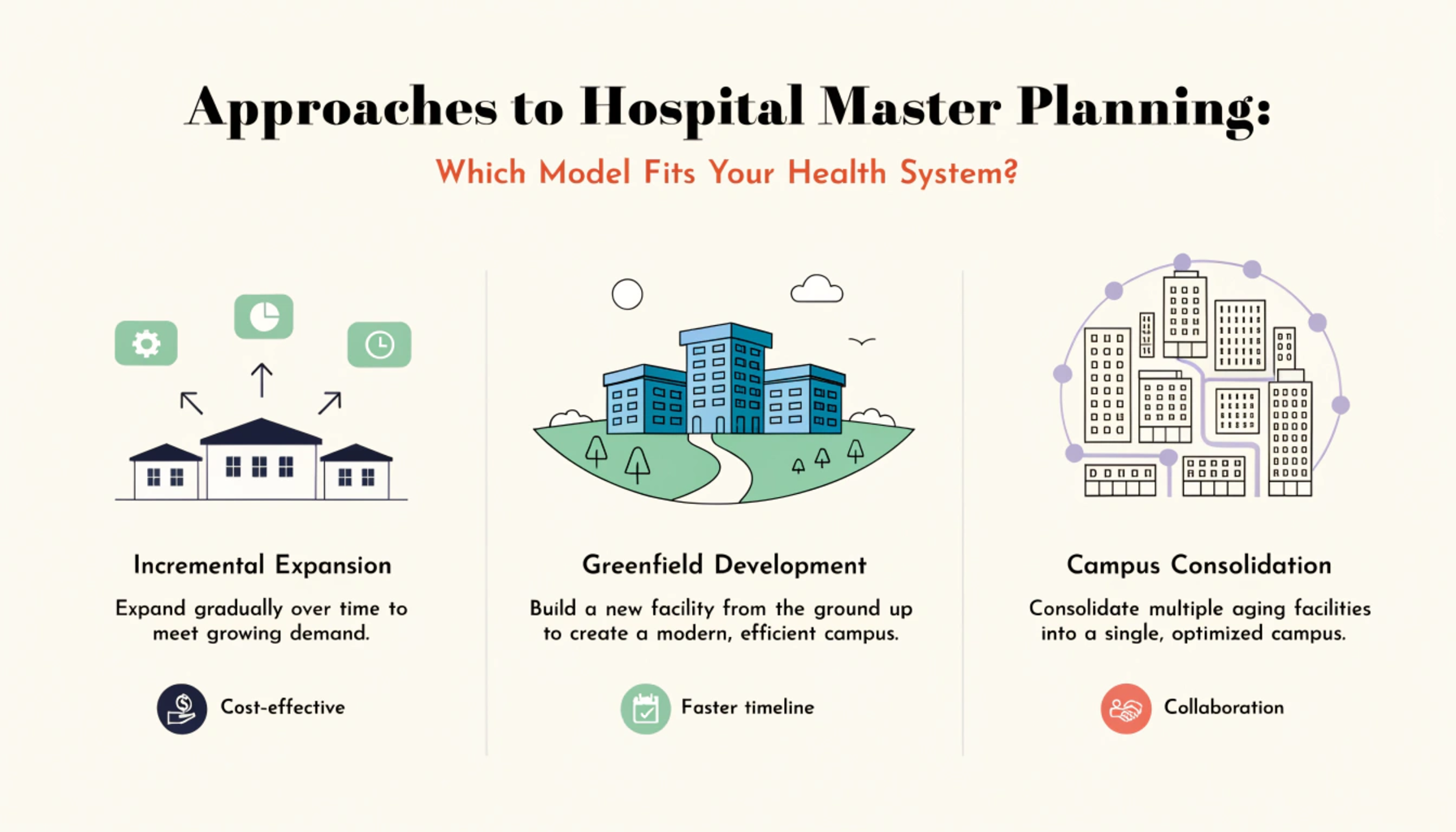
1. Incremental Expansion Model
The incremental expansion model focuses on making improvements in stages. Instead of undertaking a major campus transformation, the health system identifies immediate capacity or operational challenges and addresses them through smaller projects.
This model can be attractive for hospitals with limited capital budgets or facilities that are already functioning reasonably well.
For example, a hospital might renovate an existing ward, expand diagnostic services, upgrade mechanical systems, and later develop additional clinical space as demand increases.
The main advantage is financial and operational flexibility. Projects can be prioritized according to urgency, available funding, and changing demand.
However, incremental development can create problems if projects are planned independently. A new department may solve an immediate capacity issue while creating circulation, parking, utility, or support-service constraints elsewhere.
For this reason, even incremental projects should operate within an overarching master plan.
2. Comprehensive Campus Master Plan
A comprehensive campus master plan takes a broader view of the entire healthcare site. It considers current facilities and establishes a long-term framework for buildings, circulation, parking, utilities, clinical adjacencies, public spaces, and future development.
This approach is particularly useful for large hospitals, academic medical centers, and established health systems with significant physical infrastructure.
The process generally begins with an assessment of existing conditions. Planners examine building age, facility utilization, clinical relationships, infrastructure capacity, patient movement, staff workflows, and future service requirements.
The next step is to develop a future campus vision.
Instead of asking only what needs to be built today, the health system asks how the campus should function 10, 15, or even 20 years from now.
This model provides a valuable framework for sequencing capital projects. It can also reduce the risk of constructing facilities that later conflict with future expansion plans.
Its primary challenge is that comprehensive planning requires significant analysis and stakeholder involvement. It can also become outdated if treated as a fixed blueprint rather than a flexible strategic framework.
3. Service-Line-Based Planning
Service-line-based planning organizes the master plan around major clinical specialties rather than buildings.
Instead of beginning with the question, “What should we build?”, planners begin with questions such as, “How should cardiovascular care operate in the future?” or “What will oncology services require over the next decade?”
The planning process then evaluates clinical volumes, patient journeys, staffing, equipment, technology, support services, and space requirements for each major service line.
This can be especially effective for health systems pursuing clinical specialization or centers of excellence.
For instance, an oncology strategy may require coordination between outpatient clinics, infusion services, imaging, pharmacy, radiation therapy, surgery, inpatient care, and supportive services. Planning these functions together can improve operational relationships and reduce unnecessary patient movement.
The challenge is integration. If each service line develops independently, the hospital can end up with competing priorities and duplicated infrastructure.
This is why service-line planning works best when integrated into a wider campus and financial strategy.
4. Patient-Centered Planning Model
Patient-centered planning puts the patient journey at the heart of facility design.
Traditional hospital layouts often evolved department by department. Patient-centered planning instead looks at the complete experience from arrival through registration, diagnosis, treatment, discharge, and follow-up.
This approach can identify unnecessary movement, confusing wayfinding, long waiting periods, inefficient transfers, and poorly connected services.
For example, if patients regularly move between imaging, specialist consultation, laboratory services, and treatment areas, the master plan can evaluate whether these functions should be physically closer together.
The approach is increasingly relevant as healthcare systems compete not only on clinical outcomes but also on accessibility, convenience, experience, and continuity of care.
Patient-centered planning also supports the growth of outpatient and ambulatory care models. As more services move outside traditional inpatient environments, health systems need facilities that make care easier to access and navigate.
5. Flexible and Future-Ready Planning
Healthcare technology, clinical models, and patient demand can change faster than hospital buildings. A facility designed exclusively around today’s requirements may become difficult or expensive to adapt.
A flexible planning model therefore emphasizes spaces and infrastructure that can accommodate future changes.
This could include adaptable clinical spaces, modular infrastructure, accessible utility systems, flexible floor plates, scalable mechanical and electrical capacity, and technology-ready environments.
The objective is not to predict the future perfectly. Instead, it is to make the facility capable of responding when the future differs from current expectations.
This is one of the most important considerations in modern healthcare facility strategic planning because investment decisions often have consequences lasting decades.
Flexibility can also support changes in care delivery. A space initially designed for one clinical function may eventually need to support another specialty, different equipment, or a new model of care.
6. Network-Based Health System Planning
For health systems operating multiple hospitals, clinics, ambulatory centers, and specialty facilities, planning a single campus in isolation may not be enough.
A network-based approach considers how facilities work together across a geographic region.
Instead of every hospital developing identical services, the system can determine which services should be centralized and which should remain locally accessible.
For example, highly specialized procedures may be concentrated at a major medical center, while routine diagnostics, consultations, rehabilitation, and outpatient services are distributed across community locations.
This approach can improve resource utilization and create clearer roles for individual facilities.
It also requires strong data and governance. Decisions must consider population growth, travel patterns, referral flows, clinical demand, workforce availability, and financial performance across the network.
7. Phased Development Model
Phased development is particularly useful when a hospital expects substantial long-term growth but cannot or does not want to build the entire future campus immediately.
The master plan establishes an ultimate development vision and then divides it into manageable phases.
A first phase might address urgent capacity constraints. Later phases could add new inpatient towers, outpatient facilities, diagnostic centers, parking, utilities, or specialty services.
The critical principle is that each phase should support the next. Utility capacity, structural systems, circulation routes, and site planning need to account for future development.
Poorly phased projects can create expensive temporary solutions that later need to be demolished or substantially modified.
Well-planned phasing, on the other hand, allows health systems to respond to demand while maintaining financial and operational control.
How to Choose the Right Model
There is no universal winner among hospital master planning approaches. The best model depends on the health system’s circumstances.
A useful starting point is to evaluate five areas: strategic goals, demand, existing facilities, financial capacity, and flexibility requirements.
If the hospital has a stable campus and limited immediate capital, incremental expansion may be appropriate. If the site has major infrastructure limitations and significant future investment is expected, a comprehensive campus master plan may provide greater value.
If clinical transformation is the main priority, service-line planning can provide a strong foundation. If patient experience and access are major concerns, patient-centered planning should play a central role.
Large health networks may require a combination of network-based and campus-level planning.
In reality, the strongest master plans rarely rely on one model alone. They combine different approaches according to the needs of the organization.
The Role of Data in Modern Master Planning
Modern planning decisions should be supported by reliable data rather than assumptions.
Health systems can examine patient volumes, occupancy, emergency department demand, operating room utilization, imaging activity, outpatient visits, referral patterns, demographic changes, and financial performance.
Scenario modelling can then help planners test different futures.
What happens if demand grows faster than expected? What if outpatient care expands more quickly? What if workforce shortages limit operating capacity? What if a major building requires replacement earlier than planned?
Testing these scenarios helps health systems create resilient plans.
Technology should also be considered as part of infrastructure planning. Digital health, automation, connected medical devices, electronic workflows, and advanced analytics can influence how physical spaces are used.
Integrating Sustainability Into the Master Plan
Sustainability should not be treated as an isolated building feature. It should be integrated into the master planning process from the beginning.
Site orientation, energy systems, water management, building envelopes, transportation, renewable energy, waste management, and material selection can all influence long-term operating performance.
Healthcare facilities operate continuously, making energy and resource efficiency particularly important.
A master plan can also consider resilience. Hospitals need to remain operational during extreme weather, power disruptions, infrastructure failures, and other emergencies.
Therefore, sustainability and resilience should be considered alongside clinical and financial priorities.
Master Planning Is a Continuous Process
One of the biggest mistakes a health system can make is treating its master plan as a document that is completed once and then stored.
Healthcare conditions change constantly. Population needs evolve, technology advances, regulations change, financial conditions fluctuate, and clinical models develop.
A master plan should therefore be reviewed periodically.
Annual or scheduled reviews can assess whether demand assumptions remain valid, whether capital priorities have changed, and whether projects should be accelerated, delayed, redesigned, or cancelled.
This creates a living planning framework rather than a static construction roadmap.
Conclusion
Selecting among hospital master planning approaches is ultimately a strategic decision about how a health system wants to deliver care in the future.
Incremental expansion can provide flexibility, comprehensive campus planning can create long-term structure, service-line planning can support clinical transformation, patient-centered planning can improve the care experience, and network-based planning can coordinate multiple facilities.
The strongest strategy may combine several of these models.
Effective healthcare facility strategic planning connects clinical objectives with physical infrastructure, technology, financial resources, sustainability, and patient needs. When these elements are planned together, hospitals are better positioned to invest wisely, adapt to changing demand, and create facilities that support high-quality care for years to come.
For healthcare leaders, architects, facility executives, planners, and construction professionals, understanding how different planning models work is essential to making better capital decisions.
Register as a delegate for the Smart Healthcare Facilities Convention 2026 to connect with industry professionals and explore emerging strategies for smarter, more adaptable healthcare facilities.