Data centers are entering a new phase of rapid transformation. The growth of artificial intelligence, cloud computing, high-performance workloads, sustainability requirements, and rising digital demand is changing how organizations design, operate, and expand their facilities. For data center owners and operators, 2026 planning cycles will require more than simply adding servers or increasing power capacity. They will need to rethink infrastructure, energy, cooling, security, resilience, and long-term scalability.
Understanding the data center trends 2026 will bring is therefore essential for organizations preparing capital budgets, infrastructure roadmaps, modernization projects, and expansion strategies. The facilities that succeed will be those capable of adapting to higher rack densities, changing workloads, stricter efficiency expectations, and increasingly complex operational requirements.
For data center leaders, data center strategy planning should begin with a clear understanding of these trends and how they could affect infrastructure decisions over the next several years.
Here are nine major trends expected to influence data center planning in 2026.
1. AI Will Reshape Data Center Capacity Planning
Artificial intelligence is one of the biggest forces influencing data center infrastructure. AI training and inference workloads require significantly different infrastructure characteristics from traditional enterprise computing. High-performance GPUs and accelerators can create substantially higher power and thermal loads than conventional servers.
As AI adoption expands, data center operators will need to reconsider how they allocate power, floor space, cooling capacity, and network infrastructure. A facility designed around conventional rack densities may struggle to accommodate AI workloads without significant upgrades.
This makes AI readiness a central consideration in data center strategy planning. Organizations should evaluate not only today’s requirements but also the potential rack densities and power requirements of future AI deployments.
Planning for flexible power distribution, high-density rack configurations, advanced cooling, and scalable electrical infrastructure can help operators avoid expensive retrofits later.
2. Liquid Cooling Will Become a Strategic Infrastructure Decision
As rack power densities increase, traditional air cooling can become increasingly difficult to operate efficiently. This is accelerating interest in liquid cooling technologies, including direct-to-chip cooling and other advanced approaches.
Liquid cooling can provide more effective heat removal for high-density computing while potentially reducing the energy required for cooling. Its growing relevance is one of the most important data center trends 2026 planners should consider.
However, adopting liquid cooling is not simply a matter of replacing an existing cooling system. It can influence facility plumbing, heat rejection, maintenance procedures, equipment selection, monitoring, and operating practices.
Data center operators should therefore assess liquid cooling as part of a broader infrastructure roadmap. Even facilities that are not immediately deploying AI workloads may benefit from designing new capacity with cooling flexibility in mind.
3. Power Availability Will Drive Data Center Location Decisions
Power is becoming one of the most important considerations in data center development. As AI and other high-performance workloads increase electricity demand, access to reliable and scalable power can influence where new facilities are built.
Historically, location decisions often focused heavily on connectivity, land availability, taxes, latency, and proximity to customers. In 2026, power availability will increasingly sit alongside these considerations.
Organizations planning new facilities will need to investigate grid capacity, utility relationships, renewable energy availability, transmission infrastructure, backup generation, and potential future power requirements.
For existing operators, power constraints could influence expansion decisions. A facility may have adequate physical space but limited electrical capacity, making infrastructure upgrades or alternative locations necessary.
Consequently, data center strategy planning needs to incorporate long-term power requirements rather than treating electricity as a fixed operational input.
4. Sustainability Will Move From Goal to Core Planning Requirement
Sustainability is no longer just a corporate reporting issue for data center operators. Energy consumption, water use, carbon emissions, and resource efficiency increasingly influence facility design and investment decisions.
In 2026, operators will continue looking for ways to reduce energy consumption while supporting growing computational requirements. Improvements may include more efficient cooling systems, renewable power procurement, energy-efficient equipment, heat recovery, smarter controls, and improved facility management.
Power Usage Effectiveness (PUE) will remain an important efficiency metric, but organizations are also expected to pay closer attention to water consumption and carbon impacts.
This means sustainability should be incorporated into the initial design and budgeting process rather than added after a facility is operational. A data center built with energy and water efficiency in mind can be better positioned to meet future environmental expectations.
5. Data Center Automation Will Become More Advanced
Modern data centers are becoming increasingly automated. Infrastructure management platforms, sensors, artificial intelligence, machine learning, predictive analytics, and automated controls can help operators understand facility conditions and respond to issues more efficiently.
Automation can support everything from temperature monitoring and energy optimization to predictive maintenance and capacity management.
For example, real-time monitoring can identify unusual equipment behavior before it develops into a major failure. Automated systems can also adjust cooling and other infrastructure based on changing workloads and environmental conditions.
In 2026, automation will increasingly become part of data center strategy planning, particularly for operators managing large or geographically distributed facilities.
The objective is not necessarily to automate every task. Instead, organizations should identify repetitive, data-intensive, or time-sensitive processes where automation can improve reliability, efficiency, and operational visibility.
6. Resilience Planning Will Become More Comprehensive
Data center resilience has traditionally focused on power outages, equipment failures, cooling failures, and network interruptions. However, the risk environment is becoming more complex.
Extreme weather, supply chain disruptions, cyber threats, utility constraints, and equipment shortages can all affect data center continuity.
As a result, resilience planning in 2026 will need to extend beyond traditional redundancy models. Operators should evaluate how facilities would perform under multiple simultaneous disruptions and whether critical components can be replaced quickly.
This could involve greater emphasis on geographic redundancy, spare equipment strategies, diversified suppliers, backup power, disaster recovery capabilities, and operational contingency planning.
A resilient data center is not simply one with redundant equipment. It is one designed to continue delivering critical services when unexpected conditions occur.
7. Edge Data Centers Will Support Distributed Computing
The demand for low-latency computing is contributing to the growth of distributed infrastructure. Applications such as autonomous systems, industrial IoT, smart cities, connected devices, real-time analytics, and certain AI applications can benefit from processing data closer to where it is generated.
This is driving interest in edge data centers and smaller distributed computing facilities.
Instead of relying entirely on large centralized campuses, organizations may deploy computing resources across multiple locations. This approach can improve latency and reduce the need to transfer all data to a distant facility.
However, distributed infrastructure also creates additional operational complexity. Organizations must manage security, remote monitoring, power, cooling, connectivity, maintenance, and physical access across multiple locations.
For companies considering edge deployments, data center strategy planning should address how centralized and distributed infrastructure will work together.
8. Cybersecurity and Physical Security Will Converge
The modern data center is both a physical facility and a critical digital environment. Cybersecurity teams and facility teams can no longer operate in completely separate silos.
Building management systems, environmental monitoring platforms, access control systems, connected sensors, and operational technology can create additional digital entry points. Protecting these systems is increasingly important because a cyber incident could potentially affect physical operations.
At the same time, physical security remains essential. Unauthorized access, equipment tampering, insider threats, and environmental risks can create serious operational consequences.
In 2026, security planning will therefore become more integrated. Data center operators should consider identity management, network segmentation, access controls, surveillance, monitoring, incident response, and vendor security as connected components of facility resilience.
Security should be incorporated during design and modernization rather than treated as an operational afterthought.
9. Modular and Scalable Data Center Design Will Gain Importance
Data center demand can change quickly. Organizations may need significantly more capacity because of AI, cloud adoption, digital transformation, or business growth. At the same time, committing to excessive capacity too early can increase capital expenditure and create underutilized infrastructure.
This is increasing interest in modular and scalable data center design.
Rather than building an entire facility for projected future requirements, organizations can create infrastructure that expands in stages. Modular electrical systems, cooling infrastructure, prefabricated components, and standardized designs can help operators add capacity as demand develops.
Scalability can also improve planning flexibility. Operators can make investments based on actual workload growth rather than relying entirely on long-term forecasts.
This trend is particularly relevant to data center strategy planning because it encourages organizations to design for change rather than locking facilities into a single capacity model.
How These Data Center Trends Will Change 2026 Planning Cycles
The most important takeaway from the data center trends 2026 outlook is that data center planning is becoming more interconnected.
Power affects location. Location affects connectivity and sustainability. AI affects rack density. Rack density affects cooling. Cooling affects energy consumption and facility design. Automation affects operational efficiency, while cybersecurity affects both digital and physical infrastructure.
As a result, organizations should avoid planning each infrastructure component independently.
A more effective approach is to create an integrated data center roadmap covering capacity, power, cooling, connectivity, sustainability, security, automation, resilience, and future expansion.
Organizations should also consider different growth scenarios. What happens if AI workloads increase faster than expected? What if power availability becomes a constraint? What if sustainability requirements become more demanding? What if the facility needs to support significantly higher rack densities?
Scenario planning can help organizations identify infrastructure decisions that remain useful across multiple possible futures.
What Data Center Leaders Should Prioritize in 2026
The first priority should be capacity visibility. Operators need an accurate understanding of available power, cooling, floor space, network capacity, and equipment utilization.
The second priority should be flexibility. Infrastructure should be designed to accommodate changing workloads rather than being optimized exclusively for today’s requirements.
The third priority should be efficiency. Energy, water, and operational costs need to be evaluated alongside performance and reliability.
Finally, organizations should connect infrastructure planning with business objectives. A data center strategy should explain not only what technology needs to be installed but also why the investment matters to the organization’s future growth and resilience.
Preparing for the Next Generation of Data Centers
The data center industry is entering a period where infrastructure decisions made today can have long-term consequences. AI workloads, higher rack densities, power constraints, sustainability requirements, automation, edge computing, and security challenges are changing the definition of an efficient and resilient facility.
For data center owners, operators, engineers, technology leaders, and infrastructure planners, staying ahead of these developments is essential.
The best data center strategy planning approach for 2026 will be proactive rather than reactive. Instead of waiting for capacity constraints or technology changes to force expensive upgrades, organizations can use current trends to identify future requirements and build adaptable infrastructure today.
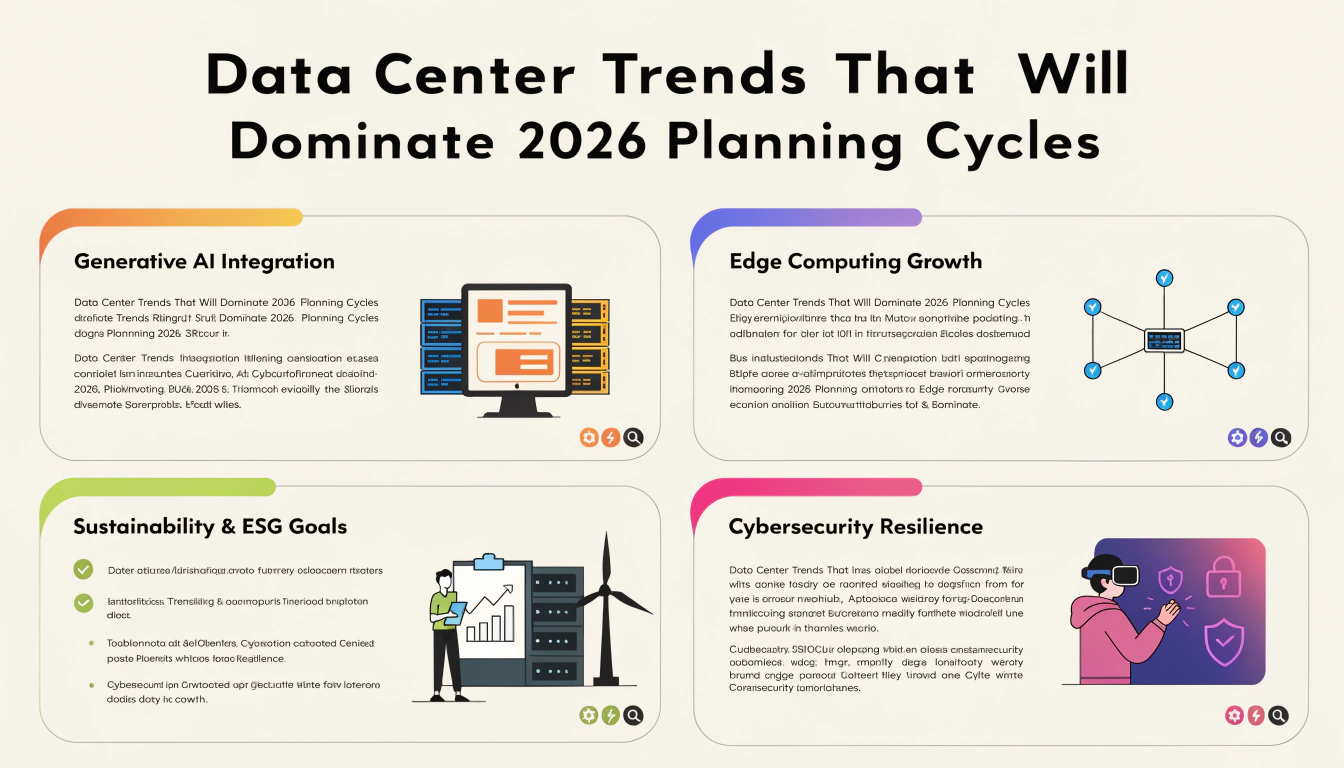
The nine data center trends 2026 planning teams should watch closely are AI-driven capacity requirements, liquid cooling, power availability, sustainability, automation, resilience, edge computing, integrated security, and modular scalability.
Understanding these trends is only the first step. The real advantage comes from turning them into practical investment priorities, infrastructure roadmaps, and operational strategies.
Explore the Future of Data Center Infrastructure
Want to connect with industry professionals and explore the technologies and strategies shaping the next generation of data center facilities?
Register interest for BMA Data Center 2026 and discover opportunities to learn, network, and stay informed about the evolving data center landscape.