Introduction
Manufacturers are under increasing pressure to produce more, reduce operating costs, improve quality, respond faster to customer demand, and maintain competitiveness without making uncontrolled capital investments. In 2026, smart manufacturing is no longer simply about building a highly connected factory. The focus has shifted toward technologies that can demonstrate measurable business value and deliver a clear return on investment.
This is where smart factory ROI 2026 becomes a critical consideration for manufacturing leaders. Instead of investing in every available Industry 4.0 solution, companies are increasingly prioritizing technologies that solve specific operational problems and generate measurable improvements in productivity, downtime, quality, energy consumption, labor utilization, or maintenance.
The strongest manufacturing technology investment decisions are therefore not necessarily the ones involving the most advanced technology. They are the investments that connect technology to a well-defined business outcome.
From industrial IoT and automated inspection to predictive maintenance, robotics, AI-powered analytics, and digital twins, several technologies stand out in 2026 for their ability to produce practical and measurable returns. The key is knowing where each technology fits, how quickly it can generate value, and how it should be implemented.
What Does Smart Factory ROI Mean in 2026?
Smart factory ROI measures the financial and operational value generated by investments in connected, automated, and intelligent manufacturing technologies compared with their total cost.
Traditional ROI calculations might focus mainly on direct cost savings. Smart factory investments require a broader view because technology can influence multiple areas simultaneously.
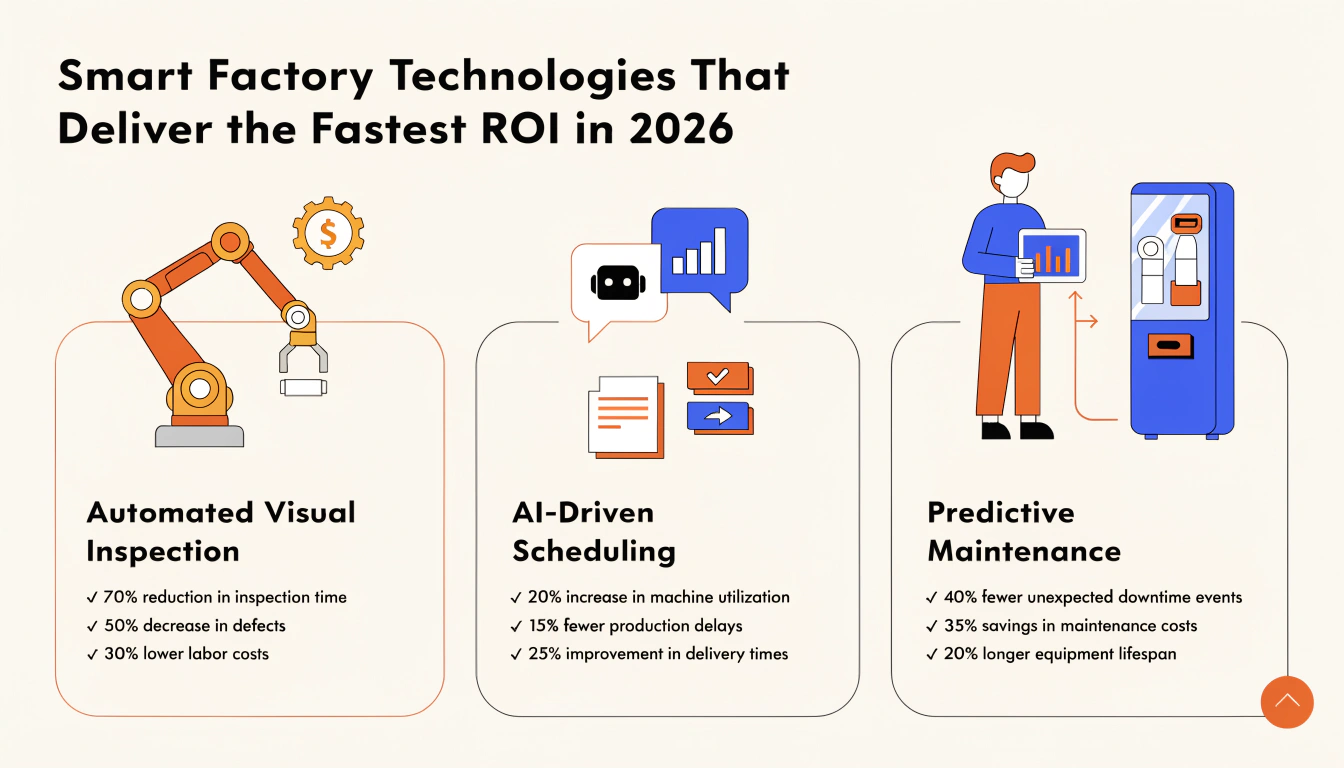
For example, an automated quality inspection system can reduce inspection labor while also identifying defects earlier, lowering scrap and rework. Similarly, predictive maintenance software may reduce maintenance expenses while increasing equipment availability and improving production scheduling.
A useful ROI calculation should therefore consider factors such as increased production output, reduced downtime, lower scrap rates, energy savings, labor productivity, maintenance cost reduction, improved asset utilization, and better quality.
Manufacturers should also consider the time required to achieve payback. A technology that produces measurable results within months may be more attractive than a sophisticated system requiring several years to justify its cost.
1. Industrial IoT: A Strong Foundation for Fast ROI
Industrial Internet of Things, or IIoT, remains one of the most practical smart factory technologies for manufacturers seeking measurable returns.
IIoT connects machines, sensors, production lines, and other industrial assets so that operational data can be collected continuously. Instead of relying on manual readings or periodic reporting, production teams can monitor equipment and processes in near real time.
The ROI opportunity comes from visibility.
Manufacturers can identify machine downtime, bottlenecks, abnormal operating conditions, production delays, and other inefficiencies that may otherwise remain hidden. Real-time machine data can also support better production planning and faster decision-making.
For facilities that already have modern equipment but lack adequate data visibility, IIoT can be an especially attractive manufacturing technology investment. Sensors and connectivity can often be introduced incrementally rather than requiring an entire factory to be replaced.
The fastest returns generally come when IIoT is connected to a specific problem, such as monitoring critical machines, tracking production performance, or identifying energy-intensive processes.
2. Predictive Maintenance: Turning Downtime Into Savings
Unplanned downtime remains one of the most expensive problems in manufacturing. A machine failure can disrupt production schedules, create overtime requirements, delay customer deliveries, and increase maintenance costs.
Predictive maintenance addresses this problem by using machine data, sensors, analytics, and increasingly AI to identify signs of equipment deterioration before a failure occurs.
Instead of maintaining every machine according to a fixed schedule, manufacturers can prioritize maintenance based on actual equipment condition.
This approach can deliver ROI through fewer unexpected failures, better spare-parts planning, reduced emergency maintenance, longer asset life, and improved equipment availability.
The technology becomes particularly valuable when applied to production assets that represent a major operational bottleneck. Manufacturers should not necessarily begin with every machine in the facility. Starting with a small number of high-value or failure-prone assets can make the business case easier to prove.
In terms of smart factory ROI 2026, predictive maintenance is one of the most compelling technologies when downtime has a direct and significant financial impact.
3. AI-Powered Manufacturing Analytics
Artificial intelligence is moving from experimentation toward practical industrial applications. In 2026, manufacturers are increasingly using AI to analyze large volumes of production data and identify patterns that may not be obvious to human operators.
AI-powered analytics can support production optimization, quality management, demand forecasting, anomaly detection, energy management, and maintenance.
The value of AI is not simply that it can process large datasets. Its real advantage comes from turning data into actionable decisions.
For example, an AI system could detect unusual changes in equipment behavior and alert operators before a major problem occurs. It could identify production conditions associated with higher defect rates or help determine which process variables influence product quality.
However, manufacturers should avoid investing in AI merely because it is a high-profile technology. AI produces stronger ROI when reliable operational data is already available and when the business problem is clearly defined.
Companies should begin with specific use cases that have measurable financial outcomes rather than attempting to introduce AI across the entire factory simultaneously.
4. Robotics and Collaborative Robots
Robotics continues to be one of the most visible components of smart manufacturing. However, the ROI case in 2026 is increasingly focused on targeted automation rather than automation for its own sake.
Industrial robots can perform repetitive, physically demanding, or highly precise tasks consistently. Collaborative robots, or cobots, can provide additional flexibility in applications where humans and machines need to work within the same production environment.
The business case for robotics can include increased throughput, consistent quality, reduced repetitive labor, lower workplace risks, and improved utilization of skilled employees.
The strongest ROI often comes from repetitive processes that are currently labor-intensive and have predictable workflows.
For manufacturers facing labor shortages or difficulty filling repetitive production roles, robotics can also provide strategic value beyond direct cost savings. Employees can be redirected toward tasks involving problem-solving, machine supervision, quality management, and process improvement.
The key is to select processes where automation can operate consistently and where utilization will be high enough to justify the investment.
5. Automated Quality Inspection
Quality problems can be extremely expensive because the cost of a defect often increases as the product moves further through the production process.
Automated inspection technologies using machine vision, sensors, and AI can detect defects faster and more consistently than manual inspection in many applications.
These systems can inspect products at high speeds and identify variations that may be difficult for human inspectors to detect consistently over long shifts.
The ROI comes from reducing scrap, rework, returns, warranty claims, and customer complaints while improving production consistency.
Automated inspection can also generate valuable process data. If defects repeatedly appear under specific production conditions, manufacturers can investigate the root cause instead of simply identifying defective products at the end of the line.
For this reason, automated quality inspection can contribute to both immediate cost savings and long-term process improvement.
6. Energy Management and Smart Sensors
Energy efficiency has become an important part of manufacturing technology investment decisions. Rising energy costs, sustainability targets, and pressure to reduce operational waste are encouraging manufacturers to monitor energy use more closely.
Smart meters and connected sensors can provide detailed visibility into electricity, compressed air, heating, cooling, and other energy-intensive processes.
The first step toward improving energy performance is knowing where energy is being consumed.
A connected energy management system can identify unusual consumption patterns, equipment operating outside expected conditions, and processes that consume more energy than necessary.
Manufacturers can then optimize equipment schedules, reduce unnecessary consumption, identify leaks, and improve overall energy efficiency.
Energy management can deliver relatively fast ROI when a facility has significant energy-intensive operations and limited visibility into consumption. It can also support broader environmental goals without requiring major changes to production processes.
7. Digital Twins for Process Optimization
Digital twins create virtual representations of physical assets, production systems, or processes. They can combine operational data with simulations and models to help manufacturers understand how changes might affect real-world operations.
While digital twins can require more planning and integration than basic sensors or automation, their ROI potential is significant for complex manufacturing environments.
A manufacturer can use a digital twin to evaluate process changes before physically modifying equipment. Teams can explore production scenarios, identify bottlenecks, optimize layouts, test capacity changes, or evaluate equipment performance.
This can reduce the risk associated with expensive operational decisions.
However, digital twins should generally be introduced after manufacturers have established adequate data collection and system connectivity. Without reliable data, the virtual model may not accurately represent real production conditions.
Therefore, digital twins can deliver excellent strategic ROI, but they may not always be the fastest first investment for a manufacturer starting its smart factory journey.
8. Manufacturing Execution Systems
A Manufacturing Execution System, or MES, can connect production planning with actual shop-floor execution.
An MES can provide visibility into production schedules, work orders, machine performance, quality information, material movement, and operator activity.
The ROI opportunity comes from improved production control and better information flow.
When production information is scattered across spreadsheets, paper documents, disconnected systems, and manual reports, managers may struggle to understand what is happening on the shop floor in real time.
An MES can centralize critical production information and improve coordination between operations, quality, maintenance, and management teams.
The business value can include improved production visibility, reduced administrative effort, better traceability, faster issue resolution, and improved schedule adherence.
For manufacturers dealing with disconnected processes, an MES can become an important foundation for further smart factory investments.
9. Edge Computing for Faster Industrial Decisions
As factories generate increasingly large volumes of data, sending every piece of information to remote cloud systems may not always be the most effective approach.
Edge computing allows data processing to occur closer to machines and production processes.
This can reduce latency and support faster responses where real-time decisions are critical. It can be particularly useful for applications involving machine monitoring, automated inspection, robotics, and production control.
The ROI may come indirectly by enabling other smart factory technologies to perform more effectively.
For example, an automated inspection system may need to analyze images rapidly enough to identify defects while production is still underway. Processing data closer to the production line can support that requirement.
Manufacturers should evaluate edge computing based on the performance requirements of their applications rather than treating it as a standalone investment.
Choosing the Right Technology for Faster ROI
The biggest mistake manufacturers can make in 2026 is choosing technology before defining the business problem.
A successful smart factory strategy should begin with a clear understanding of current operational challenges.
Is downtime reducing production capacity? Are quality defects creating excessive scrap? Are energy costs rising? Are maintenance teams spending too much time responding to emergencies? Are production managers relying on delayed information?
Once the problem is defined, the appropriate technology becomes easier to identify.
Manufacturers should also establish baseline metrics before implementation. If the objective is to reduce downtime, for example, the company should record current downtime hours, failure frequency, maintenance costs, and lost production.
The same principle applies to quality, energy, labor productivity, and throughput.
After implementation, these baseline figures provide a way to measure actual ROI rather than relying on assumptions.
Why Smaller Smart Factory Projects Can Deliver Faster Returns
Smart manufacturing does not always require a complete factory transformation.
In fact, a phased approach can often provide faster and lower-risk results.
A manufacturer might begin by connecting ten critical machines, introducing predictive maintenance on one production line, automating one inspection process, or installing energy monitoring in one high-consumption area.
The initial project can then be evaluated based on measurable performance improvements.
If the technology delivers the expected results, the company can expand it to additional assets or production lines.
This approach creates a cycle of investment and validation. It also helps manufacturing teams gain experience with new systems before introducing them across the entire organization.
For businesses evaluating smart factory ROI 2026, this staged strategy can be especially effective because it links future investment directly to demonstrated results.
Building the Business Case for Manufacturing Technology Investment
A strong business case should go beyond the purchase price of equipment or software.
Manufacturers should calculate the total cost of ownership, including installation, integration, employee training, maintenance, software subscriptions, cybersecurity, system upgrades, and ongoing support.
At the same time, the benefits should include both direct and indirect gains.
Direct benefits may include lower maintenance costs, reduced scrap, lower energy consumption, and increased production output.
Indirect benefits can include improved employee utilization, faster decision-making, greater production flexibility, improved customer satisfaction, and stronger operational resilience.
The payback period should also be evaluated.
A technology that costs less but produces limited operational improvements may not necessarily be a better investment than a more expensive solution that significantly improves production capacity.
The objective is not to find the cheapest technology. It is to find the investment that creates the strongest measurable business value.
The Role of Employees in Smart Factory ROI
Technology alone does not create transformation.
Employees need to understand why new systems are being introduced, how the technology will affect their roles, and how they can use the resulting data to improve operations.
Manufacturers should therefore include training and change management in the initial investment plan.
Operators can provide valuable insights into machine behavior and production problems. Maintenance teams can help identify the assets where predictive monitoring would have the greatest value. Quality teams can identify recurring defects that could benefit from automated inspection.
Involving employees early can improve adoption and ensure that smart factory technology solves real operational problems.
The most successful factories combine technology with human expertise rather than treating automation as a replacement for people.
What Will Define Smart Factory ROI in 2026?
The most successful smart factories in 2026 will not necessarily be those with the largest number of connected devices or the most advanced AI systems.
They will be the factories that can demonstrate measurable improvement from their technology investments.
Industrial IoT can create visibility. Predictive maintenance can reduce downtime. Robotics can increase productivity. Automated inspection can improve quality. AI can transform operational data into insights. Energy management can reduce waste. Digital twins can support complex optimization.
The best results occur when these technologies are connected to clear business objectives.
Manufacturers should therefore ask a simple question before approving any new project: What measurable problem will this technology solve, and how quickly can we prove the result?
That question can help companies separate valuable innovation from technology spending that lacks a clear business case.
Conclusion
Smart factory technology is becoming more accessible, but the pressure to demonstrate ROI is becoming stronger. In 2026, manufacturers have an opportunity to move beyond experimental Industry 4.0 projects and focus on technologies that directly improve productivity, quality, maintenance, energy efficiency, and operational visibility.
The technologies most likely to deliver fast returns include IIoT, predictive maintenance, targeted robotics, automated quality inspection, AI-powered analytics, energy monitoring, and manufacturing execution systems. Digital twins and edge computing can also create significant value when deployed in environments where their capabilities match specific operational requirements.
Ultimately, smart factory ROI 2026 is less about adopting every new technology and more about making disciplined, data-driven manufacturing technology investment decisions.
Companies that start with measurable problems, establish clear baselines, select focused use cases, involve employees, and scale successful pilots can build smarter factories while maintaining financial discipline.
The future of manufacturing will be connected and intelligent, but the smartest investment will always be the one that produces measurable business results.
Enquire About Sponsorship
Connect with manufacturing leaders, technology providers, automation experts, and decision-makers shaping the next generation of industrial operations.
Enquire about sponsorship for the Smart Manufacturing & Automation Convention and explore opportunities to showcase your solutions to an audience focused on the future of smart manufacturing.