Healthcare organizations are increasingly dependent on connected medical devices, electronic health records, cloud platforms, telehealth systems, and digital communication tools. While these technologies improve patient care and operational efficiency, they also create more opportunities for cybercriminals to target hospitals, clinics, and healthcare networks.
A well-designed healthcare cybersecurity incident response plan is therefore no longer an optional IT document. It is a critical part of healthcare risk management and business continuity. When a ransomware attack, data breach, phishing incident, or system compromise occurs, healthcare organizations need to respond quickly while protecting patients, clinical operations, sensitive information, and regulatory compliance.
In 2026, healthcare cybersecurity planning must go beyond simply installing antivirus software or maintaining backups. Organizations need a structured incident response framework that identifies threats, establishes responsibilities, enables rapid containment, supports recovery, and continuously improves security.
This guide explains how healthcare organizations can build an effective cybersecurity incident response plan for 2026.
What Is a Healthcare Cybersecurity Incident Response Plan?
A healthcare cybersecurity incident response plan is a documented framework that explains how a healthcare organization will detect, investigate, contain, respond to, and recover from cybersecurity incidents.
A cyber incident could include ransomware, unauthorized access to electronic health records, stolen credentials, phishing, malware infections, compromised medical devices, insider threats, cloud account breaches, or denial-of-service attacks.
The objective is not only to restore technology. Healthcare organizations must maintain patient safety and essential clinical services during an incident.
For example, if ransomware makes an electronic health record system unavailable, the response plan should explain how clinicians will access critical patient information, how medication and treatment processes will continue, who will communicate with leadership, and how the affected systems will eventually be restored.
A strong healthcare cybersecurity incident response strategy connects IT security with clinical, operational, legal, compliance, and communications teams.
Why Healthcare Cybersecurity Incident Response Matters in 2026
Healthcare organizations are attractive targets because they process large volumes of valuable information. Patient records may contain names, addresses, insurance information, medical histories, financial information, and other sensitive data.
At the same time, hospitals operate continuously. Emergency departments, intensive care units, laboratories, pharmacies, imaging departments, and other clinical services cannot simply stop operating when a cyberattack occurs.
The increasing adoption of connected devices also expands the potential attack surface. Medical devices, building management systems, mobile applications, cloud platforms, remote-access technologies, and third-party systems may all need to be considered in cybersecurity planning.
Ransomware remains one of the most serious concerns. Effective hospital ransomware protection requires more than backups. Hospitals need prevention, monitoring, access controls, segmentation, employee awareness, tested recovery procedures, and clearly defined incident response responsibilities.
A structured response plan helps organizations reduce downtime, limit damage, protect patient information, and recover more efficiently.
Step 1: Identify Critical Healthcare Systems and Assets
The first step is understanding what needs to be protected.
Healthcare organizations should maintain an up-to-date inventory of critical assets, including electronic health record systems, patient portals, medical devices, pharmacy systems, laboratory systems, imaging platforms, financial applications, cloud services, employee endpoints, network infrastructure, and backup systems.
However, simply creating an asset list is not enough. Organizations should determine which systems are essential for patient care.
For example, an outage affecting a cafeteria management system may be inconvenient, while an outage affecting medication administration or emergency department systems could have immediate patient-safety implications.
Classifying systems according to their operational and clinical importance allows cybersecurity teams to prioritize response and recovery activities.
The organization should also document dependencies. A clinical application may rely on authentication servers, databases, cloud services, network connectivity, or third-party vendors. Understanding these relationships helps responders determine how an incident could spread.
Step 2: Conduct a Healthcare Cybersecurity Risk Assessment
Once critical assets are identified, organizations should evaluate their cybersecurity risks.
The assessment should consider common threats such as ransomware, phishing, credential theft, malware, insider threats, unauthorized access, data exfiltration, supply-chain attacks, and vulnerabilities in connected medical devices.
Healthcare organizations should also evaluate vulnerabilities associated with remote work, cloud infrastructure, third-party vendors, legacy systems, and unsupported technologies.
Risk assessment should not be treated as a one-time exercise. Threats and technology environments change constantly, so organizations should periodically reassess their risk profile.
A useful approach is to rank risks according to their potential effect on confidentiality, integrity, availability, patient safety, regulatory compliance, and business continuity.
This enables leadership to prioritize investments in hospital ransomware protection and broader cybersecurity resilience.
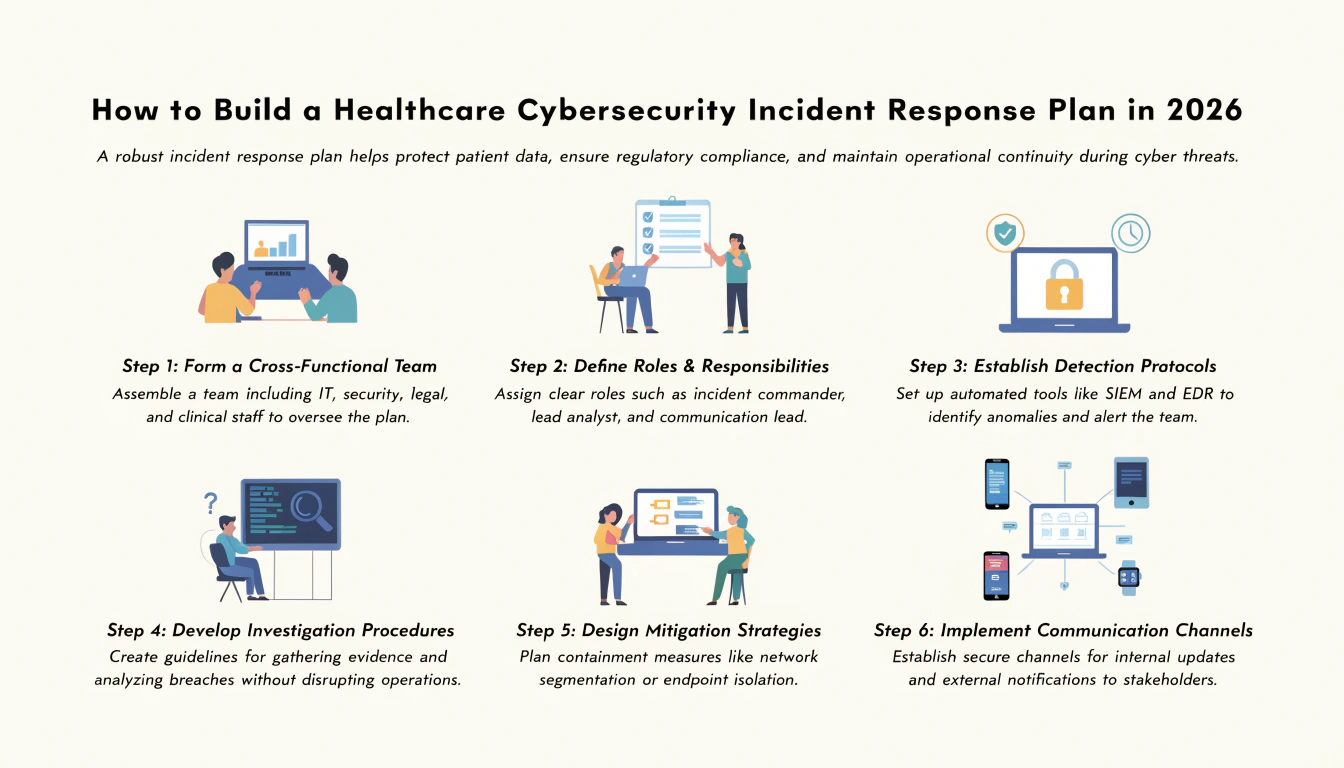
Step 3: Establish an Incident Response Team
A cybersecurity incident should never be handled by the IT department alone.
Healthcare organizations should establish a multidisciplinary incident response team with clearly defined responsibilities. Depending on the organization’s size, the team may include representatives from cybersecurity, IT, clinical operations, executive leadership, legal, compliance, communications, human resources, risk management, and facilities.
External partners may also be needed, including cybersecurity specialists, forensic investigators, insurance providers, technology vendors, and legal counsel.
Each team member should understand their responsibilities before an incident occurs.
For example, cybersecurity personnel may investigate the technical attack, while clinical leaders determine how patient care can continue safely. Legal and compliance teams may assess reporting obligations, while communications teams manage internal and external messaging.
Having these responsibilities documented prevents confusion during a high-pressure event.
Step 4: Define Incident Classification and Escalation Procedures
Not every cybersecurity event requires the same response.
A failed login attempt, suspicious email, malware alert, and confirmed ransomware infection have different levels of urgency.
The response plan should establish incident categories and severity levels. It should also explain when an event must be escalated to senior leadership or the incident response team.
For example, a low-level phishing attempt may be handled by the security team, while unauthorized access to patient records or ransomware affecting clinical systems should trigger immediate escalation.
Clear classification criteria help healthcare organizations avoid unnecessary delays when serious incidents occur.
Step 5: Create Detection and Monitoring Procedures
Fast detection is one of the most important components of healthcare cybersecurity incident response.
Organizations should use appropriate monitoring capabilities to identify unusual activity, unauthorized access, malware, suspicious network traffic, abnormal login patterns, and other indicators of compromise.
Security logs should be collected and reviewed where appropriate. Organizations may also use security information and event management platforms, endpoint detection and response solutions, identity monitoring, network monitoring, and other security technologies.
However, technology alone cannot guarantee detection.
Employees should know how to report suspicious emails, unexpected system behavior, unusual login notifications, and other potential security incidents.
A simple reporting process can help reduce the time between discovering a potential threat and beginning an investigation.
Step 6: Develop a Ransomware Response Strategy
Ransomware deserves specific attention because it can disrupt both administrative and clinical operations.
An effective hospital ransomware protection strategy should include preventive controls as well as a detailed response process.
Organizations should maintain secure and tested backups, restrict administrative privileges, implement strong authentication, segment critical networks, patch systems where feasible, and monitor endpoints and network activity.
If ransomware is detected, the response plan should explain how affected systems will be isolated, how evidence will be preserved, who will be notified, and how clinical services will continue.
The organization should also define its approach to restoration. Backups should not simply exist; they should be periodically tested to verify that systems and data can actually be recovered.
Regular recovery exercises can expose problems before a real attack occurs.
Step 7: Plan for Containment
Once an incident is confirmed, the organization must contain it quickly.
Containment procedures may include isolating affected endpoints, disabling compromised accounts, restricting network access, blocking malicious connections, disconnecting affected devices, or temporarily shutting down specific systems.
Healthcare organizations must balance cybersecurity containment with patient safety.
For example, disconnecting a medical device or clinical application without understanding its role could create operational or patient-care risks.
The incident response plan should therefore include clinical representatives who can help cybersecurity teams make informed decisions about containment.
Step 8: Define Communication and Notification Procedures
Communication can become challenging during a major cyber incident.
The response plan should identify who communicates with employees, patients, leadership, vendors, regulators, law enforcement, and the media when necessary.
Organizations should prepare communication templates in advance so that teams are not developing messages from scratch during an emergency.
Internal communications should explain what employees need to know and what actions they should take. External communications should be accurate, coordinated, and consistent with legal and regulatory requirements.
Healthcare organizations should also identify alternative communication methods in case email, messaging platforms, or internal systems become unavailable.
Step 9: Prepare for Downtime and Business Continuity
A cybersecurity incident response plan should assume that some systems may become unavailable.
Hospitals should therefore maintain downtime procedures for essential clinical operations.
These procedures may include alternative methods for documenting patient information, accessing critical clinical information, communicating between departments, processing medication orders, handling laboratory requests, and continuing emergency services.
Downtime procedures should be practical rather than theoretical. Staff should understand how to use them, where relevant documentation is stored, and who is responsible for activating them.
The goal is to ensure that patient care continues safely while cybersecurity teams work to resolve the incident.
Step 10: Establish Recovery Procedures
After containment, the organization needs a structured recovery process.
Recovery should begin only after security teams have determined that affected systems are sufficiently safe to restore.
The recovery process should prioritize systems according to clinical and operational importance. Critical patient-care applications may need to be restored before lower-priority administrative systems.
Organizations should verify backups, rebuild compromised systems when necessary, reset credentials, patch vulnerabilities, and monitor restored environments for signs of continued compromise.
Recovery should also include validation. Simply bringing a system online does not mean the incident is over.
Clinical and operational teams should confirm that applications, data, integrations, and workflows are functioning correctly.
Step 11: Document the Incident
Detailed documentation is essential during and after a cybersecurity incident.
The organization should record key events, decisions, actions taken, systems affected, communications, recovery activities, and lessons learned.
Documentation can support regulatory requirements, legal processes, insurance claims, internal investigations, and future security improvements.
It also provides valuable information for evaluating whether the incident response process worked as intended.
Step 12: Test the Plan Regularly
One of the biggest mistakes organizations can make is creating an incident response plan and then leaving it untouched.
Cybersecurity plans should be tested through tabletop exercises, simulations, technical recovery tests, and other appropriate exercises.
A tabletop exercise could simulate a ransomware attack that takes an electronic health record system offline. Participants can then work through questions such as:
Who declares the incident?
Who contacts leadership?
How does the hospital continue patient care?
Which systems should be isolated?
How will employees communicate if email is unavailable?
How will systems be restored?
These exercises help identify gaps in procedures, communication, staffing, technology, and decision-making.
The plan should be updated after each exercise and after significant technology, staffing, regulatory, or operational changes.
Common Mistakes to Avoid
Healthcare organizations should avoid treating cybersecurity as exclusively an IT responsibility. Cyber incidents can affect patient safety, finances, reputation, compliance, and operational continuity.
Another common mistake is relying exclusively on backups for ransomware defense. Backups are extremely important, but they do not prevent attacks or stop attackers from stealing information before encryption.
Organizations should also avoid creating overly complicated plans that employees cannot realistically follow. During an incident, teams need clear responsibilities, escalation paths, communication channels, and practical procedures.
Finally, organizations should not assume that vendors automatically handle cybersecurity risks. Third-party connections should be assessed as part of the organization’s broader security strategy.
Building a Resilient Healthcare Cybersecurity Strategy in 2026
A strong healthcare cybersecurity incident response plan should be viewed as a living program rather than a static document.
Healthcare organizations should continuously improve their cybersecurity capabilities by reviewing emerging threats, updating technology controls, strengthening employee awareness, assessing vendors, testing backups, and conducting incident response exercises.
The most resilient organizations combine technology with people and processes. Security tools can detect threats, but trained employees must know how to escalate them. Backup systems can support recovery, but teams must know how to restore them. Policies can define responsibilities, but those responsibilities must be tested through realistic exercises.
As healthcare becomes increasingly connected, cybersecurity resilience will become increasingly important to patient safety and healthcare continuity.
Conclusion
Cybersecurity incidents can have consequences far beyond lost data or temporary IT disruption. A serious attack can affect clinical services, patient safety, operational continuity, financial performance, and organizational reputation.
Building a comprehensive healthcare cybersecurity incident response plan enables hospitals and healthcare organizations to prepare for these risks before an emergency occurs.
From asset identification and risk assessment to ransomware protection, incident containment, communication, downtime planning, and recovery, every stage should be clearly documented and regularly tested.
In 2026, healthcare organizations should aim not only to prevent cyberattacks but also to build the resilience needed to respond quickly and recover safely when incidents occur.
Interested in connecting with healthcare facility and technology leaders? Enquire about BMA conventions to explore opportunities for industry networking, knowledge sharing, and healthcare infrastructure discussions.