Healthcare is changing rapidly. Hospitals are adopting smart technologies, managing rising operational costs, strengthening sustainability programmes and preparing for increasingly complex patient-care environments. Behind many of these priorities is one role that often determines whether a healthcare facility operates safely, efficiently and reliably: the healthcare facility manager.
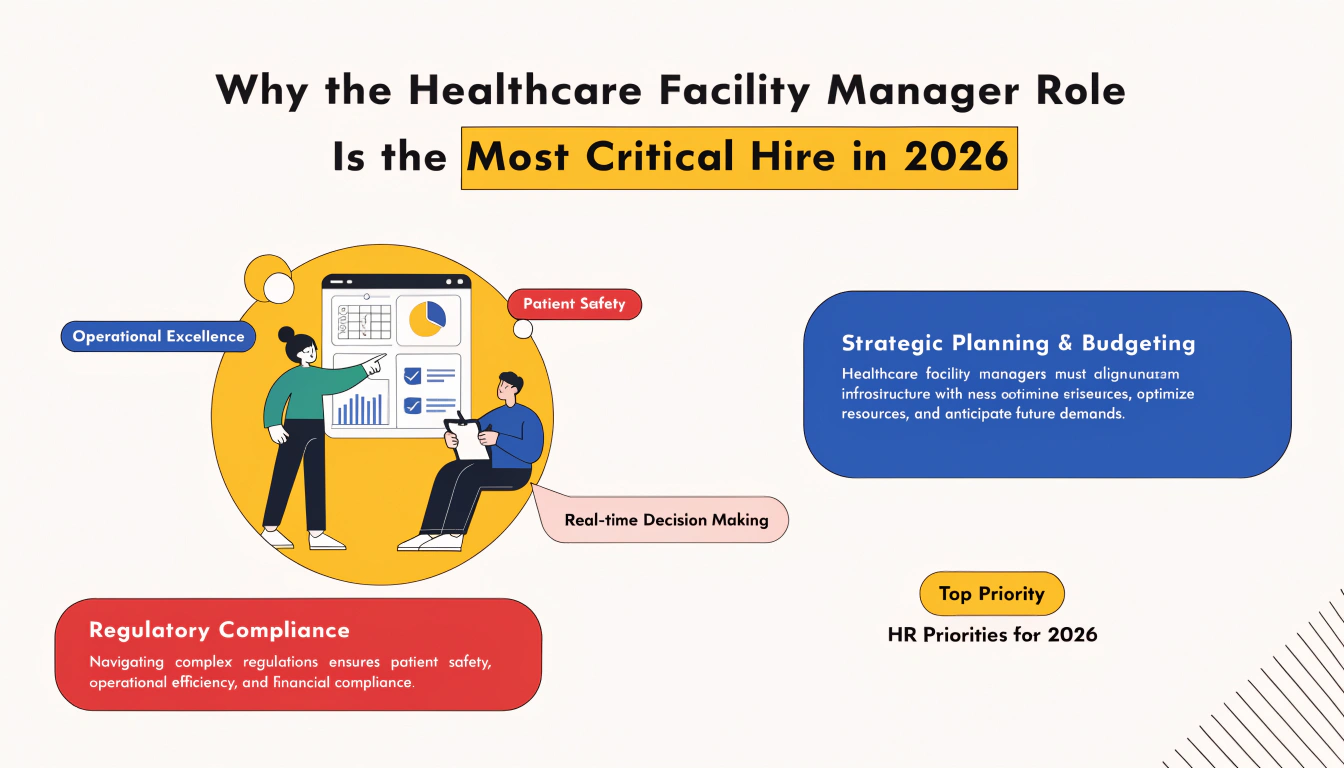
The healthcare facility manager role 2026 is becoming more strategic than ever. Facility managers are no longer responsible only for maintenance, repairs and building operations. They are increasingly involved in energy management, compliance, digital transformation, emergency preparedness, sustainability, infrastructure planning and patient experience.
As hospitals become more technology-driven and infrastructure becomes more complex, hiring the right facility management professional can have a direct impact on operational resilience and quality of care.
The Healthcare Facility Manager Role Is Evolving
Traditionally, healthcare facility management focused heavily on keeping buildings, utilities and essential equipment functioning. While these responsibilities remain important, the modern healthcare environment requires a much broader skill set.
A healthcare facility manager may oversee HVAC systems, electrical infrastructure, water systems, medical gases, fire safety, security, building management systems and critical backup systems. At the same time, they may be expected to support sustainability goals, manage contractors, monitor budgets and coordinate with clinical and administrative teams.
This evolution makes the healthcare facility manager role 2026 a strategic position rather than simply an operational one.
Hospitals cannot afford infrastructure failures. A power interruption, HVAC malfunction, water-system problem or cybersecurity-related disruption to a connected building system can affect clinical operations and patient safety.
The facility manager therefore becomes an important link between the physical environment and the delivery of healthcare.
1. Patient Safety Starts With Reliable Infrastructure
Patient care depends on infrastructure that works continuously and safely.
Operating rooms require appropriate environmental conditions. Intensive care units depend on reliable power and HVAC systems. Laboratories need controlled environments. Emergency departments require uninterrupted access to critical utilities.
A healthcare facility manager is responsible for creating the conditions in which these services can function reliably.
Preventive maintenance, asset management, emergency planning and infrastructure monitoring all contribute to reducing operational risks. Instead of waiting for equipment to fail, modern facility managers increasingly use data and predictive maintenance strategies to identify potential problems earlier.
This makes the role directly relevant to patient safety.
A strong facility manager also understands that even seemingly minor infrastructure issues can create major consequences in a healthcare environment. The ability to prioritise maintenance according to clinical risk is therefore becoming an essential leadership capability.
2. Smart Hospitals Need Smart Facility Managers
Technology is transforming hospital infrastructure.
Building management systems, IoT sensors, automated controls, digital twins, predictive analytics and connected equipment are increasingly being used to monitor and optimise healthcare facilities.
However, technology alone does not create a smart hospital.
Hospitals need professionals who understand how to implement these technologies, interpret the information they generate and translate data into operational decisions.
This is another reason why the healthcare facility manager role 2026 is becoming increasingly valuable.
A modern facility manager may use real-time information to monitor temperature, humidity, energy consumption, equipment performance and building conditions. Instead of relying solely on manual inspections, teams can identify unusual patterns and take corrective action before a failure occurs.
The role is therefore moving from reactive maintenance towards proactive and predictive facility management.
3. Energy Costs Are Making Facility Management More Strategic
Healthcare facilities are among the most energy-intensive buildings because many systems must operate around the clock.
HVAC, lighting, medical equipment, refrigeration, sterilisation systems, IT infrastructure and other essential services can consume significant amounts of energy.
At the same time, hospitals are under pressure to control operating costs and reduce environmental impact.
This places facility managers at the centre of healthcare sustainability.
A capable manager can identify energy-saving opportunities through building automation, equipment upgrades, improved HVAC controls, efficient lighting, renewable energy integration and better operational practices.
The challenge is to reduce energy consumption without compromising patient safety or clinical requirements.
That balance requires technical knowledge, financial awareness and an understanding of healthcare operations.
For hospitals planning long-term sustainability programmes, the facility manager is increasingly becoming one of the most important people involved in translating environmental goals into practical action.
4. Compliance and Risk Management Cannot Be Afterthoughts
Healthcare facilities operate within complex regulatory and safety environments.
Facility managers need to understand requirements related to fire protection, emergency preparedness, electrical safety, infection prevention, water quality, medical gases, building systems and other areas relevant to their facility.
Compliance is not simply about preparing for inspections. It should be integrated into everyday operations.
Strong facility management teams maintain documentation, conduct inspections, track maintenance activities and identify risks before they become serious problems.
In 2026, this proactive approach is becoming increasingly important as hospitals face growing operational complexity.
The best facility managers also work closely with clinical, safety, security, IT and administrative teams. Their role requires them to understand that facility decisions can influence patient care, employee safety and organisational continuity.
5. Emergency Preparedness Is a Core Responsibility
Healthcare facilities cannot simply shut down when something goes wrong.
Hospitals need to remain operational during power outages, extreme weather, water disruptions, equipment failures, cyber incidents and other emergencies.
Facility managers play a major role in preparing for these scenarios.
Backup generators, emergency power systems, water reserves, HVAC redundancy, communication procedures and emergency response plans all need regular testing and maintenance.
The healthcare facility manager must also understand which systems are most critical and how long the facility can operate under different disruption scenarios.
In an increasingly uncertain operating environment, resilience has become a strategic priority.
A hospital with strong infrastructure but weak emergency planning can still be vulnerable. Facility managers help close that gap by developing systems designed not only for normal operations but also for unexpected events.
6. The Role Connects Clinical and Operational Teams
One of the most underestimated aspects of healthcare facility management is collaboration.
Facility managers work with clinicians, nurses, infection prevention teams, IT professionals, procurement departments, finance teams, contractors and senior leadership.
Each group has different priorities.
Clinical teams may focus on patient care and workflow. Finance may prioritise cost control. IT may focus on connected systems and cybersecurity. Facility teams must understand these different perspectives and find practical solutions.
For example, a renovation project cannot be planned solely around construction requirements. The facility manager needs to consider patient movement, infection-control risks, clinical schedules, noise, ventilation and continuity of care.
This makes communication and stakeholder management essential skills for anyone pursuing a hospital FM career.
7. Data Is Becoming a Core Facility Management Tool
The modern healthcare facility generates enormous amounts of operational information.
Energy meters, sensors, maintenance systems, building automation platforms and connected equipment can provide valuable data about how a facility performs.
The challenge is turning that data into decisions.
Facility managers increasingly need basic data literacy to identify trends, compare performance, measure energy efficiency and prioritise maintenance.
For example, instead of replacing equipment based purely on age, managers can examine performance data and maintenance history to determine whether an asset is becoming unreliable.
Similarly, energy data can reveal which areas of a hospital are consuming more resources than expected.
This shift means future healthcare facility managers will need a combination of engineering knowledge, operational expertise and digital skills.
8. Talent Development Is Becoming Part of the Job
Technology and infrastructure are only as effective as the people operating them.
Healthcare facility managers increasingly need to develop multidisciplinary teams that understand modern systems and can respond quickly to operational challenges.
Training may cover emergency procedures, energy management, digital systems, equipment maintenance, safety protocols and compliance requirements.
A good manager also creates a culture in which employees report problems early rather than waiting for failures.
This human element is particularly important when considering the future of a hospital FM career. Professionals entering the field can no longer rely solely on traditional maintenance skills. They need to develop leadership, communication, technology and strategic planning capabilities.
9. Why Hospitals Need to Rethink the Hiring Process
Given the expanding responsibilities of the role, hospitals should rethink how they evaluate facility management candidates.
Technical qualifications remain important, but they should not be the only criteria.
The strongest candidates may also demonstrate experience in sustainability, digital transformation, risk management, budgeting, contractor management and cross-functional collaboration.
Hospitals should consider whether candidates can think strategically and communicate effectively with senior leadership as well as technical teams.
The right hire should be capable of understanding both the physical infrastructure and the organisation’s wider objectives.
This is especially important in 2026, when hospitals are simultaneously dealing with cost pressures, technology adoption, sustainability expectations and growing resilience requirements.
10. The Healthcare Facility Manager Is Becoming a Strategic Leader
The biggest change in the healthcare facility manager role 2026 is perhaps the move from back-office operations to strategic leadership.
Facility managers are increasingly involved in decisions about capital investment, infrastructure modernisation, energy performance, sustainability and operational resilience.
Their decisions can influence long-term costs and the reliability of essential healthcare services.
A well-managed facility can support better workflows, reduce avoidable disruptions, improve resource efficiency and create a safer environment for patients and staff.
This makes facility management a leadership function that deserves representation in strategic discussions.
What the Future Holds for a Hospital FM Career
The future looks promising for professionals who want to build a hospital FM career.
As hospitals become smarter and more sustainable, demand is likely to increase for professionals who can manage complex infrastructure while understanding the needs of healthcare organisations.
Future facility managers may increasingly work with AI-powered analytics, digital twins, automated building systems, predictive maintenance platforms and advanced energy-management technologies.
However, technology will not eliminate the need for experienced professionals. Instead, it will change the nature of their work.
The facility manager of the future will spend less time reacting to basic failures and more time analysing performance, managing risk, planning investments and improving resilience.
For professionals entering the sector, this creates an opportunity to build careers at the intersection of engineering, healthcare, sustainability and technology.
Conclusion: The Most Critical Hire for a Resilient Healthcare Future
Hospitals depend on people who keep their infrastructure safe, reliable and efficient. In 2026, the importance of that responsibility is becoming increasingly visible.
The healthcare facility manager role 2026 combines technical expertise with strategic thinking, sustainability, digital transformation, compliance, emergency preparedness and leadership.
As healthcare organisations invest in smarter facilities, the role will become even more important.
The right facility manager can help a hospital reduce operational risks, manage resources more effectively, prepare for disruptions and create an environment where clinicians can focus on what matters most: delivering quality patient care.
For healthcare organisations, hiring a capable facility manager should therefore be viewed as a strategic investment rather than simply filling an operational position.
For professionals, meanwhile, the expanding responsibilities of the role make a hospital FM career an increasingly relevant and future-focused career path.
Nominate for BMA Healthcare Awards
Recognise the healthcare professionals and facility leaders helping shape safer, smarter and more sustainable healthcare environments. Nominate for BMA Healthcare Awards and give outstanding healthcare facility management leaders the recognition they deserve.