For many patients, the healthcare experience doesn’t begin with a clinician.
It begins at the check-in desk.
Long lines, repetitive paperwork, unclear instructions, and disconnected systems have historically made patient check-ins one of the most frustrating parts of care delivery. Today, healthcare organizations across the United States are rethinking this first interaction—not just to improve convenience, but to improve outcomes.
Simplifying patient check-ins has become both a patient experiences priority and an operational necessity.
The Check-In Process Is a Critical Moment
The check-in process sets the tone for the entire care journey. When it is slow or confusing, it increases stress, delays care, and creates inefficiencies that ripple through clinical and administrative teams.
Healthcare leaders increasingly recognize that inefficient check-ins contribute to:
- Patient dissatisfaction before care even begins
- Increased workload for front-desk and clinical staff
- Data inaccuracies and downstream billing issues
- Disrupted patient flow and longer wait times
In a system already under pressure from staffing shortages and rising demand, these inefficiencies are no longer acceptable.
Moving Beyond Paper and Fragmented Systems
Many healthcare organizations are simplifying check-ins by reducing dependence on manual processes and disconnected tools.
Common approaches include:
- Digital pre-registration prior to arrival
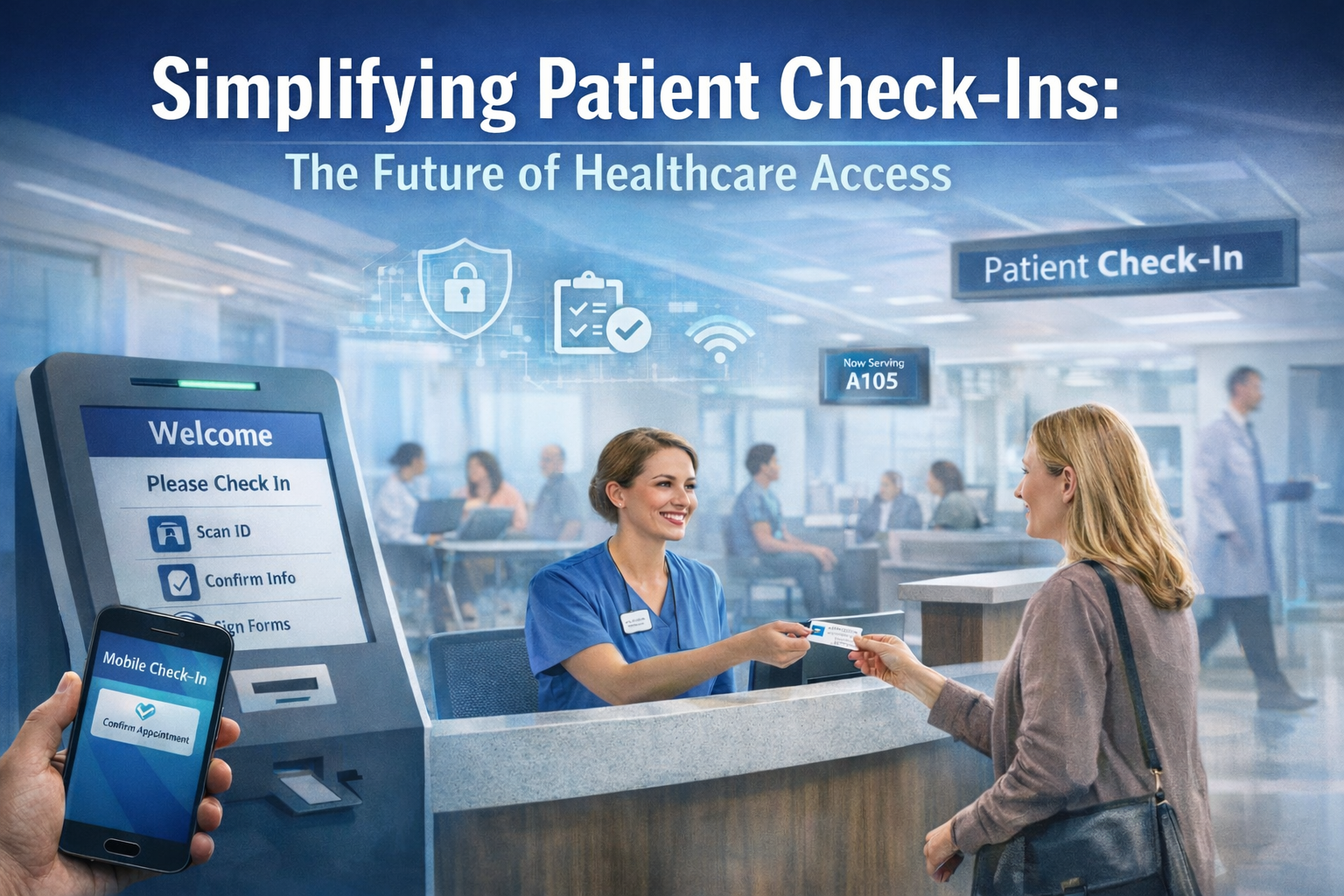
- Self-service kiosks and mobile check-in solutions
- Automated identity and insurance verification
- Better integration between scheduling, EHRs, and billing platforms
The objective is not speed alone, but clarity, accuracy, and consistency across the patient journey.
When patients are asked to provide information once—and systems share it effectively—both trust and efficiency improve.
Patient Experience and Operational Efficiency Are Linked
Simplified check-ins benefit more than just patients.
Organizations that modernize this process often see:
- Reduced administrative burden on staff
- Faster patient throughput
- Fewer errors in patient records and claims
- More time for staff to focus on care coordination and support
This alignment between patient experience and operational efficiency is why check-in modernization has become an executive-level conversation—not just a front-desk issue.
Where Infrastructure and Experience Intersect
Successful check-in transformation does not rely on software alone. It requires alignment between technology, facility design, workflows, and people.
Organizations making the most progress focus on:
- Designing processes around patient behavior, not just system capability
- Supporting patients with varying levels of digital comfort
- Training staff for hybrid check-in environments
- Aligning physical spaces, signage, and wayfinding with digital workflows
This is where patient experience meets healthcare facilities strategy.
The Role of BMA Conventions in Advancing These Conversations
BMA Conventions contributes to the evolution of patient experience by creating platforms where infrastructure, technology, and care delivery are discussed together—not in isolation.
Through its healthcare-focused conventions and forums, BMA Conventions brings together:
- Healthcare executives and operations leaders
- Facilities and engineering teams
- Digital health and infrastructure solution providers
- Patient experience and access leaders
These cross-functional conversations are critical for addressing challenges like patient check-ins, where success depends on coordination across departments, systems, and physical environments.
Rather than treating patient access as a single workflow, BMA Conventions helps elevate it as a facility-enabled, system-wide strategy.
Looking Ahead
Simplifying patient check-ins reflects a broader shift in healthcare—toward systems that respect patients’ time, reduce friction, and support care teams more effectively.
As healthcare delivery continues to evolve, first impressions matter. The check-in experience is no longer a minor operational detail—it is a signal of how prepared an organization is to deliver modern, patient-centered care.
By fostering dialogue at the intersection of infrastructure, technology, and experience, BMA Conventions plays a role in helping healthcare organizations move from incremental fixes to sustainable, system-level improvement.