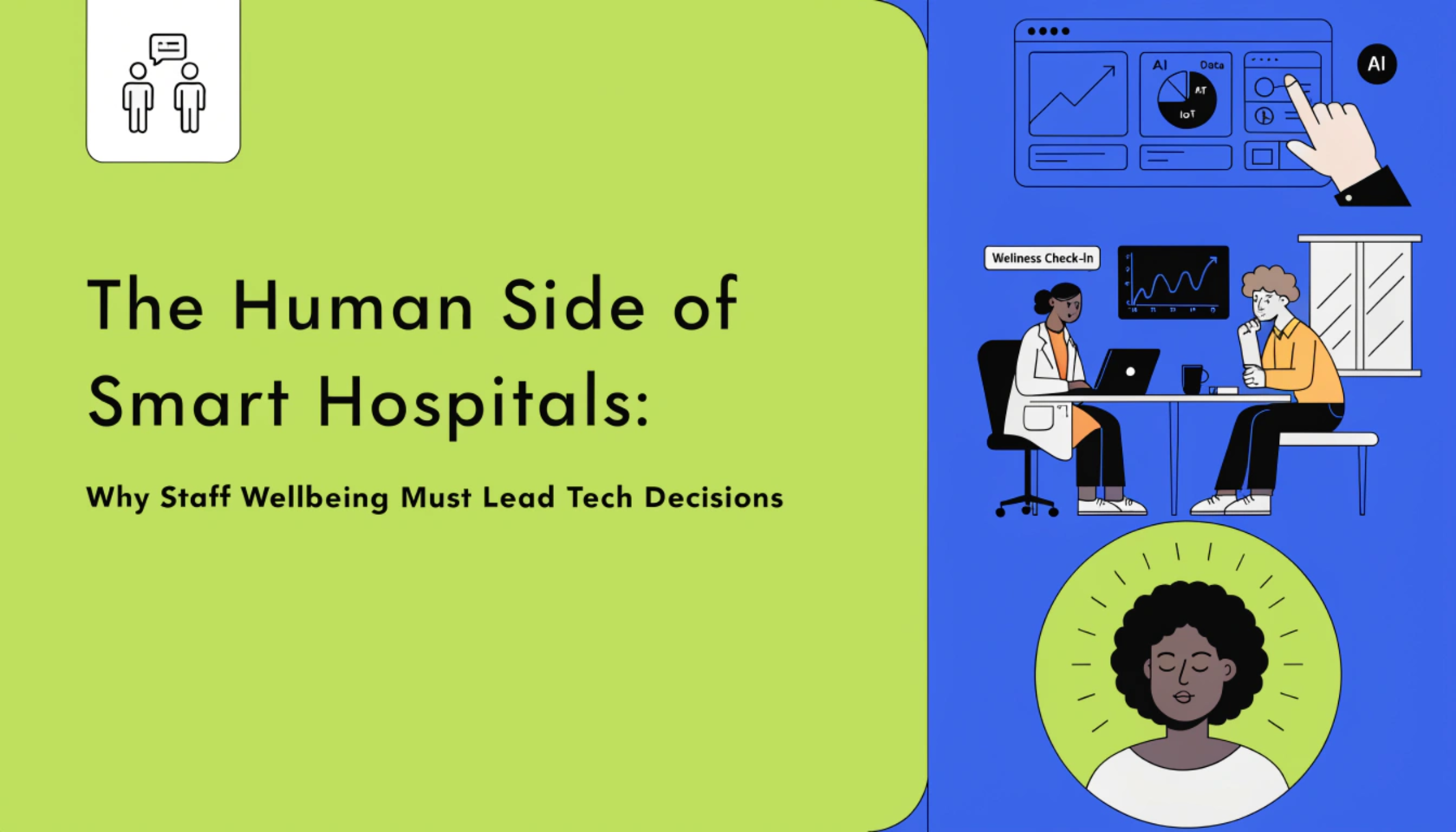
Smart hospitals are changing the way healthcare organizations deliver care, manage facilities, and support clinical teams. From artificial intelligence and predictive analytics to connected medical devices and automated workflows, technology is becoming an essential part of modern healthcare infrastructure. But while hospitals often focus on what new technology can accomplish, an equally important question is sometimes overlooked: How will it affect the people who use it every day?
A hospital cannot become truly smart simply by installing more digital systems. Its success depends on whether doctors, nurses, technicians, administrators, engineers, and support teams can use those systems effectively without increasing stress or workload. This is why hospital staff wellbeing technology should be a central consideration whenever healthcare organizations make technology investment decisions.
When technology is designed around the needs of employees, it can reduce administrative pressure, improve working conditions, support better communication, and ultimately contribute to better patient outcomes. When technology is introduced without considering the human experience, it can create new frustrations, increase cognitive load, and make already demanding jobs even harder.
Why Staff Wellbeing Matters in Smart Hospitals
Healthcare professionals work in environments where pressure is often unavoidable. Long shifts, complex patient needs, staffing shortages, emotional demands, and high levels of responsibility can contribute to fatigue and burnout.
Technology has the potential to address some of these challenges. Automated documentation, intelligent scheduling, predictive maintenance, remote monitoring, and centralized communication systems can eliminate repetitive tasks and make information easier to access.
However, technology can also create problems when it is poorly implemented. Too many alerts, complicated interfaces, multiple logins, disconnected systems, and constant digital notifications can add to workplace stress.
This makes staff wellbeing an important measure of whether a technology investment is actually successful.
A smart hospital should therefore ask more than whether a system is innovative or technically advanced. Leaders should also consider whether it saves staff time, simplifies workflows, reduces unnecessary interruptions, and allows healthcare professionals to focus more attention on patients.
Technology Should Reduce Workload, Not Add to It
One of the biggest opportunities for hospital staff wellbeing technology is reducing repetitive administrative work.
Healthcare workers spend significant amounts of time documenting information, updating records, coordinating schedules, communicating with departments, and completing routine processes. While these activities are necessary, excessive administrative work can take time away from patient care.
Automation can help by handling repetitive and predictable tasks. Digital scheduling tools can optimize staff allocation. Automated inventory systems can monitor supplies. AI-assisted documentation can help clinicians capture information more efficiently. Integrated communication platforms can reduce the need to search across multiple systems for updates.
The goal should not be to automate people out of the healthcare environment. Instead, smart technology should automate tasks that consume employee time without requiring meaningful human judgment.
When staff spend less time on repetitive processes, they can devote more energy to clinical decision-making, patient interaction, and teamwork.
Listening to Staff Before Selecting Technology
Technology decisions are often made at the leadership or procurement level, but the people who use a system every day should have a meaningful role in selecting it.
A hospital may invest in an advanced platform that looks impressive during a demonstration but proves difficult to use in a real clinical environment. Without employee feedback, organizations may discover usability problems only after implementation.
Staff involvement should therefore begin before purchasing decisions are finalized.
Hospitals can gather feedback through surveys, focus groups, pilot programs, and department-level discussions. Nurses may identify workflow problems that executives do not see. Facilities teams may understand operational requirements that are not obvious to clinical staff. IT teams can identify integration challenges before they become expensive implementation problems.
This approach creates a more practical definition of smart healthcare technology: technology that works for the people who depend on it.
The Connection Between Wellbeing and Workforce Retention
Employee wellbeing is closely connected to an organization’s ability to attract and retain skilled professionals. This makes healthcare workforce retention an important consideration when hospitals evaluate technology investments.
Healthcare organizations compete for experienced employees in a demanding labor market. Compensation remains important, but workplace experience also influences whether employees choose to stay.
If technology makes daily work easier, employees may feel better supported. If it creates additional administrative tasks and constant interruptions, frustration can increase.
For example, a well-designed digital scheduling system could make shift management more transparent and reduce unnecessary scheduling conflicts. A predictive maintenance system could help facilities teams identify equipment problems before they disrupt operations. Mobile communication tools could allow employees to receive important updates without relying on inefficient communication methods.
These improvements may appear operational rather than employee-focused, but they can significantly influence workplace experience.
Technology should therefore be viewed as part of a broader strategy for healthcare workforce retention, rather than simply an IT investment.
Designing Technology Around Different Staff Needs
A hospital workforce is diverse. Doctors, nurses, laboratory technicians, maintenance engineers, pharmacists, administrators, cleaners, security personnel, and other employees interact with technology in very different ways.
A system designed for one group may not work equally well for another.
For this reason, hospitals should avoid a one-size-fits-all approach. Technology decisions should consider the specific workflows, responsibilities, and working environments of different teams.
For clinical staff, usability and speed may be particularly important. Facilities teams may prioritize monitoring, predictive maintenance, and mobile access. Administrative employees may benefit from automation and integrated data platforms.
Accessibility should also be considered. Interfaces should be easy to understand, systems should work across appropriate devices, and training should be available for employees with different levels of digital experience.
The best technology is not necessarily the system with the most features. It is the system that employees can use confidently and efficiently.
Avoiding Technology Overload
More technology does not automatically mean a smarter hospital.
Hospitals can easily accumulate multiple platforms that perform overlapping functions. When systems are not integrated, staff may need to enter the same information repeatedly or move between different applications throughout the day.
This creates technology overload.
One of the principles of hospital staff wellbeing technology should therefore be simplification. Before introducing another platform, leaders should ask whether an existing system can be improved or integrated instead.
Reducing the number of unnecessary tools can be just as valuable as introducing new technology.
Alert management is another important consideration. Clinical environments can generate enormous amounts of digital information. If employees receive too many notifications, important alerts can become difficult to identify.
Smart systems should prioritize information rather than simply generating more of it.
Training Is Part of Staff Wellbeing
Even the most user-friendly technology requires appropriate training.
When employees are expected to use new systems without sufficient preparation, technology can become a source of anxiety. Staff may worry about making mistakes, slowing down workflows, or failing to understand new processes.
Training should therefore be considered part of the technology investment rather than an optional additional activity.
Hospitals can provide hands-on training, demonstrations, short learning sessions, peer support, and accessible digital resources. Training should also continue after implementation because employees often encounter new challenges once a system becomes part of their everyday work.
Organizations should create an environment where staff feel comfortable asking questions and reporting problems.
Measuring Whether Technology Is Actually Helping
Hospitals need practical ways to determine whether technology is improving staff wellbeing.
Traditional technology metrics such as system uptime, adoption rates, and implementation costs are useful, but they do not tell the entire story.
Healthcare organizations can also measure indicators such as administrative time saved, employee satisfaction, workflow interruptions, training requirements, overtime levels, and staff feedback.
For example, if a hospital introduces an automated documentation tool, leaders should examine whether employees actually spend less time documenting information. If a new communication platform is introduced, the organization should evaluate whether communication becomes faster and less fragmented.
The objective is continuous improvement.
Technology should be evaluated based on its real-world impact on both patients and employees.
Building a Culture Where People Come First
Smart hospitals require more than digital infrastructure. They require a culture that recognizes technology as a tool for supporting people.
Leadership plays a major role in creating this culture. Executives and facility managers should communicate why a technology is being introduced, how it is expected to improve working conditions, and how employee feedback will influence future decisions.
This helps staff see technology as something being implemented with them rather than something being imposed on them.
The human side of digital transformation also requires collaboration between departments. IT, clinical teams, facilities management, human resources, finance, and senior leadership should work together when evaluating major technology investments.
When these groups collaborate, hospitals are more likely to identify both technical opportunities and human challenges before implementation.
The Future of Hospital Technology Is Human-Centered
The next generation of smart hospitals will increasingly rely on AI, robotics, connected devices, automation, digital twins, predictive analytics, and intelligent building systems. These technologies can transform healthcare operations, but their value ultimately depends on how effectively they support people.
The future should not be defined by how much technology a hospital can deploy. It should be defined by how effectively technology helps healthcare professionals perform their jobs.
This means placing employee wellbeing alongside patient safety, operational efficiency, sustainability, and financial performance when making technology decisions.
Hospital staff wellbeing technology can become a strategic advantage when it removes unnecessary work, improves communication, supports safer environments, and gives employees more time to focus on meaningful responsibilities.
At the same time, prioritizing staff experience can strengthen healthcare workforce retention by creating workplaces where professionals feel supported rather than overwhelmed by digital transformation.
Conclusion
Smart hospitals should ultimately be designed around people.
Technology can automate repetitive tasks, improve facility operations, enhance communication, and provide healthcare professionals with better information. But these benefits are only realized when systems are practical, accessible, integrated, and aligned with the realities of frontline work.
For hospital leaders, the question should not simply be, “What technology should we implement next?” A better question is, “What technology will make work better for our people while improving patient care?”
By putting staff wellbeing at the center of technology decisions, healthcare organizations can build smarter, more resilient, and more sustainable hospitals. The smartest hospital may not be the one with the most technology it may be the one where technology quietly makes it easier for people to do their best work.
Register as a Delegate
Discover emerging ideas, technologies, and strategies shaping the future of healthcare facilities and smart hospitals. Register as a delegate to connect with industry leaders and explore practical approaches to building more human-centered healthcare environments.