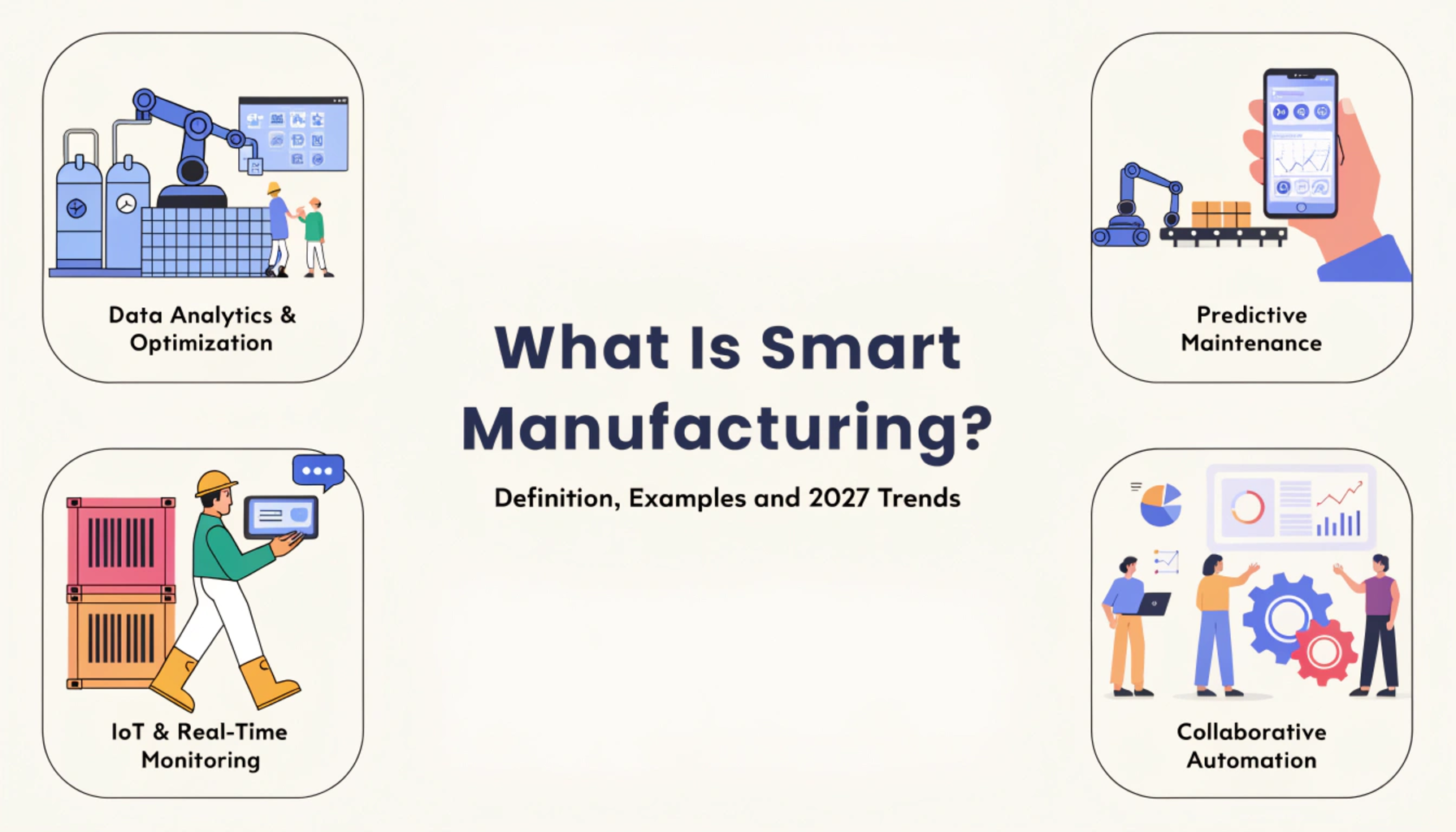
Manufacturing is moving beyond traditional automation. Modern factories are increasingly using connected machines, industrial data, artificial intelligence, robotics, sensors, cloud and edge computing, and advanced analytics to make production more efficient, flexible, resilient, and responsive.
But what is smart manufacturing, and how is it different from conventional manufacturing or basic automation?
Smart manufacturing brings physical production systems and digital technologies together so manufacturers can collect data, understand what is happening on the factory floor, and make faster, better-informed decisions. According to NIST, smart manufacturing uses advanced capabilities and digital technologies to support products that can be produced faster, more efficiently, with greater customization and sustainability. (NIST)
As manufacturers prepare for 2027, understanding this transformation is becoming increasingly important. Artificial intelligence, digital twins, industrial robotics, predictive maintenance, connected supply chains, and cybersecurity are expected to play a larger role in the factories of the future.
This guide explains what is smart manufacturing, provides practical examples, introduces the smart factory definition, and explores the major trends likely to shape manufacturing in 2027.
What Is Smart Manufacturing?
Smart manufacturing is a connected approach to production that combines machines, sensors, software, automation, data analytics, artificial intelligence, and human expertise to improve manufacturing operations.
Instead of machines operating independently and production information being reviewed only after a problem occurs, smart manufacturing creates connected systems that can continuously collect and exchange information.
For example, sensors installed on industrial equipment can monitor temperature, vibration, pressure, speed, energy consumption, and other operating conditions. That information can be analysed in real time to identify unusual patterns, predict potential failures, improve production parameters, or alert employees to emerging problems.
NIST describes smart manufacturing systems as adaptive systems that use cyber-physical infrastructure and data analytics to respond to changing conditions and improve performance. (NIST)
Therefore, smart manufacturing is not simply about purchasing new machines. It is about connecting technology, data, processes, and people to create a more intelligent manufacturing environment.
Smart Manufacturing vs. Traditional Manufacturing
Traditional manufacturing can rely heavily on manual processes, isolated equipment, periodic inspections, and historical information. Automation may exist, but individual machines or production systems may not communicate effectively with each other.
Smart manufacturing takes a more integrated approach.
Consider a production machine that suddenly begins showing abnormal vibration. In a conventional environment, the issue might only become apparent when product quality deteriorates or the machine stops working.
In a smart manufacturing environment, connected sensors can detect changes in vibration. An analytics system can compare current readings with historical patterns, identify a possible equipment problem, and notify the maintenance team before a major failure occurs.
This shift—from reacting to problems toward predicting and preventing them—is one of the major advantages of smart manufacturing.
The National Academies also describes smart manufacturing as the integration of networked data with plant-wide optimisation, sustainable production, and resilient, demand-driven supply chains. (National Academies)
Understanding the Smart Factory Definition
The smart factory definition is closely connected to smart manufacturing, but the terms are not always identical.
A smart factory is a manufacturing facility where connected technologies, data, automation, and intelligent systems work together to monitor, analyse, and optimise production.
In simple terms, the smart factory definition can be understood as
A connected and data-driven manufacturing environment capable of monitoring operations, supporting intelligent decisions, and responding rapidly to changing production conditions.
A smart factory can include industrial IoT sensors, robotics, automated material handling, manufacturing execution systems, artificial intelligence, digital twins, cloud platforms, edge computing, computer vision, and advanced analytics.
The objective is not necessarily to remove humans from manufacturing. Instead, smart factories can give employees better information and tools to make faster and more accurate decisions.
Key Technologies Behind Smart Manufacturing
Understanding what smart manufacturing is also requires looking at the technologies that make it possible.
Industrial IoT and Connected Sensors
Industrial Internet of Things (IIoT) technologies connect machines, sensors, equipment, and other assets.
Sensors can continuously capture operational information such as temperature, pressure, vibration, speed, energy usage, and machine status. This data creates visibility into what is happening across production.
Connected equipment can also allow manufacturers to monitor operations remotely and identify problems more quickly.
Artificial Intelligence and Machine Learning
AI and machine learning are becoming increasingly important in smart manufacturing.
Manufacturers can use AI to analyse large datasets, identify patterns, detect anomalies, improve scheduling, support quality inspection, and optimise processes.
NIST’s 2026 roadmap identifies industrial big-data analytics, advanced sensing, autonomous systems, digital twins, robotics, supply-chain optimisation, and sustainable manufacturing among important areas for AI and machine learning in smart manufacturing. (NIST)
This means AI is increasingly moving from experimentation toward practical industrial applications.
Robotics and Automation
Robotics is another important component of smart manufacturing.
Industrial robots can perform repetitive, precise, or physically demanding tasks. Collaborative robots, or cobots, can work alongside employees in suitable applications.
Modern automation is also becoming more flexible. Instead of using automation for only one fixed task, manufacturers are increasingly looking for systems that can adapt to different products, production volumes, and workflows.
Digital Twins
A digital twin creates a virtual representation of a physical machine, production line, process, or facility.
Manufacturers can use digital twins to simulate changes, identify bottlenecks, analyse performance, and evaluate potential improvements before making physical changes.
Recent research highlights the growing integration of digital twins with AI, sensors, IoT, simulation, and advanced analytics for real-time monitoring and intelligent decision-making. (ScienceDirect)
Cloud and Edge Computing
Cloud computing enables manufacturers to store and analyse large quantities of data across facilities, while edge computing can process information closer to where it is generated.
This combination can support faster decision-making while allowing manufacturers to manage data from machines, production lines, and facilities more effectively.
Real-World Examples of Smart Manufacturing
The easiest way to understand what is smart manufacturing is to look at practical applications.
Predictive Maintenance
Predictive maintenance uses equipment data to identify signs that a machine may be developing a problem.
For example, vibration and temperature sensors can monitor a motor continuously. If readings begin to move outside normal patterns, analytics software can flag the equipment for inspection.
Instead of waiting for a breakdown, maintenance teams can investigate the issue earlier.
This can help reduce unplanned downtime, improve maintenance planning, and extend equipment availability.
AI-Based Quality Inspection
Computer vision and AI can inspect products as they move through a production line.
Cameras can capture images while AI models analyse them for defects, incorrect assembly, scratches, dimensional inconsistencies, or other quality problems.
This can make quality inspection faster and more consistent, particularly in high-volume manufacturing environments.
Intelligent Production Scheduling
Manufacturers often need to balance orders, machine capacity, workforce availability, raw materials, and delivery deadlines.
AI and advanced analytics can analyse these variables to support more effective production scheduling.
When demand changes or a machine becomes unavailable, connected systems can help planners understand the potential impact and evaluate alternative schedules.
Energy Optimisation
Smart manufacturing can also support sustainability.
Connected energy meters and sensors can provide visibility into electricity, compressed air, heating, cooling, and other resource consumption.
Manufacturers can analyse this information to identify inefficient processes, unusual consumption, and opportunities to reduce energy use.
Major Smart Manufacturing Trends for 2027
The next phase of manufacturing transformation is likely to focus less on isolated technology projects and more on connected, intelligent, and adaptable production systems.
Here are some of the most important trends to watch.
1. AI Will Move Deeper Into Factory Operations
AI is likely to become increasingly embedded in everyday manufacturing workflows.
Instead of being used only for reporting or experimentation, AI can increasingly support quality management, maintenance, scheduling, production optimisation, forecasting, and decision-making.
The emergence of industrial AI also means manufacturers will need to pay greater attention to data quality, explainability, reliability, and cybersecurity.
NIST’s 2026 roadmap specifically highlights challenges involving industrial data, heterogeneous sensing and control systems, and trustworthy and reliable AI in high-stakes manufacturing environments. (NIST)
2. AI-Powered Digital Twins Will Grow
Digital twins are expected to become more intelligent as AI and real-time industrial data are integrated into them.
A future digital twin may not simply show what is happening inside a production system. It could help manufacturers evaluate different scenarios, identify potential issues, and recommend optimisation strategies.
This can make digital twins increasingly valuable for production planning, predictive maintenance, process optimisation, and equipment commissioning.
3. Physical AI and Advanced Robotics
One of the emerging trends entering manufacturing discussions is physical AI—the combination of AI with robots and physical machines.
Recent industry developments show increasing interest in robots that can perceive their surroundings, adapt to changing conditions, and perform more complex tasks. (Financial Times)
However, manufacturers should distinguish between technological demonstrations and solutions that are genuinely ready for industrial deployment. Reliability, safety, cost, dexterity, integration, and workforce training will remain important considerations.
4. Greater Human-Machine Collaboration
The future of smart manufacturing will not be purely automated.
Employees will continue to play an important role, but their responsibilities may change. Workers may increasingly supervise automated systems, analyse production data, manage robotics, troubleshoot advanced equipment, and make decisions supported by AI.
This makes workforce development an important part of smart manufacturing strategies.
5. Cybersecurity Will Become More Important
Connecting machines and production systems creates new opportunities—but also new cybersecurity risks.
A factory with connected equipment, cloud platforms, remote access, industrial networks, and third-party systems needs a strong cybersecurity strategy.
Manufacturers will increasingly need to consider security during the design and deployment of smart manufacturing systems rather than treating it as an afterthought.
6. Smart Manufacturing Will Extend Beyond the Factory
The future smart factory will not operate as an isolated environment.
Manufacturers are increasingly connecting production with procurement, suppliers, logistics, inventory, customer demand, and other parts of the value chain.
This can create greater visibility across operations and help businesses respond more quickly to changes in demand or supply.
What Are the Benefits of Smart Manufacturing?
Now that we have explored what is smart manufacturing, it is important to understand why businesses are investing in it.
Smart manufacturing can help manufacturers improve:
Productivity: Connected data and automation can help identify bottlenecks and improve equipment utilisation.
Quality: Automated inspection and real-time process monitoring can help identify defects earlier.
Maintenance: Predictive analytics can help maintenance teams move from reactive repairs toward proactive intervention.
Flexibility: Connected and programmable systems can make it easier to respond to changing product requirements and demand.
Sustainability: Energy and resource monitoring can help identify opportunities to reduce waste and consumption.
Decision-making: Real-time operational information gives managers and engineers greater visibility into production.
Resilience: Connected systems can improve visibility across manufacturing and supply-chain operations, supporting faster responses to disruptions.
Challenges of Implementing Smart Manufacturing
Despite its potential, smart manufacturing is not a simple technology upgrade.
Many manufacturers operate legacy equipment that was never designed to connect with modern digital systems. Integrating old and new technologies can therefore be challenging.
Data quality is another major issue. AI systems are only as useful as the information they receive. Poor-quality, incomplete, inconsistent, or unreliable data can limit the value of analytics and AI.
Cybersecurity, interoperability, employee training, implementation costs, and change management are also important considerations.
Manufacturers should therefore avoid adopting technology simply because it is new. A better approach is to identify a specific business problem, establish measurable objectives, select the appropriate technology, test it through a focused pilot, and then scale successful solutions.
How Manufacturers Can Prepare for 2027
Companies preparing for the next stage of smart manufacturing should begin with their existing operations.
First, identify where production currently loses time, money, quality, or efficiency. Then determine whether better data, automation, AI, or connectivity can address those problems.
Manufacturers should also assess their digital infrastructure. Can machines communicate with existing systems? Is production data accessible? Are employees trained to use digital tools? Are cybersecurity controls sufficient?
Starting with a focused use case can often be more effective than attempting to transform an entire factory simultaneously.
The goal should be to create a scalable foundation that can support additional smart manufacturing applications over time.
The Future of Smart Manufacturing
The answer to what is smart manufacturing will continue to evolve as technology advances.
What began with connected machines, sensors, automation, and industrial data is increasingly moving toward AI-powered, adaptive, and highly integrated production environments.
By 2027, manufacturers are likely to place greater emphasis on AI-enabled decision-making, digital twins, advanced robotics, predictive maintenance, industrial connectivity, cybersecurity, and sustainable operations.
But successful smart manufacturing will not be determined by the number of robots or sensors installed in a factory. The strongest results will come from combining technology with well-designed processes, reliable data, skilled employees, and clear business objectives.
The smart factory definition is ultimately about more than a technologically advanced building. It represents a manufacturing environment that can understand its operations, respond to change, and continuously improve.
For manufacturers preparing for the next generation of industrial production, 2027 presents an opportunity to move from isolated automation projects toward a more connected and intelligent manufacturing strategy.
Ready to explore the technologies and strategies shaping the future of manufacturing?
Explore convention topics and discover key discussions around smart manufacturing, automation, AI, robotics, digital transformation, and the factory of the future.