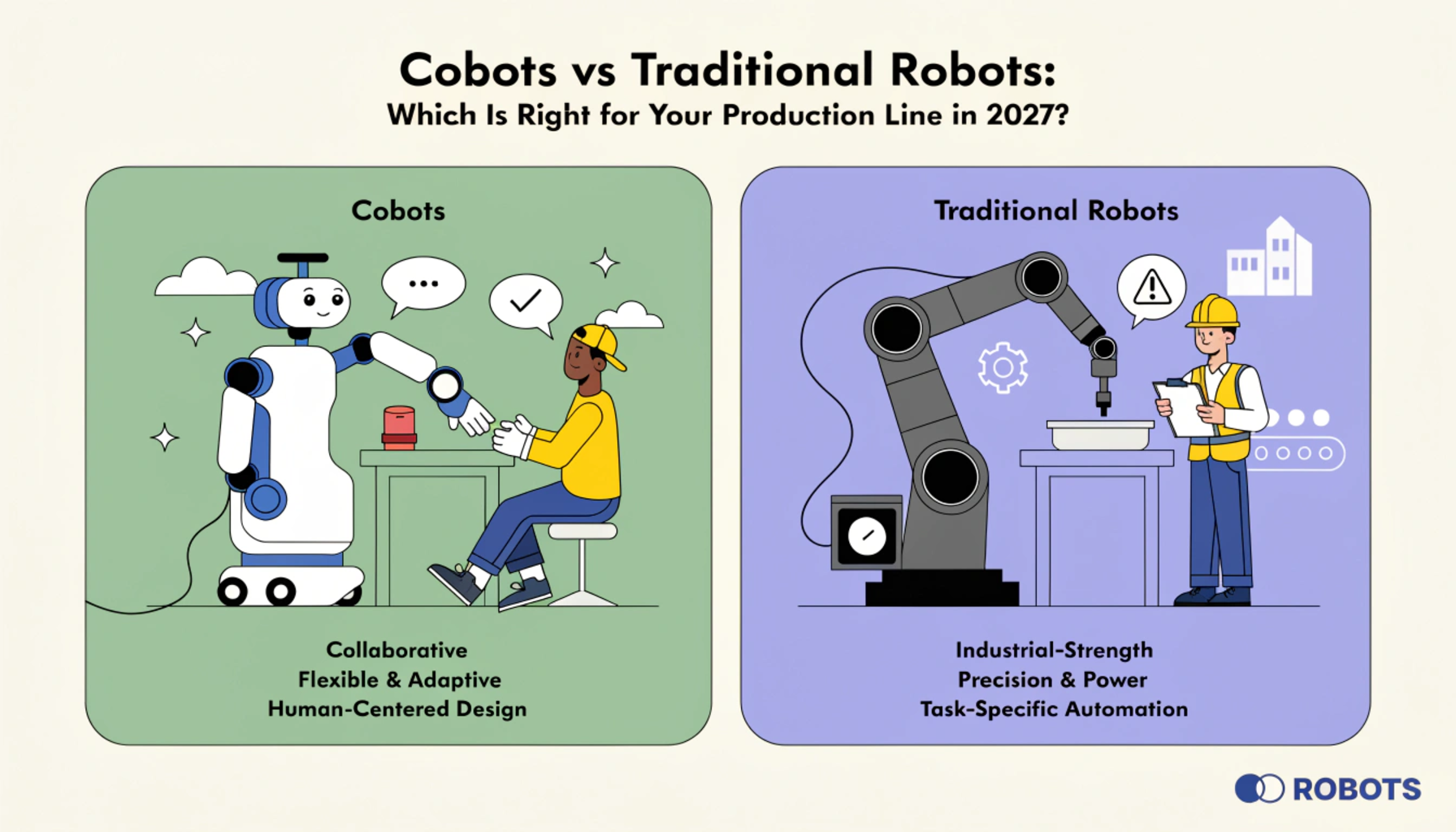
Manufacturing is entering a new phase of automation. As companies face pressure to improve productivity, maintain consistent quality, reduce operating costs, and respond faster to changing customer demand, robotics is becoming an increasingly important part of modern production strategies. However, choosing the right type of robot is not always straightforward.
One of the biggest decisions manufacturers will face in 2027 is whether to invest in traditional industrial robots or collaborative robots, commonly known as cobots. While both technologies can automate repetitive processes, their capabilities, deployment requirements, safety considerations, and ideal applications are different.
Understanding cobots vs robots manufacturing is therefore essential for companies planning their next automation investment. The right choice depends on factors such as production volume, available floor space, task complexity, workforce requirements, safety needs, and the level of flexibility expected from the production line.
What Are Traditional Industrial Robots?
Traditional industrial robots are automated machines designed to perform repetitive, precise, and often high-speed manufacturing tasks. They have been used in factories for decades, particularly in industries such as automotive, electronics, metalworking, plastics, and consumer goods.
These robots are commonly installed in dedicated work cells and separated from human workers using physical barriers, safety fencing, scanners, interlocks, and other protective systems. Their ability to handle heavy payloads and operate at high speeds makes them suitable for demanding industrial applications.
Typical applications include welding, painting, palletizing, machine tending, assembly, material handling, and high-volume packaging.
Traditional robots are particularly effective when manufacturers have stable production processes and large volumes of repetitive work. Once properly programmed and integrated, they can operate continuously with consistent performance.
However, traditional robotic systems can require significant upfront investment. Installation may involve robot hardware, safety equipment, tooling, programming, conveyors, sensors, and integration with other production equipment.
What Are Collaborative Robots?
Collaborative robots, or cobots, are designed to work more closely with human operators under appropriately engineered safety conditions. Rather than completely separating people and machines, cobots can support workers with repetitive, ergonomically difficult, or precision-based tasks.
The growth of the collaborative robots industry reflects the increasing demand for flexible automation. Manufacturers, particularly small and medium-sized businesses, are exploring cobots because they can often be deployed in smaller spaces and adapted to changing production requirements.
Cobots are commonly used for machine tending, pick-and-place operations, assembly, inspection, packaging, screwdriving, dispensing, and material handling.
Their relatively flexible deployment makes them useful in environments where production changes frequently or where humans and automation need to work alongside each other.
However, “collaborative” does not automatically mean that every cobot application is inherently safe for direct human interaction. A proper risk assessment and application-specific safety design remain essential.
Cobots vs Robots Manufacturing: Key Differences
When comparing cobots vs robots manufacturing, it is important to look beyond the basic difference between “working with humans” and “working separately.”
The biggest difference is generally the way the automation system is designed and deployed.
Traditional robots are usually optimized for speed, payload, repeatability, and dedicated high-volume production. Cobots are generally optimized for flexibility, ease of deployment, and applications where human workers remain an important part of the process.
Speed and Productivity
Traditional industrial robots typically have an advantage when maximum speed and throughput are the primary objectives. They are designed to perform rapid repetitive movements and can be optimized for high-volume manufacturing.
Cobots can deliver excellent productivity improvements, but their operating speeds may be limited depending on the application and safety requirements. In some collaborative applications, the robot may slow down when a person enters a defined workspace.
Therefore, manufacturers operating high-volume production lines may find traditional robots more suitable, while facilities prioritizing flexibility may benefit from cobots.
Payload Capacity
Traditional industrial robots generally offer a wider range of payload capacities, including systems designed to move very heavy components.
Cobots are available in different payload classes, but many are intended for lighter applications. Newer collaborative robot models continue to expand payload and reach capabilities, but manufacturers should evaluate the exact requirements of the application rather than assuming one technology will fit every task.
If the production process involves heavy automotive components, large metal parts, or substantial material handling, traditional robots may have a significant advantage.
Flexibility and Changeovers
Flexibility is one of the strongest arguments for cobots.
Production environments increasingly need to manufacture multiple product variations rather than relying exclusively on long production runs of a single product. A cobot can often be repositioned or reprogrammed for different tasks, making it attractive for high-mix, low-volume manufacturing.
Traditional robots can also be reprogrammed and made flexible through sophisticated tooling, vision systems, and programming. However, their installation in fixed robotic cells can make physical changes more involved.
For manufacturers expecting frequent product changes in 2027, cobots may provide an easier route to adaptable automation.
Floor Space and Installation
Factory floor space is expensive. Traditional robotic cells can require dedicated areas for fencing, guarding, conveyors, fixtures, and safety equipment.
Cobots can potentially require a smaller footprint because their applications may not need the same type of fully enclosed cell. However, the actual space requirements depend on the application, robot movement, tooling, surrounding machinery, and required safeguarding.
This can make cobots particularly attractive for manufacturers operating in facilities where expansion is difficult.
Programming and Ease of Use
Another important consideration in the cobots vs robots manufacturing debate is programming.
Many cobots are designed with user-friendly programming interfaces that allow trained production personnel to configure or adjust certain tasks without relying entirely on specialist robotics engineers.
Traditional robots can also be programmed using increasingly sophisticated graphical interfaces, simulation platforms, offline programming tools, and digital manufacturing software. However, complex robotic cells can require specialized integration and programming expertise.
For companies with limited automation engineering resources, ease of programming can be a significant factor when selecting technology.
Cost: Which Robot Is More Affordable?
Cost comparisons should not focus only on the purchase price of the robot.
A complete automation project includes hardware, tooling, programming, safety systems, integration, installation, maintenance, training, downtime, and potential production improvements.
Cobots can sometimes offer a lower barrier to automation because of their compact design and flexible deployment. This can make them attractive to smaller manufacturers or companies automating a process for the first time.
Traditional robots may require a larger initial investment, particularly when a complete robotic cell is needed. However, their higher speed, payload capacity, and productivity can make them highly cost-effective for large-scale production.
The right question is not simply “Which robot costs less?” but “Which automation solution delivers the strongest return on investment for this production process?”
Safety Considerations
Safety should be central to any decision involving robotics.
Cobots are designed with features that can support certain human-robot collaborative applications, such as force and power monitoring, speed limitations, and protective sensing. However, manufacturers cannot assume that a cobot can be placed beside a worker without additional safety measures.
The risk depends on the robot, end effector, workpiece, speed, force, application, environment, and potential hazards surrounding the system.
Traditional robots generally operate within controlled areas using physical or electronic safeguarding. This approach can provide strong separation between people and automated machinery.
Before implementation, manufacturers should conduct a documented risk assessment and follow applicable machinery safety requirements and standards.
Where Traditional Robots Make More Sense
Traditional robots remain a strong choice for high-volume, highly repetitive production.
Automotive manufacturing is a classic example. Processes such as welding and heavy material handling can require speed, precision, reach, and payload capabilities that make traditional industrial robots particularly effective.
They can also be suitable for applications where human access to the robot’s operating area is unnecessary during normal production.
If the production line runs continuously with predictable processes and the main objective is maximum throughput, traditional robots should be seriously considered.
Where Cobots Make More Sense
Cobots can be particularly useful when manufacturers need automation without completely redesigning their production environment.
For example, a worker could load components while a cobot performs a repetitive assembly, inspection, or machine-tending task. In another application, a cobot could handle packaging while employees focus on quality checks and process supervision.
The collaborative robots industry is also becoming increasingly relevant to manufacturers with high product variety and frequent changeovers.
Cobots can be especially attractive for smaller production batches, ergonomic improvement projects, machine tending, assembly, inspection, and processes where human judgment remains valuable.
How AI and Vision Systems Could Change Robotics in 2027
The robotics market is increasingly connected with artificial intelligence, machine vision, advanced sensors, digital twins, and data analytics.
In 2027, manufacturers are likely to place greater emphasis on robots that can respond to changing production conditions rather than simply repeat fixed movements.
Vision systems can allow robots to identify objects, inspect products, detect defects, and adjust their actions. AI-powered software can also support better process optimization and predictive maintenance.
These technologies can benefit both traditional robots and cobots. As a result, the distinction between the two categories may become less important than the overall automation architecture.
Questions to Ask Before Choosing a Robot
Manufacturers should evaluate the production process before selecting a specific robotic technology.
Start by identifying the task that needs to be automated. What is the required cycle time? What is the payload? How frequently will products change? How much floor space is available? Does a worker need to access the same workspace? What level of precision is required?
The existing workforce should also be considered. Automation does not necessarily mean eliminating human involvement. In many modern factories, robots take over repetitive or physically demanding activities while employees move toward supervision, quality control, programming, maintenance, and higher-value tasks.
Manufacturers should also calculate the expected return on investment. Compare equipment costs with labor savings, productivity gains, quality improvements, reduced downtime, ergonomic benefits, and expected equipment life.
Cobots vs Traditional Robots: Which Should You Choose?
There is no universal winner in the cobots vs robots manufacturing comparison.
Choose traditional industrial robots when your priority is high speed, high throughput, heavy payloads, and consistent large-volume production. They are particularly effective for dedicated automated cells where human interaction is limited.
Choose cobots when flexibility, compact deployment, human-machine interaction, and frequent production changes are more important. They can be a practical option for companies that want to automate individual processes without making an extensive transformation to the entire production line.
In some cases, the best strategy may be a combination of both. A factory could use traditional robots for high-speed production processes while deploying cobots for assembly, inspection, machine tending, or other flexible applications.
Preparing Your Production Line for 2027
The future of manufacturing will not be defined by robots alone. Competitive factories will combine robotics with connected machines, industrial IoT, artificial intelligence, machine vision, advanced analytics, digital twins, and skilled employees.
Manufacturers should therefore approach robotics investment as part of a broader automation roadmap. Instead of asking which technology is more advanced, decision-makers should identify the technology that best solves their specific production challenge.
Whether the answer is a traditional robot, a collaborative robot, or a combination of both, successful implementation will depend on careful planning, appropriate integration, workforce training, safety assessment, and continuous performance measurement.
As automation technology evolves, understanding the strengths and limitations of different robotic systems will become increasingly important for manufacturers preparing for the next generation of production.
Conclusion
The debate over cobots vs robots manufacturing is ultimately about matching technology with production requirements. Traditional robots remain powerful solutions for high-speed, high-volume, heavy-duty applications, while cobots offer flexibility and can support human-centered automation strategies.
For 2027, manufacturers should avoid choosing robotics technology based solely on trends or initial purchase price. The better approach is to evaluate productivity requirements, safety, flexibility, floor space, workforce capabilities, integration complexity, and long-term return on investment.
The collaborative robots industry will continue to evolve alongside traditional industrial robotics, giving manufacturers more options than ever before. Companies that carefully evaluate their processes today will be better positioned to build efficient, flexible, and competitive production lines for the future.
Ready to explore the future of manufacturing automation?
Enquire now to discover insights, technologies, and opportunities shaping smart manufacturing and automation in 2027.