Manufacturing quality has always depended on precision, consistency, and the ability to identify problems before they become costly failures. But as production lines become faster and product specifications become more demanding, traditional inspection methods can struggle to keep pace. Manual inspections, sampling-based quality checks, and rule-based machine vision can all leave manufacturers exposed to defects, rework, and customer complaints.
A Texas manufacturer recently demonstrated how technology can change that equation by integrating artificial intelligence into its quality-control process. By using AI-powered visual inspection, real-time production data, and automated defect detection, the manufacturer reportedly reduced defects by 40% while improving inspection consistency and giving production teams faster access to actionable information.
This example offers valuable lessons for manufacturers exploring AI quality control manufacturing strategies in 2026 and planning technology investments for 2027.
Why Quality Control Is Becoming an AI Priority
Quality control is one of the most data-intensive areas of manufacturing. Every production line generates information about dimensions, temperatures, machine conditions, materials, cycle times, and product characteristics. Historically, much of this information has been reviewed manually or through systems based on fixed rules.
That approach works well when production conditions remain stable. However, modern factories operate with greater product variety, shorter production cycles, and increasingly complex processes. A small variation in a component or process parameter can result in thousands of defective units if it goes unnoticed.
AI changes the quality-control model by identifying patterns across large amounts of production data. Instead of simply checking whether a product meets a predefined rule, an AI system can learn from historical examples and identify subtle deviations that may indicate a developing quality problem.
For manufacturers, this creates an opportunity to move from reactive inspection toward more proactive quality management.
The Texas Manufacturing Challenge
The Texas manufacturer at the center of this example was dealing with a familiar production problem: defects were not necessarily caused by one major failure. Instead, quality issues could emerge from small variations occurring at different stages of production.
Traditional inspection required operators to visually examine products and identify imperfections. While experienced inspectors could recognize many issues, manual inspection naturally introduced variability. Fatigue, workload, lighting conditions, production speed, and differences in individual judgment could influence inspection outcomes.
Another challenge was timing.
If a defect was discovered several stages after it occurred, the manufacturer could already have produced a significant quantity of affected products. That meant additional inspection, rework, material waste, and production downtime.
The manufacturer needed a system capable of monitoring quality continuously rather than relying primarily on periodic human inspection.
This became the foundation for its AI-driven quality initiative.
How AI-Powered Quality Control Worked
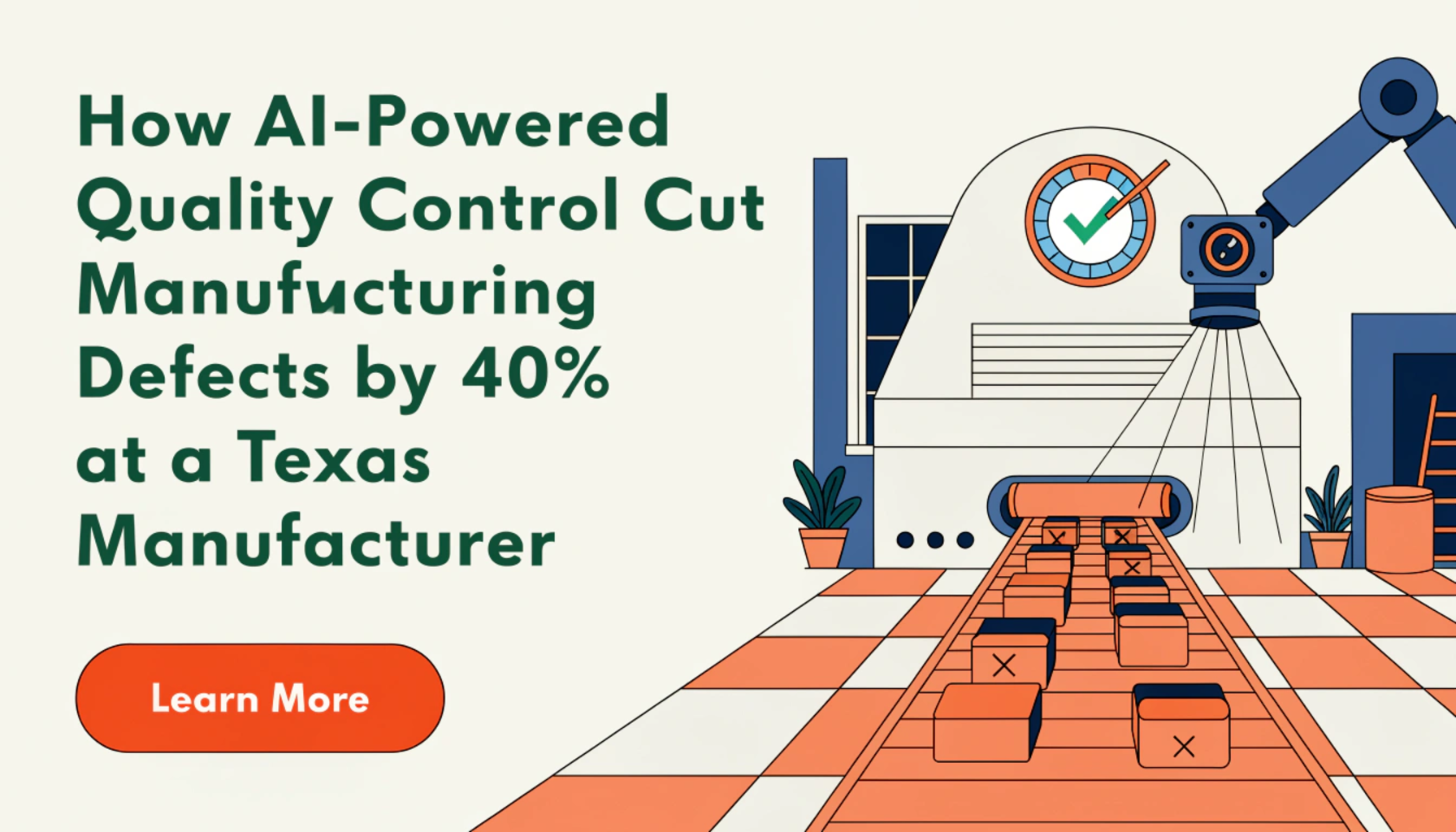
The manufacturer introduced AI-powered inspection technology that combined cameras, machine-vision systems, production data, and machine-learning models.
High-resolution cameras captured images of products as they moved through the production process. Instead of relying only on basic image-processing rules, the AI model analyzed product images to recognize defects and variations.
The system could identify characteristics such as surface imperfections, incorrect assembly, dimensional inconsistencies, missing components, or other deviations from expected product standards.
The major difference was that the AI system could continuously improve its ability to distinguish acceptable products from defective ones as more data became available.
This approach is central to modern AI quality control manufacturing. Rather than treating inspection as an isolated end-of-line activity, AI can make quality monitoring part of the production process itself.
When the system detected a potential defect, information could be sent to operators or connected manufacturing systems. Production teams could then investigate the issue much sooner.
The 40% Defect Reduction
The most significant outcome of the initiative was a reported 40% reduction in manufacturing defects.
That improvement matters because defect reduction has a direct impact on several areas of manufacturing performance. Fewer defects can mean less scrap, reduced rework, lower inspection costs, fewer production interruptions, and improved customer satisfaction.
The financial impact can be even greater when manufacturers consider the total cost of poor quality.
A defective component does not simply represent the cost of the material used to produce it. Manufacturers may also spend money on labor, machine time, energy, inspection, transportation, reprocessing, warranty claims, and customer service.
By detecting quality issues earlier, AI can help prevent these costs from accumulating.
The Texas example therefore demonstrates that AI quality systems should not be viewed simply as an automation investment. They can become a broader operational improvement strategy.
From Detection to Prevention
One of the most important advantages of AI is its potential to move quality control beyond simple defect detection.
Traditional inspection essentially asks: Is this product defective?
AI-enabled quality systems can move toward a more valuable question: Why is this defect happening, and can we prevent it?
Suppose an AI system identifies that defects become more common when a particular machine operates under specific conditions. Production managers can investigate those conditions before the issue affects a larger batch.
Similarly, if the system detects a relationship between quality problems and changes in temperature, pressure, machine speed, raw-material characteristics, or tooling conditions, the manufacturer can use that information to improve the process.
This connection between quality data and production data creates opportunities for predictive quality management.
That is one reason AI is increasingly becoming part of broader smart-manufacturing strategies.
Why Human Expertise Still Matters
The success of AI-powered quality control does not mean eliminating human workers from the inspection process.
In fact, the strongest implementations typically combine AI capabilities with human expertise.
AI is highly effective at continuously analyzing images and data at production speed. Humans remain essential for interpreting unusual situations, investigating root causes, making operational decisions, and improving manufacturing processes.
Instead of spending hours performing repetitive visual inspections, quality professionals can focus more heavily on analysis and continuous improvement.
This changes the role of the quality-control team. Employees become less focused on finding every individual defect and more focused on understanding why defects occur and how production can be improved.
For manufacturers considering AI adoption, workforce engagement is therefore just as important as technology selection.
Building the Right AI Quality-Control System
A successful AI quality control manufacturing strategy begins with clearly defining the quality problem.
Manufacturers should identify where defects occur, how frequently they occur, what they cost, and how quickly they are currently detected. This provides a baseline against which AI performance can be measured.
Data quality is equally important. AI systems need reliable examples of both acceptable and defective products. Poor-quality training data can produce inaccurate results, making data preparation one of the most important stages of implementation.
Manufacturers also need to integrate AI with existing production systems.
An inspection system that identifies a defect but does not communicate that information effectively to operators or manufacturing software will have limited value. The greatest benefits come when quality information can flow into the broader production environment.
This may involve connections with manufacturing execution systems, industrial IoT platforms, enterprise systems, or machine controls.
Measuring the Business Impact
A successful AI project should be evaluated using business and operational metrics rather than technology adoption alone.
Defect rates are an obvious starting point, but manufacturers should also monitor rework, scrap, downtime, inspection time, production yield, customer returns, and overall equipment effectiveness.
For example, if AI reduces defects by 40% but creates excessive maintenance costs or slows production, the implementation may require adjustment.
On the other hand, if defect reduction is accompanied by improved throughput and lower rework costs, the business case becomes significantly stronger.
Manufacturers can also compare performance before and after implementation to calculate return on investment.
This measurement approach turns an AI experiment into a structured manufacturing improvement program.
Lessons From This Manufacturing AI Case Study
This Texas example provides several lessons for organizations considering similar investments.
First, manufacturers do not need to transform an entire factory at once. A focused quality problem can provide a practical starting point for AI adoption.
Second, AI works best when it is connected to operational data rather than treated as a standalone inspection tool.
Third, successful implementation requires collaboration between production, engineering, IT, quality, and frontline employees.
Finally, manufacturers should focus on measurable business outcomes. Reducing defects is valuable because it improves efficiency and profitability—not simply because AI has been installed on the production line.
These lessons are particularly relevant as manufacturers develop technology strategies for 2027.
The Future of AI Quality Control in Manufacturing
The next generation of AI quality systems is likely to become increasingly integrated with predictive maintenance, digital twins, robotics, industrial IoT, and automated process control.
Instead of detecting a defect after production, factories will increasingly attempt to predict quality problems before they occur.
For example, AI could analyze machine condition, production parameters, environmental information, and product images simultaneously. If the system recognizes a pattern associated with quality deterioration, it could alert operators or recommend adjustments.
Eventually, some manufacturing environments may use closed-loop systems in which AI identifies a process deviation and automatically adjusts production parameters within predefined limits.
This represents a major shift from traditional quality assurance toward intelligent, continuous quality management.
Why Manufacturers Should Act Now
The competitive advantage of AI is not simply about having newer technology. It is about developing the organizational capabilities needed to use that technology effectively.
Manufacturers that begin experimenting with AI quality systems now can build valuable experience with data management, workforce training, system integration, and performance measurement before these technologies become even more widespread.
The reported 40% defect reduction achieved by the Texas manufacturer illustrates what can happen when AI is applied to a clearly defined manufacturing challenge.
For leaders, the key question is no longer whether AI can contribute to quality control. The more important question is where AI can create the greatest measurable improvement within their own operations.
Conclusion
The Texas manufacturer’s experience demonstrates the potential of artificial intelligence to transform quality control from a largely reactive function into a continuous, data-driven process.
By combining machine vision, machine learning, production data, and human expertise, manufacturers can detect defects earlier, identify patterns, reduce waste, and improve consistency. A reported 40% reduction in defects shows why AI-powered inspection is becoming an important part of modern manufacturing strategy.
As factories prepare for the next stage of automation, AI quality control should be considered alongside robotics, predictive maintenance, digital twins, and industrial analytics. The organizations that connect these technologies to clear operational goals will be better positioned to build smarter and more resilient manufacturing environments.
Want to connect with manufacturing leaders shaping the next generation of industrial innovation?
Sponsor Smart Manufacturing Convention 2027 and explore opportunities to engage with professionals focused on automation, AI, smart factories, and the future of manufacturing.