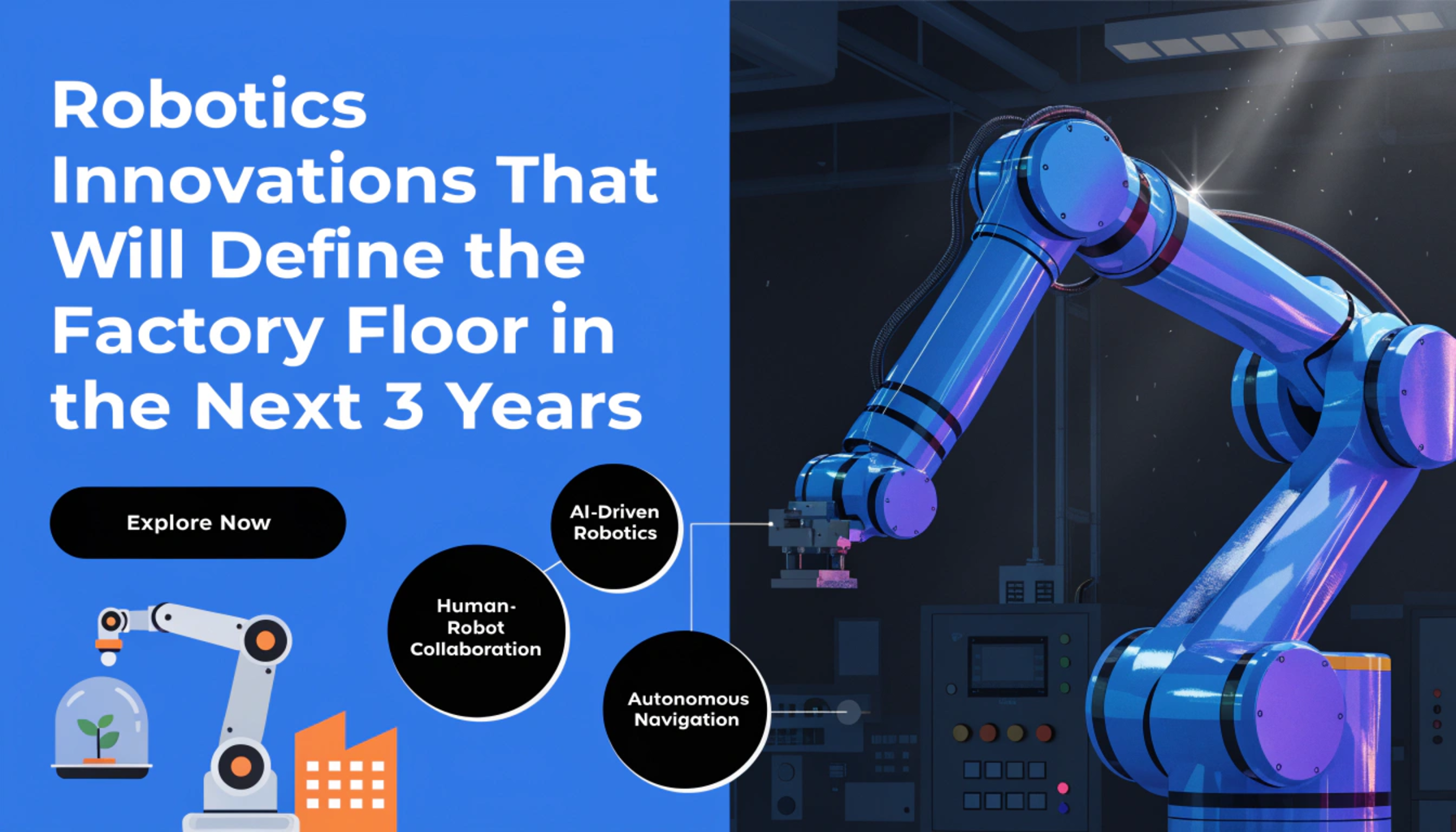
The factory floor is entering a new phase of automation. Robots are no longer limited to repetitive welding, assembly, packaging, or material-handling tasks. Advances in artificial intelligence, computer vision, sensors, connectivity, and simulation are making robotic systems more flexible, intelligent, and easier to integrate into changing production environments.
The scale of adoption is already significant. According to the International Federation of Robotics (IFR), 542,000 industrial robots were installed globally in 2024, more than twice the number installed a decade earlier. (International Federation of Robotics)
The next three years could be even more transformative. As manufacturers deal with labor shortages, pressure to improve productivity, increasingly customized products, and the need for resilient supply chains, robotics will become an increasingly important part of the smart factory.
For manufacturers planning their manufacturing robotics 2027 strategy, the key question is no longer whether robots will be used. It is how intelligent, connected, flexible, and autonomous those robots will become.
Here are seven robotics innovations expected to have a major impact on the factory floor.
1. AI-Powered Industrial Robots
Traditional industrial robots are highly capable, but they generally depend on carefully programmed instructions. AI is changing this model by allowing robots to interpret data, recognize patterns, adapt to variations, and make decisions within defined operating environments.
AI-powered robotics combines robotic hardware with machine learning, computer vision, advanced sensors, and increasingly sophisticated software. Instead of programming every possible scenario, manufacturers can use AI systems to help robots respond to variations in products, positioning, or production conditions.
This is particularly important for factories moving from high-volume standardized production toward more flexible manufacturing.
For example, an AI-enabled robot equipped with vision technology could identify different components arriving at a workstation and determine how they should be handled. This reduces the need to manually reprogram the robot every time production requirements change.
The 2026 NIST roadmap for AI and machine learning in smart manufacturing identifies robotics, advanced sensing, autonomous systems, digital twins, industrial data analytics, and foundation models among important areas shaping future manufacturing systems. (NIST)
This makes AI-powered robotics one of the most important industrial automation trends to monitor through 2027 and beyond.
2. Collaborative Robots Will Move Into More Applications
Collaborative robots, commonly called cobots, are designed to work alongside human employees in appropriate applications rather than being isolated behind traditional industrial safety barriers.
Cobots have already become popular for tasks such as assembly, machine tending, inspection, packaging, and material handling. Their relatively flexible deployment makes them attractive to manufacturers that cannot justify large fixed automation systems.
Over the next three years, improvements in sensors, vision, grippers, software, and safety systems could allow cobots to handle a wider range of production activities.
One major advantage is flexibility. A conventional automated production line may require substantial engineering work when products or processes change. A cobot-based workstation can potentially be reconfigured more easily.
NIST notes that advances in sensors, software, and vision systems are helping make robotics and manufacturing automation increasingly accessible to smaller manufacturers as well. (NIST)
For manufacturers developing a manufacturing robotics 2027 roadmap, cobots can therefore provide a practical bridge between manual operations and fully automated production.
3. Autonomous Mobile Robots Will Transform Material Flow
Autonomous mobile robots, or AMRs, can move materials, components, tools, and finished products around factories and warehouses. Unlike traditional automated guided vehicles that often depend on predefined routes, modern AMRs can use sensors and software to navigate dynamic environments.
This makes them particularly useful in factories where production layouts frequently change.
Imagine a production facility where components need to move between receiving, storage, machining, assembly, quality inspection, and shipping. Instead of relying entirely on forklifts or manual transportation, a fleet of AMRs could coordinate these movements.
The bigger opportunity is integration. Future AMRs are likely to communicate with manufacturing execution systems, warehouse management systems, production equipment, and other robots.
This creates a connected material-flow network rather than isolated automation projects.
As manufacturers pursue shorter production cycles and greater operational visibility, AMRs will become an important component of the industrial automation trends shaping smart factories.
4. Machine Vision Will Make Robots More Perceptive
Robots can move with remarkable precision, but perception is equally important.
Machine vision gives robots the ability to identify objects, detect defects, determine positions, read labels, and evaluate product characteristics. Improvements in cameras, 3D sensing, edge computing, and AI-based image processing are making robotic vision more powerful.
This could significantly expand automated inspection.
Instead of simply checking whether an object is present, a vision-enabled robot can potentially identify subtle differences in shape, surface condition, alignment, or assembly.
For manufacturers, this means robotics and quality control can increasingly operate as one integrated system.
A robotic inspection station could pick up a component, scan it, compare the results against predefined requirements, classify potential defects, and automatically send the information into a production database.
That creates another important advantage: data.
Every inspection can generate information that helps manufacturers identify recurring quality problems and improve processes.
The combination of robotics, AI, and advanced sensing is therefore likely to become one of the defining elements of manufacturing robotics 2027.
5. Digital Twins Will Change How Robots Are Designed and Managed
One of the biggest challenges with robotics is implementation. Installing a robotic system directly on a live production floor can be expensive and disruptive.
Digital twins offer an alternative.
A digital twin is a virtual representation of a physical system that can be used to simulate, analyze, monitor, and optimize its real-world counterpart.
For robotic manufacturing, a digital twin can represent a robot, workcell, production line, or even a larger manufacturing system.
Engineers can use virtual environments to test layouts, evaluate robot movements, identify potential bottlenecks, and assess changes before implementing them physically.
NIST research highlights digital twins as a way to support the design, testing, commissioning, operation, and reconfiguration of robot systems. (NIST)
Digital twins can also support predictive and prescriptive decision-making. Rather than simply showing what is happening, advanced systems can help manufacturers understand why something is happening and evaluate possible responses.
This will be especially valuable as factories become more complex.
Manufacturers implementing manufacturing robotics 2027 strategies should therefore consider digital twins not just as visualization tools but as part of the broader lifecycle management of robotic assets.
6. Humanoid and General-Purpose Robots Will Enter the Conversation
Humanoid robots have received enormous attention, particularly because they could theoretically perform multiple tasks using a form factor designed around human workspaces.
The technology, however, is still developing.
Current humanoid systems face challenges involving reliability, dexterity, cost, autonomy, safety, and the ability to perform complex factory tasks consistently. Recent reporting from Reuters highlights that humanoid robots remain far from replacing conventional industrial robots for many factory applications. (Reuters)
That does not mean manufacturers should ignore them.
The important development is the movement toward more general-purpose robotic systems capable of learning or adapting to multiple tasks instead of being designed for only one highly specific operation.
In the next three years, early industrial applications are more likely to appear in controlled environments where tasks are repetitive but still require human-like mobility or manipulation.
Manufacturers should approach humanoids strategically rather than treating them as an immediate replacement for conventional robots.
The most practical approach is to monitor pilot projects, evaluate specific use cases, and determine whether these systems offer measurable value compared with existing automation technologies.
7. Robots Will Become Part of Connected Autonomous Production Systems
Perhaps the biggest innovation is not a specific robot at all.
It is the connection of robots into a larger intelligent production ecosystem.
The factory of the near future will increasingly involve industrial robots, cobots, AMRs, machine vision systems, sensors, production software, digital twins, AI models, and human workers operating as connected components.
Instead of individual automation islands, manufacturers can build integrated systems where information moves continuously between machines and business processes.
For example, a quality-control system could detect a defect using machine vision. That information could be sent to an AI analytics platform, which identifies a potential process problem. A connected robot or machine could then adjust a parameter, while the manufacturing execution system records the event.
This creates a feedback loop between production, inspection, analysis, and action.
NIST’s 2026 smart-manufacturing roadmap emphasizes exactly this broader challenge: integrating industrial data, heterogeneous sensing and control systems, autonomous systems, robotics, digital twins, and AI while maintaining trustworthy and reliable operations. (NIST)
This connected approach could ultimately have a greater impact than any individual robotic innovation.
What These Robotics Innovations Mean for Manufacturers
The next three years will not simply be about buying more robots. They will be about building smarter automation strategies.
Manufacturers should evaluate robotics based on business outcomes rather than technology alone. Productivity, quality, flexibility, worker safety, energy efficiency, maintenance requirements, and return on investment should all be considered.
Another important factor is workforce development.
Robotics does not eliminate the need for people. Instead, it changes the skills required on the factory floor. Operators, technicians, engineers, and maintenance teams increasingly need to understand robotics, data, AI-enabled systems, programming, and troubleshooting.
The International Federation of Robotics has also highlighted how robotization can create opportunities for employment and skill development in adopting companies. (International Federation of Robotics)
Manufacturers that invest in employee training alongside automation will be better positioned to capture the value of these technologies.
Cybersecurity and interoperability will also become increasingly important. A highly connected factory creates more opportunities for data-driven optimization, but it also creates more connections that need to be protected and managed.
Preparing for the Manufacturing Robotics 2027 Era
The factories that benefit most from robotics will not necessarily be those that deploy the largest number of machines.
They will be the organizations that understand where robotics creates the greatest operational value.
A sensible roadmap can begin with identifying repetitive, dangerous, quality-sensitive, or labor-intensive tasks. Manufacturers can then evaluate whether fixed robots, cobots, AMRs, machine vision, or AI-enabled systems are appropriate.
The next step is integration.
A robot operating independently may improve one process. A connected robot that communicates with production systems, quality platforms, sensors, and digital twins can contribute to a much broader transformation.
That is why manufacturing robotics 2027 should be viewed as part of the smart manufacturing journey rather than a standalone technology investment.
The factories of the next three years will increasingly combine physical automation with intelligence, connectivity, and adaptability.
The Future Factory Is Flexible, Connected, and Intelligent
Robotics is moving beyond the traditional image of a fixed robotic arm performing the same movement thousands of times.
AI-powered robots, collaborative systems, autonomous mobile robots, machine vision, digital twins, and emerging general-purpose robots are pushing automation toward greater flexibility.
At the same time, connected systems are allowing robots to exchange information with machines, software, and human workers.
These developments represent some of the most important industrial automation trends for manufacturers preparing for the next phase of Industry 4.0.
For businesses planning investments today, the goal should not simply be to automate more. It should be to create a factory that can adapt faster, produce consistently, respond intelligently to changing demand, and make better use of both technology and human expertise.
The companies that begin evaluating these technologies now will be better prepared for the factory floor of 2027 and beyond.
Ready to connect with industry leaders and explore the future of smart manufacturing and automation?
Register as a vendor and discover opportunities to showcase your robotics, automation, AI, and manufacturing technologies to decision-makers.