The first half of 2026 has been a defining period for the data center sector. Artificial intelligence continued to accelerate demand for compute capacity, while power availability, cooling requirements, construction timelines and regulatory pressure became increasingly important to infrastructure decisions.
This data center industry review 2026 shows an industry that correctly anticipated the scale of AI-driven growth in several areas, but also underestimated how quickly infrastructure constraints would become the limiting factor. The result is a market where demand remains exceptionally strong, but the ability to deliver capacity is becoming just as important as the ability to secure customers.
According to CBRE, global data center inventory increased significantly in Q1 2026, driven largely by hyperscale and AI demand. At the same time, power constraints and limited availability pushed developers toward new locations and emerging markets. (cbre.com)
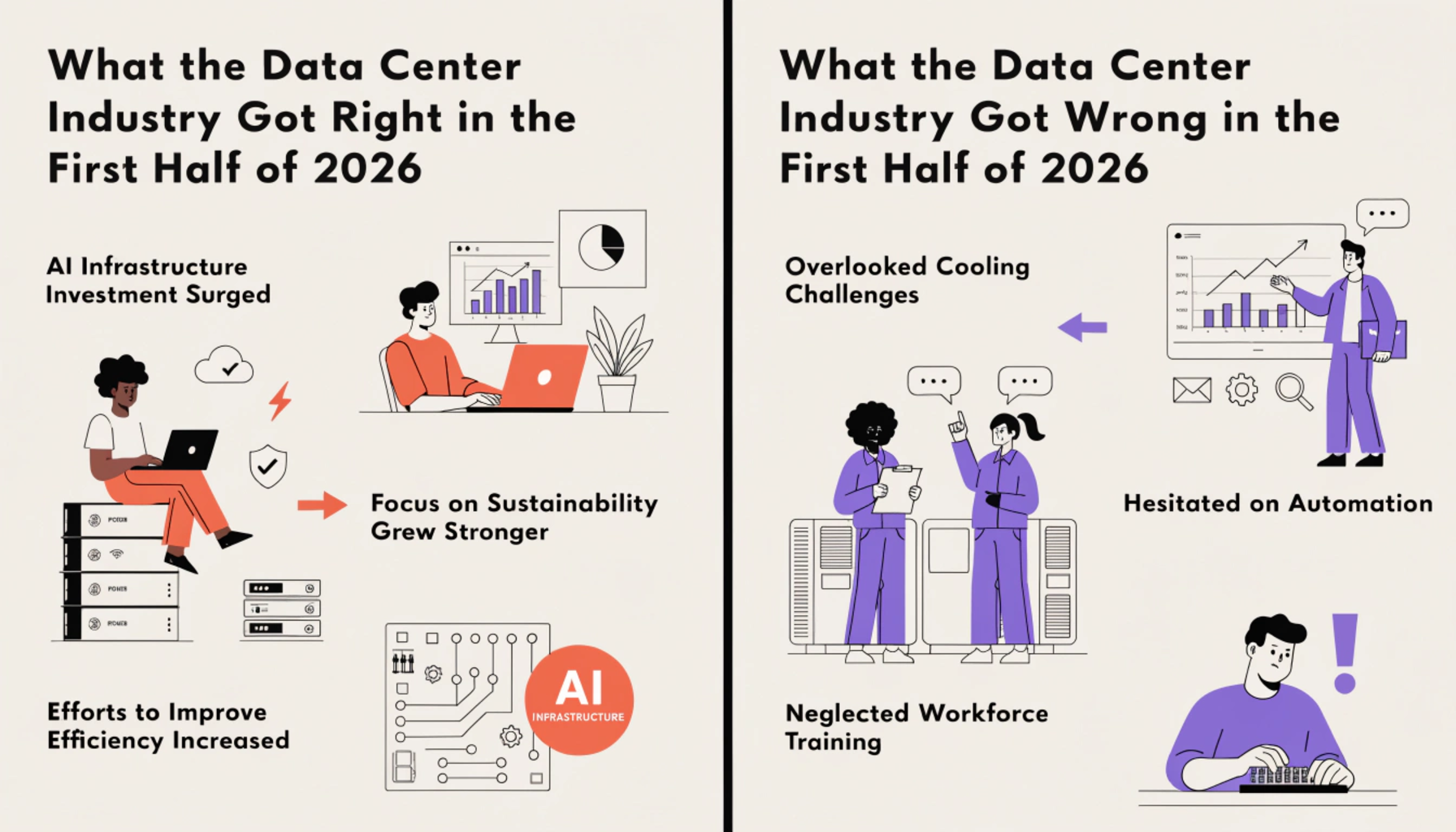
What the Industry Got Right: AI Would Transform Infrastructure
The biggest prediction that proved correct was the industry’s expectation that AI would fundamentally reshape data center infrastructure.
AI workloads require significantly greater compute density than many traditional enterprise and cloud workloads. As a result, operators increasingly designed facilities around high-density GPU deployments, advanced networking and specialized cooling.
Gartner estimates that AI-optimized servers will account for 31% of global data center electricity consumption in 2026. Overall data center electricity consumption is forecast to reach 565 TWh this year, representing a 26% increase from 2025. (gartner.com)
This confirms that AI is no longer simply another workload hosted inside existing facilities. It is becoming one of the primary forces determining how new data centers are designed, powered and operated.
The first half of 2026 therefore validated the industry’s decision to prioritize AI-ready infrastructure.
What the Industry Got Right: Cooling Became a Strategic Priority
Another area where operators moved in the right direction was cooling.
Traditional air cooling can become increasingly challenging as rack densities rise. AI systems generate considerably more heat, forcing facility managers to rethink thermal management rather than simply increasing conventional cooling capacity.
Liquid cooling has consequently moved closer to mainstream adoption. S&P Global reports that 21% of surveyed enterprise data center decision-makers planned to shift to liquid cooling within the following year, compared with 13% in its 2024 survey. (spglobal.com)
Direct-to-chip cooling, liquid distribution systems and hybrid cooling architectures are becoming increasingly relevant for AI deployments.
The important lesson from the first half of 2026 is that cooling can no longer be treated as an isolated facilities issue. It directly affects rack density, energy efficiency, equipment performance and ultimately the economics of AI infrastructure.
What the Industry Got Right: Diversifying Data Center Locations
The industry also correctly recognized that traditional data center hubs would struggle to accommodate unlimited growth.
Power availability, land constraints, construction costs and permitting challenges are encouraging developers to consider secondary and emerging markets.
CBRE’s Q1 2026 data shows strong inventory growth in several emerging markets, including parts of Latin America and Asia-Pacific. It also highlights the growing importance of locations where developers can secure scalable power and land. (cbre.com)
This geographic diversification is likely to remain an important component of the industry’s strategy.
Instead of asking only, “Where is the customer?” developers increasingly need to ask, “Where can we secure reliable power, cooling, connectivity and approvals quickly enough?”
That represents a significant shift in site-selection strategy.
Where the Industry Got It Wrong: Underestimating the Power Problem
If there is one area where the industry underestimated the challenge, it is power.
The rapid expansion of AI has transformed electricity availability from a supporting requirement into a central strategic constraint.
Gartner forecasts global data center power demand will rise to 132 GW in 2026, up from 104 GW in 2025. It also expects power consumption to continue increasing sharply through the end of the decade. (gartner.com)
The problem is not simply that data centers consume more electricity. It is that large AI facilities can require enormous amounts of power in locations where grid capacity cannot expand at the same speed.
That creates a fundamental mismatch:
AI infrastructure can be planned in months, but power infrastructure often takes years.
This mismatch is already influencing site selection, construction schedules and investment decisions.
In the United States, the Federal Energy Regulatory Commission took action in June 2026 to address rules governing the connection of data centers and other large energy users to regional electricity grids. (ferc.gov)
The development highlights how central power access has become to the data center industry’s future.
Where the Industry Got It Wrong: Assuming More Capacity Would Solve Everything
The industry’s response to rising demand has understandably focused on building more capacity. However, the first half of 2026 demonstrated that simply adding megawatts is not enough.
AI data centers require a coordinated infrastructure ecosystem.
Power must be available. Cooling must support high-density equipment. Networking must handle enormous volumes of internal traffic. Construction must be completed on schedule. Skilled personnel must be available to operate the facility. Regulatory approvals must also be secured.
This is where the data center trends analysis becomes more complicated.
A facility can have excellent physical capacity but still fail to meet its commercial objectives if power delivery is delayed, cooling infrastructure is unsuitable or network connectivity cannot support the intended workload.
The industry is therefore moving from a capacity-first mindset toward an infrastructure-readiness mindset.
The Sustainability Gap Became More Visible
Sustainability remained an important topic during the first half of 2026, but the industry’s priorities revealed a noticeable tension.
AI infrastructure needs enormous amounts of electricity, while operators and customers continue to face pressure to improve energy efficiency and reduce environmental impact.
Uptime Institute’s 2026 survey indicates that power consumption remains the most commonly tracked sustainability metric among operators, while Scope 3 emissions tracking remains significantly less common. (datacenterknowledge.com)
This suggests that the industry has made progress in measuring operational efficiency but still has work to do in understanding the broader environmental footprint of data center infrastructure.
The next stage of sustainability will need to move beyond PUE alone.
Operators will increasingly need to consider water consumption, embodied carbon, renewable energy sourcing, equipment lifecycle management and supply-chain emissions alongside traditional efficiency metrics.
The Industry Also Underestimated Regulatory and Community Pressure
Another lesson from the first half of 2026 is that data center development is becoming a public-policy issue.
As facilities grow larger and electricity consumption rises, communities are paying greater attention to issues such as grid capacity, utility costs, water consumption, land use and environmental impact.
Regulation is consequently becoming part of infrastructure strategy rather than simply a compliance exercise.
S&P Global notes that geopolitical conditions, data sovereignty requirements, environmental restrictions and energy policies are increasingly influencing where data centers can be developed. (spglobal.com)
This means developers must engage with regulators and communities earlier in the development process.
A technically excellent project can still face significant delays if its social and regulatory environment has not been properly considered.
The Biggest Lesson: Speed Has Become a Competitive Advantage
Perhaps the most important conclusion from the first half of 2026 is that speed matters more than ever.
Demand for AI capacity is moving extremely quickly, while traditional data center development remains constrained by long construction cycles, power interconnection timelines and equipment availability.
Developers are therefore looking at strategies such as modular construction, phased deployment and pre-secured infrastructure.
The objective is no longer simply to build the biggest facility.
It is to bring the right capacity online at the right location as quickly and efficiently as possible.
This changes how developers evaluate projects. Power certainty, permitting timelines, cooling architecture and supply-chain resilience can be just as important as land availability.
What the Second Half of 2026 Should Focus On
The lessons from the first six months provide a clear direction for the remainder of the year.
First, data center operators need to treat power strategy as a board-level priority. Securing electricity supply and understanding grid constraints should happen much earlier in the development process.
Second, AI-ready cooling and high-density infrastructure should be designed into facilities rather than added as an afterthought.
Third, sustainability strategies need to become broader and more measurable. Energy efficiency remains important, but water, carbon and supply-chain impacts will increasingly influence investment and regulatory decisions.
Finally, operators need to improve flexibility. AI workloads and hardware requirements are evolving quickly, so infrastructure designed for only one generation of technology could become difficult to adapt.
Conclusion
The first half of 2026 proved that many of the industry’s biggest expectations about AI were correct. Demand accelerated, high-density computing became more important, liquid cooling gained momentum and new data center markets attracted investment.
But the period also exposed several assumptions that did not hold up.
The industry underestimated the speed at which power would become the primary constraint. It underestimated the complexity of scaling AI infrastructure and the growing influence of regulation, communities and sustainability requirements.
The most useful takeaway from this data center industry review 2026 is therefore simple: the future of data centers will not be determined by compute capacity alone.
Success will depend on the ability to combine power, cooling, connectivity, efficiency, sustainability and speed into one coordinated infrastructure strategy.
As the second half of 2026 unfolds, industry leaders will need to learn from these successes and shortcomings while preparing for even greater AI-driven demand.
Enquire about BMA conventions to connect with industry professionals and explore the latest strategies shaping data center infrastructure, facilities and technology.