Introduction
Manufacturing is entering a new phase of digital transformation. For years, manufacturers invested in automation, connected equipment, cloud platforms, analytics, and industrial software. In 2027, however, simply having advanced technology will no longer be enough. The companies that gain a competitive advantage will be those that invest strategically, integrate technologies effectively, and connect digital investments directly to business outcomes.
The difference between leaders and laggards will increasingly come down to manufacturing technology investment 2027 strategies. Leaders will focus on technologies that improve productivity, resilience, quality, energy efficiency, workforce performance, and decision-making. Laggards may continue purchasing isolated systems without a clear roadmap for integration or measurable return on investment.
The next generation of manufacturing competitiveness will therefore depend less on buying the newest technology and more on choosing the right technology at the right time.
Why Manufacturing Technology Investment Will Matter More in 2027
Manufacturers are operating in an environment where margins, labor availability, supply chain disruptions, energy costs, customer expectations, and production complexity are all putting pressure on operations.
Technology can address many of these challenges, but investment decisions must become more disciplined. A new machine, software platform, sensor network, or AI solution should contribute to a measurable operational objective.
This is why manufacturing technology investment 2027 will increasingly move from experimental projects toward scalable business strategies. Manufacturers will ask questions such as: Can this technology increase throughput? Can it reduce unplanned downtime? Can it improve quality? Can it reduce energy consumption? Can it help employees make faster decisions?
Companies that can answer these questions before investing will be better positioned to achieve sustainable returns.
AI Will Move From Experimentation to Operational Value
Artificial intelligence is expected to become one of the most important areas of manufacturing investment in 2027. While manufacturers have already experimented with predictive maintenance, computer vision, demand forecasting, and generative AI, the next stage will focus on integrating AI into everyday operations.
AI can analyze large volumes of production data and identify patterns that may be difficult for human teams to detect manually. This creates opportunities for manufacturers to predict equipment failures, identify quality issues earlier, optimize production schedules, and improve inventory decisions.
Generative AI may also support technicians, engineers, planners, and managers by providing faster access to operational knowledge. For example, an AI assistant could help employees locate maintenance procedures, interpret equipment alerts, or analyze historical production information.
However, successful AI investment will depend on data quality. Manufacturers with disconnected systems and inconsistent data will struggle to generate reliable AI outcomes. As a result, investments in data infrastructure will become just as important as investments in AI applications.
Smart Factory Automation Will Become a Strategic Priority
Automation will remain a central part of smart factory spending priorities in 2027. But the focus will increasingly shift from isolated automation to connected and flexible automation.
Traditional automation can perform repetitive tasks efficiently, but modern smart factories require systems that can communicate with one another. Robots, automated material handling systems, sensors, machines, manufacturing execution systems, and enterprise platforms need to exchange information.
Robotics will continue to expand across assembly, packaging, material handling, inspection, and other applications. Collaborative robots can also support human workers in environments where complete automation is impractical.
The biggest opportunity will be creating automation systems that can adapt to changing production requirements. Manufacturers producing more product variations and smaller batches will need flexible automation rather than rigid production systems.
This makes connected automation one of the most important smart factory spending priorities for companies seeking long-term competitiveness.
Industrial IoT Will Strengthen Real-Time Visibility
Industrial Internet of Things technology will remain an important foundation for smart manufacturing. Sensors and connected equipment can provide real-time information about machine performance, temperature, vibration, energy consumption, production rates, and other operational conditions.
The value of IIoT, however, does not come from collecting data alone. Manufacturers need systems that convert data into actionable information.
In 2027, leading manufacturers are likely to prioritize IIoT investments that support specific use cases. These may include predictive maintenance, energy management, asset tracking, production monitoring, and quality control.
A connected factory can give managers greater visibility into what is happening across production lines. Instead of waiting for end-of-shift reports, teams can identify issues while they are occurring and respond more quickly.
This ability to act on real-time information can become a significant competitive advantage.
Digital Twins Will Support Better Decisions
Digital twins are another technology likely to receive greater attention as manufacturers look for ways to optimize complex operations.
A digital twin creates a digital representation of a physical asset, production line, facility, or process. Manufacturers can use these models to understand performance, test scenarios, identify bottlenecks, and evaluate potential changes before implementing them in the physical environment.
For example, a manufacturer considering a production-line redesign could use a digital model to simulate different configurations. This can help identify potential problems before equipment is moved or production is interrupted.
Digital twins can also support maintenance and lifecycle management by providing a clearer understanding of asset performance.
For companies making major capital decisions, digital twins can therefore become an important part of the manufacturing technology investment 2027 landscape.
Cybersecurity Will Become a Core Manufacturing Investment
As factories become more connected, cybersecurity can no longer be treated as an IT issue alone. Operational technology environments are increasingly connected to enterprise networks, cloud systems, suppliers, and remote monitoring platforms.
This connectivity creates new opportunities but also increases the potential attack surface.
Manufacturers will need to invest in protecting industrial control systems, connected equipment, production networks, cloud platforms, and sensitive operational data. Security monitoring, access controls, network segmentation, employee training, backup strategies, and incident-response capabilities will become increasingly important.
The most successful manufacturers will build cybersecurity into technology projects from the beginning rather than attempting to add security after deployment.
In other words, cybersecurity should be considered one of the essential smart factory spending priorities, not an optional technology expense.
Energy Management and Sustainable Manufacturing Will Gain Investment
Energy efficiency will increasingly influence technology decisions in manufacturing. Rising energy costs, environmental expectations, and sustainability objectives are encouraging manufacturers to understand exactly where and how energy is being consumed.
Connected energy-monitoring systems can provide detailed information about electricity, gas, compressed air, heating, cooling, and other resource consumption.
Manufacturers can use this information to identify inefficient equipment, detect abnormal consumption, optimize operating schedules, and reduce unnecessary energy use.
Automation and AI can further improve energy management by adjusting production processes according to demand and operating conditions.
The most effective sustainability strategies will therefore combine environmental objectives with financial benefits. Reducing energy consumption can lower operating costs while supporting broader sustainability goals.
Workforce Technology Will Separate Forward-Thinking Manufacturers
Technology investment should not focus exclusively on machines. People remain essential to manufacturing operations, and workforce capabilities will influence how effectively new technologies are adopted.
Manufacturers are facing skills gaps as experienced employees retire and new generations enter the industry. Digital tools can help bridge some of these gaps.
Augmented reality, digital work instructions, mobile applications, training platforms, and AI-powered knowledge systems can help employees perform tasks more efficiently and access information when they need it.
For example, technicians could use digital instructions to follow maintenance procedures or access equipment information without searching through large paper manuals.
Leaders will therefore treat workforce technology as part of their broader digital transformation strategy rather than viewing it as a separate HR initiative.
Cloud and Edge Computing Will Work Together
Manufacturers will continue to invest in cloud technologies, but the future of industrial computing will not necessarily be cloud-only.
Edge computing allows data to be processed closer to where it is generated. This can be valuable for applications requiring fast response times, such as machine monitoring, robotics, quality inspection, and industrial control.
Cloud platforms, meanwhile, can support large-scale analytics, centralized data management, collaboration, and enterprise-wide visibility.
The strongest technology architectures will combine both approaches. Edge computing can handle time-sensitive operational workloads, while cloud infrastructure can support broader analysis and coordination.
This hybrid approach will become an important consideration when planning manufacturing technology investment 2027.
Data Integration Will Matter More Than Individual Technologies
One of the biggest mistakes manufacturers can make is investing in technologies that cannot communicate effectively.
A factory may have advanced robots, sensors, analytics software, and enterprise systems, yet still struggle to make good decisions if information remains trapped in separate platforms.
Technology leaders will increasingly prioritize integration. Manufacturing execution systems, enterprise resource planning platforms, industrial control systems, IoT platforms, maintenance software, and analytics tools should work together as part of a connected ecosystem.
Integration allows information to move across departments and gives decision-makers a more complete view of operations.
This means manufacturers should evaluate interoperability and scalability before purchasing new technology. The best technology is not necessarily the most advanced product; it is the solution that fits into the organization’s long-term digital architecture.
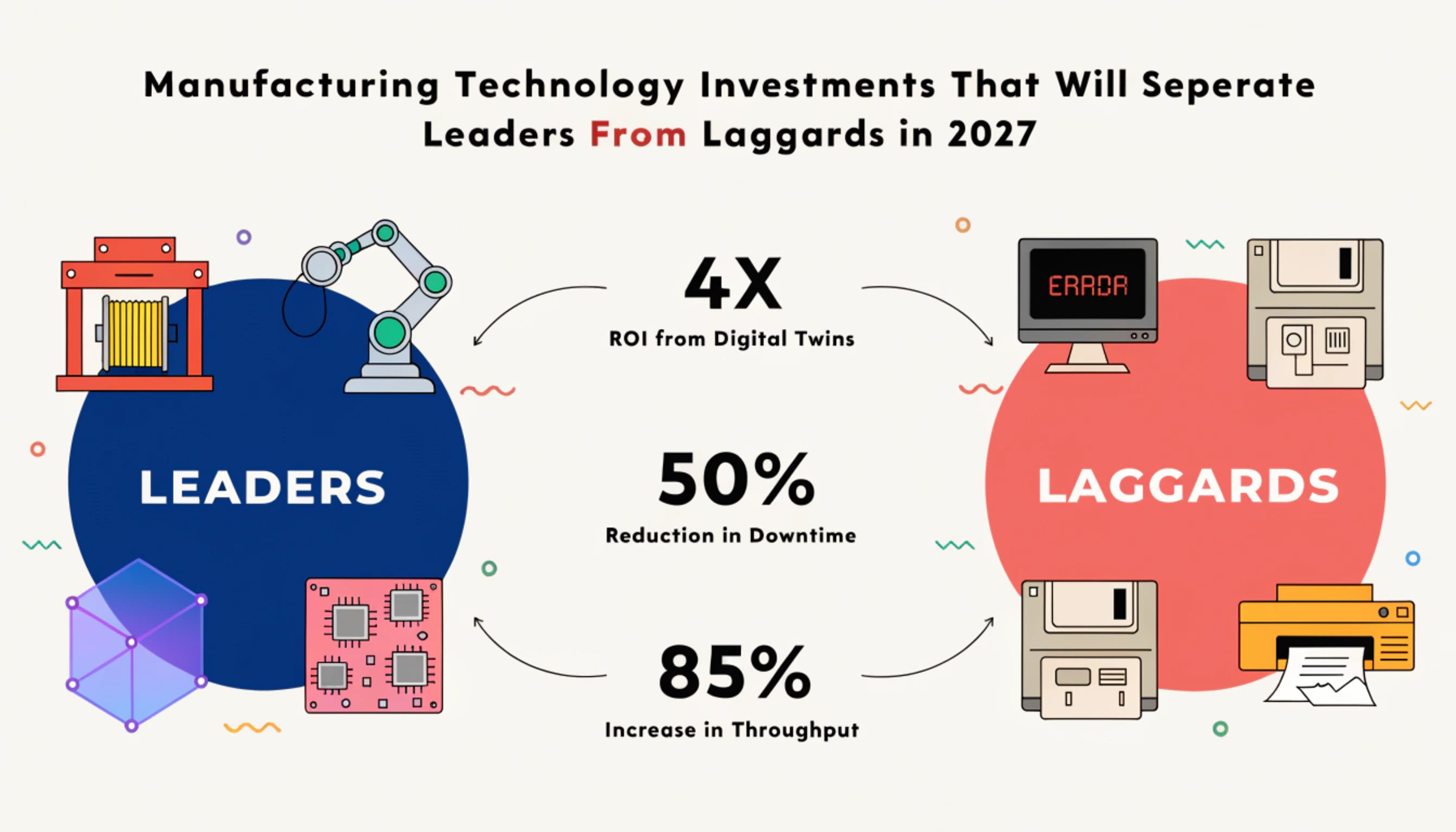
What Will Separate Leaders From Laggards?
The difference between manufacturing leaders and laggards in 2027 will not simply be the size of their technology budgets.
Leaders will create clear technology roadmaps based on business objectives. They will prioritize scalable solutions, measure performance improvements, train employees, strengthen cybersecurity, and continuously evaluate return on investment.
Laggards may continue to operate through disconnected pilot projects. They may purchase technology without establishing clear ownership, fail to integrate systems, or focus on technology features rather than measurable business outcomes.
Another major difference will be speed. Leaders will develop the organizational ability to test, learn, scale, and improve technologies quickly. Instead of waiting for a perfect digital transformation plan, they will begin with high-value use cases and expand successful solutions across their operations.
How Manufacturers Should Approach Their 2027 Technology Roadmap
A successful technology strategy should begin with operational problems rather than technology trends.
Manufacturers should first identify their biggest challenges. Is downtime reducing output? Are quality problems increasing costs? Is labor availability limiting production? Are energy costs affecting margins? Is the supply chain creating uncertainty?
Once these challenges are identified, companies can evaluate which technologies can provide measurable solutions.
A phased approach can also reduce risk. Instead of attempting to transform an entire facility at once, manufacturers can begin with targeted applications such as predictive maintenance, automated inspection, energy monitoring, or connected production lines.
The results from these projects can then guide larger investments.
Most importantly, manufacturers should establish measurable KPIs before deployment. Metrics such as OEE, downtime, scrap rate, throughput, energy consumption, maintenance costs, and labor productivity can help determine whether an investment is delivering its expected value.
The Future of Manufacturing Investment Is Connected
The manufacturing industry is moving toward more intelligent, connected, automated, and data-driven operations. In 2027, technologies such as AI, robotics, IIoT, digital twins, edge computing, cybersecurity, and advanced analytics will create significant opportunities.
But technology alone will not determine which manufacturers succeed.
The winners will be companies that connect technology investments to business strategy. They will understand that automation without integration creates silos, AI without quality data produces limited value, and digital tools without workforce adoption cannot deliver their full potential.
That is why manufacturing technology investment 2027 should be viewed as a strategic decision rather than simply a technology purchase.
Manufacturers that establish clear priorities today can enter 2027 with a stronger foundation for productivity, resilience, innovation, and sustainable growth.
Conclusion
The competitive manufacturing landscape of 2027 will reward companies that invest with purpose. AI, automation, IIoT, digital twins, cybersecurity, energy management, workforce technologies, and connected infrastructure will all play important roles, but their value will depend on how effectively they are integrated into manufacturing operations.
The most important smart factory spending priorities will be those that solve real operational challenges and create measurable improvements.
Manufacturing leaders will not necessarily be the companies spending the most money. They will be the companies making the smartest technology decisions, scaling successful solutions, developing their workforce, and continuously measuring results.
As manufacturers prepare their 2027 investment strategies, now is the time to evaluate where technology can create the greatest operational advantage.
Enquire about BMA conventions to connect with industry professionals and explore the technologies, strategies, and ideas shaping the future of smart manufacturing:
https://bmaconventions.com/smart-manufacturing-automation-convention-2027/