Data center efficiency has become a strategic priority for telecom providers as workloads grow, energy prices fluctuate, and sustainability expectations increase. For operators managing large infrastructure footprints, improving efficiency is not simply about reducing electricity consumption. It is about making cooling, power distribution, equipment utilization, and facility operations work together more intelligently.
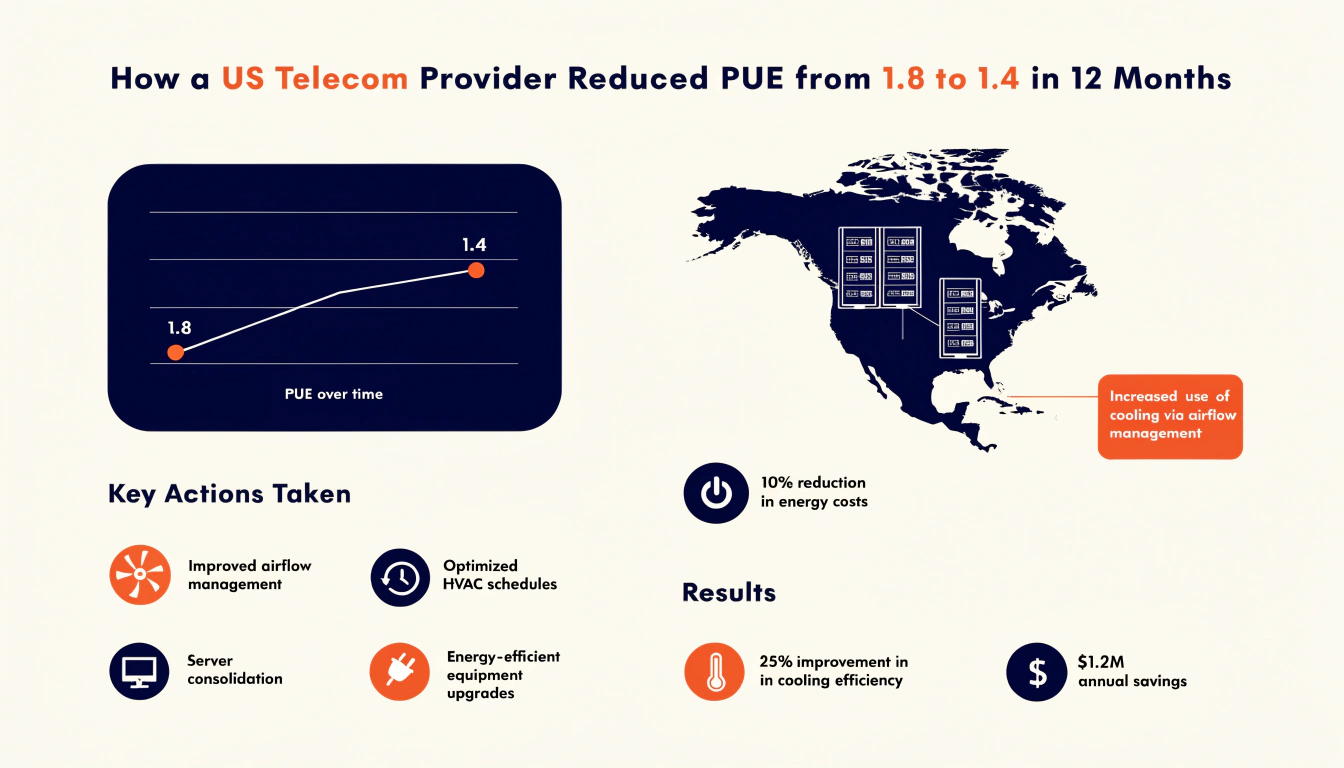
This illustrative case study examines how a US telecom provider could reduce its Power Usage Effectiveness (PUE) from 1.8 to 1.4 within 12 months through a structured facility optimization program. The scenario reflects practical strategies available to telecom data center operators and demonstrates how a focused approach can deliver measurable improvements without requiring a complete facility rebuild.
Understanding the Starting Point
The telecom provider in this case operated several data center facilities supporting network infrastructure, enterprise applications, cloud services, storage, and communications workloads. Its primary challenge was that facility energy consumption had increased faster than useful IT capacity.
At a PUE of 1.8, the facility consumed 1.8 units of total energy for every 1 unit used by IT equipment. In other words, for every 1 kWh consumed by servers, networking equipment, and storage systems, another 0.8 kWh was being used by cooling, power distribution, lighting, and other facility systems.
Management established a 12-month target: reduce average PUE from 1.8 to 1.4 while maintaining uptime, network reliability, and equipment performance.
The objective was not to sacrifice resilience for efficiency. Instead, the provider wanted to identify wasted energy, optimize existing infrastructure, and introduce better operational controls.
Establishing an Energy Baseline
The provider began by creating a detailed energy baseline across its facilities. Rather than looking only at monthly utility bills, the operations team measured energy consumption at multiple levels.
Power meters were used to understand consumption by IT loads, cooling systems, UPS equipment, power distribution units, lighting, and auxiliary infrastructure. Historical data was then compared with real-time measurements to identify abnormal patterns.
This process revealed an important issue: the facilities were not operating consistently with their actual IT demand. Cooling equipment, for example, was frequently operating at capacity even during periods when server loads were significantly lower.
The team also discovered that some equipment had been configured according to historical peak loads rather than current operating conditions. As IT infrastructure had changed over time, the facility’s cooling and power systems had not always been adjusted accordingly.
The baseline gave management a clear picture of where energy was being consumed and where improvements were most likely to produce results.
Tackling Cooling Inefficiencies
Cooling represented one of the largest opportunities for improvement.
The data center used a combination of computer room air-conditioning systems, chilled-water equipment, and air distribution infrastructure. However, airflow management was inconsistent. Hot and cold air were mixing in several areas, forcing cooling systems to work harder than necessary.
The provider introduced stronger hot-aisle and cold-aisle containment practices. Blank panels were installed in unused rack spaces, cable openings were sealed, and airflow paths were reorganized.
Temperature sensors were also repositioned to provide more accurate readings at rack level. Instead of relying heavily on a small number of room-level measurements, operators could now identify localized hot spots and respond to actual equipment conditions.
Cooling set points were gradually optimized within equipment manufacturer and operational requirements. Variable-speed drives were also used where appropriate to allow fans and pumps to operate according to actual demand.
These changes reduced unnecessary cooling capacity while maintaining appropriate environmental conditions for IT equipment.
Moving from Static Operations to Dynamic Cooling
One of the most important changes was the introduction of more intelligent cooling controls.
Previously, several cooling systems operated according to relatively fixed schedules. This meant that equipment continued consuming substantial energy even when IT demand changed.
The provider connected building management and environmental monitoring systems to operational data. Cooling output could then be adjusted based on temperature, humidity, rack density, and workload conditions.
This created a more dynamic relationship between IT demand and facility energy consumption.
During lower-load periods, cooling systems could reduce their output. During higher-load periods, capacity could be increased before temperature conditions became problematic.
This approach helped the organization achieve data center energy efficiency improvement without compromising availability.
Optimizing UPS and Power Distribution
Cooling was only one part of the problem. The provider also examined its electrical infrastructure.
Several UPS systems were operating below their most efficient load ranges. Older equipment had been selected when facility requirements were different, resulting in inefficient operation under current conditions.
The organization evaluated UPS loading and consolidated certain loads where operationally appropriate. It also introduced higher-efficiency UPS operating modes where the required resilience and manufacturer guidance allowed their use.
Power distribution losses were reviewed across transformers, switchgear, power distribution units, and cabling infrastructure.
The goal was not simply to replace every older component. Instead, the team prioritized upgrades based on energy savings, operational risk, equipment age, and expected return on investment.
This targeted strategy prevented unnecessary capital spending while addressing the areas with the strongest efficiency potential.
Eliminating Unused IT and Facility Loads
The energy assessment also identified equipment that was consuming power without providing meaningful operational value.
Some servers had been left running despite low or obsolete workloads. Network equipment was similarly reviewed to identify redundant or underutilized systems.
The IT and facilities teams created a process for identifying unused equipment and safely removing or consolidating it.
This step had a double benefit. It reduced direct IT electricity consumption while also lowering the cooling demand associated with unnecessary heat generation.
Importantly, equipment was not simply switched off based on energy consumption alone. Each system was evaluated against business requirements, redundancy requirements, application dependencies, and disaster recovery considerations.
Using Monitoring to Sustain the Gains
Achieving a lower PUE once is easier than maintaining it over time. The provider therefore introduced a stronger monitoring and reporting framework.
Facility teams received dashboards showing energy consumption, cooling performance, IT load, and PUE trends. Instead of reviewing efficiency only at the end of each month, operators could identify changes much earlier.
Alerts were established for abnormal energy consumption and unexpected cooling behavior. When PUE moved outside an established range, engineers could investigate potential causes.
The organization also introduced regular energy-performance reviews involving facilities, IT, engineering, and management teams.
This cross-functional approach was important because data center efficiency does not belong exclusively to the facilities department. IT decisions influence power and cooling demand, while facilities decisions affect the operating environment of IT infrastructure.
The 12-Month Improvement Journey
The provider treated the PUE reduction as a staged program rather than a single large project.
During the first three months, the focus was on measurement, baseline development, airflow assessment, and identification of major inefficiencies.
Months four through six concentrated on containment, airflow improvements, sensor deployment, cooling optimization, and equipment scheduling.
During months seven through nine, the organization addressed UPS efficiency, power distribution, equipment consolidation, and additional control improvements.
The final three months focused on fine-tuning, monitoring, employee training, and establishing procedures to maintain the gains.
By the end of the 12-month period, average PUE had moved from 1.8 toward the 1.4 target.
The improvement represented a substantial reduction in overhead energy relative to useful IT energy. More importantly, the project demonstrated that efficiency gains could come from operational changes and targeted upgrades rather than relying entirely on major infrastructure replacement.
Why the PUE Reduction Worked
The success of this data center PUE reduction case study came from combining multiple improvements rather than depending on one technology.
Cooling optimization reduced the amount of energy required to remove heat. Better airflow management ensured that conditioned air reached equipment more effectively. Dynamic controls allowed cooling systems to respond to actual demand.
UPS and electrical optimization reduced conversion and distribution losses. IT equipment consolidation lowered unnecessary power consumption and associated cooling demand.
Finally, monitoring ensured that the improvements became part of normal facility operations rather than being treated as a temporary project.
This combination is particularly relevant to telecom operators because their facilities often contain a mixture of legacy infrastructure, high-availability systems, network equipment, and newer computing platforms. A single efficiency strategy may not work across the entire environment.
The Business Impact Beyond PUE
A lower PUE can deliver benefits beyond a better efficiency metric.
Reducing facility energy consumption can lower operating costs, particularly in facilities with high electricity demand. More efficient cooling and power infrastructure can also reduce unnecessary equipment stress and improve the overall operating environment.
The project can additionally support corporate sustainability objectives by reducing energy consumption and associated emissions.
For telecom organizations, there is another strategic benefit: improved infrastructure efficiency can create additional capacity within existing facilities.
If cooling and power systems are no longer spending as much energy on overhead, operators may have greater flexibility when adding IT capacity. This can delay some expansion requirements and make existing data center assets more productive.
Lessons for Other Data Center Operators
The biggest lesson is that PUE improvement should begin with measurement.
Operators cannot effectively manage efficiency without understanding where energy is being consumed. A facility that appears inefficient at a high level may have very specific problems involving airflow, cooling controls, UPS loading, equipment utilization, or operational practices.
The second lesson is to prioritize optimization before replacement. New equipment can provide significant efficiency benefits, but existing infrastructure may often deliver meaningful savings through better configuration and controls.
The third lesson is to involve both IT and facilities teams. Energy efficiency cannot be achieved when infrastructure decisions are made in isolation.
Finally, efficiency must be continuously monitored. A data center changes over time as workloads, equipment, temperatures, configurations, and operating schedules change. A successful improvement program therefore needs continuous measurement and adjustment.
What Comes Next for Telecom Data Centers?
The pressure to improve data center efficiency is unlikely to disappear. Telecom providers are supporting increasingly demanding digital services while managing growing expectations around reliability, cost control, and sustainability.
Emerging technologies such as AI-driven monitoring, advanced cooling controls, liquid cooling, digital twins, intelligent power management, and predictive maintenance could create additional opportunities for efficiency improvement.
However, technology alone will not solve every efficiency challenge. Strong operational discipline, accurate measurement, appropriate infrastructure design, and continuous optimization remain essential.
The move from a PUE of 1.8 to 1.4 in 12 months demonstrates the potential of a structured approach. By identifying energy waste, optimizing cooling and electrical systems, removing unnecessary loads, and using data to guide operational decisions, telecom data centers can make significant progress toward more efficient infrastructure.
For organizations planning their next efficiency initiative, the key question is not whether improvement is possible. It is where the greatest opportunity exists and how quickly those opportunities can be converted into measurable results.
Final Takeaway
This illustrative data center PUE reduction case study highlights an important principle: major efficiency improvements do not always require rebuilding a data center from the ground up.
A combination of better measurement, airflow management, intelligent cooling, UPS optimization, IT consolidation, and continuous monitoring can create meaningful improvements within an existing facility.
For telecom providers managing complex infrastructure, the path to better efficiency begins with understanding the facility as one interconnected system. IT workloads, power infrastructure, cooling systems, and operational processes all influence one another.
A PUE target of 1.4 should therefore be viewed not simply as an energy metric but as a reflection of how effectively the entire facility operates.
Sponsor BMA Data Center Convention
Connect with industry professionals, technology providers, and data center leaders to explore the strategies shaping modern data center infrastructure, efficiency, resilience, and operations.