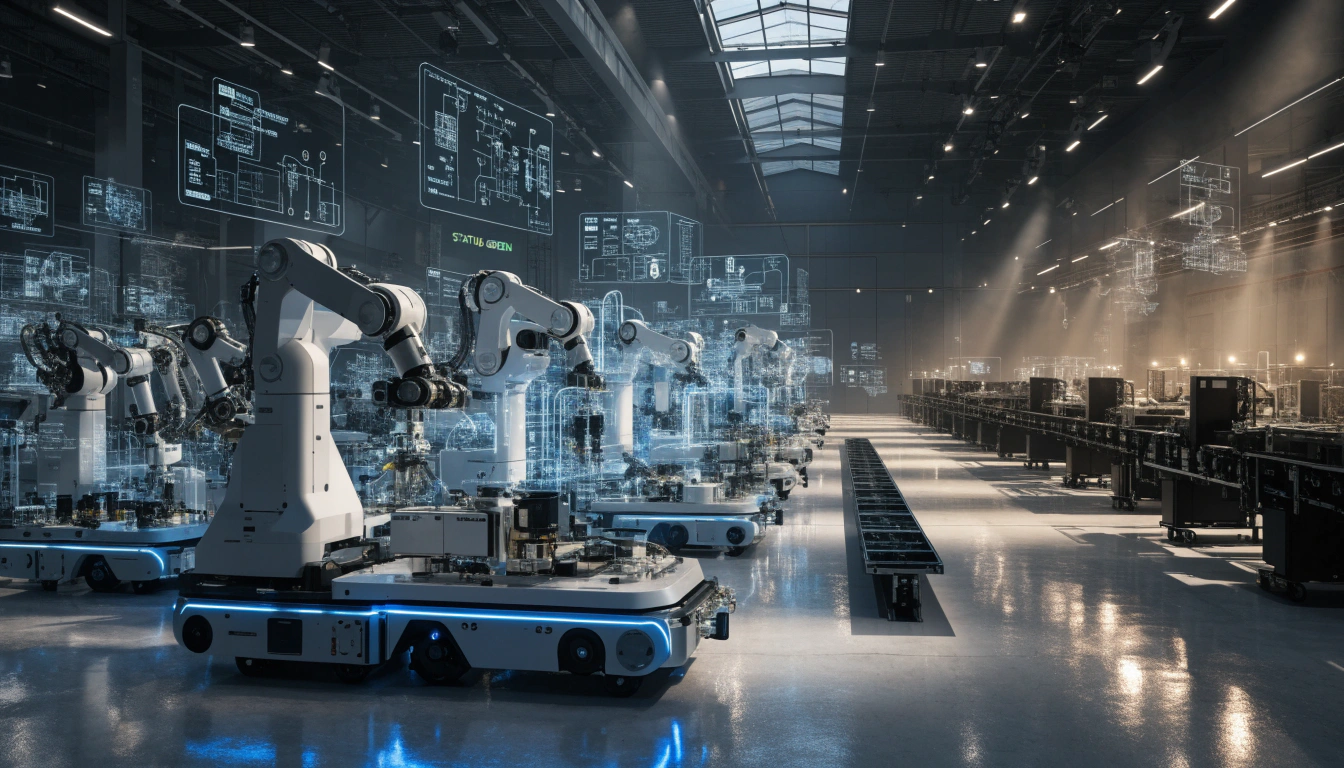
Introduction: The Shifting Industrial Horizon
For the past three decades, manufacturing automation followed a straightforward, predictable script: engineer fixed programmable logic controllers (PLCs), establish rigid assembly lines, minimize direct manual intervention, and calculate throughput based on steady-state uptime. This formula built the modern industrial era. However, entering 2027, this legacy paradigm faces a breaking point.
Global supply networks are inherently volatile. Product lifecycles that once spanned five to ten years have shrunk to months, driven by hyper-customization and shifting market demands. Energy pricing unpredictability, stringent sustainability mandates, and persistent skilled-labor deficits mean that static automation is no longer sufficient. When an automated line is rigid, any unexpected disruption, a single component shortage, an undetected vibration variance, or a sudden change in batch specifications, halts production entirely.
The competitive imperative is shifting from basic automated execution to cognitive autonomy. Today’s industrial leaders are no longer asking how to automate repetitive motions; they are engineering adaptive ecosystems capable of self-diagnosis, dynamic reconfiguration, and real-time optimization.
1. From Fixed Automation to Cognitive Autonomy
Traditional automation executes predefined rules: “If sensor X trips, close valve Y.” In contrast, cognitive manufacturing introduces closed-loop intelligence: “Sensor X indicates anomalous thermal expansion; cross-reference historical degradation rates, balance current batch priority against energy tariff rates, modulate line velocity by 4.2%, and order a replacement actuator for the next scheduled shift.”
This transition marks the evolution from automated machines to autonomous operations. The foundational pillars driving this leap include:
A. Edge Computing and Ultra-Low Latency Inference
While cloud computing enabled centralized plant reporting and historical analytics, it cannot manage microsecond feedback loops required for precision machining, high-speed vision sorting, or immediate safety overrides. Edge AI hardware equipped with dedicated neural processing units (NPUs) executes complex deep learning models directly on the shop floor. Vibration sensors, acoustic monitors, and thermal cameras process petabytes of telemetry locally, filtering actionable insights without saturating network bandwidth or introducing cloud latency.
B. The Convergence of IT and OT
Historically, Information Technology (IT) and Operational Technology (OT) operated in strictly isolated silos. IT managed enterprise resource planning (ERP), databases, and business software, while OT governed SCADA systems, PLCs, and field devices. Today, unified namespace (UNS) architectures and open standard industrial protocols (such as MQTT Sparkplug B and OPC UA over TSN) allow shop-floor machine states to update enterprise financial and resource models seamlessly in real time.
2. High-Fidelity Digital Twins: The Virtual Operations Room
Digital twins have transitioned from static 3D computer-aided design (CAD) models to dynamic, physics-based operational mirrors. By pairing real-time IoT sensor telemetry with deterministic multi-physics simulation, plant engineers can simulate entire manufacturing processes in the virtual realm before cutting a single piece of raw stock.
Key Applications in 2027 Operations:
- Virtual Commissioning: Machine builders validate PLC code, kinematic motions, and safety sequences entirely inside a virtual twin. This slashes on-site physical commissioning times by upwards of 60%, preventing costly tooling collisions and physical redesigns.
- Stress-Testing Supply Chain Variability: What happens if the tensile strength of an incoming aluminum coil varies by 3%? Instead of discovering defects during stamping, the digital twin stress-tests incoming material properties against machine parameters, automatically adjusting tooling pressure to maintain zero-defect standards.
- Decarbonization and Energy Routing: Integrating carbon-accounting algorithms into digital twins allows manufacturers to model the carbon intensity per unit produced, scheduling energy-intensive thermal or chemical cycles during peak renewable generation hours.
3. Collaborative Robotics and Mobile Manipulation
The image of industrial robotics as gigantic, cage-bound hydraulic arms is rapidly becoming obsolete. Modern shop floors demand agile, safe, and mobile robotic units capable of working alongside humans.
Next-Generation Autonomous Mobile Robots (AMRs)
Unlike first-generation Automated Guided Vehicles (AGVs) that relied on magnetic strips or optical floor tape, 2027 AMRs utilize LiDAR, 3D spatial vision, and SLAM (Simultaneous Localization and Mapping) algorithms. They navigate complex, dynamic facility floor plans seamlessly, rerouting around forklift traffic, spills, or temporary staging zones. Furthermore, mobile manipulators AMRs equipped with multi-axis cobot arms bridge the gap between intra-logistics and assembly by transporting parts, loading machine chucks, and executing delicate quality inspections autonomously.
Human-Robot Collaboration (Cobots)
Force-torque sensing, computer vision safety envelopes, and intuitive lead-through programming allow shop-floor operators without coding backgrounds to train cobots in minutes. This empowers human specialists to focus on high-value problem-solving, quality governance, and continuous improvement while delegating repetitive, ergonomically hazardous physical tasks to robotics.
4. Predictive to Prescriptive Maintenance: Eliminating Unplanned Downtime
Unplanned downtime costs heavy industrial sectors hundreds of billions of dollars annually. For years, maintenance regimes oscillated between reactive (“run to failure”) and preventive (“replace parts on a fixed calendar schedule regardless of wear”).
With the deployment of pervasive IIoT sensing, industry progressed to predictive maintenance (PdM). Today, leading operations are deploying prescriptive maintenance:
- Acoustic Profiling: Ultrasonic microphones listen to bearing raceways to detect micro-cavitation and lubrication breakdown weeks before thermal indicators elevate.
- Automated Root-Cause Diagnosis: Machine-learning models correlate anomalous current draws with hydraulic pressure spikes, isolating whether an issue originates in mechanical wear, electrical contamination, or operator error.
- Prescriptive Intervention: The system does not merely flag that a spindle is failing; it cross-references MRO spare parts inventory, verifies whether a replacement bearing is in stock, reserves the technician’s calendar, generates a work order, and limits spindle RPM to extend operating life until the repair window.
5. Sustainability, Energy Optimization, and Circular Manufacturing
The industrial sector accounts for over 30% of global greenhouse gas emissions. In 2027, decarbonization is not simply a public relations initiative; it is a legal compliance necessity and a core driver of operating margin.
- Energy-Aware Scheduling: Machine learning systems analyze variable time-of-use electrical tariffs, scheduling energy-dense operations (such as metal casting, furnace heating, or additive manufacturing) during off-peak periods.
- Closed-Loop Scrap and Waste Reduction: High-resolution computer vision detects dimensional deviations early in the value chain, flagging machining anomalies before defective parts consume downstream finishing, plating, or packaging resources.
- Material Traceability (Digital Product Passports): End-to-end serialization and blockchain-backed product passports track alloy genealogy, recyclability ratios, and chemical safety certifications across tiers, preparing manufacturers for evolving environmental regulations.
6. Overcoming the Adoption Hurdle: Legacy Modernization & Workforce Upskilling
While the vision of the fully cognitive facility is compelling, most manufacturers do not possess the luxury of building greenfield “lights-out” plants. They operate brownfield infrastructure: legacy machines that have functioned reliably for twenty or thirty years without native digital connectivity.
The Retrofit Strategy
Modernizing brownfield facilities does not require wholesale capital equipment replacement. Non-invasive external vibration monitors, clamp-on current transformers, and smart I/O modules can digitize legacy stamping presses and injection molders within hours. By connecting legacy hardware to edge industrial gateways, manufacturers achieve immediate visibility into Overall Equipment Effectiveness (OEE) and energy consumption.
The Human Component: Upskilling the Industrial Workforce
Technology is only as effective as the people orchestrating it. The modern factory floor requires an evolution in skill sets, turning traditional operators into data-informed system orchestrators. Upskilling programs must focus on data literacy, basic robotics diagnostics, and human-machine interface (HMI) collaboration, ensuring manufacturing talent is empowered rather than alienated by technological progress.
7. Benchmarking Your Plant: The 2027 Smart Manufacturing Maturity Curve
Where does your enterprise sit along the transformation continuum?
| Level | Maturity Stage | Key Operational Capabilities |
|---|---|---|
| Level 1 | Connected (Visibility) | Machines stream operational data to central dashboards; basic OEE metrics are visible in real time. |
| Level 2 | Intelligent (Diagnostics) | Telemetry is analyzed to diagnose failure mechanisms and correlate process bottlenecks. |
| Level 3 | Predictive (Anticipation) | Machine learning algorithms forecast equipment failure and quality fluctuations before occurrences. |
| Level 4 | Adaptive (Self-Optimization) | Closed-loop systems adjust machine speeds, tooling paths, and environmental parameters dynamically without human overrides. |
| Level 5 | Cognitive (Autonomous Ecosystem) | Integrated fleet-level intelligence self-orchestrates supply chain intake, dynamic scheduling, energy load-balancing, and predictive lifecycle maintenance across multi-site networks. |
Conclusion: Shape the Industrial Frontier at SMAC 2027
The manufacturing landscape is undergoing its most radical transformation since the dawn of mass electrification. Staying competitive requires moving beyond incremental improvements and embracing systemic, intelligent automation.
Industry leaders, technical visionaries, and manufacturing executives from around the world are assembling to define this next operational chapter at the Smart Manufacturing & Automation Convention (SMAC) 2027. Experience hands-on technical showcases, interact with enterprise case studies, and discover the exact frameworks driving high-yield, zero-downtime manufacturing facilities.
Don’t let your plant fall behind in the era of cognitive production.
Ready to lead the future of industrial automation?
Secure your seat among industry pioneers, plant leaders, and technology architects:
👉 Register as a Delegate and unlock exclusive access to technical sessions, keynote panels, and transformative industrial solutions.