Introduction
The global manufacturing landscape in 2027 stands at a decisive crossroads. Industrial operations are no longer governed merely by incremental efficiency gains or localized automation. Instead, real-time connectivity, predictive decision-making, and dynamic supply chain integration dictate market leadership. At the heart of this transformation lies the Manufacturing Execution System (MES), the foundational software engine that links enterprise-level planning with actual shop-floor execution.
For decades, plant operations relied exclusively on legacy, on-premise deployments. These localized systems provided plant managers with absolute control over their software infrastructure, data storage, and physical security. However, as factories evolved into interconnected ecosystems powered by edge computing, machine learning, and advanced robotics, traditional architectures began showing structural strain. The ongoing debate surrounding cloud MES vs on-premise solutions has shifted from a discussion about IT preference to a pivotal strategic decision impacting throughput, capital efficiency, and operational resilience.
In 2027, executive leadership from Chief Technology Officers to Vice Presidents of Operations must re-evaluate their plant architecture. The decision is no longer a binary choice between local servers and remote cloud hosting. It encompasses microservices, hybrid-cloud meshes, zero-trust cybersecurity, and edge intelligence. Understanding what modern manufacturers are choosing requires an in-depth examination of operational demands, total cost of ownership, deployment speed, and long-term scalability across multi-site manufacturing environments.
The Evolution of the Manufacturing Execution System
To understand current technology choices, one must analyze the historic trajectory of shop-floor software. The early generations of MES were designed around localized server racks, highly customized codebases, and hardwired Programmable Logic Controller (PLC) integrations. These systems excelled at monolithic execution: recording batch records, tracking work-in-progress, and enforcing standard operating procedures on a single production line. However, modifications required specialized systems integrators, months of downtime testing, and substantial capital outlay.
As digital transformation initiatives accelerated over the last decade, industrial software vendors adapted enterprise enterprise resource planning (ERP) methodologies to production environments. The emergence of scalable cloud infrastructure challenged the assumption that critical operational software must live physically within the plant perimeter. Early iterations of cloud MES faced skepticism, primarily centered around network latency, internet reliability, and data privacy.
By 2027, technical hurdles that once plagued web-based industrial solutions have largely been resolved. Ultra-low-latency edge devices, high-bandwidth private network infrastructure, and robust containerization have redefined what is possible. Consequently, market selection in manufacturing cloud software 2027 focuses on agility and intelligence rather than basic uptime preservation.
Deep Dive: On-Premise MES in the Modern Industrial Era
On-premise Manufacturing Execution Systems retain a specific, dedicated footprint across the industrial spectrum. In an on-premise architecture, the software application, database, and processing engines reside locally on physical hardware situated directly within the manufacturing facility or a localized enterprise data center.
Operational Advantages of On-Premise Architecture
The principal advantage of an on-premise MES remains deterministic reliability. Because the entire server infrastructure operates within the Local Area Network (LAN), machine communication occurs with minimal latency. High-speed assembly operations such as high-volume semiconductor fabrication or ultra-fast consumer packaged goods bottling require millisecond execution signals. On-premise installations guarantee that operational data loops remain uninhibited by external internet outages or WAN performance degradation.
Data sovereignty and regulatory isolation represent another stronghold for local deployments. Certain defense contractors, aerospace manufacturers handling classified specifications, and pharmaceutical facilities subject to stringent air-gapped security mandates often default to on-premise setups. For these organizations, physical access control over hard drives and local database clusters offers compliance comfort that standard public cloud environments struggle to match without expensive custom configurations.
Hidden Friction and Structural Challenges
Despite operational control, the limitations of on-premise deployments have become pronounced in 2027. The total cost of ownership (TCO) for local infrastructure extends far beyond the initial software license fee. Maintenance requires on-site IT resources, routine hardware replacement cycles, climate-controlled server rooms, manual security patching, and complex backup disaster recovery plans.
Furthermore, on-premise systems suffer from chronic configuration lock-in. Because these platforms are often customized over years to accommodate unique plant quirks, upgrading the base software becomes a monumental task. Many plants remain trapped on legacy versions released a decade prior, unable to adopt new software functionalities, modern user interfaces, or advanced analytics modules without executing a costly system overhaul.
Deep Dive: Cloud-Based MES and Next-Gen Architecture
Cloud-based Manufacturing Execution Systems leverage remote cloud infrastructure, distributed microservices, and web-native interfaces to manage production workflows. Rather than running application logic on a server sitting in a plant backroom, the software is delivered as a managed platform, updating seamlessly in the background.
The Capabilities of Manufacturing Cloud Software in 2027
The modern iteration of manufacturing cloud software 2027 is explicitly designed to handle high-throughput industrial environments. Utilizing cloud-native architecture, where functional components run as isolated microservices, these solutions enable dynamic scaling without system downtime. If a plant adds ten new production lines, the cloud environment scales computing resources instantly, bypassing the need to procure, rack, and configure physical hardware.
Centralized multi-site visibility is perhaps the single largest driver of cloud adoption. Global manufacturing enterprises operating dozens of facilities across continents can no longer afford isolated operational silos. A cloud MES consolidates performance data across all plants into a single pane of glass. Executives and operational engineers can benchmark Overall Equipment Effectiveness (OEE), scrap rates, and cycle times in real time across geographically dispersed locations, enforcing standard operating procedures universally.
Continuous feature deployment represents another significant evolution. Cloud platforms eliminate the paradigm of major software updates every five years. Functional updates, security patches, compliance updates, and AI-driven feature enhancements deploy automatically via continuous integration pipelines. This ensures that the shop floor always runs on modern software capabilities without interrupting scheduled production shifts.
Resolving Latency: The Hybrid-Cloud Edge Mesh
The strategic debate surrounding cloud MES vs on-premise historically centered on latency and connectivity risk. What happens if the plant loses its internet connection? In 2027, the answer lies in hybrid edge-cloud architecture. Modern cloud manufacturing systems deploy lightweight, local edge runtimes directly on the plant floor.
These edge nodes execute real-time control loops, buffer local production data, and manage immediate shop-floor operations even during complete external network disconnects. Once WAN connectivity restores, the edge node synchronizes accumulated operational state data back to the central cloud platform. This hybrid framework delivers the ultra-low latency and fault tolerance of on-premise hardware alongside the scalability, storage, and processing analytics of the cloud. +——————————————————————-+
| ENTERPRISE CLOUD PLATFORM |
| – Multi-Plant Analytics – Global Quality Standards – AI Models |
| – Enterprise ERP Link – Dynamic Supply Chain – Master Data |
+——————————————————————-+
▲
│ Continuous Sync & Analytics
▼
+——————————————————————-+
| LOCAL PLANT EDGE MESH |
| – Real-Time Control – Local Data Buffering – Zero Lag |
| – Machine Connectivity | – High-Speed Execution | – Standalone |
+——————————————————————-+
Comparative Analysis: Strategic Decision Dimensions
To clearly understand how organizations evaluate these technologies, executive teams examine five core dimensions when selecting their software environment.
| Evaluation Dimension | On-Premise MES | Cloud-Native / Hybrid MES |
|---|---|---|
| Capital Expenditure & TCO | High initial CapEx (hardware, perpetual licenses, integration); high ongoing local IT maintenance costs. | Predictable OpEx subscription; minimal local hardware outlay; automatic infrastructure scaling. |
| Deployment Speed | Slow (6–18 months per facility); extensive custom coding and local configuration required. | Fast (weeks to a few months); standardized templates, pre-built API connectors, and cloud orchestration. |
| Scalability Across Sites | Extremely difficult; requires duplicate server stacks and localized engineering per plant. | Instantaneous; global rollout of standardized templates across multiple plants simultaneously. |
| Data Integration & AI | Siloed data stores and complex ETL pipelines are required to feed enterprise AI tools. | Native data lake connectivity; real-time feeding of machine learning models for predictive maintenance. |
| Security & Compliance | Physical control over assets; vulnerable to unpatched local OS and delayed security updates. | Zero-trust cloud architecture, automated threat monitoring, centralized access management, and ISO compliance. |
Cost Structure Dynamics: CapEx vs. OpEx
Financial strategy plays an important role in system selection. On-premise solutions demand substantial upfront capital expenditure (CapEx). Buying enterprise server hardware, securing perpetual software licenses, paying integration fees, and designing redundant network power systems requires significant upfront budget allocation.
Conversely, cloud solutions operate primarily on an operational expenditure (OpEx) subscription model. Costs scale predictably alongside active users, connected machines, or transactional volumes. This financial alignment reduces barrier-to-entry risks for medium-sized enterprises and allows large corporations to allocate capital directly toward production line hardware and physical automation tooling.
Integration Ecosystems and Artificial Intelligence
In 2027, an MES cannot function as an isolated application; it must operate as an open platform connected to computer vision systems, automated guided vehicles (AGVs), predictive maintenance algorithms, and supply chain management platforms.
Cloud MES environments natively support modern Web APIs, GraphQL, and event-driven architectures (such as MQTT and Kafka). Connecting a cloud-native MES to enterprise data lakes or training custom generative AI models for quality inspection requires minimal data pipeline configuration. On-premise platforms, bound by legacy database schemas and proprietary API wrappers, often require expensive custom middleware to export shop-floor telemetry to broader enterprise analytics systems.
Market Trends: What Manufacturers Are Choosing in 2027
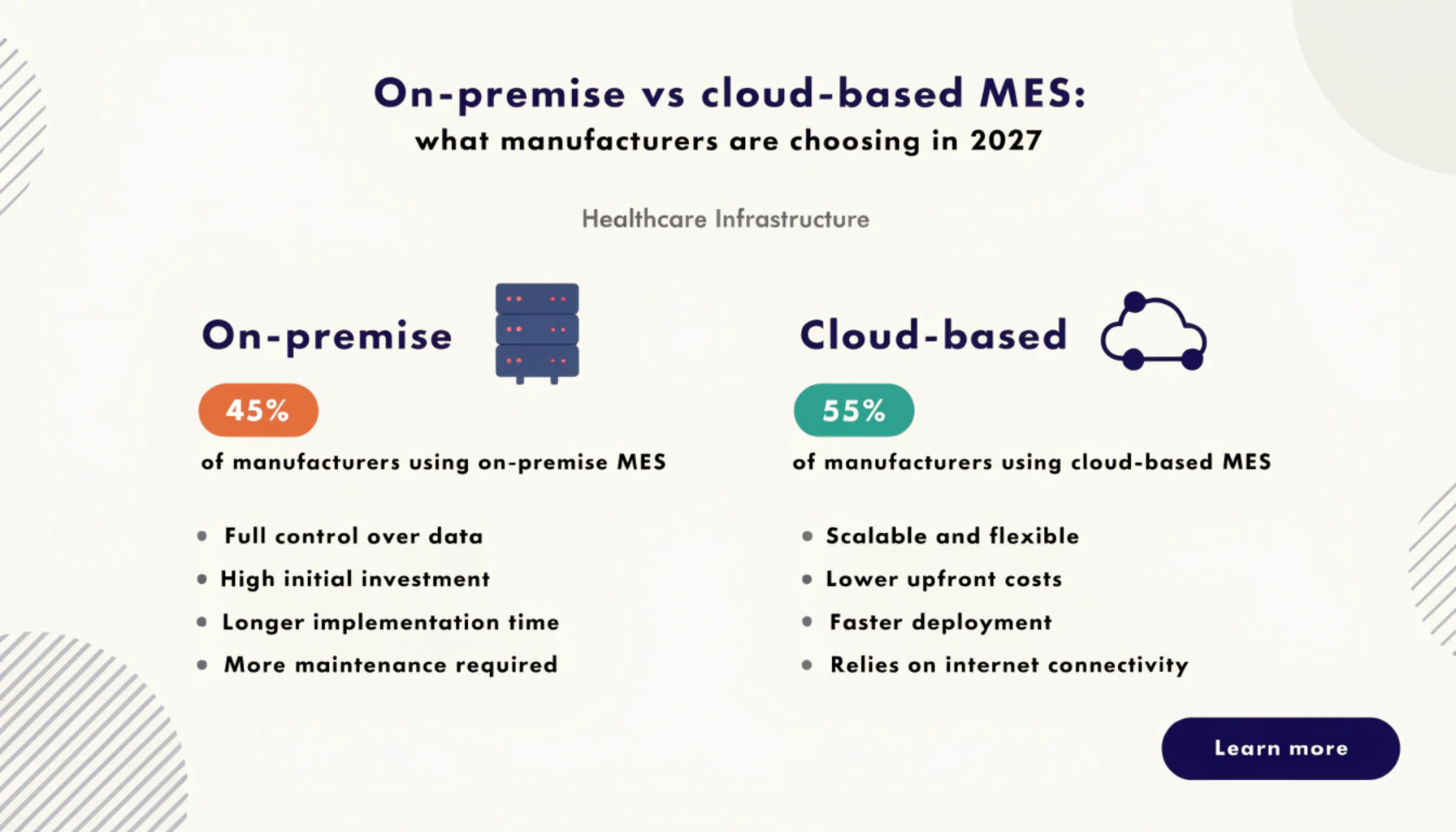
Market data from across the manufacturing industry highlights a clear trend. The absolute majority of new Manufacturing Execution System implementations in 2027 are cloud-native or cloud-hybrid solutions.
The Shift Toward Hybrid Cloud Standardization
Discrete manufacturing sectors such as automotive component manufacturing, industrial machinery, electronics, and consumer goods have overwhelmingly adopted cloud MES architectures. These industries operate in volatile demand environments where agility, dynamic re-routing, and rapid supplier integration are mandatory. The ability to deploy standardized execution workflows across ten plants in months rather than years has made cloud platforms the default choice for modern operational leaders.
Process industries, including specialty chemicals, food and beverage, and pharmaceuticals, are rapidly transitioning as well. While regulatory compliance previously slowed cloud adoption in life sciences, modern cloud platforms engineered specifically for validated environments now provide complete audit trails, GAMP 5 compliance, and automated electronic batch recording (eBR) verification in secure cloud environments.
The Remaining Role for Pure On-Premise
Pure on-premise setups are increasingly confined to specific operational niches:
- Highly classified defense and aerospace manufacturing, where regulations strictly mandate air-gapped physical infrastructure.
- Remote industrial operations located in areas with unreliable communications infrastructure where continuous satellite or cellular backhaul is cost-prohibitive.
- Specialized small-scale facilities operating legacy machinery where the capital cost of retrofitting IoT connectivity outweighs the operational benefits of digital transformation.
For mainstream industrial enterprises, pure on-premise MES is no longer viewed as a long-term technology strategy; it is recognized as a legacy asset to be systematically modernized.
Strategic Roadmap for Manufacturing Leaders
Transitioning execution platforms requires careful planning. Enterprise leaders evaluating their software architecture should follow a structured approach to ensure high returns on investment and minimal operational disruption:
- Audit Existing Architecture and Connectivity: Evaluate current network infrastructure across all facilities. Determine whether edge devices can handle local execution buffering and confirm bandwidth capacity between local plant networks and cloud servers.
- Define Data Governance and Security Policies: Establish clear operational guidelines regarding data classifications. Identify which operational parameters require local edge isolation and which datasets should feed central enterprise data lakes.
- Prioritize Cloud-Native Microservices: Avoid lifted-and-shifted legacy applications hosted on generic cloud virtual machines. True operational benefits stem from microservices architectures that scale dynamically and offer modern cloud APIs.
- Execute Phased Rollouts via Model Plants: Avoid attempting simultaneous enterprise-wide deployments. Select a representative “model plant” to validate edge connectivity, user adoption, and ERP integration before scaling the deployment across the broader network.
- Engage Ecosystem Partners and Industry Peers: Continuous learning from industry leaders accelerates implementation timelines and prevents common deployment mistakes.
Join the Discussion at the Smart Manufacturing & Automation Convention 2027.
Navigating the strategic shift between on-premise, edge, and cloud architectures requires actionable insights from industry pioneers who are actively shaping the future of global production.
To explore cutting-edge solutions, connect with enterprise technology leaders, and evaluate the latest innovations in smart factory systems, join us at the Smart Manufacturing & Automation Convention 2027. Held at the Doubletree by Hilton Dallas Market Center from February 23rd–25th, 2027, this premier event brings together manufacturing executives, technology innovators, and plant engineering leaders from across North America.
Whether you are seeking to showcase your smart factory software solutions or engage in B2B networking with senior operational decision-makers, this event provides an exceptional platform for industry leadership.
Enquire about sponsorship today to secure your position alongside leading solution providers driving the next industrial revolution.